Recently, the S&P 500 index has shown volatility at high levels. As of the close on July 16, the S&P 500 index was at 7,533.77 points, down 0.51% for the day. Despite the short-term pullback, technical analysis indicates that the medium to long-term uptrend remains intact, with institutions maintaining a positive outlook for the future of the S&P 500 index.
Why is the S&P 500 Index Falling?
From a market perspective, the recent S&P 500 pullback is firstly due to cooling in technology and semiconductor stocks. Over the past few months, the U.S. stock market rally has largely been driven by the AI, chip, cloud computing, and data center industry chains, with gains concentrated among a few large tech companies and semiconductor leaders. Once concerns about AI trading overheating emerge, or investors choose to take profits ahead of the earnings season, the index becomes prone to corrections.
Secondly, geopolitical risks and rising oil prices are also dampening risk appetite. Escalating U.S.-Iran tensions have pushed up crude oil prices, raising market concerns that a rebound in energy prices could reignite inflationary pressures. If rising oil prices translate into higher corporate costs and consumer spending, expectations for Federal Reserve policy may turn more hawkish, which would be unfavorable for high-valuation growth stocks.
Thirdly, the S&P 500 valuation is no longer low, reducing the market's tolerance for error. The index had previously reached new highs continuously, with investors already pricing in favorable factors such as earnings growth, AI investment, and economic resilience. Therefore, any signs of semiconductor stock declines, rising oil prices, or inflation data uncertainty tend to prompt investors to reduce positions first.
Continued Heavy AI Investment by Large Tech Companies like Meta, Microsoft, and Alphabet Provides Key Support for the S&P 500
Although the S&P 500 has recently experienced volatile corrections at high levels, AI investment by major U.S. tech companies has not slowed down; instead, it shows signs of further acceleration. This is an important reason why the market is reluctant to turn bearish on U.S. stocks in the medium term. For the S&P 500, AI is evolving into a capital expenditure cycle covering data centers, chips, servers, storage, networking equipment, power, and cloud computing services.
Meta (META) is one of the most aggressive companies in recent AI investment. Latest reports indicate that the company is expanding its Hyperion data center project in Louisiana to a 5GW computing power scale, with total investment exceeding $50 billion. Additionally, it has raised its 2026 capital expenditure forecast to $125-145 billion, up from the previous range of $115-135 billion.
Microsoft (MSFT) is also continuously expanding its AI infrastructure layout. The company announced plans to invest $10 billion in Japan from 2026 to 2029 for AI infrastructure, cybersecurity, and talent development. Furthermore, Microsoft plans to purchase approximately 3,200 acres of land in Cheyenne, Wyoming, to build data centers, further expanding its global cloud computing and AI computing network.
Alphabet (GOOGL) is also significantly increasing its investment. The company previously projected 2026 capital expenditures to be between $175-185 billion, primarily for AI, technological infrastructure, and cloud computing capacity. Recently, Alphabet also announced plans for an $80 billion equity financing to further expand AI infrastructure and computing capabilities.
These latest moves indicate that major U.S. tech companies are not reducing their investments due to market concerns about an AI bubble. On the contrary, they are continuing to bet on long-term AI demand growth by building new data centers, expanding cloud infrastructure, developing proprietary AI chips, and increasing computing power reserves. For the S&P 500, AI capital expenditures will continue to support earnings expectations for semiconductor, server, storage, power equipment, and cloud computing companies. However, it is important to note that larger capital expenditure scales come with higher market demands for returns.
Therefore, AI investment is both the core driver for the S&P 500's continued upward movement and the main point of tension during its recent high-level volatility. As long as investors believe that the AI investments by large tech companies can ultimately translate into actual revenue growth, the S&P 500 still has a foundation to challenge higher levels. However, if subsequent earnings reports show that the pace of revenue and profit realization from AI investments falls short of expectations, the risk of a correction in the S&P 500 will significantly increase.
Goldman Sachs Raises S&P 500 Target for the Second Half of This Year to 8000
From an institutional perspective, Wall Street overall remains optimistic. Goldman Sachs has raised its year-end 2026 target for the S&P 500 to 8000 points, citing strong corporate earnings growth and expectations that AI infrastructure-related companies will contribute about half of the S&P 500's earnings growth this year. The bank also cautions that narrow market breadth and excessive momentum have become risk signals.
J.P. Morgan has raised its year-end S&P 500 target to 7800 points, citing the earnings momentum driven by AI investment and continued U.S. economic resilience. Wells Fargo sets an even higher target at 7950 points, raising its 2026 and 2027 EPS expectations and believing that improving corporate earnings can still support the index. Morgan Stanley sets its year-end target at 8000 points and forecasts the S&P 500 could reach 8300 points by mid-2027, primarily based on earnings growth and the continuation of the AI capital expenditure cycle.
Overall, major investment banks do not believe the recent pullback will alter the medium-term trend of U.S. stocks, but their optimistic assessments are based on one premise: corporate earnings must continue to materialize, especially large tech companies must prove that AI investments can yield tangible returns.
S&P 500 Trend Analysis: Potential to Break Through 8000 Points in the Second Half of 2026
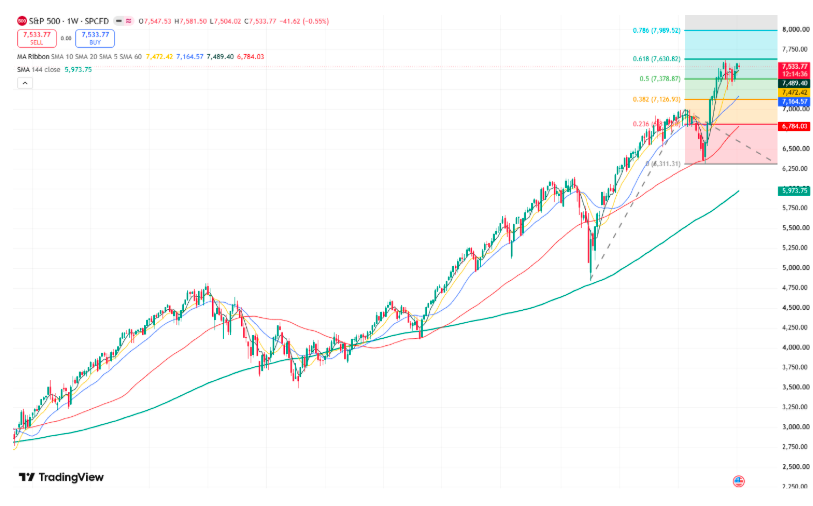
In terms of the overall trend, with the continuous upward movement of highs and lows in the candlestick chart, the S&P 500 index shows a clear uptrend. Meanwhile, in the moving average system, the SMA60 and SMA144, two medium to long-term moving averages, maintain a bullish alignment, indicating the strong sustainability of the S&P 500 index's upward trend.
From a market perspective, the recent movement of the S&P 500 index has remained within a high-level range of 7250-7600, showing consolidation. The index has tested the key resistance level at 7600 upwards three consecutive times without a breakthrough, indicating strong pressure at this level. On Monday, the index weakened under pressure below 7600, suggesting it may continue its range-bound consolidation trend with further downward retracement in the short term.
On the downside, the primary support level for the S&P 500 index is at 7400. If this level is breached, the index could further decline towards 7250. A continued drop below 7250 would open up downside space towards the support area near 7100.
On the upside, the primary resistance level for the S&P 500 index is at the 7600 mark. If it can effectively break through and stabilize above this level, the index will open up upside space towards the 8000 mark.