Kalshi, MTS, and a16z's Ambition

链捕手2026-06-07 tarihinde yayınlandı2026-06-07 tarihinde güncellendi

Özet

The article "Kalshi, MTS, and a16z's Ambition" explores prediction markets as a focal point of excitement in 2025 for investors, crypto enthusiasts, and media. It traces their intellectual lineage from Friedrich Hayek's ideas on dispersed knowledge and market coordination to Robin Hanson's Logarithmic Market Scoring Rule (LMSR), which incentivizes truthful information sharing. The piece argues that a16z's significant investment in prediction market platform Kalshi (valued at $220B) transcends mere financial speculation. a16z frames prediction markets as a new form of "media" that provides "presence"—a way for individuals to actively engage with and influence world events through financial stakes, countering postmodern detachment. By wagering on outcomes, users become "super observers," and the market's aggregated probabilities gain authoritative power to define event truth and importance. The article uses media company MTS ("Monitoring The Situation") as a case study of a16z's "new media" strategy: rapidly producing high-intensity, multi-format content to "take over the timeline." However, prediction markets like Kalshi are presented as the ultimate piece in this media empire. Their real-money, crowd-sourced probabilities possess a unique "reality distortion field" and perceived objectivity, potentially swaying public opinion and granting a private company unprecedented interpretive power over reality. Ultimately, Kalshi's immense valuation is attributed not just to its ex...

Author: Matou, Da Da Luosi

Prediction markets might be the only field in 2025 that can simultaneously excite distinguished dollar fund investors, crypto bros, and media professionals.

There are actually many reasons to be optimistic about it, such as the arbitrage between state and federal regulations for gambling in the US, the massive transaction fees driven by the extreme extrapolation of 0DTE, and the convergence of content industries with light betting, and so on.

But let's not talk about those today. Let's change direction and discuss the spirit behind prediction markets, and how this spirit aligns with a16z, which waves the banner of "New Media," making it one of the most crucial pieces in its new media empire.

The Chronicle of the Prediction Market Spirit

The product of a prediction market is simple (or so it seems on the surface): it turns the object of a binary option bet into any event or information. But in reality, its underlying spiritual core has gone through several periods of transformation.

The earliest discussion about prediction markets actually came from Friedrich Hayek. In his view, knowledge is unevenly distributed, and the market, as a coordinating mechanism, mobilizes information from the furthest reaches of society—from vendors to experts. Different people's judgments about the future converge into a price on the order book within the prediction market.

This discussion is the oldest, but it's also the one most frequently mentioned today. When you see terms like "probability aggregation market" or "truth machine" on marketing blogs, they all originate from Friedrich Hayek's "The Use of Knowledge in Society," written nearly a hundred years ago.

The torch was then passed to Robin Hanson after Hayek. The elder scholar is still highly active on X, battling with crypto bros. His main contribution lies in designing a system called the Logarithmic Market Scoring Rule (LMSR), which makes it more beneficial for those who know the truth to speak it. This design essentially established the paradigm for current prediction market design.

With such an incentive mechanism, information holders in various corners have the motivation to contribute their information and participate in the market. Extending this further, it seems such markets could also be used for public governance. By opening a market for every future issue and having people vote with real money, the future landscape would be constructed in the changing odds on the order book. This utopia is called "Futarchy," composed of "future" and the suffix "-archy," denoting a form of government.
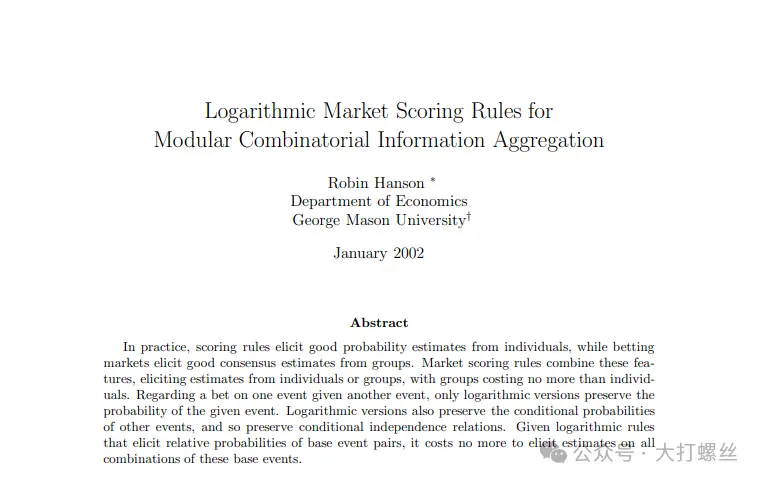
Foundational Work: "The Logarithmic Market Scoring Rule for Modular Combinatorial Information Aggregation"

The above constitutes the official, orthodox history—the kind you'd find in a university microeconomics textbook timeline. But I believe metaphysical discussions about prediction markets after this point were largely meaningless until a16z turned its gaze to this field.

Presence and New Media

a16z came into contact with the prediction market company Kalshi in 2024 and then invested in its $5 billion round in August 2025. It's currently unknown if there was a discount. Now, Kalshi's valuation has reached an astonishing $22 billion and is called one of the fastest-growing companies (in valuation) outside of AI firms.

After taking a position, a16z mobilized its media machine, writing a series of long articles explaining why Kalshi is one of the most important companies of our time. Honestly, while the exchange and casino business is attractive, due to potential regulatory pressure and moral risk, it never commands a very high PE multiple in the market. Clearly, a16z's vision extends beyond that.

So, what is truly important about Kalshi, or the entire prediction market track? The answer a16z gives is "Presence."

At the current point in time, people's contact with the world is actually separated by a layer of plastic film, somewhat like you can only browse the front end of a webpage but know nothing about its backend construction. You can consume the front-end audiovisual experiences, narratives, and even "real feelings," but you cannot change or be present.

Not to mention, obviously in the not-too-distant future, even the transformation of the real world will gradually be outsourced to agents. So, what is humanity's role in the historical process? It seems we are only left to bury our heads in light-colored sheets and cry after eating and drinking our fill.

But prediction markets offer a method of intervention called prediction. It requires you to bet with real money, then, like buying a ticket to enter a stadium, participate and observe the fluctuation of probabilities throughout the process, willingly endure theta decay, and also screenshot the prediction market probabilities, forward them in all group chats, and loudly declare your position and the views behind it.

This feeling is very anti-cynical. In an instant, the infinite distance, the endless people, the choice of the cardinal, the depth of snow in New York, the rise and fall of crude oil within five minutes, and even whether Jesus will return in 2026, all become relevant to you. All the uncertainty and powerlessness of postmodernity collapse under your powerful prediction. You are no longer a gambler; you are a distinguished super-observer, a prophet of your tribe, a calm bystander of history.

When enough people start using, discussing, and relying on this medium, the authority of the market itself begins to rise. Kalshi will grant the final interpretive power over events regarding: 1. Authenticity and 2. Importance. This is undoubtedly a key component in the new media empire envisioned by a16z.
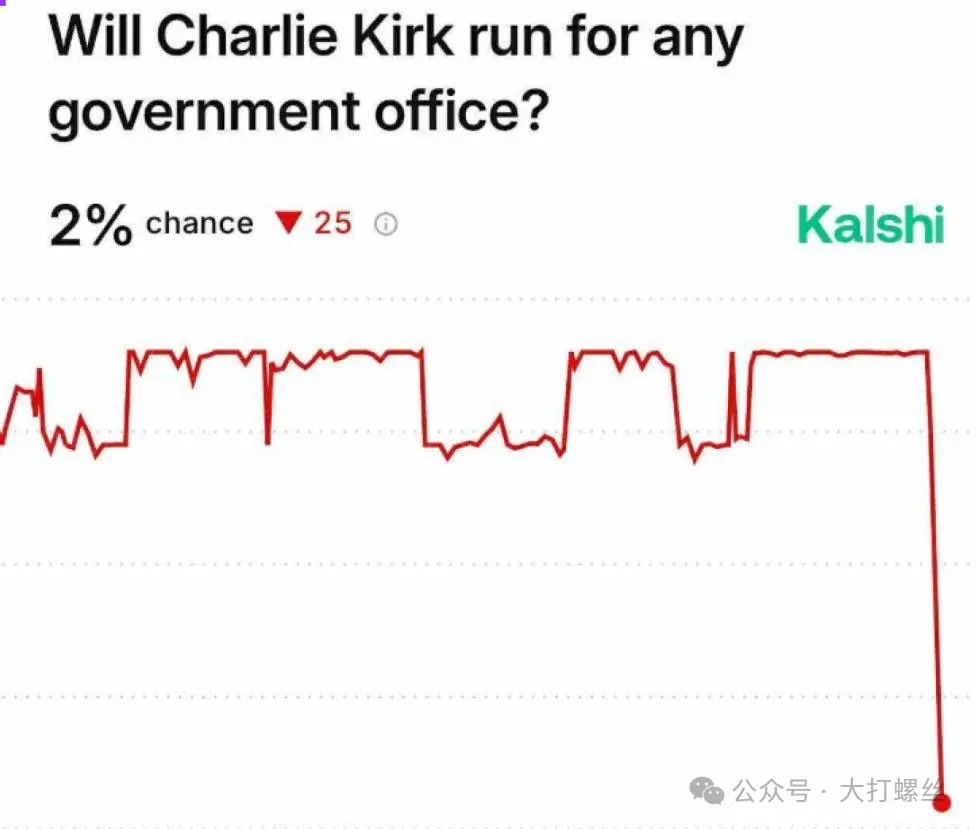
One chart explaining Charlie Kirk's assassination

Case Study: MTS

Finally, let's talk about this new media as defined by a16z. In fact, from the first-generation In-house Media advocated by a16z and YC, to the second-generation VCs that grew out of media like 20VC and Not Boring Capital, and finally to media like TBPN being acquired by companies and institutions, the power of media has been constantly shifting and decentralizing. The battlefield of public opinion has also moved from blogs and TV shows to X and podcasts.

Talking about VCs also needing to create content and build brands, helping founders with distribution, is already utterly unoriginal in 2026. The new media a16z talks about is a full-spectrum project, covering everything from upstream narrative setting, midstream product financing and promotion, to downstream customer acquisition—all within its scope, and at a speed far beyond what traditional media and agencies can comprehend.

What used to take 3-6 months to complete as a planning project, new media will accomplish in a few weeks: founder podcasts, short video clips, AI-generated launch videos, newsletters about the company's spirit and development plan, etc. They release information with extreme intensity in an extremely short time frame, calling it "taking over the timeline."

Perhaps various self-media and AI-generated information are too noisy, so we just have to be noisier. And our noise is more important than yours.

The media company MTS (full name "Monitoring The Situation") embodies this philosophy, conducting 24/7 live news broadcasts on X, bringing a series of political figures, tech company founders, and key figures from hot news topics onto the mic, then slicing and disseminating the content. They claim to only report on the most important thing happening in the world right now, until the next more important thing occurs.

MTS interviewing Robinhood

Looking back at Kalshi, everything seems to fall into place. Relying solely on clout and a16z's endorsement, media like MTS can certainly survive, but their influence outside a16z's sphere remains limited, more like a fraternity media outlet or a campus club publication. But prediction markets are different; the trading volume and positions on them are backed by real money, seemingly possessing a certain independent, third-party, cold, authoritative quality and persuasive power.

Imagine, if you were a staunch MAGA supporter, at the time of the midterm elections, you saw that the Republican victory market on Kalshi had already reached tens of billions of dollars in trading volume, but the price of the YES option for victory had dropped to $0.1. Wouldn't you waver for a moment—do the Capitol Hill elites already know the outcome? Has the fair information market already painted a picture of the future?

This is perhaps the core reason why Kalshi is worth $22 billion. This reality distortion field has not often been obtained by a private company in human history.
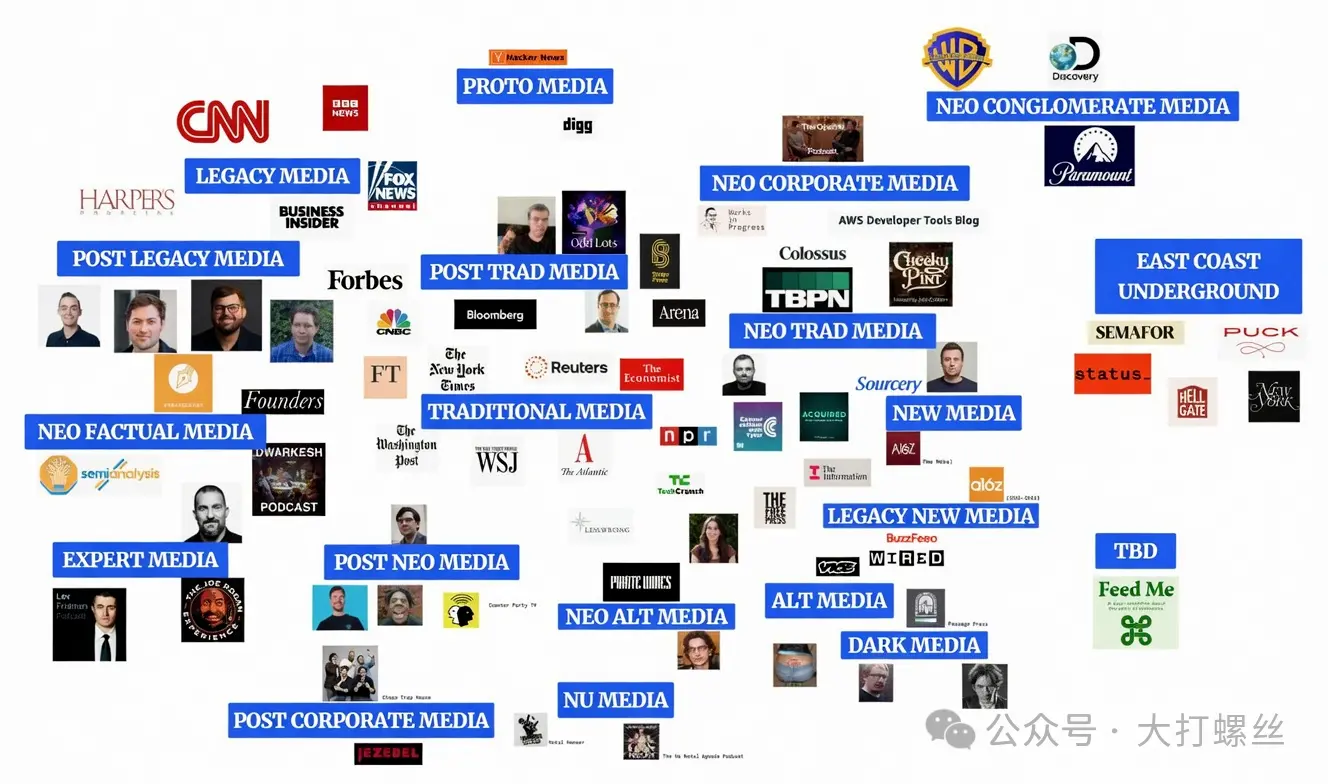
TBPN New Media Landscape

References:

[1] Alex Danco, “Prediction: the successor to postmodernism,” Andreessen Horowitz, October 10, 2025.

[2] Alex Danco, “Prediction Path Screenshots: A New Kind of Meme,” Andreessen Horowitz, October 10, 2025.

[3] F. A. Hayek, “The Use of Knowledge in Society,” The American Economic Review, Vol. 35, No. 4, pp. 519–530, 1945.

[4] Erik Torenberg, Ben Horowitz, and Marc Andreessen, “a16z’s New Media Playbook,” Andreessen Horowitz Podcast, February 27, 2026.


İlgili Sorular

QAccording to the article, what is the 'core reason' why the prediction market company Kalshi is worth $22 billion?

AThe core reason is that Kalshi has obtained a 'reality distortion field'—the authority to provide the final interpretation of an event's authenticity and importance. When a prediction market is widely used and trusted, its price signals gain a cold, third-party, and persuasive authority that can influence public perception and even sway political beliefs, a power historically rare for a private company.

QWhat key concept does a16z propose as the answer to the importance of prediction markets like Kalshi?

Aa16z proposes the concept of 'presence' or 'being there' ('在场感'). In a world where people are often passive consumers of information separated from reality, prediction markets offer a way to actively intervene and participate. By placing real-money bets, users become engaged observers, feeling connected to global events and countering postmodern feelings of uncertainty and powerlessness.

QWho are the two key historical figures mentioned in the 'intellectual history' of prediction markets, and what were their main contributions?

A1. Friedrich Hayek: He laid the early theoretical foundation, arguing in 'The Use of Knowledge in Society' that markets are coordination mechanisms that aggregate dispersed information from all corners of society, forming a collective forecast reflected in prices. 2. Robin Hanson: He designed the Logarithmic Market Scoring Rule (LMSR), an incentive mechanism that makes it more profitable for those with true information to reveal it. This established the core design paradigm for modern prediction markets.

QHow does the article describe the evolution and current strategy of a16z's 'New Media' empire?

AThe evolution moved from 1st-gen in-house VC media, to 2nd-gen media-born VCs, to 3rd-gen media acquisitions. a16z's current 'New Media' is a full-spectrum engineering project covering upstream narrative setting, midstream product promotion/funding, and downstream customer acquisition. It operates at an extreme speed, 'taking over timelines' by rapidly producing podcasts, video clips, AI-generated content, and newsletters within weeks, creating an intense, high-volume information barrage to establish its messages as 'more important' than the noise.

QWhat role does the media company MTS (Monitoring The Situation) play in illustrating a16z's New Media philosophy?

AMTS exemplifies the philosophy of speed and intensity in 'taking over the timeline.' It conducts 24/7 live news broadcasts on Twitter, featuring key figures like politicians and founders, then rapidly slices and disseminates the content. It claims to only cover the world's most important event until the next one occurs, embodying the strategy of overwhelming the information space with high-velocity, high-volume content to assert relevance and authority.

İlgili Okumalar

Has BTC's 'Digital Gold' Narrative Failed?

The article discusses Bitcoin's "digital gold" narrative, its recent price drop, and long-term outlook through the perspective of "Jason". It argues the narrative is not a failure but that Bitcoin represents a superior, new asset class due to its fixed supply (21 million), portability, and auditability. The piece compares its current ~3-4% global adoption rate to early internet/e-commerce, suggesting significant growth potential. Regarding the 2025-2026 price decline (from ~$126k to briefly under $61k), the author views it as a predictable, consensus-driven sell-off within Bitcoin's ~4-year cycle post-halving, exacerbated by a major "handover" from early, low-cost holders to new institutional buyers via ETFs. A key observation is that historical peak-to-trough drawdowns have lessened over time (e.g., 93% in 2011 to ~50% in 2026), indicating maturing volatility as holder structure changes. For the long term, the author uses a simple framework: Bitcoin's total market cap (~$1.4T at $70k) is only about 7% of gold's (~$20T). Even capturing 30-50% of gold's value would imply substantial upside. However, the article strongly cautions against viewing this as investment advice, emphasizing extreme volatility and the critical importance of risk management, position sizing, and deep fundamental understanding to survive severe drawdowns. It concludes by drawing a parallel to Amazon's 95% crash in 2000 and subsequent 42x recovery, stressing that the key is surviving market cycles to realize long-term potential.

链捕手3 dk önce

Has BTC's 'Digital Gold' Narrative Failed?

链捕手3 dk önce

From Code to Cognition: A Ten-Thousand-Word Guide to the Evolution of the Robot Brain

"From Code to Cognition: The Evolution of Robot Brains" The journey of robotic intelligence has shifted dramatically from manually coded systems to AI-driven brains. For decades, robots relied on layered software stacks—perception, state estimation, planning, control—each handcrafted. While predictable, they lacked adaptability. The 2010s saw deep learning revolutionize perception (e.g., object detection) and control (via reinforcement learning), but learned skills remained narrow. The arrival of Large Language Models (LLMs) marked a turning point. LLMs acted as high-level planners, interpreting natural language instructions and generating sequences of actions for traditional robotic systems to execute. However, true integration came with Visual-Language-Action (VLA) models, which fused vision, language, and motion prediction into a single network. Pioneered by models like RT-2 and open-source projects like OpenVLA, VLAs enable robots to reason and act directly from visual input and commands. The most advanced humanoid robots now employ a "dual-brain" architecture: a slow-thinking, large VLA (System 2) for reasoning and planning, and a fast-reacting, small network (System 1) for high-frequency motion control, sometimes with an even lower-level System 0 for balance. This split balances cognition with the physics of real-time movement. Computation is split between onboard hardware (e.g., NVIDIA Jetson) for safety-critical control loops and cloud/edge servers for non-critical tasks like learning and interfaces. A crucial driver is the open-source ecosystem—models like GR00T and OpenVLA allow startups to build upon pre-trained brains and fine-tune them with their own data, accelerating development. Despite progress, current systems struggle with recovery from errors, sample inefficiency, and long-horizon tasks. This has spurred the rise of **World Models**—neural networks that predict the consequences of actions. By simulating possible futures before acting (like NVIDIA Cosmos or Meta V-JEPA), robots can plan, recover, and generalize better. This represents the next frontier: shifting intelligence from learned reactions to an internal model of physics and cause-and-effect. The field is rapidly evolving. While not yet at its "ChatGPT moment," the convergence of cheaper hardware, scalable simulation, and world models points toward robots that are increasingly capable, adaptive, and useful. The question is shifting from "what can robots do?" to "what *should* they do?"

marsbit33 dk önce

From Code to Cognition: A Ten-Thousand-Word Guide to the Evolution of the Robot Brain

marsbit33 dk önce

AI Bubble Is Bursting

The AI Bubble is Bursting: A Necessary Purge on the Path to Ubiquitous Intelligence Market volatility has reignited debates about an AI bubble, with figures like Ray Dalio pointing to high valuations. However, this parallels the dot-com bubble, which, despite its crash, laid the physical infrastructure for today's internet era. The current AI investment frenzy, with tech giants planning trillions in infrastructure spending far outstripping current AI application revenues, appears similarly imbalanced. This 'bubble' is seen as an inevitable phase for a disruptive technology, paying the "innovation tax." Critically, AI inference costs have plummeted over 99.7% since 2023, making intelligence nearly free at the margin. This hasn't reduced spending but has instead unlocked massive new demand, as seen in enterprise AI cloud expenditure tripling. This follows the Jevons Paradox: efficiency gains lead to greater total consumption. The market is now entering a cleansing phase, weeding out speculative ventures lacking real moats. The deeper shift is a move from capital expenditure (CapEx) on hardware to value creation in operational expenditure (OpEx) through AI applications that solve real industry problems. While infrastructure valuations are high, rapid earnings growth from widespread AI adoption across sectors—from manufacturing and finance to law and healthcare—may digest these valuations over time. Ultimately, this creative destruction will leave behind robust infrastructure and optimized models, cheaply powering an AI-augmented future for all industries, much as the internet became indispensable after its own bubble burst. The core productive potential remains undiminished.

链捕手43 dk önce

AI Bubble Is Bursting

链捕手43 dk önce

İşlemler

Spot
Futures
活动图片