After the 'Golden Finger' Points to IBM, the Stock God Trump's Next Target Emerges

marsbit2026-06-02 tarihinde yayınlandı2026-06-02 tarihinde güncellendi

Özet

The White House occupant is being called a "stock god." Financial disclosures show former President Trump executed 3,642 stock trades in Q1 2026, averaging 58 per trading day. More significantly, a pattern has emerged where companies he publicly praises often see their stock prices rise and frequently overlap with his personal portfolio holdings, government industrial policy, and federal funding. Since a high-profile Tesla event in March 2025, Trump has publicly endorsed at least nine companies, including Intel, Dell, Micron, Palantir, IBM, Apple, Thermo Fisher, Nvidia, and AMD. These "Trump concept stocks" share key traits: they are tied to AI, semiconductors, quantum computing, or "Made in America" narratives; they often receive government contracts, subsidies (like CHIPS Act funding), or regulatory favors; and their CEOs typically have strong personal or political ties to Trump. Timing raises questions. In several instances, such as with Palantir and Dell, Trump's personal account established or increased positions weeks before his public endorsements, which were followed by significant stock price jumps. While his assets are reportedly held in a blind trust managed by his children, the correlation is notable. Based on this pattern, analysis suggests the next companies likely to be endorsed are those where the US government has already taken a strategic equity stake but which haven't yet received a high-profile "call-out." Prime candidates include MP Materials (rare ear...

This White House is home to a stock god.

According to the latest disclosed financial documents, Trump completed 3,642 U.S. stock trades in the first quarter of this year, averaging about 58 trades per trading day. This frequency far exceeds that of most professional fund managers.

If it were only about high trading frequency, this matter wouldn't be enough to attract market attention.

What has truly started making Wall Street talk is another set of increasingly difficult-to-ignore data: over the past year, publicly listed companies that Trump has publicly praised by name are showing increasingly obvious overlap with his holdings, government industrial policies, and the flow of federal funds.

Perhaps the most impressive was last year when Trump turned the White House South Lawn into a Tesla product launch event. In front of media cameras, he sat in a Model S, calling Tesla a "great product" and the Cybertruck having the "coolest design."

This was followed by a series of companies including Dell, Intel, Micron, NVIDIA, IBM, Apple, Thermo Fisher, and others entering his public praise list one after another.

The stock prices of some companies showed noticeable abnormal movements after being named; for others, Trump's account had already established positions before the praise; and some companies simultaneously received government contracts, subsidies, export licenses, or other policy support.

When these events occur individually, they might just be coincidences. But when more and more coincidences start pointing to the same group of companies, we can't help but ask a question: Is Trump supporting U.S. manufacturing and the tech industry, or is he shaping his own list of "presidential concept stocks"?

And if this pattern truly exists, then the question the market cares most about is: Who will be the next to be named by the White House?

Common Traits of the Promoted Companies

Counting from the March 2025 performance that turned the White House South Lawn into a Tesla showroom to May 2026, there have been nine publicly listed companies that Trump has publicly named or posted strong support for on Truth Social, with the density sharply rising in 2026. The most typical examples are Dell and Intel.

On February 10th of this year, the Trump account established a position of $1 million to $5 million. On May 8th, he publicly called out from the White House, "Go buy a Dell, they're great." Dell's stock price surged about 14% intraday. Before this, the Dell family had already committed $6.25 billion to "Trump accounts."

Intel represents another typical case. In August 2025, the Trump administration converted the $8.9 billion subsidy owed to Intel under the CHIPS and Science Act into equity, acquiring approximately 9.9% at $20.47 per share, making the U.S. government Intel's largest shareholder. The online community simply calls it a "U.S. state-owned enterprise." Six months later, in early March 2026, his personal account also appeared in Intel's holdings. Subsidy conversion to equity, government backing, personal holdings, and public promotion have all become bullish factors for Intel.

Another landmark moment was Palantir (PLTR). On April 10th, he endorsed it on Truth Social by its company name and stock ticker, calling it "proven to have powerful combat capabilities and equipment," becoming the first sitting president to do so.
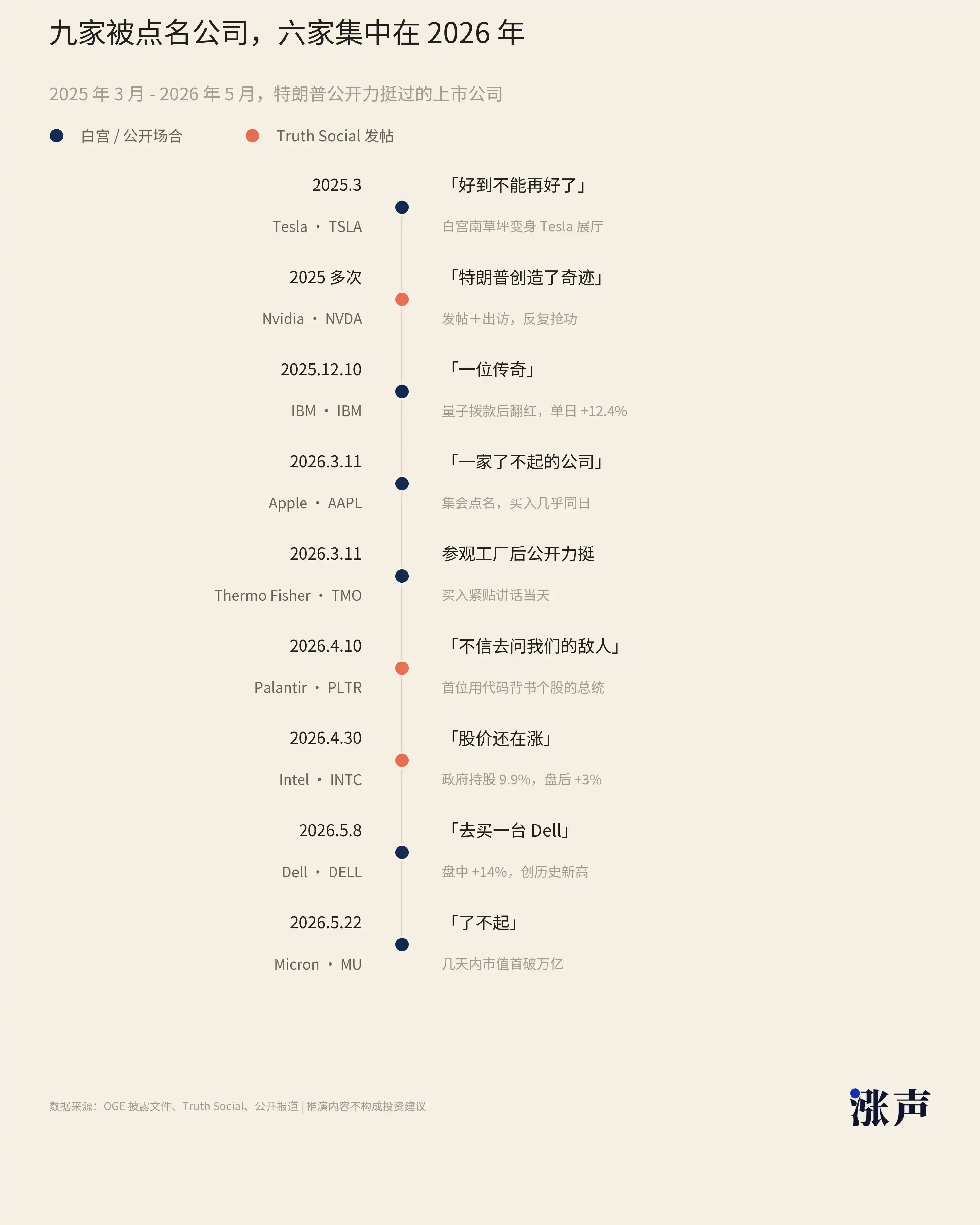
If we expand the scope from Trump's personal holdings to publicly listed companies he has publicly praised by name, the number far exceeds the few familiar tech giants. Based on statistics from public speeches, White House events, and Truth Social posts, Trump has explicitly praised at least 9 publicly listed companies over the past year or so, causing short-term stock price increases, including Intel, Dell, Micron, Palantir, IBM, Apple, Thermo Fisher Scientific, Tesla, and NVIDIA.

We've summarized some of their commonalities:

First and most obviously, they almost all fit the narratives of "AI/new tech," "U.S. leading manufacturing," and "reshoring of production capacity."

Industrially, they are highly concentrated in the AI computing power and semiconductor chain. Intel, Micron, NVIDIA, AMD are chips; Dell is computing hardware; IBM is quantum; Palantir is AI software.

Secondly, each named company has a direct interest lever that the government can pull. For example, Intel has 9.9% government ownership; Palantir is a major federal contractor; IBM and Intel received CHIPS Act grants; NVIDIA and AMD benefit from loosened export controls to China; Dell received a $9.7 billion Pentagon contract on May 27th, shortly after being praised. Apple was praised because it promised investment in the U.S. and iPhone glass production at its Kentucky factory; Intel and Micron are domestic fabs; Dell assembles AI servers in the U.S.; IBM has its quantum foundry in Albany; Tesla, on the day it was promoted, saw Musk promise on the spot to double U.S. production. Trump rarely praises purely overseas production; he praises the act of "moving production lines back to the U.S." itself.

To some extent, the narratives of these companies have been packaged and elevated into matters of "national security" and "competition with China." Chips are a bottleneck; quantum is cybersecurity. Of course, a prerequisite for being named is often the CEO first submitting a pledge of allegiance.
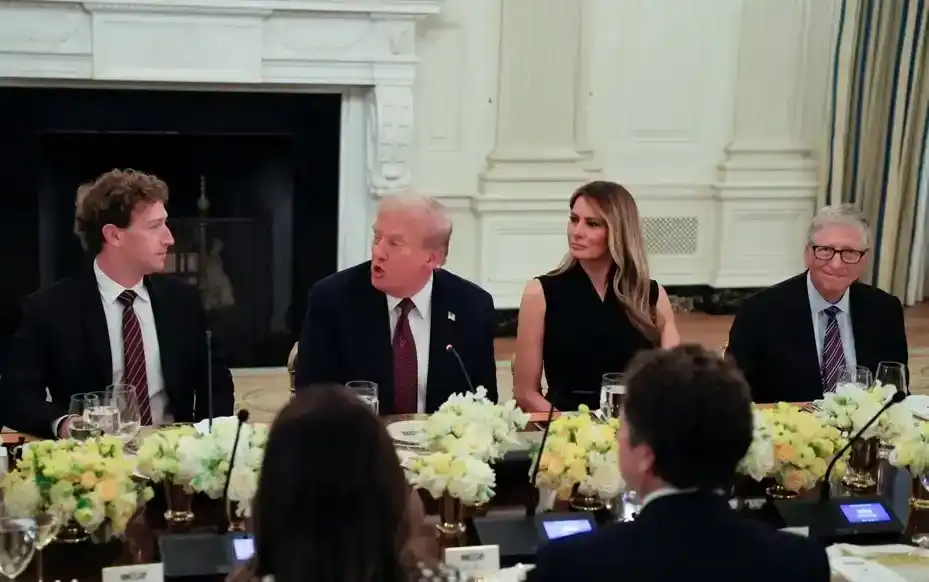
Trump hosting a dinner for tech giants after taking office last year, asking each about their investment amounts in the U.S.

All the positive factors are, first and foremost, "having the right connections." These CEOs generally publicly expressed support for Trump or have personal relationships with him.

Jensen Huang accompanied him on visits and publicly thanked him; the Dell family donated $6.25 billion to "Trump accounts"; Oracle's Larry Ellison is a long-time supporter, deeply involved in the Stargate and TikTok deals; Musk was an ally during the promotion period; Arvind Krishna was named in the room during a face-to-face meeting.

Although the White House's unified explanation is that the President's assets are held in a trust managed by his children, with independent third-party discretionary accounts, and Trump himself does not participate in specific trades, we can indeed observe that the timing of Trump's promotions overlaps with his personal holdings and trades.

For example, Palantir was intensively bought in March, and Trump named it on Truth Social a few weeks later; Dell was bought on February 10th ($1-5 million per month), and publicly promoted in May; Apple and Thermo Fisher were bought and publicly praised almost on the same day.

If these patterns are correct, then predicting Trump's next promotion isn't difficult.

Who Might Be the Next to Be Promoted

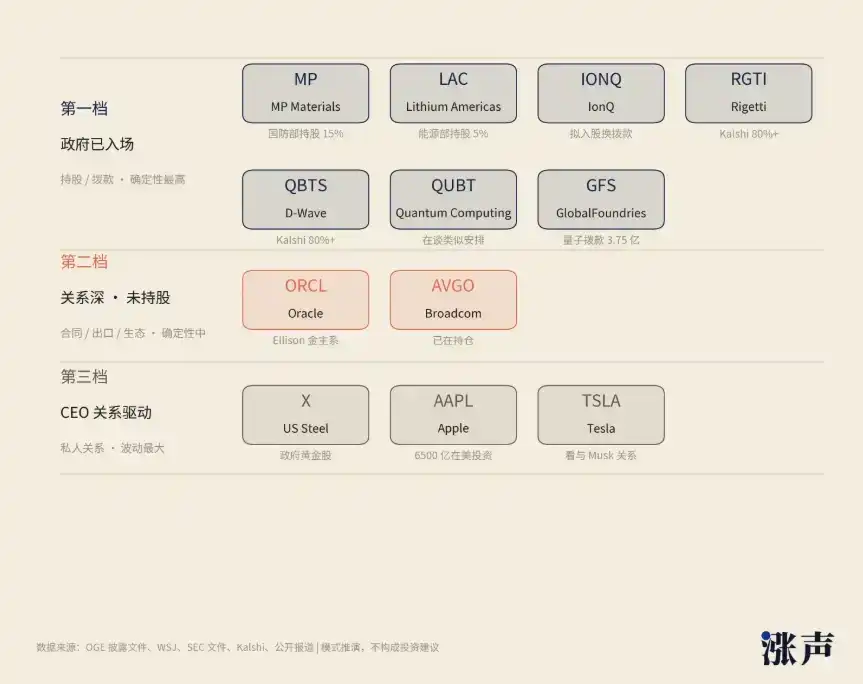
First and most likely are companies where the government has already taken a position: MP Materials (MP), Lithium Americas (LAC), IonQ (IONQ), Rigetti (RGTI), D-Wave (QBTS), etc.

MP Materials is currently one of the U.S.'s core rare earth magnet suppliers. Its main business is rare earth mining and separation processing, ultimately used to manufacture permanent magnets, which go directly into fighter jets, electric vehicles, and missile systems.

In other words, it's not just a "resource company" but a link in the defense supply chain.

In July 2025, the U.S. Department of Defense acquired approximately 15% equity and related arrangements, transforming it from an ordinary publicly listed company into a kind of "quasi-strategic asset." More crucially, this move occurred before the government's investment in Intel.

But an interesting point in the market is: compared to Intel being frequently discussed, MP is relatively low-key, and hasn't even been centrally named in political narratives. This state of being "already invested in but not yet narrated" itself constitutes a lag in pricing.

Lithium Americas is a typical lithium resource development company. Its core asset is the Thacker Pass lithium project in Nevada, USA, one of the largest known lithium resources in North America. The strategic significance of lithium needs no explanation: electric vehicles, battery storage, military energy systems all depend on it.

The U.S. Department of Energy indirectly holds approximately 5% equity through warrants and project structures and obtains about a 5% economic interest in the Thacker Pass project. Simultaneously, the project is tied to General Motors (GM), forming a tripartite structure of "government + industry + listed company."
More critically, the U.S. Department of Energy explicitly defined Thacker Pass as a "national security-level strategic lithium asset" in documents.

Furthermore, according to The Wall Street Journal, several companies including IonQ (IONQ), Rigetti (RGTI), and D-Wave (QBTS) are discussing obtaining at least $10 million-level grant support through "government equity stakes or quasi-equity arrangements." Quantum Computing (QUBT) and Atom Computing are also being considered under similar frameworks.

These quantum computing players are currently still in very early stages, but their peculiarity lies in the fact that they almost naturally belong to the intersection of national security and basic scientific research.

If we extend the timeline, the U.S. government previously initiated a roughly $20 billion quantum technology support program, with IBM receiving about $10 billion, GlobalFoundries (GFS) about $3.75 billion, and the remaining funds allocated to various labs and companies.

IBM has already been fully traded by the market for a round, and the next step will naturally go to more "pure" quantum plays. Notably, the market has already priced this ahead of him. On Kalshi, in the market betting on "which companies the government will invest in this year," the probability for Rigetti and D-Wave has already been bet to over 80%.

GlobalFoundries (GFS) deserves special mention. It both received that $3.75 billion quantum grant and is itself a U.S. domestic fab, fitting both the chip and domestic manufacturing narratives, making it the most suitable company to be incidentally named at a "Made in America Chips" event.

Apart from companies where the government has already taken a position, there are also some that perfectly fit structurally and have deep enough government ties but haven't yet received explicit equity that are worth mentioning.

However, this category is more likely to be named through contracts, exports, or ecosystem support, potentially less direct than previous promotions.

Oracle (ORCL) might be the best positioned among them. Ellison's personal relationship, Stargate, the TikTok deal, and existing holdings in his personal account—all the soft conditions are in place, just waiting for a formal verbal endorsement. Broadcom (AVGO) is similar, a core supplier of custom AI chips and data center construction, already in the holdings.

Besides these, there are companies driven by CEO personal relationships. The U.S. Steel (X) line is worth separate attention. In the Nippon Steel acquisition case, the government obtained a "golden share" stronger than ordinary equity, and the "protect American steel" narrative can be reused at any time. Apple, although already promoted, has a $650 billion U.S. investment promise that is material that can be reused repeatedly, so the probability of being promoted again is not low. Tesla depends on the degree of repair in his relationship with Musk, making it the most volatile item on this list.

It should be noted that the above is a pattern extrapolation based on publicly disclosed industrial policies and equity stake clues, not a deterministic prediction, and certainly does not constitute any investment advice. These targets themselves carry high political premiums, and political premiums are always double-edged. They can push stock prices up after a post, but can also compress valuations when the wind changes direction.

After all, relying solely on the "White House Stock God" to promote stocks makes price increases very fragile.

İlgili Sorular

QAccording to the article, what is the average number of stock trades President Trump executed per trading day in Q1 of the reported year, and why did it attract Wall Street's attention?

AAccording to the article, President Trump executed an average of approximately 58 stock trades per trading day in Q1, totaling 3,642 trades. This frequency itself surpassed that of most professional fund managers. However, what truly drew Wall Street's focus was the increasing overlap between the companies he publicly praised, his personal stock holdings, government industrial policies, and the flow of federal funds, suggesting a potential pattern beyond mere coincidence.

QWhat are the three main common characteristics shared by the companies publicly praised by Trump, as summarized in the article?

AThe article summarizes three main common characteristics of the companies Trump praised: 1) Their narratives align with 'AI & New Tech,' 'U.S. Leading Manufacturing,' and 'Production Reshoring.' 2) Each company has a direct interface where government interests can be applied, such as receiving CHIPS Act grants, government contracts, export license approvals, or commitments to U.S. investment. 3) Their CEOs generally have demonstrated public support or personal connections with Trump, having offered what the article terms 'pledges of allegiance' or investments.

QUsing the pattern identified in the article, which category of companies is most likely to be Trump's next 'stock tip' target, and name two specific examples mentioned.

ABased on the pattern identified, companies where the U.S. government has already taken an equity stake or similar financial interest are the most likely category to be Trump's next 'stock tip' target. Two specific examples mentioned are MP Materials (MP), a rare earths supplier where the Defense Department acquired ~15% interest, and Lithium Americas (LAC), a lithium developer where the Department of Energy holds an indirect ~5% stake and economic interest.

QBesides companies with direct government stakes, what other type of company might be named by Trump, and which company is cited as the best candidate due to its 'soft conditions'?

ABesides companies with direct government stakes, companies that perfectly fit the strategic narrative and have deep government ties, even without an explicit equity stake, might also be named. The article cites Oracle (ORCL) as the best candidate in this category due to its 'soft conditions' being fully in place: CEO Larry Ellison's personal relationship with Trump, involvement in projects like Stargate and the TikTok deal, and Trump's existing personal holdings in the company.

QWhat cautionary note does the article provide regarding investments based on the 'presidential stock tip' phenomenon?

AThe article cautions that investments based on this phenomenon carry high 'political premium,' which is a double-edged sword. This premium can push stock prices up following a public endorsement but can also compress valuations just as quickly if the political winds change. It concludes that stock gains relying solely on 'White House stock god' tips are inherently fragile.

İlgili Okumalar

Blockchain Has Finally Started to Sail into the Mainstream After 18 Years

Blockchain Finds Its True Path After 18 Years: Becoming the Financial Backbone for AI Agents and Autonomy This analysis explores a pivotal shift in the blockchain and crypto investment landscape, driven by the dominance of AI. Major venture capital firms, including Variant, Paradigm, Haun Ventures, and YZi Labs, are moving beyond pure "crypto" investment theses. They are expanding their focus to AI, robotics, and frontier tech, signaling that blockchain is no longer seen as a standalone sector but as an underlying infrastructure layer. The core argument is that blockchain's killer application may not be user-facing apps, but rather providing the economic rails for the coming wave of AI agents, autonomous robots, and automated systems. Key capabilities like self-custody wallets, programmable stablecoins for micropayments, on-chain identity, and verifiable smart contracts are positioned as essential for a future where machines conduct economic activity. The recent $1.4 billion investment by Tether (via its venture arm) in German robotics company NEURA Robotics exemplifies this, aiming to embed Tether's wallet tools directly into robots for autonomous transactions. While many "AI + Crypto" projects remain superficial, the article concludes that true value lies where crypto is a necessary component—enabling machine-to-machine payments, agent autonomy, verifiable data provenance, and open financial settlement for the AI era. For crypto venture capital, this convergence with AI represents both an adaptation to shifting capital flows and a potential path to unlocking the large-scale, non-speculative utility the industry has long sought.

marsbit10 dk önce

Blockchain Has Finally Started to Sail into the Mainstream After 18 Years

marsbit10 dk önce

Blockchain has finally begun sailing toward the main channel after 18 years

After 18 years of development, blockchain technology is beginning to move from a specialized niche into mainstream adoption, according to a recent industry analysis. The shift is reflected in the changing strategies of major crypto venture capital firms, which are expanding their focus beyond pure "digital ownership" towards broader themes like "autonomy." The report highlights that leading VC firms like Variant, Paradigm, Haun Ventures, and YZi Labs are broadening their investment mandates to include not only crypto but also artificial intelligence (AI), robotics, biotech, and other frontier technologies. This reflects a recognition that the isolated "crypto investment" narrative is losing appeal to limited partners (LPs) as capital and attention increasingly flow toward AI and other high-growth tech sectors. A key emerging thesis is that blockchain's most significant future application may not be as a consumer-facing product, but as the underlying economic and settlement infrastructure for the AI era. As AI agents and autonomous systems become more prevalent, they will require programmable, global, and low-cost payment networks (like stablecoins), verifiable digital identities, and secure wallets to manage transactions and assets on behalf of users. The investment by stablecoin issuer Tether into robotics company NEURA, with plans to integrate its wallet technology, is cited as a prime example of this convergence. However, the article cautions that simply labeling projects as "AI + Crypto" is insufficient. True value lies in integrations where blockchain technology is essential—such as enabling machine-to-machine micropayments, verifiable data provenance for AI, or transparent governance for autonomous organizations—rather than being a superficial marketing add-on. In conclusion, while AI currently dominates the tech narrative and capital flows, it may ultimately create the real-world, high-frequency demand that the crypto industry has long sought. For crypto VCs and projects, the path forward is to position blockchain not as a competing sector, but as a critical foundational layer powering autonomy and economic activity in an AI-driven future.

链捕手17 dk önce

Blockchain has finally begun sailing toward the main channel after 18 years

链捕手17 dk önce

Y Combinator Co-founder: How to Make a Billion Dollars?

The Y Combinator co-founder argues that becoming a billionaire by founding a successful startup is not only possible but demonstrably achievable without unfair or unethical practices. He disputes a politician's claim to the contrary, using the example of a founder whose company grew at 93% monthly solely through creating a product users loved and recommended. The core mechanism is exponential growth. A conservative 15% monthly growth rate compounds to a 4384x increase over five years, which can easily lead to billion-dollar valuations and founder wealth. The process depends on two key variables: the growth rate and the duration it can be sustained. A high growth rate stems from a great product that users naturally promote, while a long duration requires a large enough market. For aspiring founders, especially young ones, the simplest path is to build something they and their friends genuinely need. Young people's current needs often predict future mass-market trends. He advises against actively "searching" for ideas, as this tends to filter out unconventional but promising ones. Instead, inspiration should come from working on interesting projects with friends, as many iconic companies (e.g., Apple, Facebook) started this way. Ultimately, building a massively valuable startup is not about exploitation but empathy: deeply understanding a user group and building a product that significantly improves their lives. This, powered by exponential growth in a large market, is the legitimate path to immense wealth creation.

Foresight News19 dk önce

Y Combinator Co-founder: How to Make a Billion Dollars?

Foresight News19 dk önce

The 800V Voltage Standard Championed by Nvidia: Which Infrastructure Providers Stand to Benefit?

NVIDIA is actively promoting the 800VDC architecture as a key direction for its next-generation AI factories and high-power racks, particularly for the upcoming Rubin and Kyber platforms. The primary driver is the rapidly increasing power density of AI racks, with designs like GB200/GB300 NVL72 reaching 120-140kW and future systems potentially hitting 180-220kW. At such high power levels, traditional low-voltage power delivery becomes inefficient due to massive current, leading to significant copper use, cable bulk, heat, and power loss. The 800VDC standard aims to increase efficiency by transmitting power at higher voltage and lower current to the rack before stepping it down locally for GPUs. NVIDIA claims this can improve efficiency by up to 5%, reduce total cost of ownership (TCO) by up to 30%, and cut copper usage by approximately 45%. This shift redefines infrastructure roles, pushing power engineering to the forefront alongside GPU performance. Key beneficiaries and ecosystem partners highlighted include: 1. **Power Infrastructure Providers:** Companies like Vertiv, Schneider Electric, Delta Electronics (台达电), and Korean firms LS Electric and HD Hyundai Electric are involved in designing next-gen AI factory power distribution, rack power supplies, and backup systems. 2. **Power Semiconductors:** Suppliers of SiC/GaN devices, such as Infineon and STMicroelectronics, are better suited for high-voltage, high-efficiency conversion in this new architecture. 3. **Connectivity & Structure:** The focus shifts to high-reliability components like busbars, high-voltage connectors, and advanced PCBs that meet stricter insulation and safety requirements. 4. **Liquid Cooling & Rack ODM:** As power and heat density rise, liquid cooling becomes critical. Full-rack system integrators (e.g., Dell, Wiwynn, Wistron) must now demonstrate robust pre-delivery testing capabilities, including burn-in testing under full load, requiring significant power and cooling infrastructure in their factories. The transition is not immediate for all data centers but is targeted at high-density AI factories. NVIDIA’s 800VDC ecosystem is in a preparatory phase, with full-scale production expected to align with the 2027 launch of Kyber rack-scale systems. The investment thesis revolves around which companies can demonstrate proven product integration, customer validation, and reliable delivery of complete, high-power AI rack systems, making power, cooling, and testing capabilities new critical variables in the AI infrastructure value chain alongside GPUs.

marsbit40 dk önce

The 800V Voltage Standard Championed by Nvidia: Which Infrastructure Providers Stand to Benefit?

marsbit40 dk önce

İşlemler

Spot
Futures
活动图片