Robinhood Chain Comprehensive Review: Beyond Meme Coins like cashcat, What Other Projects Are Worth Watching?

marsbit2026-07-15 tarihinde yayınlandı2026-07-15 tarihinde güncellendi

Özet

A two-week review of Robinhood Chain (RHC), an Ethereum L2, reveals an initial meme-driven surge led by CASHCAT—which briefly propelled daily active addresses to 193k—now giving way to utility-focused projects. Chain-native projects like Arrow Finance (ARROW), a CDP protocol accepting tokenized stocks/ETFs as collateral, and INDEX, a fee-redistribution token for stock token holders, have seen significant price appreciation despite the broader meme downturn. The ecosystem includes established partners like Lighter (LIT, integrated for perps trading), Morpho (MORPHO, dominant in TVL for lending), Chainlink (LINK, oracle provider), and Arbitrum (ARB, the underlying stack). Key projects yet to launch tokens offer interaction opportunities: Arcus (a dYdX-incubated stock token/RWA platform likely to airdrop to dYdX and early Arcus users) and Rialto (a multi-asset DEX with a proprietary PropAMM engine, running a referral program). However, structural concerns remain: TVL is overly concentrated in Morpho, DEX volume heavily relied on meme trading, and real on-chain activity for the flagship stock tokens is currently minimal (~0.27% of ERC-20 transfers). The sustainability of activity after the initial 90-day gas fee subsidy period is a critical watchpoint.

Author: Curry, Shenchao TechFlow

Shenchao Introduction: Two weeks after the Robinhood Chain mainnet launch, its TVL has surpassed $160 million, stablecoin market cap exceeds $327 million, and cumulative DEX trading volume has reached $4 billion. The meme coin CASHCAT has corrected from its peak market cap of $170 million to around $138 million, and the on-chain speculative trend is shifting from memes towards utility-based projects. Among the list of ecosystem partners, Arcus (by the dYdX team) and Rialto (a multi-asset DEX) have not yet issued tokens, presenting early interaction opportunities; on-chain native projects like Arrow Finance and INDEX have surged against the meme market downturn.
On July 1st, Robinhood launched the public mainnet of Robinhood Chain at the "The World is Flat" event in London. Two weeks later, this Arbitrum tech stack-based Ethereum L2 has gone through a standard cycle of "meme ignition, data peaking, and hype cooling down," and is now entering a critical window for ecosystem development.

According to DeFiLlama data, as of July 15th, Robinhood Chain TVL is approximately $161 million, stablecoin market cap around $327 million (USDG accounts for 68.2%), cumulative DEX trading volume about $3.9 billion, and RWA active market cap roughly $12.4 million. For a two-week-old L2, these figures are not bad, but the structure requires closer examination.

CASHCAT Ignites the First Week, Stories of $85 Turning into $2 Million Drive Daily Active Users to 193,000

The first week's activity on Robinhood Chain was almost entirely driven by a single token: CASHCAT.

The name CASHCAT originates from the alternative name founders Vlad Tenev and Baiju Bhatt once considered for their company. This token was deployed before the mainnet launch. On July 8th, it contributed approximately $98 million in daily DEX volume, with its market cap once surging to $150-170 million. That day, Robinhood Chain's total 24-hour DEX volume reached $560-570 million, briefly surpassing Hyperliquid.

Typical early wealth-creation stories emerged on-chain: one wallet bought CASHCAT for about $85 (0.05 ETH), with its holdings' value peaking at over $2 million; another wallet started with $838, achieving a return exceeding 1180x. These on-chain data, tracked by Lookonchain and Bubblemaps, quickly spread and became the main narrative driving new wallet inflows. On July 8th, there were 141,000 new active wallets, with total daily actives nearing 193,000.

Tenev himself joined the hype. He posted on X platform that Robinhood Chain was "built for RWA, but memes work too."

However, as of July 15th, according to GMGN market data, CASHCAT's market cap has fallen back to around $138 million, down 12% in 24 hours. Other meme coins like HOODRAT and JUGGERNAUT have fallen over 25%. The meme retreat has begun.

Utility-Based Projects Rise Against the Trend: ARROW and INDEX Become New Focal Points

While memes recede, some on-chain native projects with practical product logic are beginning to attract capital.

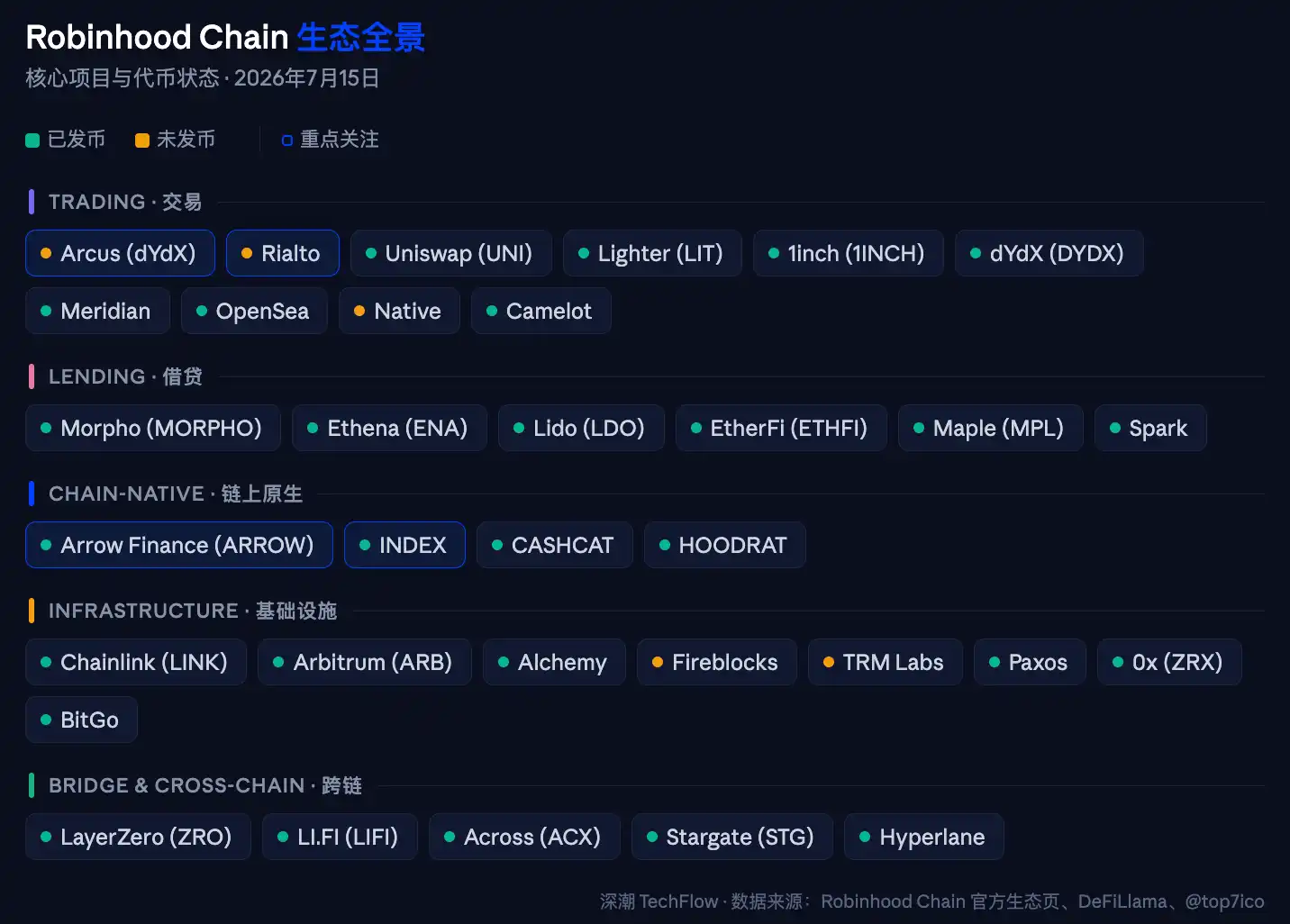
Arrow Finance (ARROW) is a native CDP (Collateralized Debt Position) protocol on Robinhood Chain. Users can deposit collateral to mint the aUSD stablecoin. Its core difference from typical CDP protocols lies in its collateral scope: besides mainstream crypto assets and stablecoins, Arrow Finance is the first CDP protocol to accept tokenized public stocks and ETFs as collateral. Holders of tokenized stocks can borrow liquidity without selling their stock positions, avoiding taxable events and the need to leave Robinhood Chain.

According to CoinGecko data, ARROW's current market cap is approximately $16 million, with a price of around $1.79, marking an over 10x increase from its starting price of about $0.15 on July 7th. CoinMarketCap shows a higher price of around $2.26. ARROW has launched staking functionality (LP Staking), with trading mainly concentrated on Uniswap V2/V3/V4 (Robinhood Chain).

INDEX is another utility token gaining attention. Public data shows that INDEX surged 160% on the evening of July 14th after gaining attention from Robinhood team members. At the time of writing, its market cap is around $7.36 million. The project's core mechanism involves using trading fees to purchase on-chain stock tokens and distributing them to INDEX holding addresses. This "trading fees → buy stock tokens → distribute" flywheel structure essentially builds a revenue distribution layer on top of Robinhood Chain's stock token ecosystem.

It's important to emphasize that both INDEX and ARROW are extremely early-stage on-chain native projects, with thin liquidity, highly volatile prices, and project information primarily from on-chain data and community dissemination, lacking institutional-level due diligence verification.

Ecosystem Projects with Tokens Issued: Fundamentals vs. On-Chain Performance

Robinhood Chain's initial partner list covers 16 projects. Most already have tokens. For these projects, investor focus lies in their fundamentals and the token's actual utility on Robinhood Chain.

Lighter (LIT): A ZK-powered perpetuals and spot DEX, directly integrated into the Robinhood Wallet. Eligible users can trade perpetual contracts within the wallet. Lighter has committed $11 million worth of LIT tokens to the Robinhood community. Trading earns points (double points for trading via Robinhood Wallet), which can later be converted to LIT. This is currently the most direct points farming channel on Robinhood Chain.

Morpho (MORPHO): A lending protocol hosting the majority of the chain's TVL. In its first week, around $90 million TVL concentrated in Morpho, serving as the underlying infrastructure for the Robinhood Earn product (estimated 7% APY USDG lending). It has insurance coverage from Lloyd's of London and RELM. High TVL concentration in a single protocol is a risk, but also indicates lending demand is not purely speculative.

Chainlink (LINK): As Robinhood Chain's official oracle and cross-chain infrastructure, it provides price data for all Stock Tokens. CCIP, Data Streams, and Data Feeds were deployed on the mainnet from day one.

Arbitrum (ARB): The underlying tech stack for Robinhood Chain. Offchain Labs simultaneously launched a revenue-sharing model: 10% of Robinhood Chain's net protocol fees flow back to the Arbitrum ecosystem (8% to the DAO Treasury, 2% to the Developer Guild). ARB rose about 7.6% after the mainnet launch.

Other partners with existing tokens include Uniswap (UNI), LayerZero (ZRO), 1inch (1INCH), etc. These projects have real deployments on Robinhood Chain, but their token price drivers are not primarily from Robinhood Chain.

Projects Without Tokens: Interaction Paths and Airdrop Expectations

Four projects on the partner list have not yet conducted a TGE. Among them, TRM Labs (compliance & risk control) and Fireblocks (MPC infrastructure) are more B2B-focused, offering little participation entry for retail users. The real interaction opportunities lie with Arcus and Rialto.

Arcus: Incubated by dYdX Labs and co-built with Robinhood Crypto, which has also invested an undisclosed amount. CEO is Eddie Zhang, previously founder of social trading app Pocket Protector (acquired by dYdX Labs in July 2025). dYdX founder Antonio Juliano has joined Arcus's board.

Arcus currently offers zero-fee spot trading for 95 Stock Tokens, operating 24/7 across 120+ countries (excluding the US, Canada, UK). 35 RWA perpetual contracts are still in a waitlist stage, with plans to open a Pre-IPO market.

Regarding tokens, dYdX explicitly stated in its announcement: future Arcus tokens will be prioritized for distribution to users who trade, stake, or validate on dYdX. In other words, there are two potential interaction paths for an Arcus airdrop. One is accumulating trading, staking, and validation history on dYdX Chain; the other is directly trading Stock Tokens on Arcus (currently zero fees, making interaction cost extremely low). The issuance timeline is undetermined.

Market reaction to the Arcus launch was mixed: DYDX token fell about 23% in 24 hours (traders concerned about resource diversion), while Robinhood stock (HOOD) rose over 10% during the same period.

Rialto: A stealth-mode launched, all-asset-class on-chain spot exchange supporting 24/7 trading of cryptocurrencies, Stock Tokens, ETFs, commodities, and Pre-IPO assets. The team has backgrounds in hedge funds, HFT, and market making.

Rialto's core differentiation is its PropAMM (Proactive Automated Market Maker) engine "Rivo Altus." Unlike passive AMMs, PropAMM is powered by the team's own inventory and proprietary pricing logic for on-chain market making. Using Arbitrum's Stylus infrastructure, it deploys the market-making logic directly on-chain, aiming for execution quality close to centralized exchanges.

Rialto has no token plans announced yet, but has launched a referral program: unlock a referral code after reaching $10,000 in cumulative trading volume; referrers earn 10% of the referee's fees. New exchanges on fresh chains using referral programs and volume accumulation to filter early users before a potential token launch is a common pre-airdrop signal. Initial listing covers 90+ Robinhood Stock Tokens and mainstream crypto assets.

Structural Issues with Robinhood Chain

Two weeks of data reveal a hard-to-ignore fact: on-chain TVL is highly concentrated in Morpho, DEX volume heavily relies on meme speculation, and RWA active market cap is only about $12.4 million. Robinhood Chain's narrative is "financial infrastructure," but so far, the most actively traded asset on-chain is a cat meme coin.

The actual on-chain activity of Stock Tokens also falls far below expectations. According to SQD's on-chain data analysis, during the mainnet's early stages, only 24 Stock Tokens and ETF tokens had any on-chain transfers, totaling 313 transactions, accounting for a mere 0.27% of all ERC-20 transfers on the chain. The real trading demand for tokenized stocks on-chain has yet to be validated.

The 90-day gas fee waiver period is another variable. The current trading activity on Robinhood Chain benefits from gas subsidies. The retention rate after the subsidy ends will be a key window to judge the ecosystem's true stickiness.

Trend Kriptolar

İlgili Sorular

QWhat is the current focus of activity on Robinhood Chain after the initial meme coin frenzy subsided?

AAfter the meme coin (e.g., CASHCAT) frenzy subsided, activity on Robinhood Chain is shifting towards utility-focused projects. Examples include Arrow Finance (ARROW), a CDP protocol that accepts tokenized stocks as collateral, and INDEX, a token that allocates trading fees to purchase and distribute stock tokens to holders.

QWhich two key projects in the Robinhood Chain ecosystem have not yet launched a token, presenting potential early interaction and airdrop opportunities?

ATwo key projects in the Robinhood Chain ecosystem that have not yet launched a token are Arcus (a stock/RWA trading platform incubated by dYdX Labs) and Rialto (a multi-asset spot DEX with a proprietary PropAMM engine). These represent potential early interaction and airdrop opportunities for users.

QWhat are the structural issues highlighted for Robinhood Chain after its first two weeks of operation?

AKey structural issues highlighted for Robinhood Chain include: highly concentrated TVL in the Morpho lending protocol, DEX trading volume heavily dependent on meme coin speculation, and low actual on-chain activity for its flagship Stock Tokens (only 0.27% of ERC-20 transfers). The chain's real-world asset (RWA) narrative is not yet matched by significant on-chain trading demand for tokenized stocks.

QHow did the launch of Arcus affect the prices of DYDX and HOOD (Robinhood stock)?

AThe market reaction to the Arcus launch was divergent. The DYDX token price dropped approximately 23% within 24 hours, likely due to trader concerns about resource diversion from the dYdX chain. Conversely, Robinhood's stock (HOOD) rose over 10% in the same period.

QWhat is the unique mechanism of the INDEX token on Robinhood Chain?

AThe INDEX token's core mechanism involves using trading fees generated from its associated platform to purchase on-chain stock tokens. These purchased stock tokens are then distributed to INDEX token holders. This creates a 'flywheel' effect where trading activity funds the acquisition and distribution of real-world asset (RWA) exposure.

İlgili Okumalar

From Being Ignored to the Venture Capital Queen Investing: Has AI Revived This Ultra-Niche Sector?

From obscurity to receiving investment from the "queen of venture capital," AI has revitalized the ultra-niche social networking track. In recent years, the social networking sector experienced a deep freeze in venture capital, with high-profile projects like the video social app "Huayin" (founded by a former WeChat core team member) and the offline-online dating app "Single's Tavern" ultimately failing. These failures underscored the immense difficulty of challenging WeChat's dominance in熟人社交 (close-contact social networking) and the general lack of scalable monetization paths for niche concepts like metaverse, female-only, or Muslim community apps. However, a shift emerged in 2025. "Liangpei," an AI-powered matchmaking company, secured a $2 million angel round from Today Capital, led by renowned investor Xu Xin. Its approach uses AI conversational profiling to create detailed user matches and charges only upon successful connections. Similarly, projects like "Pixel Rhythm" (reportedly focused on AI-assisted content creation for Gen Z overseas) and "Moobius" (AI-native group chat) signal a new trend. The investment logic has fundamentally changed. Instead of pursuing broad, traffic-driven "platform dreams" to compete with giants like WeChat, Douyin, or Soul, the new wave focuses on using AI as a tool to solve specific, high-pain-point problems for targeted, niche user segments. The path to viability now lies in achieving healthy cash flow by solving a concrete problem rather than chasing massive scale.

marsbit42 dk önce

From Being Ignored to the Venture Capital Queen Investing: Has AI Revived This Ultra-Niche Sector?

marsbit42 dk önce

From TrueFi to Elara: Why the Next Stop for On-Chain Finance is Liquidity Infrastructure?

From TrueFi to Elara: Why On-Chain Finance's Next Stage is Liquidity Infrastructure? The article analyzes the evolving focus in decentralized finance, shifting from narrative-driven expansion to robust, operationally sound infrastructure. The author, drawing from experience at TrueFi and building Elara, argues that early DeFi incorrectly assumed technological superiority alone would force adoption. Instead, financial systems evolve through workflow compatibility. Traditional finance prioritizes stability and predictability, creating intentional "viscosity" (friction) through controls, which slows execution but ensures durability. Crypto-native systems minimized friction for rapid experimentation and iteration but often lacked operational safeguards, leading to reflexive liquidity that can disintegrate under stress. The core insight is that sustainable on-chain finance cannot rely solely on isolated products like RWA lending or token incentives. The real opportunity lies in a coordinated financial architecture for liquidity management, collateral coordination, and capital deployment. Elara is presented as an example of this next-generation "programmable treasury infrastructure"—a yield-bearing, dollar-pegged collateral asset designed for capital efficiency and operational flexibility within fragmented digital markets. A key architectural decision separates liquidity from yield generation, allowing the collateral to remain liquid and programmable while accruing value. The funding environment has also shifted. Investors now prioritize operational proof—working systems, integrations, and controls—over visionary narratives. Competitive advantage comes from building systems that endure under real market conditions, not just launching quickly. Ultimately, the path forward is not a sudden replacement of traditional finance but a selective hybridization. Lasting infrastructure will combine the iterative speed of digital assets with the control architecture of traditional finance. Systems like Elara are built to operate efficiently in today's low-viscosity crypto markets while embedding the operational discipline—compliance, reporting, risk management—required to eventually support institutional capital as it gradually integrates with on-chain settlement rails. The focus is not on who launches first, but on who can build infrastructure capable of managing both high-speed digital-native liquidity and the slower, more deliberate flow of institutional capital.

marsbit52 dk önce

From TrueFi to Elara: Why the Next Stop for On-Chain Finance is Liquidity Infrastructure?

marsbit52 dk önce

İşlemler

Spot

Popüler Makaleler

MEME 2.0 Nedir

Memecoin 2.0: Kripto Para Dünyasında $MEME 2.0'ın Yükselişi Giriş Kripto para dünyasının sürekli gelişen yapısında, yeni bir rakip olarak Memecoin 2.0 ortaya çıktı. $MEME 2.0 sembolüyle öne çıkan bu proje, meme coinlerinin kavramını heyecan verici bir yeni seviyeye taşıyor. Orijinal Memecoin'in bir yan ürünü olarak, bu proje, odağını geleneksel finansal teşviklerden, katılımcı ve eğlenceli bir deneyime kaydırarak kripto topluluğunun dikkatini çekmeyi başardı. Ethereum blockchain'inde faaliyet gösteren Memecoin 2.0, kripto alanında topluluk katılımını cesurca yeniden tanımlıyor. Memecoin 2.0, $MEME 2.0 Nedir? Memecoin 2.0, temelinde topluluk ruhunu ve meme kültürüyle ilişkilendirilen eğlenceyi öncelikli olarak benimseyen bir kripto para projesidir. Pratik kullanım alanlarına ve somut faydalara odaklanan geleneksel kripto paralardan farklı olarak, Memecoin 2.0 dijital para biriminin daha hafif yönünü benimseyerek kendini gösteriyor. Proje, herhangi bir fayda, yapılandırılmış bir yol haritası veya finansal getiri vaadi olmadan varlığını sürdürüyor ve bunun yerine memelere ve ortak keyfe odaklanmış canlı bir topluluk oluşturmayı hedefliyor. Bu sayede, çevrimiçi alanda meme kültürünün artan trendine hitap ederek dijital varlıklar dünyasında benzersiz bir oyuncu haline geliyor. Memecoin 2.0'ın Yaratıcısı, $MEME 2.0 Memecoin 2.0'ın kökenleri üzerine yapılan kapsamlı araştırmalara rağmen, yaratıcısının kimliği belirsizliğini koruyor. Bu anonimlik, birçok projenin sahne arkasında kalmayı tercih eden bireyler veya gruplar tarafından yönetildiği kripto topluluğunda alışılmadık bir durum değil. Yaratıcının kamuya açık bilgilere sahip olmaması, topluluk katılımına odaklanarak bireysel ünlülük yerine topluluğun önemini vurgulayan stratejik bir hamle olarak görülebilir. Memecoin 2.0 Yatırımcıları, $MEME 2.0 Memecoin 2.0 için yatırımcılar veya mali destek ile ilgili bilgiler sınırlıdır. Bu bilgi eksikliği projenin ya kendi kendini finanse ettiğini ya da geleneksel yatırım yapılarına kıyasla topluluğa odaklanmasının farklı bir destekçi türünü çektiğini öne sürebilir. Meme coinlerinin dünyası tipik olarak daha fazla taban katılımı içerdiği için bu yaklaşım, topluluk odaklı projelerin etikleriyle uyumlu bir yapı sergiliyor. Memecoin 2.0, $MEME 2.0 Nasıl Çalışır? Memecoin 2.0 tamamen Ethereum blockchain'inde faaliyet gösteriyor ve bu sayede güvenlik özelliklerinden ve ölçeklenebilirliğinden yararlanıyor. Ethereum'un güçlü yönlerinden faydalanarak, Memecoin 2.0 kullanıcı etkileşimleri için güvenli bir ortam sunarken, işlemlerin hem verimli hem de maliyet etkili olmasını sağlıyor. Memecoin 2.0'ın benzersiz özelliklerinden biri topluluk odaklı yapısıdır. $MEME 2.0 tokeninin değeri ve popülaritesi, kullanıcıların aktif katılımlarından geliyor, içsel faydadan ziyade. Bu tasarım, projenin kripto para biriminin eğlence yönüne odaklanmasını pekiştirerek, gülmenin ve topluluk etkileşiminin başarısını sağlayan gerçek para birimleri olduğunu ima eder. Ayrıca, proje, meme coinlerinin daha geniş ekosisteminin bir parçası olarak yer alıyor; burada her meme coininin değeri, kültür, trendler ve topluluk katılımına göre dalgalanıyor, geleneksel ekonomik prensiplerden ziyade. Memecoin 2.0'ın Zaman Çizelgesi, $MEME 2.0 Memecoin 2.0'ın evrimini ve kilometre taşlarını daha iyi anlamak için, tarihindeki önemli olayları vurgulayan bir zaman çizelgesi: 2024: Memecoin 2.0'ın ortaya çıkışı, orijinal Memecoin'in bir yan ürünü olarak kabul edilir ve Ethereum blockchain'inde faaliyet gösterirken meme coinlerinin gelişen bağlamında kendini konumlandırır. 13 Temmuz 2024: Memecoin 2.0, Ethereum ağında topluluk odaklı bir meme coin olarak resmi bir konum alır ve kullanıcıların katılımını ve büyümeye katkı sağlamasını teşvik eden eğlence odaklı yaklaşımını vurgular. Memecoin 2.0'a Dair Anahtar Noktalar, $MEME 2.0 Memecoin 2.0'ı tanımlayan birkaç kritik özellik: Topluluk Merkezli Yaklaşım: Memecoin 2.0'ın temel misyonu, memetik kültürden elde edilen ortak keyfi kullanarak eğlenceli ve katılımcı bir topluluk deneyimi yaratmaktır. Ethereum Üzerinde İnşa Edilmiş: Ethereum blockchain'inde faaliyet göstermek, projeye güvenlik ve ölçeklenebilirlik sağlayan temel bir altyapı sunar. Fayda veya Yol Haritası Yokluğu: Geleneksel kripto paralardan çarpıcı bir şekilde farklı olarak, Memecoin 2.0 herhangi bir faydalı özellik veya finansal getiri vaadinde bulunmamakta, topluluk katılımı ve sosyal etkileşime olan bağlılığını pekiştirmektedir. Memetik Kültüre Odağı: Mem fenomeninin mizahi ve kültürel yönlerini benimseyerek, Memecoin 2.0 kullanıcıların kripto ile çevrimdışı ve çevrimiçi etkileşimde bulunması için bir platform sağlar. Ek Bağlam: Meme Coinlerinin Önemi Meme coinler, kabaca mizah ve ticarete yönelik hafif bir yaklaşım tarafından yönlendirilen belirgin bir kripto para sınıfı olarak ortaya çıkmıştır. Bu paralar genellikle önemli bir fayda veya gelişim yol haritasından yoksundur ve kullanıcıları eğlence, topluluk etkileşimi ve kültürel relevans vaadiyle çeker. Daha geniş kripto ekosisteminde, meme coinler topluluk katılımının önemini yeniden canlandırırken, yalnızca kar odaklı yaklaşımlara karşı bir duruş sergiliyor. Memecoin 2.0 gibi projeler, eğlencenin finansal hedeflerle uyum sağlamasını sağlayarak, blockchain'i yaratıcılık ve sosyal etkileşim için bir oyun alanı haline getiriyor. Sonuç Memecoin 2.0, veya $MEME 2.0, topluluk katılımını katı finansal yapıların üzerinde önceliklendirerek yeni bir kripto para dalgasını temsil ediyor. Mizah ve sosyal etkileşime odaklanarak, meme kültürü etrafındaki ilgiden faydalanıyor. Ethereum blockchain'inde faaliyet göstererek, Memecoin 2.0, teknolojinin yeteneklerinden yararlanırken dijital para biriminin eğlence değerine olan bağlılığında kararlılığını koruyor. Kripto para alanı gelişmeye devam ederken, Memecoin 2.0, dijital varlıkların geleceğinin ortak deneyimlere, gülmelere ve sağlam topluluk bağlantılarına bağlı olabileceğinin bir kanıtı olarak hizmet ediyor. Kripto dünyası belirsiz olsa da, belki de neşe, geleneksel finansal kazanç kadar değerli olabilir.

183 Toplam GörüntülenmeYayınlanma 2024.04.04Güncellenme 2024.12.03

MEME 2.0 Nedir

MEME Nasıl Satın Alınır

HTX.com’a hoş geldiniz! Memeland (MEME) satın alma işlemlerini basit ve kullanışlı bir hâle getirdik. Adım adım açıkladığımız rehberimizi takip ederek kripto yolculuğunuza başlayın. 1. Adım: HTX Hesabınızı OluşturunHTX'te ücretsiz bir hesap açmak için e-posta adresinizi veya telefon numaranızı kullanın. Sorunsuzca kaydolun ve tüm özelliklerin kilidini açın. Hesabımı Aç2. Adım: Kripto Satın Al Bölümüne Gidin ve Ödeme Yönteminizi SeçinKredi/Banka Kartı: Visa veya Mastercard'ınızı kullanarak anında Memeland (MEME) satın alın.Bakiye: Sorunsuz bir şekilde işlem yapmak için HTX hesap bakiyenizdeki fonları kullanın.Üçüncü Taraflar: Kullanımı kolaylaştırmak için Google Pay ve Apple Pay gibi popüler ödeme yöntemlerini ekledik.P2P: HTX'teki diğer kullanıcılarla doğrudan işlem yapın.Borsa Dışı (OTC): Yatırımcılar için kişiye özel hizmetler ve rekabetçi döviz kurları sunuyoruz.3. Adım: Memeland (MEME) Varlıklarınızı SaklayınMemeland (MEME) satın aldıktan sonra HTX hesabınızda saklayın. Alternatif olarak, blok zinciri transferi yoluyla başka bir yere gönderebilir veya diğer kripto para birimlerini takas etmek için kullanabilirsiniz.4. Adım: Memeland (MEME) Varlıklarınızla İşlem YapınHTX'in spot piyasasında Memeland (MEME) ile kolayca işlemler yapın.Hesabınıza erişin, işlem çiftinizi seçin, işlemlerinizi gerçekleştirin ve gerçek zamanlı olarak izleyin. Hem yeni başlayanlar hem de deneyimli yatırımcılar için kullanıcı dostu bir deneyim sunuyoruz.

685 Toplam GörüntülenmeYayınlanma 2024.12.12Güncellenme 2026.06.02

MEME Nasıl Satın Alınır

Tartışmalar

HTX Topluluğuna hoş geldiniz. Burada, en son platform gelişmeleri hakkında bilgi sahibi olabilir ve profesyonel piyasa görüşlerine erişebilirsiniz. Kullanıcıların MEME (MEME) fiyatı hakkındaki görüşleri aşağıda sunulmaktadır.

活动图片