JPYSC Launch, Heavy Bet on DeFi: Deconstructing Japanese Financial Giant SBI's On-Chain Financial System

marsbit2026-07-15 tarihinde yayınlandı2026-07-15 tarihinde güncellendi

Özet

Japanese financial giant SBI Holdings is intensifying its focus on building an integrated on-chain financial ecosystem, shifting from its earlier scattered digital asset investments. Following its sponsorship of Tokyo's WebX conference, SBI has launched the yen-pegged stablecoin JPYSC, partnered with Solana, and made significant investments in DeFi protocols Morpho ($175M) and Gauntlet ($125M). SBI's strategic framework organizes its on-chain vision into layers: settlement (featuring JPYSC, USDC, and RLUSD), assets (via the Strium blockchain and RWA platform SBI Onchain), markets (Morpho), and yield vaults (Gauntlet). JPYSC, a trust-structured stablecoin, aims for enterprise and cross-border use, though its circulation is currently limited to SBI's internal platform. The company is also pursuing a multi-chain approach, developing Strium for tokenized securities while partnering with Solana for high-performance applications. The goal is to combine SBI's traditional financial licenses and client base with acquired blockchain-native technologies to recreate services like settlement, asset issuance, trading, and wealth management on-chain. While the strategic outline is clear, the full integration and practical success of this on-chain financial system remain to be tested over time.

Author: Zen, PANews

The major Asian Web3 industry conference, WebX, just concluded in Tokyo. Japanese Prime Minister Takaichi Sanae stated in a video address that she hopes the synergy between the WebX conference and government policies will further advance the development of Japan's innovation ecosystem.

The bustling crowd at the venue contrasted sharply with the current chill in the crypto market, leading many participants to joke that they felt "the beauty of a crypto bull market" at the event.

As part of the expanding business footprint of Japanese financial group SBI Holdings, this conference also allowed this "old-timer" actively involved in the crypto market to "steal the spotlight" on-site. Not only was SBI the title sponsor, but the group's Chairman, Yoshitaka Kitao, also delivered a keynote speech. Just last October, SBI acquired a 51% stake in CoinPost, the Japanese crypto media organizing WebX, and incorporated it into the group.

This change somewhat echoes SBI's recent flurry of activity in the digital asset space. Over the past month or so, SBI Holdings has participated in a $175 million funding round for decentralized lending protocol Morpho, launched the yen-pegged stablecoin JPYSC, and listed Ripple's U.S. dollar stablecoin RLUSD in Japan.

Entering July, it also invested $125 million in the DeFi risk management and yield strategy platform Gauntlet, and during the WebX conference, established a strategic partnership with the Solana Foundation, planning to expand business around stablecoins, RWA, cross-border settlements, and institutional on-chain services.

Compared to its previous broad-ranging layouts around Ripple, exchanges, market-making, and digital securities, SBI's recent strategic focus has become more concentrated. This 27-year-old traditional financial group is attempting to reassemble traditional financial elements like settlements, asset issuance, trading, credit, and asset management onto the chain.

From Dispersed Layouts to On-Chain Finance: SBI Integrates Its Digital Asset Businesses

SBI's entry into the crypto industry spans a decade. Early investments in Ripple, participation in enterprise blockchain company R3, and the successive establishment of crypto trading, institutional liquidity, and digital securities businesses have made it one of the traditional Japanese financial groups with earlier and broader coverage in digital assets.

However, the early businesses were relatively disconnected. SBI VC Trade handled crypto asset trading and custody, B2C2 provided global institutional liquidity, while the digital securities business explored tokenization of bonds, funds, and other real-world assets. It wasn't until recent years that "on-chain finance" began to emerge as a new framework connecting these businesses.

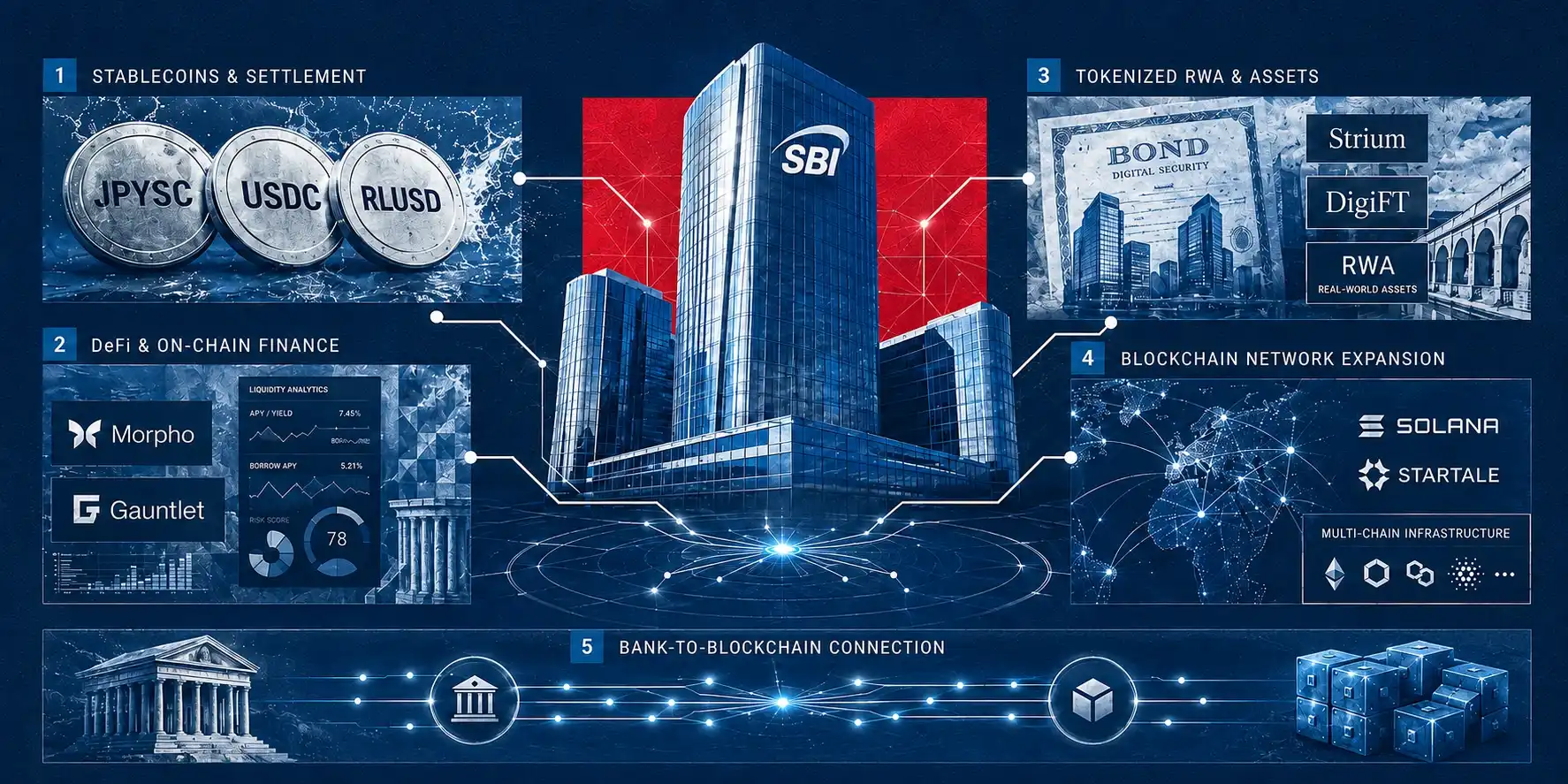
In strategic materials released in May 2026, SBI divided on-chain finance into six layers: settlement, assets, markets, yield vaults, distribution, and investors, proposing the construction of an "SBI On-Chain Asset Management Platform."

According to its plan, JPYSC, USDC, and RLUSD handle settlement and fund transfers; blockchains and RWA platforms host asset issuance and trading; DeFi improves capital efficiency; while the group's internal asset management, securities, and digital asset businesses are responsible for product design and customer outreach.

Judging from recent investments, SBI is strictly following this structure and layering for its layout. In its own strategic materials, SBI categorizes Circle's finance-oriented blockchain Arc under the "settlement layer," Morpho under the "markets layer," and Gauntlet corresponds to the "yield vaults layer."

This classification also reveals SBI's investment rationale—to fill the missing foundational capabilities in its on-chain financial system.
Stablecoins First, Building Yen and Dollar Settlement Networks

In SBI's on-chain finance framework, stablecoins are the first part to enter actual operation.

On June 24, JPYSC, co-developed by SBI and Startale, officially launched. JPYSC is issued by SBI Shinsei Trust Bank, with SBI VC Trade responsible for circulation and Startale handling the primary technical development. As Japan's first trust-structured yen-pegged stablecoin, JPYSC is designed according to the "Type 3 Electronic Payment Instrument" under Japan's Payment Services Act. Reserve assets are managed by the trust bank, with 1 JPYSC pegged to 1 yen.

A key difference brought by the trust structure is that JPYSC is not subject to the 1 million yen remittance and holding limits imposed on "partial fund transfer type" and "overseas-issued" stablecoins. In theory, this makes it more suitable for corporate fund transfers, large-value settlements, RWA transactions, and cross-border payments.

However, JPYSC is still some distance away from open on-chain circulation. Currently, the product is only offered internally within SBI VC Trade accounts; users cannot deposit or withdraw JPYSC to/from external wallets. SBI stated that it will transition to public blockchain circulation only after further clarification of relevant legal interpretations, tax practices, and operational arrangements.

While external transfers are not yet open, SBI has already begun expanding JPYSC's use cases within the platform. SBI VC Trade announced that it would accept applications for JPYSC lending services starting July 16, with the service officially launching on July 23. Users can lend their held JPYSC to the platform and receive yields paid in JPYSC upon maturity; the initial annualized yield is 3%, with the regular rate expected to remain between 1% and 3%.

Beyond the yen stablecoin, dollar stablecoins provide connectivity on the other end.

In March 2025, SBI VC Trade became Japan's first platform to offer USDC trading services to retail users. Since then, SBI's collaboration with Circle has extended from stablecoins to capital and business levels.

In March 2025, the two parties signed an agreement to establish a joint venture, Circle SBI Japan, with SBI and Circle each holding a 50% stake. It is primarily responsible for promoting USDC circulation in Japan and expanding payment and other financial applications. In June of the same year, when Circle was listed on the New York Stock Exchange, the SBI Group purchased $50 million worth of Circle shares as a strategic investor.

In March 2026, SBI VC Trade further launched a USDC lending service, extending stablecoin applications from trading and payments to yield products.

Besides USDC, SBI VC Trade listed RLUSD in June of this year. RLUSD is issued by Ripple's regulated trust company and is treated by SBI as Japan's first "Type 4 Electronic Payment Instrument." Thus, SBI's licensed digital asset platform now simultaneously covers JPYSC, USDC, and RLUSD, forming a product structure with both yen and dollar stablecoins.

The three stablecoins do not play identical roles. JPYSC connects Japan's domestic bank funds and yen-denominated assets; USDC possesses broader global on-chain liquidity; RLUSD continues SBI's decade-long collaboration with Ripple and targets institutional payments and cross-border financial scenarios.

SBI also hopes to further promote cross-currency settlements between JPYSC and dollar stablecoins and explore stablecoin applications in card clearing, cross-border payments, and tokenized asset settlements. The group has already engaged in digital finance cooperation with Visa and tested USDC offline payments.

Bringing Traditional Assets On-Chain, Connecting to Global Markets

Stablecoins address how funds enter the chain; the next step is to bring investable financial assets onto the chain.

At this stage, Startale is becoming a crucial technical partner for SBI. In March of this year, SBI announced an investment of approximately $50 million in Startale and plans to make it an equity-method affiliate. The two parties are currently jointly advancing two core products: the yen stablecoin JPYSC and the Layer 1 network Strium, designed for tokenized securities and RWA trading.

The Strium project was officially announced in February this year. This network plans to support round-the-clock spot and derivatives trading of tokenized stocks, bonds, and RWA-related products, attempting to establish an on-chain market unrestricted by traditional trading hours. Currently, Strium is still in the proof-of-concept phase, with testnet and commercial deployment timelines yet to be formally determined.
SBI also established a joint venture, SBI Onchain, with Singapore-licensed RWA platform DigiFT, with SBI holding a 60% stake. This platform plans to build tokenization, legal, and risk management frameworks around Japanese assets and connect with overseas on-chain capital. SBI's long-term vision is to transform the group's internal securities, funds, and other financial products into on-chain assets, then use stablecoins to complete trading and settlement.

The partnership with Solana on July 13th further supplements this framework. According to the plan, the Solana Foundation will participate in the subsequent development of SBI R3 Japan, which is proposed to be renamed "SBI Solana Global." Business will revolve around stablecoins like JPYSC, RWAs such as corporate bonds and commercial paper, cross-border settlements, institutional on-chain financial services, and AI agent payments.

This collaboration also reflects SBI's move to strengthen a multi-chain approach. The group continues to co-develop Strium, geared towards tokenized financial assets, with Startale, while retaining layouts on XRPL, Canton, and Ethereum; Solana provides a high-performance public chain and a global liquidity gateway. How different networks will divide labor in the future has not been fully disclosed, but SBI has explicitly stated it does not want to bind financial products and customers to a single chain.

From Morpho to Gauntlet, Completing On-Chain Credit and Asset Management

If stablecoins and RWA primarily address "how funds and assets get on-chain," Morpho and Gauntlet correspond to the question: once funds are on-chain, how are lending, allocation, and yield generation accomplished?

In June, SBI participated in Morpho's new funding round, which raised $175 million. This round was co-led by Paradigm, a16z crypto, and Ribbit Capital. Compared to early DeFi lending models where the protocol uniformly set asset and risk parameters, Morpho adopts a modular architecture, allowing institutions and developers to establish isolated lending markets and choose their own collateral, risk conditions, and yield strategies.

SBI categorizes it under the "markets layer" of on-chain finance in its official strategic materials, valuing precisely this credit infrastructure that can be embedded into banks, fintech platforms, and asset management products.

In July, SBI, through its U.S. subsidiary, led Gauntlet's $125 million Series C funding round. Gauntlet was initially known for its DeFi risk models, having provided market parameters, liquidation risk, and stress testing services for multiple lending protocols. In recent years, it has gradually shifted towards yield vault management, designing on-chain allocation strategies based on assets, yield targets, and risk preferences.

Morpho and Gauntlet are highly complementary in their businesses. Morpho provides the underlying credit network for establishing lending markets, while Gauntlet assesses risks, designs vaults, and allocates funds on top of these markets. The former is closer to market infrastructure in on-chain finance, while the latter handles asset management and risk optimization functions.

Through recent intensive deployments, SBI's on-chain finance blueprint has formed a relatively clear outline. The advantage of this structure is that SBI does not need to build all technical modules from scratch. The group can introduce technologies from native on-chain companies through investments and partnerships, then leverage its own financial licenses, customer base, and distribution network to drive adoption.

However, this on-chain financial system is still in the construction phase, with many components some distance away from large-scale implementation. At this stage, SBI has established a relatively complete strategic framework. Still, whether different businesses can form synergies and ultimately transform into a continuously operating on-chain financial system requires time and validation through practical application.


Trend Kriptolar

İlgili Sorular

QWhat are the main components of SBI Holdings' 'on-chain finance' framework as outlined in their 2026 strategy materials?

ASBI's on-chain finance framework is divided into six layers: settlement, assets, markets, yield vaults, distribution, and investors. Key components include stablecoins (JPYSC, USDC, RLUSD) for settlement, blockchain and RWA platforms for asset issuance and trading, DeFi protocols to improve capital efficiency, and their in-house asset management, securities, and digital asset businesses for product design and customer reach.

QWhat is unique about the structure of SBI's JPYSC stablecoin, and what benefits does this structure offer?

AJPYSC is Japan's first trust-type yen stablecoin, structured under the 'Type 3 electronic payment method' of Japan's Payment Services Act. Its reserves are managed by a trust bank, and it is pegged 1:1 to the yen. This structure is significant because it is not subject to the 1 million yen transfer and holding limits imposed on 'partial fund transfer-type' and 'overseas-issued' stablecoins, making it theoretically more suitable for corporate fund transfers, large settlements, RWA transactions, and cross-border payments.

QHow is SBI expanding the use of stablecoins beyond trading and payments?

ASBI is expanding stablecoin use into yield-generating products and services. For example, SBI VC Trade has launched lending services for both JPYSC and USDC. Users can lend their stablecoins to the platform and earn interest paid in the same stablecoin, with JPYSC initially offering a 3% annual yield. This moves stablecoins from mere settlement and payment tools to components of on-chain asset management and earning strategies.

QWhat roles do the platforms Morpho and Gauntlet play in SBI's on-chain finance strategy, and how do they complement each other?

AIn SBI's strategy, Morpho is positioned in the 'market layer' as a modular, institutional-grade lending infrastructure that allows for the creation of isolated lending markets. Gauntlet is positioned in the 'yield vault layer', providing risk modeling, strategy design, and asset management services for on-chain capital. They are complementary: Morpho provides the underlying credit network for building lending markets, while Gauntlet designs risk-optimized yield strategies and manages capital allocation across those markets.

QWhat is the purpose of SBI's strategic partnership with Solana Foundation announced during WebX?

AThe partnership with Solana Foundation, through the entity to be renamed 'SBI Solana Global', aims to develop business around several key areas: stablecoins (like JPYSC), real-world assets (RWA) such as corporate bonds and commercial paper, cross-border settlements, on-chain financial services for institutions, and AI agent payments. This collaboration strengthens SBI's multi-chain approach, leveraging Solana's high-performance public blockchain and global liquidity to complement its other blockchain initiatives like the Strium network being developed with Startale.

İlgili Okumalar

Founder of Real Vision: We Are Living in the Era of Exponential Growth

Real Vision founder Raoul Pal argues that humanity is now in an "Age of Exponential Growth," a reality the human brain's linear intuition struggles to comprehend. The core drivers are the convergence of multiple, mutually-reinforcing technological curves: Artificial Intelligence, robotics, solar & storage, biotechnology, and blockchain networks. He notes that while his 2021 analysis correctly identified fiat currency debasement and assets like Bitcoin as inflation hedges, he underestimated the scale of change. Beyond monetary liquidity, a more profound force is at work: these key technologies have moved from theoretical promise into simultaneous, accelerating commercialization. They are no longer growing in parallel but are fusing, creating a "double exponential" growth curve. AI and robotics create an "artificial labor supply," breaking the cycle of debt-driven growth needed to offset aging demographics. Energy, particularly solar power guided by Wright's Law, is seeing collapsing costs, removing a key bottleneck for compute-hungry AI. Cryptocurrencies are evolving from monetary assets into the essential, programmable settlement layer for transactions between future AI agents. This fusion creates a feedback loop: AI optimizes energy grids, cheaper energy powers more compute, which builds better AI, and crypto networks settle the transactions. This leads to "Reed's Law" playing out at scale, where intelligent nodes (AI agents) form and re-form groups at machine speed, creating network value that grows at 2^n. Pal concludes that the critical question is no longer how to protect jobs from machines, but how to own a share of the machines and their foundational infrastructure. He sees the 2030-2032 period as a potential "Economic Singularity" where these trends fully merge, fundamentally transforming the economy. The data, he asserts, shows this is not a bubble but an observable, quantifiable new era.

Foresight News18 dk önce

Founder of Real Vision: We Are Living in the Era of Exponential Growth

Foresight News18 dk önce

Golden Age VS Crisis Era? Bank of Korea Set to Hike Rates, Brokerage Margin Requirements May Increase 5-Fold

South Korea's financial authorities are taking coordinated action to cool an overheated and volatile stock market. The Bank of Korea is widely expected to raise its benchmark interest rate by 25 basis points to 2.75% on Thursday, which would be its first hike in approximately three and a half years since January 2023. Analysts predict further increases, potentially bringing the rate to 3.00% by year-end. This move aims to tighten market liquidity, raising costs for leveraged investments. Concurrently, major Korean brokerages have agreed to raise the minimum investment requirement for single-stock leveraged ETFs fivefold, from 10 million won to 50 million won, to curb excessive retail speculation. This follows extreme market swings focused on major chip stocks like Samsung Electronics and SK Hynix, which together account for nearly half of the KOSPI index's weight. The index itself has seen a dramatic 204% surge from its recent low. President Yoon Suk Yeol acknowledged market instability and urged regulators to address risks from leveraged products. Meanwhile, financial watchdogs are imposing new limits on stock-backed loans to individual investors to prevent bubble formation. These measures come as foreign investors have been massive net sellers this year, offloading a record $110 billion in assets, while domestic retail investors, using significant leverage, have been the primary buyers, absorbing the sales pressure. The government's multi-pronged strategy seeks to stabilize the market by restricting leverage, raising barriers, and tightening monetary policy.

Odaily星球日报27 dk önce

Golden Age VS Crisis Era? Bank of Korea Set to Hike Rates, Brokerage Margin Requirements May Increase 5-Fold

Odaily星球日报27 dk önce

From Being Ignored to the Venture Capital Queen Investing: Has AI Revived This Ultra-Niche Sector?

From obscurity to receiving investment from the "queen of venture capital," AI has revitalized the ultra-niche social networking track. In recent years, the social networking sector experienced a deep freeze in venture capital, with high-profile projects like the video social app "Huayin" (founded by a former WeChat core team member) and the offline-online dating app "Single's Tavern" ultimately failing. These failures underscored the immense difficulty of challenging WeChat's dominance in熟人社交 (close-contact social networking) and the general lack of scalable monetization paths for niche concepts like metaverse, female-only, or Muslim community apps. However, a shift emerged in 2025. "Liangpei," an AI-powered matchmaking company, secured a $2 million angel round from Today Capital, led by renowned investor Xu Xin. Its approach uses AI conversational profiling to create detailed user matches and charges only upon successful connections. Similarly, projects like "Pixel Rhythm" (reportedly focused on AI-assisted content creation for Gen Z overseas) and "Moobius" (AI-native group chat) signal a new trend. The investment logic has fundamentally changed. Instead of pursuing broad, traffic-driven "platform dreams" to compete with giants like WeChat, Douyin, or Soul, the new wave focuses on using AI as a tool to solve specific, high-pain-point problems for targeted, niche user segments. The path to viability now lies in achieving healthy cash flow by solving a concrete problem rather than chasing massive scale.

marsbit1 saat önce

From Being Ignored to the Venture Capital Queen Investing: Has AI Revived This Ultra-Niche Sector?

marsbit1 saat önce

İşlemler

Spot

Popüler Makaleler

$S$ Nedir

SPERO'yu Anlamak: Kapsamlı Bir Genel Bakış SPERO'ya Giriş İnovasyonun manzarası gelişmeye devam ederken, web3 teknolojilerinin ve kripto para projelerinin ortaya çıkışı dijital geleceği şekillendirmede önemli bir rol oynamaktadır. Bu dinamik alanda dikkat çeken projelerden biri SPERO, $$s$$ olarak adlandırılmaktadır. Bu makale, SPERO hakkında ayrıntılı bilgi toplamak ve sunmak amacıyla, meraklılar ve yatırımcıların web3 ve kripto alanlarındaki temellerini, hedeflerini ve yeniliklerini anlamalarına yardımcı olmayı amaçlamaktadır. SPERO,$$s$$ Nedir? SPERO,$$s$$, kripto alanında merkeziyetsizlik ve blok zinciri teknolojisi ilkelerini kullanarak etkileşimi, faydayı ve finansal kapsayıcılığı teşvik eden bir ekosistem yaratmayı amaçlayan benzersiz bir projedir. Proje, kullanıcıların yenilikçi finansal çözümler ve hizmetler sunarak eşler arası etkileşimleri yeni yollarla kolaylaştırmayı hedeflemektedir. SPERO,$$s$$'nin temel amacı, bireyleri güçlendirmek ve kripto para alanındaki kullanıcı deneyimini artıran araçlar ve platformlar sağlamaktır. Bu, daha esnek işlem yöntemlerini mümkün kılmayı, topluluk odaklı girişimleri teşvik etmeyi ve merkeziyetsiz uygulamalar (dApp'ler) aracılığıyla finansal fırsatlar yaratmayı içermektedir. SPERO,$$s$$'nin temel vizyonu kapsayıcılık etrafında dönmekte olup, geleneksel finansal sistemlerdeki boşlukları kapatmayı ve blok zinciri teknolojisinin faydalarından yararlanmayı hedeflemektedir. SPERO,$$s$$'nin Yaratıcısı Kimdir? SPERO,$$s$$'nin yaratıcısının kimliği bir miktar belirsizdir, çünkü kurucusu(ları) hakkında ayrıntılı arka plan bilgisi sağlayan sınırlı kamuya açık kaynaklar bulunmaktadır. Bu şeffaflık eksikliği, projenin merkeziyetsizlik taahhüdünden kaynaklanabilir—birçok web3 projesinin paylaştığı bir etik anlayışı, bireysel tanınmanın yerine kolektif katkıları önceliklendirmektedir. Topluluk ve onun kolektif hedefleri etrafında tartışmaları merkezileştirerek, SPERO,$$s$$, belirli bireyleri öne çıkarmadan güçlendirme özünü taşımaktadır. Bu nedenle, SPERO'nun etik anlayışını ve misyonunu anlamak, tek bir yaratıcının kimliğini belirlemekten daha önemlidir. SPERO,$$s$$'nin Yatırımcıları Kimlerdir? SPERO,$$s$$, kripto sektöründe yeniliği teşvik etmeye adanmış girişim sermayedarlarından melek yatırımcılara kadar çeşitli yatırımcılar tarafından desteklenmektedir. Bu yatırımcıların odak noktası genellikle SPERO'nun misyonuyla uyumlu olup, toplumsal teknolojik ilerlemeyi, finansal kapsayıcılığı ve merkeziyetsiz yönetimi vaat eden projeleri önceliklendirmektedir. Bu yatırımcı temelleri, yalnızca yenilikçi ürünler sunan projelere değil, aynı zamanda blok zinciri topluluğuna ve ekosistemlerine olumlu katkılarda bulunan projelere de ilgi duymaktadır. Bu yatırımcıların desteği, SPERO,$$s$$'yi hızla gelişen kripto projeleri alanında dikkate değer bir rakip haline getirmektedir. SPERO,$$s$$ Nasıl Çalışır? SPERO,$$s$$, onu geleneksel kripto para projelerinden ayıran çok yönlü bir çerçeve kullanmaktadır. İşte benzersizliğini ve yeniliğini vurgulayan bazı temel özellikler: Merkeziyetsiz Yönetim: SPERO,$$s$$, kullanıcıların projenin geleceğiyle ilgili karar alma süreçlerine aktif olarak katılmalarını sağlayan merkeziyetsiz yönetim modellerini entegre etmektedir. Bu yaklaşım, topluluk üyeleri arasında sahiplik ve hesap verebilirlik duygusunu teşvik etmektedir. Token Kullanımı: SPERO,$$s$$, ekosistem içinde çeşitli işlevler sunmak üzere tasarlanmış kendi kripto para token'ını kullanmaktadır. Bu token'lar, işlemleri, ödülleri ve platformda sunulan hizmetlerin kolaylaştırılmasını sağlayarak genel etkileşimi ve faydayı artırmaktadır. Katmanlı Mimari: SPERO,$$s$$'nin teknik mimarisi, modülerlik ve ölçeklenebilirliği destekleyerek projenin evrimi sırasında ek özelliklerin ve uygulamaların sorunsuz bir şekilde entegrasyonuna olanak tanımaktadır. Bu uyum sağlama yeteneği, sürekli değişen kripto manzarasında geçerliliği sürdürmek için hayati öneme sahiptir. Topluluk Katılımı: Proje, işbirliği ve geri bildirim teşvik eden mekanizmalar kullanarak topluluk odaklı girişimlere vurgu yapmaktadır. Güçlü bir topluluk oluşturarak, SPERO,$$s$$, kullanıcı ihtiyaçlarını daha iyi karşılayabilir ve piyasa trendlerine uyum sağlayabilir. Kapsayıcılığa Odaklanma: Düşük işlem ücretleri ve kullanıcı dostu arayüzler sunarak, SPERO,$$s$$, daha önce kripto alanında yer almamış bireyler de dahil olmak üzere çeşitli bir kullanıcı tabanını çekmeyi hedeflemektedir. Bu kapsayıcılık taahhüdü, erişilebilirlik yoluyla güçlendirme misyonuyla uyumludur. SPERO,$$s$$ Zaman Çizelgesi Bir projenin tarihini anlamak, gelişim yolculuğu ve kilometre taşları hakkında kritik bilgiler sağlar. Aşağıda, SPERO,$$s$$'nin evriminde önemli olayları haritalayan önerilen bir zaman çizelgesi bulunmaktadır: Kavram Geliştirme ve Fikir Aşaması: SPERO,$$s$$'nin temelini oluşturan ilk fikirler, blok zinciri endüstrisindeki merkeziyetsizlik ve topluluk odaklılık ilkeleriyle yakından uyumlu olarak geliştirildi. Proje Beyaz Kağıdının Yayınlanması: Kavramsal aşamayı takiben, SPERO,$$s$$'nin vizyonunu, hedeflerini ve teknolojik altyapısını ayrıntılı bir şekilde açıklayan kapsamlı bir beyaz kağıt yayımlandı ve topluluk ilgisini ve geri bildirimini toplamak amacıyla sunuldu. Topluluk Oluşturma ve Erken Katılımlar: Projenin hedefleri etrafında tartışmalar yürüterek destek toplamak ve erken benimseyenler ile potansiyel yatırımcılar için bir topluluk oluşturmak amacıyla aktif iletişim çabaları gerçekleştirildi. Token Üretim Etkinliği: SPERO,$$s$$, yerel token'larını erken destekçilere dağıtmak ve ekosistem içinde başlangıç likiditesini sağlamak amacıyla bir token üretim etkinliği (TGE) gerçekleştirdi. İlk dApp'in Yayınlanması: SPERO,$$s$$ ile ilişkili ilk merkeziyetsiz uygulama (dApp) faaliyete geçti ve kullanıcıların platformun temel işlevleriyle etkileşimde bulunmalarını sağladı. Sürekli Gelişim ve Ortaklıklar: Projenin tekliflerine sürekli güncellemeler ve iyileştirmeler yapılmakta olup, blok zinciri alanındaki diğer oyuncularla stratejik ortaklıklar, SPERO,$$s$$'yi rekabetçi ve gelişen bir oyuncu haline getirmiştir. Sonuç SPERO,$$s$$, web3 ve kripto paranın finansal sistemleri devrim niteliğinde dönüştürme ve bireyleri güçlendirme potansiyelinin bir kanıtıdır. Merkeziyetsiz yönetime, topluluk katılımına ve yenilikçi tasarlanmış işlevselliğe olan bağlılığıyla, daha kapsayıcı bir finansal manzaraya doğru bir yol açmaktadır. Hızla gelişen kripto alanındaki herhangi bir yatırımda olduğu gibi, potansiyel yatırımcılar ve kullanıcılar, SPERO,$$s$$ içindeki devam eden gelişmelerle ilgili olarak kapsamlı bir araştırma yapmaları ve düşünceli bir şekilde katılmaları teşvik edilmektedir. Proje, kripto endüstrisinin yenilikçi ruhunu sergileyerek, sayısız olasılığını keşfetmeye davet etmektedir. SPERO,$$s$$'nin yolculuğu hala devam ederken, temel ilkeleri, teknoloji, finans ve birbirimizle etkileşim biçimimizi etkileyebilir.

181 Toplam GörüntülenmeYayınlanma 2024.12.17Güncellenme 2024.12.17

$S$ Nedir

AGENT S Nedir

Agent S: Web3'te Otonom Etkileşimin Geleceği Giriş Web3 ve kripto para dünyasında sürekli gelişen manzarada, yenilikler bireylerin dijital platformlarla etkileşim biçimlerini sürekli olarak yeniden tanımlıyor. Bu tür öncü projelerden biri olan Agent S, açık ajans çerçevesi aracılığıyla insan-bilgisayar etkileşimini devrim niteliğinde değiştirmeyi vaat ediyor. Otonom etkileşimlerin yolunu açarak, Agent S karmaşık görevleri basitleştirmeyi ve yapay zeka (AI) alanında dönüştürücü uygulamalar sunmayı hedefliyor. Bu detaylı inceleme, projenin karmaşıklıklarına, benzersiz özelliklerine ve kripto para alanındaki etkilerine dalacaktır. Agent S Nedir? Agent S, bilgisayar görevlerinin otomasyonunda üç temel zorluğu ele almak üzere özel olarak tasarlanmış çığır açıcı bir açık ajans çerçevesidir: Alan Spesifik Bilgi Edinimi: Çerçeve, çeşitli dış bilgi kaynaklarından ve iç deneyimlerden akıllıca öğrenir. Bu çift yönlü yaklaşım, alan spesifik bilgi açısından zengin bir veri havuzu oluşturmasını sağlar ve görev yürütmedeki performansını artırır. Uzun Görev Ufukları Üzerinde Planlama: Agent S, karmaşık görevlerin verimli bir şekilde parçalanmasını ve yürütülmesini kolaylaştıran deneyim artırımlı hiyerarşik planlama kullanır. Bu özellik, çoklu alt görevleri etkili ve verimli bir şekilde yönetme yeteneğini önemli ölçüde artırır. Dinamik, Homojen Olmayan Arayüzlerle Başlama: Proje, ajanlar ve kullanıcılar arasındaki etkileşimi geliştiren yenilikçi bir çözüm olan Ajan-Bilgisayar Arayüzü'ni (ACI) tanıtmaktadır. Çok Modlu Büyük Dil Modellerini (MLLM'ler) kullanarak, Agent S çeşitli grafik kullanıcı arayüzlerini sorunsuz bir şekilde gezinebilir ve manipüle edebilir. Bu öncü özellikler aracılığıyla, Agent S, makinelerle insan etkileşimini otomatikleştirmede karşılaşılan karmaşıklıkları ele alan sağlam bir çerçeve sunarak, AI ve ötesinde birçok uygulama için zemin hazırlıyor. Agent S'nin Yaratıcısı Kimdir? Agent S'nin kavramı temelde yenilikçi olsa da, yaratıcısı hakkında spesifik bilgiler belirsizliğini koruyor. Yaratıcı şu anda bilinmiyor, bu da projenin yeni aşamasını veya kurucu üyeleri gizli tutma stratejik tercihini vurguluyor. Anonimlikten bağımsız olarak, odak çerçevenin yetenekleri ve potansiyeli üzerinde kalıyor. Agent S'nin Yatırımcıları Kimlerdir? Agent S, kriptografik ekosistemde oldukça yeni olduğundan, yatırımcıları ve finansal destekçileri hakkında ayrıntılı bilgiler açıkça belgelenmemiştir. Projeyi destekleyen yatırım temelleri veya organizasyonları hakkında kamuya açık bilgilerdeki eksiklik, finansman yapısı ve gelişim yol haritası hakkında sorular doğuruyor. Destekleyicilerin anlaşılması, projenin sürdürülebilirliğini ve potansiyel pazar etkisini değerlendirmek için kritik öneme sahiptir. Agent S Nasıl Çalışır? Agent S'nin temelinde, çeşitli ortamlarda etkili bir şekilde çalışmasını sağlayan son teknoloji bir sistem yatmaktadır. İşleyiş modeli birkaç ana özellik etrafında inşa edilmiştir: İnsan Benzeri Bilgisayar Etkileşimi: Çerçeve, bilgisayarlarla etkileşimleri daha sezgisel hale getirmeyi amaçlayan gelişmiş AI planlaması sunar. Görev yürütmedeki insan davranışını taklit ederek, kullanıcı deneyimlerini yükseltmeyi vaat eder. Anlatı Belleği: Yüksek düzeyde deneyimlerden yararlanmak için kullanılan Agent S, görev geçmişlerini takip etmek amacıyla anlatı belleğini kullanarak karar verme süreçlerini geliştirir. Episodik Bellek: Bu özellik, kullanıcılara adım adım rehberlik sağlayarak, çerçevenin görevler gelişirken bağlamsal destek sunmasına olanak tanır. OpenACI Desteği: Yerel olarak çalışabilme yeteneği ile Agent S, kullanıcıların etkileşimleri ve iş akışları üzerinde kontrol sağlamasına olanak tanır ve Web3'ün merkeziyetsiz felsefesiyle uyumlu hale gelir. Dış API'lerle Kolay Entegrasyon: Çeşitli AI platformlarıyla uyumluluğu ve çok yönlülüğü, Agent S'nin mevcut teknolojik ekosistemlere sorunsuz bir şekilde entegre olmasını sağlar ve geliştiriciler ile organizasyonlar için cazip bir seçenek haline getirir. Bu işlevsellikler, Agent S'nin kripto alanındaki benzersiz konumuna katkıda bulunarak, karmaşık, çok aşamalı görevleri minimum insan müdahalesi ile otomatikleştirir. Proje geliştikçe, Web3'teki potansiyel uygulamaları dijital etkileşimlerin nasıl gelişeceğini yeniden tanımlayabilir. Agent S'nin Zaman Çizelgesi Agent S'nin gelişimi ve kilometre taşları, önemli olaylarını vurgulayan bir zaman çizelgesinde özetlenebilir: 27 Eylül 2024: Agent S'nin kavramı, “Bilgisayarları İnsan Gibi Kullanan Açık Bir Ajans Çerçevesi” başlıklı kapsamlı bir araştırma makalesi ile tanıtıldı ve projenin temelini sergiledi. 10 Ekim 2024: Araştırma makalesi arXiv'de kamuya açık olarak yayınlandı ve çerçevenin derinlemesine bir incelemesini ve OSWorld benchmark'ına dayalı performans değerlendirmesini sundu. 12 Ekim 2024: Agent S'nin yetenekleri ve özellikleri hakkında görsel bir içgörü sağlayan bir video sunumu yayımlandı ve potansiyel kullanıcılar ve yatırımcılarla daha fazla etkileşim sağlandı. Bu zaman çizelgesindeki işaretler, sadece Agent S'nin ilerlemesini değil, aynı zamanda şeffaflık ve topluluk katılımına olan bağlılığını da göstermektedir. Agent S Hakkında Ana Noktalar Agent S çerçevesi gelişmeye devam ederken, birkaç ana özellik öne çıkmakta ve yenilikçi doğasını ve potansiyelini vurgulamaktadır: Yenilikçi Çerçeve: İnsan etkileşimine benzer bir bilgisayar kullanımı sağlamak üzere tasarlanan Agent S, görev otomasyonuna yeni bir yaklaşım getiriyor. Otonom Etkileşim: GUI aracılığıyla bilgisayarlarla otonom olarak etkileşim kurabilme yeteneği, daha akıllı ve verimli hesaplama çözümlerine doğru bir sıçrama anlamına geliyor. Karmaşık Görev Otomasyonu: Sağlam metodolojisi ile karmaşık, çok aşamalı görevleri otomatikleştirerek süreçleri daha hızlı ve daha az hata payı ile gerçekleştirebilir. Sürekli İyileştirme: Öğrenme mekanizmaları, Agent S'nin geçmiş deneyimlerden öğrenmesini sağlar ve sürekli olarak performansını ve etkinliğini artırır. Çok Yönlülük: OSWorld ve WindowsAgentArena gibi farklı işletim ortamlarında uyumlu olması, geniş bir uygulama yelpazesine hizmet edebilmesini sağlar. Agent S, Web3 ve kripto alanında kendini konumlandırırken, etkileşim yeteneklerini artırma ve süreçleri otomatikleştirme potansiyeli, AI teknolojilerinde önemli bir ilerlemeyi temsil etmektedir. Yenilikçi çerçevesi aracılığıyla, Agent S dijital etkileşimlerin geleceğini örneklemekte ve çeşitli sektörlerde kullanıcılar için daha sorunsuz ve verimli bir deneyim vaat etmektedir. Sonuç Agent S, AI ve Web3'ün birleşiminde cesur bir sıçramayı temsil ediyor ve teknoloji ile etkileşim biçimimizi yeniden tanımlama kapasitesine sahip. Henüz erken aşamalarında olmasına rağmen, uygulama olanakları geniş ve çekici. Kritik zorlukları ele alan kapsamlı çerçevesi ile Agent S, otonom etkileşimleri dijital deneyimin ön plana çıkmasına taşımayı hedefliyor. Kripto para ve merkeziyetsizlik alanlarına daha derinlemesine girdikçe, Agent S gibi projelerin teknoloji ve insan-bilgisayar işbirliğinin geleceğini şekillendirmede önemli bir rol oynayacağı kesin.

658 Toplam GörüntülenmeYayınlanma 2025.01.14Güncellenme 2025.01.14

AGENT S Nedir

S Nasıl Satın Alınır

HTX.com’a hoş geldiniz! Sonic (S) satın alma işlemlerini basit ve kullanışlı bir hâle getirdik. Adım adım açıkladığımız rehberimizi takip ederek kripto yolculuğunuza başlayın. 1. Adım: HTX Hesabınızı OluşturunHTX'te ücretsiz bir hesap açmak için e-posta adresinizi veya telefon numaranızı kullanın. Sorunsuzca kaydolun ve tüm özelliklerin kilidini açın. Hesabımı Aç2. Adım: Kripto Satın Al Bölümüne Gidin ve Ödeme Yönteminizi SeçinKredi/Banka Kartı: Visa veya Mastercard'ınızı kullanarak anında Sonic (S) satın alın.Bakiye: Sorunsuz bir şekilde işlem yapmak için HTX hesap bakiyenizdeki fonları kullanın.Üçüncü Taraflar: Kullanımı kolaylaştırmak için Google Pay ve Apple Pay gibi popüler ödeme yöntemlerini ekledik.P2P: HTX'teki diğer kullanıcılarla doğrudan işlem yapın.Borsa Dışı (OTC): Yatırımcılar için kişiye özel hizmetler ve rekabetçi döviz kurları sunuyoruz.3. Adım: Sonic (S) Varlıklarınızı SaklayınSonic (S) satın aldıktan sonra HTX hesabınızda saklayın. Alternatif olarak, blok zinciri transferi yoluyla başka bir yere gönderebilir veya diğer kripto para birimlerini takas etmek için kullanabilirsiniz.4. Adım: Sonic (S) Varlıklarınızla İşlem YapınHTX'in spot piyasasında Sonic (S) ile kolayca işlemler yapın.Hesabınıza erişin, işlem çiftinizi seçin, işlemlerinizi gerçekleştirin ve gerçek zamanlı olarak izleyin. Hem yeni başlayanlar hem de deneyimli yatırımcılar için kullanıcı dostu bir deneyim sunuyoruz.

1.7k Toplam GörüntülenmeYayınlanma 2025.01.15Güncellenme 2026.06.02

S Nasıl Satın Alınır

Tartışmalar

HTX Topluluğuna hoş geldiniz. Burada, en son platform gelişmeleri hakkında bilgi sahibi olabilir ve profesyonel piyasa görüşlerine erişebilirsiniz. Kullanıcıların S (S) fiyatı hakkındaki görüşleri aşağıda sunulmaktadır.

活动图片