A Hard-Fought Battle to Defend Par Value: STRC Drifts Further Away from $100

Foresight News2026-06-25 tarihinde yayınlandı2026-06-25 tarihinde güncellendi

Özet

STRC, the dividend-paying stock issued by Michael Saylor's bitcoin reserve firm Strategy (formerly MicroStrategy), is trading far below its intended $100 par value, closing recently at $80.84. With a key dividend snapshot date approaching, Saylor aims to pull the price back to $100, as per SEC filings stating the company's goal to stabilize the stock near that level. The situation is complicated by the June volume-weighted average price (VWAP) falling below $95, triggering an internal rule that mandates the next dividend increase to be at least double the standard 0.25% per cycle, potentially pushing the annualized dividend yield to 12%. However, attracting buyers with this higher yield faces challenges: the payout is spread over 24 bi-monthly installments, the board can alter or suspend dividends at any time, and there is no guarantee against further price declines. Beyond raising dividends, Strategy has limited tools to boost the stock. These include direct share buybacks (never utilized), halting new share issuances above $100 (which currently cap the price), selling ordinary MSTR shares to build a cash buffer for dividends (with limited effect so far), or announcing special shareholder benefits. Historically, STRC has reclaimed the $100 mark, such as in October last year, driven by a combination of dividend fulfillment, a rate hike, and a pause in share sales. The core question remains how much cost and effort Strategy is willing to bear to attract the necessary buying ...


Written by: Protos

Compiled by: Chopper, Foresight News


STRC is a dividend-paying stock issued by Strategy (formerly MicroStrategy), the Bitcoin reserve company led by Michael Saylor. Its latest closing price has fallen to $80.84.


That number was supposed to be $100.
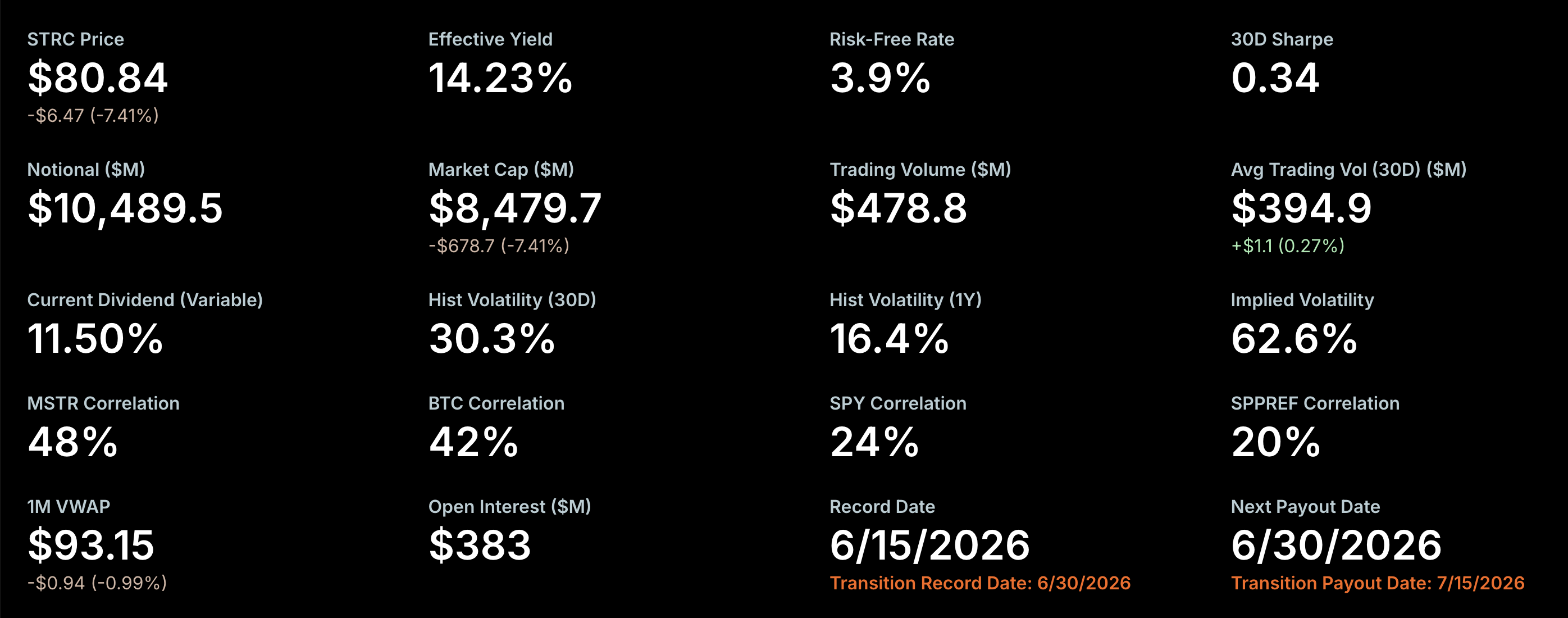

STRC Price Panel, Source: Strategy Website


Saylor places great importance on STRC maintaining a trading price at its $100 par value. With just one week left until the dividend snapshot date, he hopes to pull the stock price back to the $100 mark before then.


The company's filing with the U.S. Securities and Exchange Commission (SEC) clearly states: Strategy "aims to stabilize the trading price of STRC shares near the par value of $100 per share."


But the reality is, the current stock price is at a discount of about 20% to its par value.


More critically, the company's data panel reveals another severe crisis: As of yesterday's Nasdaq close, STRC's June monthly Volume-Weighted Average Price (VWAP) was $94.09, falling below the company's set red line of $95. According to internal rules, once this threshold is triggered, the dividend increase must be at least double the regular standard.


Based on the internal dividend mechanism, if the final June monthly VWAP closes below $95, the next STRC dividend increase cannot be lower than 0.5%. Under normal circumstances, since its listing, STRC's dividend increase per dividend registration cycle has been only 0.25%.


This means if secondary market funds do not actively enter to boost the stock price, the current 11.5% annualized dividend yield will most likely be raised to 12% in the next dividend registration cycle in mid-July. If Strategy's board wants to adopt a more aggressive strategy, their rules allow them to grant a higher increase at their discretion.



Can a 12% High Dividend Pull the Stock Price Back to $100?


Even if a 12% ultra-high dividend has the potential to attract buying interest, the current stock price of around $80 still has a huge gap to reach $100.


First, investors need to hold the stock for an entire year to receive this expected 12% dividend, and the dividend will be split into 24 bi-monthly capital return payments, each distributing only 0.5%. Second, the board can lower the dividend standard at any time during the year.


Furthermore, the STRC stock price itself still carries the risk of continued decline.


Ultimately, investing in STRC relies entirely on market expectations, with no guaranteed returns. The company's board can modify or suspend the dividend policy at any time, and this so-called "standardized dividend mechanism" has no legal binding force. The company's public disclosure documents repeatedly caution: cash dividends are not promised and there is a possibility of sudden reductions or direct suspension; meanwhile, the company provides no guarantee for the secondary market price of STRC, and the stock's current performance remains persistently weak.


Four Other Feasible Means to Boost the Stock Price


Apart from significantly raising the dividend, Strategy has four other tools to restore market confidence, but their implementation is relatively unlikely and their effectiveness limited.


First, the company could directly repurchase STRC shares in the secondary market.


Rules allow the company to buy back its own shares on the Nasdaq exchange, but it has never conducted repurchase operations, nor has it indicated any intention to do so. On the contrary, the original purpose of Strategy issuing STRC was to sell shares to raise funds and increase Bitcoin holdings, not to support the stock price through buybacks.


Second, Strategy might announce a suspension of issuing STRC at prices above $100.


Strategy's supplemental filing from last November shows plans to continuously issue new STRC in the range of $99 to $101, with the actual issuance price basically locked at $100.01. Continuous issuance dilutes the float, essentially placing a natural ceiling on the stock price, as speculative buying interest weakens significantly when the price approaches $100. If the company suddenly announced a halt to dilutive issuances around $100.01, this unexpected move might temporarily boost market sentiment.


Third, the company could signal long-term stable dividend-paying capability to the market by selling ordinary shares and continuously accumulating US dollar cash.


In recent weeks, Strategy has already used this method, selling MSTR ordinary shares and adding hundreds of millions of dollars to its cash buffer, but with little effect. Currently, the company's dollar reserves are only $1.4 billion, a scale insufficient to reassure STRC shareholders to hold on.


Fourth, Strategy might announce a benefit that surprises STRC shareholders.


A public company's board has the authority to distribute one-time special dividends or shareholder perks, creating positive surprises. For example, company CEO Phong Le purchased $1 million worth of STRC this week. Although the amount is negligible compared to his annual compensation, it still counts as a small positive signal. If the board introduced more creative shareholder benefits, it might reverse the current bearish market sentiment.


Historically, STRC has also rebounded against the trend and stabilized above $100. According to a Protos report last October, at that time, the company fully delivered dividends, raised the dividend to 10.25%, and suspended selling STRC through the ATM issuance channel since July. Multiple positive factors resonated, pushing the stock price back to $100 for the first time. Before that dividend registration date, many investors were willing to enter at $100.


Judging from its historical performance, STRC has the full potential to return to $100. The only question is: How much cost is Strategy willing to bear to attract funds to buy in?


İlgili Sorular

QWhat is the current trading price of STRC, and how does it compare to its intended par value?

AThe current closing price of STRC is $80.84, which is approximately 20% below its intended par value of $100.

QWhat is the consequence for STRC's dividend if the June Volume Weighted Average Price (VWAP) falls below $95?

AIf the June monthly VWAP falls below $95, the next dividend increase for STRC must be at least 0.5%, which is double the standard increase of 0.25% per dividend registration cycle.

QWhat are the four potential methods mentioned for Strategy to boost confidence in STRC's price?

AThe four methods are: 1. Directly repurchasing STRC shares in the secondary market. 2. Announcing a pause in issuing new STRC shares above $100. 3. Selling common shares (MSTR) to accumulate cash and signal stable dividend capacity. 4. Announcing a special surprise benefit for STRC shareholders, like a one-time special dividend.

QWhat is a key risk associated with investing in STRC, according to the company's disclosures?

AA key risk is that the dividend policy is not guaranteed. The company's board can modify, suspend, or stop the dividend policy at any time, and there is no legal guarantee for the standardized dividend mechanism or any price support for STRC's secondary market value.

QHas STRC ever traded at its $100 par value before, and what contributed to that achievement?

AYes, STRC returned to and held the $100 price level in the past. According to a Protos report from October of last year, this was achieved by the company fully delivering on dividends, raising the dividend to 10.25%, and pausing sales of STRC shares through its ATM (At-The-Market) offering channel starting in July.

İlgili Okumalar

Tidal Investment: We Remain Bullish on the AI Industry Chain, But for Different Reasons Now

Tidal Investments remains optimistic about the AI industry chain, but the rationale has shifted. The market is concerned about massive concurrent fundraising by tech giants like SpaceX, OpenAI, Alphabet, and Meta, fearing an AI peak. However, the authors argue this signals the next act of AI development, not its end. Capital expenditure (Capex) from major cloud providers (Alphabet, Amazon, Meta, Microsoft, Oracle) continues to surge aggressively into 2026. This investment cycle is more resilient than past hardware cycles due to its scale and complexity. Bottlenecks have shifted from chips to critical physical infrastructure like power grids, transformers, cooling, and data center construction—areas with long lead times and limited capacity for rapid expansion. Supply chain data (e.g., Eaton's orders) confirms substantial, tangible progress. Key market concerns are addressed: 1. **ROI vs. Capex Growth**: While Capex growth outpaces revenue, the authors note cloud giants have historically overcome similar phases through scale. The cycle will only be in danger if Capex guidance is cut, orders are canceled, or AI product demand falters—none of which are currently observed. 2. **Comparison to the 2000 Dot-com Bubble**: Unlike the telecom bubble, where cheap, oversupplied fiber crashed prices, AI infrastructure (especially power) is constrained, customized, and subject to lengthy approvals, making a similar supply glut and crash unlikely. In conclusion, the wave of fundraising reflects the immense, ongoing capital needs for AI's next phase, constrained by slow-moving physical bottlenecks. The AI cycle is not over; the script has simply changed.

链捕手7 dk önce

Tidal Investment: We Remain Bullish on the AI Industry Chain, But for Different Reasons Now

链捕手7 dk önce

Grayscale: These 15 Profitable Crypto Protocols Are Severely Undervalued

Grayscale Research identifies 15 top-revenue crypto protocols trading at significant valuation discounts, with many at single-digit or even 1x revenue multiples. Protocols like Pump.fun, PancakeSwap, and Meteora have market capitalizations roughly equal to their annual revenue. The report argues these financially-focused protocols (DEXs, lending, staking) are fundamentally undervalued and could benefit from the potential passage of the CLARITY Act, expected as soon as next month. This legislation aims to clarify digital asset regulation, potentially reducing institutional barriers and driving on-chain activity. The analysis breaks down the protocols into three groups: the "1x Club" (market cap ≈ revenue), mid-tier protocols with 3-9x multiples (e.g., Aave, Lido, Jupiter), and high-multiple protocols like Hyperliquid (15x) and Uniswap (37x), where valuation reflects future potential rather than current cash flows. Grayscale applies a traditional DCF model to Aave, suggesting a one-year price target of ~$175, representing ~130% upside from current levels. The report notes a risk-off macro environment since the Iran conflict has further compressed valuations, creating a potential entry window. The conclusion highlights that while the valuation data presents an intriguing opportunity, the investment thesis is contingent on the CLARITY Act's passage and subsequent institutional capital flows. Investors are cautioned to consider Grayscale's inherent conflict of interest as a crypto asset manager with products tied to these assets.

marsbit35 dk önce

Grayscale: These 15 Profitable Crypto Protocols Are Severely Undervalued

marsbit35 dk önce

Sam Altman's Personal Alchemy of Wealth: Investing in 400 Companies, Over 10 Deeply Tied to OpenAI

The article investigates Sam Altman's personal wealth strategy, centered around his investments in approximately 400 companies while serving as OpenAI's CEO. Despite not holding direct equity in OpenAI, Altman has built a vast portfolio, with at least 10 of his investments having commercial ties or ongoing negotiations with OpenAI. This creates a complex network of potential conflicts of interest, drawing scrutiny from U.S. congressional committees and state attorneys general. Key investments highlighted include the anti-aging startup Retro Biosciences (valued at $258 million for his stake as of late last year) and the chipmaker Cerebras, whose value soared following an OpenAI procurement deal. His most significant financial gain is linked to the nuclear fusion company Helion, where a recent funding round reportedly increased his stake's value to at least $4.1 billion. The article details a decade-long relationship between Altman, Helion, and OpenAI, including a controversial non-binding power purchase agreement and Altman's efforts to secure investments from OpenAI and its backer SoftBank for Helion. Other points include internal investigations at Tools for Humanity (developer of Worldcoin) and OpenAI's massive contracts with tech giants like Nvidia. According to Forbes, Altman's net worth is around $3.4 billion, ranking him 1251st globally—a rise of over 1400 places since 2024. OpenAI's board states that Altman's external dealings are transparent and potential conflicts are carefully managed.

Odaily星球日报55 dk önce

Sam Altman's Personal Alchemy of Wealth: Investing in 400 Companies, Over 10 Deeply Tied to OpenAI

Odaily星球日报55 dk önce

Former SpaceX Engineer Reconstructs Financial Execution System Using First Principles

Former SpaceX engineer Lex Li applies "First Principles Thinking" to financial infrastructure with Plan Execution Lab, recently raising angel funding at a $50M post-money valuation. The team argues that the core function of finance is capital allocation, and the critical gap is not in trading but in execution, which remains highly manual and fragmented. While assets, liquidity, and settlement have migrated on-chain, execution workflows (monitoring, risk management, liquidity coordination) are still human-native. In an era of accelerating AI agents, strategy decay is rapid, shifting the competitive edge from having the best strategy to having the most robust execution network. Plan Execution Lab introduces two core components: 1. **PlanX**: A Financial Execution Protocol designed as infrastructure for the migration from CEX to DEX, providing on-chain execution capabilities, liquidity access, risk management, and capital orchestration. 2. **Xgent**: An Autonomous Financial Runtime. Users define investment intents, risk preferences, and constraints; Xgent automatically constructs an execution graph, verifies it, and handles ongoing execution and optimization—streamlining the process from Intent to Autonomous Execution. The long-term vision is to create the "Bloomberg Terminal for Autonomous Finance"—a shared operating environment and execution network built collectively by participants like execution nodes, liquidity providers, and autonomous agents. The future of finance, they contend, belongs not to isolated algorithms but to open, collaborative execution networks.

marsbit1 saat önce

Former SpaceX Engineer Reconstructs Financial Execution System Using First Principles

marsbit1 saat önce

İşlemler

Spot
Futures
活动图片