Author: Chain Research Institute
As of June 3, 2026, MicroStrategy (MSTR) holds 843,706 bitcoins (market value ~$53.1 billion), while carrying $6.7 billion in convertible bonds and $15.5 billion in perpetual preferred stock. Its annualized interest and dividend obligation is approximately $1.712 billion. The STRC preferred stock alone has a size of ~$10.5 billion with annual dividend expenses of ~$1.2 billion, while the company's software business generates only about $500 million in annual revenue, which is insufficient to cover the interest.
I. The "Never-Sell" Myth Shattered
From May 26 to 31, 2026, MicroStrategy sold 32 bitcoins at an average price of $77,135 per coin, for a total of about $2.5 million. This sale represented only 0.004% of its total holdings of 843,738 bitcoins, but the market began pricing in the risk of MicroStrategy's cash flow collapsing.
Following the news, Bitcoin fell below $70,000 within 24 hours and is currently around $63,000, while MSTR's stock price dropped 17% over two days. On Polymarket, the probability of MicroStrategy selling more bitcoin before the end of 2026 surged to about 90%. Faced with depleting cash flow, MicroStrategy may have no choice but to sell bitcoin to pay interest.
$2.5 million is trivial for a company with a $44 billion market cap. However, Michael Saylor's repeated three-year promise of "never selling bitcoin" has been broken.
Saylor had already given a preview during the Q1 earnings call on May 5. His exact words were: "We may sell some bitcoin to pay dividends, aiming to desensitize the market and signal that we indeed did so." CEO Phong Le's statement was more direct: the company will sell bitcoin when it benefits the company, and won't just sit there saying "never sell."
Such statements indicate that MicroStrategy's financial health is already precarious.
II. The Full Debt Picture: How Much Does MicroStrategy Actually Owe?
MicroStrategy's capital structure can be simplified into three layers: the base layer is the 843,706 bitcoin reserve (asset side); the middle layer is convertible bonds (traditional debt); and the top layer is perpetual preferred stock (new financing layer).
2.1 Convertible Bond Structure: The Low-Interest Debt Matrix from $8.2B → $6.7B
Before 2024, MicroStrategy had accumulated approximately $4.26 billion in convertible bonds (as of Q3 2024). Subsequently, in November 2024, it issued $3 billion in 0% convertible bonds due 2029, and in Q1 2026, it issued another $2 billion in 0% convertible bonds due 2030. At its peak, the total convertible bond size was about $9.26 billion.
On May 15, 2026, MicroStrategy used approximately $1.38 billion in cash to repurchase $1.5 billion in face value of the 0% convertible bonds due 2029 at an 8% discount. After the repurchase, the total convertible bond size was reduced to about $6.754 billion (source: strategy.com Dashboard).
Details of the current convertible bond tranches are as follows:
| Maturity |
Principal Size |
Coupon Rate |
Annual Interest |
Holder Put Option |
| Feb 2027 |
~$1.050B |
~0% |
~$0 |
No Put |
| Sep 2028 |
$1.010B |
0.625% |
$6.3M |
Puttable Sep 2027 |
| Dec 2029 |
~$1.500B |
0% |
$0 |
Puttable Jun 2028 |
| Mar 2030 |
$0.800B |
0.625% |
$5.0M |
Puttable Sep 2028 |
| 2030 (New) |
$2.000B |
0% |
$0 |
To be confirmed |
| Mar 2031 |
$0.604B |
0.875% |
$5.3M |
Puttable Sep 2028 |
| Jun 2032 |
$0.800B |
2.25% |
$18.0M |
Puttable Jun 2029 |
| Total |
~$6.754B |
Weighted ~0.42% |
~$34.6M/year |
— |
These convertible bonds share several characteristics: they are all unsecured senior debt, with bitcoin never used as collateral; they have extremely low coupon rates, with a weighted average of only 0.42%; holders have conversion rights (to convert into MSTR common stock at a predetermined price), and MicroStrategy has settlement method discretion (cash/stock/combo); most tranches include a holder put option, which will be discussed later as a way to "de-froth."
This is the safest layer of the entire debt system—safe not for creditors, but for MicroStrategy. The extremely low interest cost means only about $34.6 million in annual interest payments. However, the real principal repayment pressure is spread out along the 2027-2032 timeline. Notably, a $1 billion repayment is due in February 2027.
2.2 Perpetual Preferred Stock: The $15.5 Billion Permanent Loan
Starting in January 2025, MicroStrategy opened a new financing path—perpetual preferred stock. As of June 3, 2026, the total size of preferred stock has reached a staggering $15.482 billion (source: strategy.com Dashboard), which is 2.3 times the size of its convertible bonds.
There are currently 5 publicly traded preferred stock series:
| Code |
Name |
Size |
Dividend Rate |
Key Features |
| STRK |
Strike |
~$0.563B |
Fixed 8% |
Convertible to MSTR (conversion price $1,000), Cumulative Preferred |
| STRF |
Strife |
~$2.1B |
Fixed 10% |
Non-convertible, Highest priority, Rate increases 1% annually if unpaid |
| STRD |
Stride |
~$1.1B |
Fixed 10% |
Non-Cumulative (can be suspended without make-up), Lowest priority |
| STRC |
Stretch |
~$8.5B |
Dynamic, currently 11.5% |
Perpetual Preferred, No maturity, Monthly dividends |
| STRE |
Stream |
Undisclosed |
Undisclosed |
Euro-denominated, for European institutions |
Among the five preferred stocks, STRC is not only the largest but also the core contradiction of the entire debt system.
2.3 Annualized Payment Data
| Category |
Annual Amount |
Percentage |
| STRC Preferred Dividends |
~$0.978B |
~57% |
| Other Preferred (STRK+STRF+STRD+STRE) |
~$0.360B |
~21% |
| Preferred Stock Total |
$1.338B |
~78% |
| Convertible Bond Interest (Weighted 0.42%) |
$0.035B |
~2% |
| Total Annual Payment Obligation |
$1.712B/year |
100% |
MicroStrategy's software business generates only about $500 million in annual revenue, while the STRC preferred stock alone has annual dividends approaching $1 billion, which would consume all of MicroStrategy's cash flow. This is why they have to sell bitcoin.
III. STRC: How Does the $8.5 Billion Permanent Loan Work?
3.1 Product Design Logic
STRC's full name is Series A Perpetual Stretch Preferred Stock. It was listed in July 2025, raising $2.521 billion in its IPO with an initial monthly dividend rate of 9%. Saylor called it the company's "iPhone moment," with the core proposition being to allow the company to massively expand its holdings without selling a single bitcoin.
STRC's legal attribute is perpetual preferred stock, not a bond. This means:
-
No maturity date: Investors can never demand MicroStrategy repay the principal. STRC has no principal repayment pressure.
-
No mandatory redemption clause: The company retains the right to forcibly redeem at $101, but this is an option, not an obligation.
-
Dividends are not guaranteed: If the company decides to suspend dividends, the dividend blockage clause also freezes distributions to all junior stocks (including MSTR common stock) until STRC's arrears are made up.
-
Not collateralized by Bitcoin: Officially stated, STRC and other preferred stocks are not collateralized by the company's bitcoin holdings and only have a priority claim on residual assets.
In short: Those who buy STRC give money to MicroStrategy and can never get the principal back. They can only exit by selling on the secondary market or if the company chooses to redeem at $101/share. MicroStrategy essentially uses money raised from retail and institutions that never needs to be repaid to buy more bitcoin and repay maturing debt.
Currently, STRC's face value is only $94; in February this year, STRC also fell to this level.
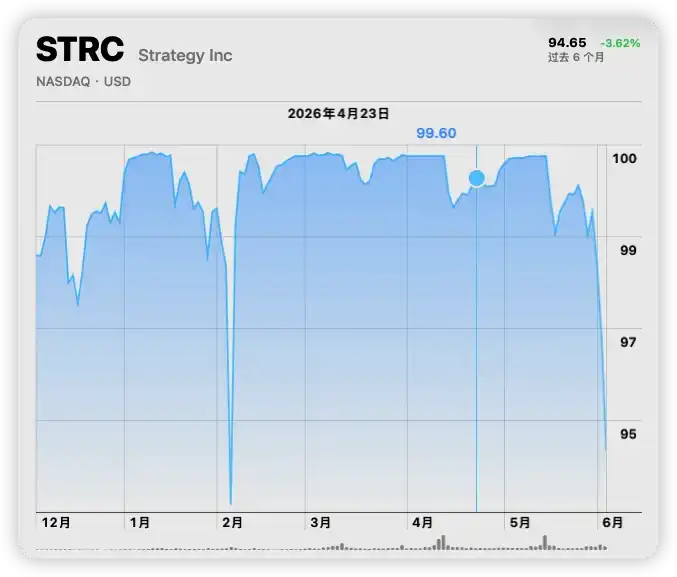
STRC's buyers are not crypto-native bitcoin believers; they are fixed-income investors seeking stable high-yield income. Their benchmark is not BTC spot, but high-yield bonds. Buyers want the 11.5% monthly cash flow, not BTC's price appreciation.
3.2 The Three-Legged Cycle
STRC's operation does not rely on operating cash flow; it runs a self-sustaining cycle:
First Leg: New investors buy STRC, raising funds that flow into MicroStrategy's account.
Second Leg: Funds are split: most to buy bitcoin (increasing BTC reserves), a small portion into the dollar reserve (USD Reserve).
Third Leg: The dollar reserve pays monthly STRC dividends; the bitcoin reserve appreciates in the secondary market.
As long as this cycle keeps turning, MicroStrategy does not need to sell a single bitcoin from its holdings to pay interest.
3.3 The 2.3% Critical Threshold
Saylor provided a key critical threshold calculation during an earnings call: As long as bitcoin's annualized appreciation rate reaches 2.3%, the annual dollar value growth of the BTC position is greater than or equal to the total annual obligation of $1.5 billion (at the time).
Recalculating with data from June 3, 2026: 843,706 BTC × $63,409 × 2.3% ≈ $1.23 billion, which is lower than the current annualized obligation of $1.712 billion. At the current coin price, BTC's annualized appreciation rate needs to be higher to cover all obligations. Further considering the price drop from ~$81,000 in March to ~$63,000 in June (a 22% decline), the debt pressure is evident.
3.4 Timeline from Dividend Rate Hike to Sell Announcement
Laying out the timeline from STRC's listing to the sell announcement reveals a clear chain of signals:
-
July 2025: STRC listed, initial dividend 9%.
-
December 2025: MicroStrategy quietly establishes a $1.44 billion reserve (beginning to prepare for "STRC issuance stagnation").
-
March 2026: STRC dividend rate raised from 9% to 11.5% (signaling secondary market demand for higher yield).
-
April 17, 2026: Switches to semi-monthly dividend payments (to reduce ex-dividend date volatility).
-
May 5, 2026: Saylor officially acknowledges possibly selling BTC to pay dividends.
In nine months, STRC went from an iPhone moment to a dividend burden.
IV. MicroStrategy's Four Debt Exit Mechanisms
MicroStrategy's debt game leverages the high premium of MSTR stock price and its preferred stock financing ability to manage debt principal and interest. Saylor's team primarily manages this debt through the following four methods.
4.1 Path One: Debt-to-Equity Conversion (The Core Exit Mechanism)
This is the underlying clause set for all of MicroStrategy's convertible bonds. According to the indenture, when debt matures or a holder triggers conversion, MicroStrategy has settlement method discretion, allowing payment in full cash, full MSTR common stock, or a cash+stock combination.
In practice, as long as MSTR's stock price remains above the conversion price set at issuance, creditors typically choose to convert (because the proceeds from selling the converted stock are higher than taking cash). This means, as long as market optimism persists, this debt ultimately does not need to be repaid with real cash; it is digested by the secondary market's stock liquidity at the cost of moderately diluting existing equity. This is also why MicroStrategy's convertible bonds were snapped up previously.
4.2 Path Two: Discounted Cash Repurchase ("De-Frothing")
When bonds trade at a discount on the secondary market, MicroStrategy directly buys back the debt early using cash.
Latest Example (May 15, 2026): MicroStrategy used approximately $1.38 billion in cash to directly repurchase $1.5 billion in face value of the 0% convertible bonds due 2029 at an 8% discount. The conversion price for these bonds was $672.40/share, while MSTR's stock price was far below that at the time, making the conversion option nearly worthless and causing the bond's market price to drop to 88.93% of face value. By repurchasing at a price slightly above the market, MicroStrategy not only reduced future repayment pressure but also generated direct book profit.
To support such operations, MicroStrategy specifically established a dollar reserve to manage liquidity. This reserve was $1.44 billion when established in December 2025, peaked at about $2.21 billion at the end of Q1, and plummeted to about $900 million after the May repurchase (Dashboard data as of June 3 shows $900 million).
4.3 Path Three: New Debt for Old & Debt Swaps
During periods of low interest rates, MicroStrategy issues new, larger bonds with longer maturities to redeem soon-to-mature or restrictive old bonds.
Classic Case (September 2024): MicroStrategy issued $1.01 billion in convertible bonds due 2028 (0.625% coupon), then immediately used the proceeds to early redeem $500 million in senior secured notes. This new-for-old move had two effects: one, it extended duration (pushed out maturity); two, most crucially, it released the 69,080 bitcoins collateralized by the old bonds, making all bitcoins high-quality, unencumbered assets again.
4.4 Path Four: Shift to Perpetual Preferred Stock (ATM Issuance)
This was MicroStrategy's most evident strategic shift in 2025-2026. To avoid the maturity wall risk of concentrated convertible bond repayments, MicroStrategy last year frantically issued two types of products to the market via ATM plans: MSTR (digital equity) and STRC (digital credit/preferred stock).
The core advantage of perpetual preferred stock like STRC is that it has no maturity date and no principal repayment pressure. MicroStrategy essentially uses money raised from retail and institutions that never needs to be repaid to pay down traditional debt with clear maturity dates, but at the cost of high interest.
Since 2026, the STRC preferred stock alone has raised approximately $5.58 billion via ATM, bringing its total size to about $8.5 billion. A significant portion of these funds was used to buy bitcoin and replenish the dollar reserve.
V. Why MicroStrategy Was Triggered to Sell Bitcoin for Dividends
5.1 Trigger Chain
STRC's design includes selling bitcoin for dividends as a contingency. The complete trigger chain is:
STRC Issuance Blocked → Dollar Reserve Depletion → Must Sell BTC to Meet Obligations Before Reserve Hits Zero
In daily operations, MicroStrategy needs to pay about $125 million monthly in dividends + interest (total annual obligation $1.5-1.7 billion). This money comes from two sources:
-
1. Funds raised from new STRC issuance. Investors buy STRC, and part of the funds goes directly into the operating account, sufficient to cover monthly payments. This is the normal path.
-
2. The $2.25 billion dollar reserve. When STRC issuance slows and monthly fundraising falls below monthly obligations, the shortfall is covered from the reserve.
With the current $900 million reserve divided by the $125 million monthly obligation, it can cover about 7.2 months. This is the current reality after the 18-month coverage capability mentioned by management earlier was compressed; the $1.4 billion repurchase in May consumed most of the reserve.
5.2 How Much Bitcoin Needs to Be Sold?
If STRC becomes completely unsellable, the dollar reserve is exhausted, and BTC price stops rising, how much would MicroStrategy need to sell from its 843,706 BTC position to pay the annual obligations?
Calculation Formula: Annual Dollar Payment Obligation ÷ BTC Price = Quantity to Sell
Based on a $1.712 billion annual obligation and the current BTC price of $63,409, annual sales of about 27,000 BTC are needed, representing approximately 3.2% of the total holdings.
If BTC rebounds to $81,000 (early-May levels), the annual sales requirement drops to about 21,100 BTC (2.5% of holdings).
At $63,409, without considering BTC appreciation, the entire position could support about 31 years. This is the origin of the BTC Dividend Coverage Years = 31.2 figure on the strategy.com Dashboard.
5.3 Why "Desensitize the Market"
When Saylor said "desensitize the market" on the May 5 earnings call, it wasn't a casual remark. The recent move was to first sell 32 coins (0.004% of holdings)—look, the sky didn't fall. If more sales are needed later, there will be less panic. Yet, the market still crashed!
CEO Phong Le described the purpose of selling bitcoin as strengthening the balance sheet and increasing BTC per share. MicroStrategy's actions imply that selling bitcoin is being redefined from a crisis backstop to a regular operational tool.
VI. Implosion Scenario: Will MicroStrategy Collapse?
6.1 A Ponzi Scheme?
Wall Street's well-known short-seller Peter Schiff has repeatedly publicly called MicroStrategy a classic centralized Ponzi scheme and STRC an unsustainable scam, predicting the company's imminent bankruptcy.
| Accusation |
Fact |
| MicroStrategy is a Ponzi Scheme |
As of June 2026, the company holds 843,706 BTC (market value ~$53.5B), with total debt + preferred stock ~$22.2B, asset coverage ratio ~2.4x. Bitcoin is not collateralized; there are no forced liquidation clauses. |
| STRC Dividends Are Unsustainable |
Dividends are indeed non-cumulative or discretionary (Board has free discretion), legally deferrable or suspendable. The 11.5% yield already includes risk compensation. |
| Company Sells BTC to Repay Debt |
True, it sold 32 BTC ($2.5M) in May 2026, but the purpose was to pay STRC dividends, representing 0.004% of holdings. |
| On the Verge of Bankruptcy |
The company has positive operating cash flow (Q1 revenue $124M), $900M cash reserve, and annual interest expense only $34.6M. In the absence of forced liquidation clauses, a bankruptcy scenario lacks a triggering mechanism. |
Conclusion: The Ponzi scheme judgment lacks data support. However, it must also be pointed out that MicroStrategy is not a value investment target. It is a leveraged bitcoin exposure tool with a premium; an mNAV of 1.23 means the stock price trades at a 23% premium to bitcoin net asset value, not at a price below intrinsic value.
6.2 Real Risk Ranking (High to Low)
⚠️ Risk One: mNAV Premium Disappears → Financing Ability Dries Up
This is MicroStrategy's most fatal risk. Currently, without collateralizing bitcoin, MicroStrategy would find it very difficult to raise more funds.
MicroStrategy's core financing logic leverages the premium of MSTR's stock price over its BTC net asset value to issue stock/preferred stock for arbitrage. As long as mNAV > 1, each share of MSTR or unit of STRC issued allows the company to obtain cash exceeding the value of equivalent BTC. If mNAV falls below 1 (i.e., stock price below per-share BTC value), this arbitrage mechanism fails.
The current mNAV is 1.23, having narrowed significantly from the earlier 1.5-2.0 range. If it continues converging toward 1, STRC ATM financing will become difficult to sustain, the dollar reserve cannot be replenished, ultimately triggering the bitcoin sale path.
⚠️ Risk Two: BTC Long-Term Stagnation + STRC Unsellable → Forced Selling Cycle
This is a positive feedback vicious cycle and the worst-case scenario currently priced by the market:
-
BTC doesn't rise → STRC new buyers wait (don't want depreciating assets)
-
STRC unsellable → Dollar reserve continuously drained
-
Reserve depleted → Forced to sell BTC for payments
-
Selling BTC → Depresses BTC price, further weakening STRC appeal
-
Cycle returns to step one
Based on the current $900 million reserve depletion rate (monthly outlay ~$125M), the reserve can last about 7 months. This means if STRC new issuance remains stagnant, early 2027 will be a key inflection point when cash reserves are depleted.
⚠️ Risk Three: Preferred Stock Dividend Deferral → Market Confidence Collapses
STRD's prospectus clearly states dividends are non-cumulative, meaning the company can suspend payment at any time without obligation to make it up. STRC dividends, while not explicitly declared non-cumulative, fall under the board's discretionary category. In theory, MicroStrategy could legally suspend all preferred stock dividends.
However, the cost of suspending dividends is extremely high. It would immediately trigger repricing of all preferred stock series, destroy STRC's product positioning as a savings account alternative, and essentially render the entire preferred stock financing plan defunct.
6.3 Risks That Do Not Exist: Will Bitcoin Be Liquidated?
❌ Forced Liquidation Risk: MicroStrategy's convertible bonds are all unsecured debt; bitcoin has never been used as collateral. A sharp drop in bitcoin price would not trigger forced sales of reserve bitcoins. Liquidation rumors in early June 2026 were clarified by the company as routine balance sheet adjustments.
❌ Debt Maturity Default Risk: The $1.05 billion convertible bond due in February 2027 is the nearest batch. MicroStrategy then has several options: repay with cash, issue new debt for swap, or encourage holders to convert. With the $900 million cash reserve and ongoing preferred stock financing, there is no technical default risk in the short term.
❌ Interest Expense Overwhelms Income Statement: Annual convertible bond interest averages only $34.6 million, which is almost negligible relative to a company with a $44 billion market cap. The real burden is the preferred stock dividends ($1.712 billion), but dividends are deferrable and not a rigid payment obligation.
February 2027 to September 2028 is MicroStrategy's concentrated put/redemption period. Within 12 months, over $5.9 billion in convertible bonds will face puts or maturity. Repaying principal is the biggest issue.
VII. If the Worst Happens, What Happens to Bitcoin?
7.1 Bitcoin Will Not Be Forcibly Liquidated
First, a crucial fact to clarify: The 843,706 bitcoins held by MicroStrategy have never been used as collateral for any debt. All convertible bonds are unsecured debt, and preferred stock is purely an equity instrument. This means:
-
No matter how low the bitcoin price falls, no creditor has the right to force MicroStrategy to sell bitcoin to repay debt.
-
Even if MicroStrategy enters bankruptcy (extremely unlikely), bitcoin would be distributed to creditors as company assets during liquidation, not sold on the market.
7.2 Selling Pressure Estimate in Worst-Case Scenario
Even if MicroStrategy is forced down the path of selling bitcoin for payments (STRC unsellable + reserve exhausted), the amount needing to be sold is far lower than market panic imagines:
-
Annual sales needed: At $63,409/BTC, ~27,000 BTC/year
-
Percentage of holdings: 3.2%
-
Daily sales needed: ~74 BTC/day
-
For comparison: Bitcoin daily trading volume is typically 200k-500k BTC
This means in the worst-case scenario, MicroStrategy's selling would represent a marginal impact of about 0.02%-0.04% of daily trading volume, insufficient to trigger systemic selling.
7.3 The Real Market Impact Isn't Selling Pressure, It's Confidence
The sale of 32 BTC ($2.5 million) in early June 2026 caused BTC to drop from about $73k to $63k within 48 hours, wiping about $60 billion in market cap—24,000 times the actual sale amount.
This illustrates that the market's real pricing factor is the *possibility* of MicroStrategy selling. The most valuable asset was the "never sell" story, now broken with just 32 bitcoins.
VIII. MicroStrategy Hasn't Betrayed Bitcoin. It Has Finally Admitted That Bitcoin Also Has Bills to Pay.
If MicroStrategy's 2020-2024 story can be summarized in one sentence, it's that a software company decided to convert all its cash into bitcoin. But the 2025-2026 story is entirely different.
MicroStrategy is no longer that simple HODL machine. What it's doing now is essentially no different from a bank: taking the underlying asset of bitcoin and processing it into financial products with different risk-return profiles, selling them to different types of capital:
-
MSTR Common Stock → Sold to equity investors seeking directional leveraged exposure to BTC.
-
STRK (Convertible Preferred) → Sold to hedge funds wanting downside protection + upside participation.
-
STRF/STRD (High-Yield Preferred) → Sold to fixed-income investors seeking high yield.
-
STRC (Dynamic Rate Preferred) → Sold to stable capital seeking a "savings account alternative."
-
Convertible Bonds → Sold to institutions doing volatility arbitrage.
Saylor wants to build a private bitcoin bank with bitcoin as the underlying reserve, the US stock market as the financing entry point, and preferred stock as the product outputting yield to the fixed-income market.
This machine's prerequisites are:
-
BTC rises long-term (at least annualized ≥2-3% to cover dividends)
-
mNAV maintains premium (preserves arbitrage space and financing ability)
-
Preferred stock market remains open (STRC remains sellable)
If all three conditions hold, Saylor might indeed transform a software company into the Berkshire Hathaway of the digital age. But if one condition breaks, especially the mNAV premium disappearing, this story quickly returns to reality.
Short-Term Outlook (Second Half 2026): No implosion risk. The $900 million cash reserve can cover about 7 months of payment obligations; the 31-year BTC coverage provides an enormous buffer. The key observation window is 2027. If by then the mNAV premium remains below 1.1 and STRC issuance stagnates, MicroStrategy will be forced to shift from a net buyer to a net seller.
Long-Term Outlook: It's playing a sophisticated, public, credit leverage game backed by real assets. It has real bitcoin assets (843,706 coins), real software business revenue (~$500M/year), real financing ability (raised ~$11.7B in 2026). But its fragility lies here too: it is highly sensitive to market sentiment and financing premiums—and those things dissipate faster than bitcoin falls in a bear market.