The 800x Golden Dog, "Gacha" Saves NFT Trading

marsbit2026-07-28 tarihinde yayınlandı2026-07-28 tarihinde güncellendi

Özet

Title: 800x Golden Dog: How 'Gacha' Mechanics Are Rescuing NFT Trading In the past month, the on-chain TCG (Trading Card Game) narrative, centered around "gacha" or loot box mechanics, has emerged as a major crypto-native revenue generator, second only to platforms like Hyperliquid and pump.fun. Recently, this trend hit Ethereum with Fake World Assets (FWA). Within just over a week, FWA generated approximately $1.3 million in revenue, ranking 15th in the past week's crypto app earnings. Its token, $FWA, surged from an initial market cap of ~$47,550 to a peak of ~$38.8 million—an 800x gain. Meanwhile, Collector Cards' token $CARDS declined significantly from its previous highs. FWA, developed by the team behind "PunkStrategy," operates as an NFT gacha system with a built-in token flywheel. Users deposit NFTs paired with ETH as liquidity into pools. Each deposit creates a personal pool; more ETH deposited lowers the chance of the NFT being "won" in a draw. Players spend ETH to "draw" (gacha). If they get an undesirable NFT, they can instantly sell it back to the original depositor at an 85% discount, generating income for the depositor. A 1% fee is taken on each draw and on depositor earnings when an NFT is kept. The key to FWA's momentum is its token $FWA. It cannot be bought directly externally. The primary way to acquire it is by playing the gacha and choosing to receive $FWA (instead of ETH) when selling back an unwanted NFT. This mechanism creates constant buy pressure ...

Author: Cookie, The Rhythm

Last month, we detailed the narrative of on-chain TCG cards. "Gacha" is almost the crypto-native "money printer" second only to Hyperliquid and pump.fun:

"CARDS Doubles in 2 Months, Is On-chain TCG the Next Big Narrative After HYPE?"

Last week, the "gacha" wind finally blew onto the Ethereum mainnet. A new protocol called Fake World Assets, launched just over a week ago, has already generated approximately $1.3 million in revenue, ranking 15th on the past 7-day crypto application revenue chart:
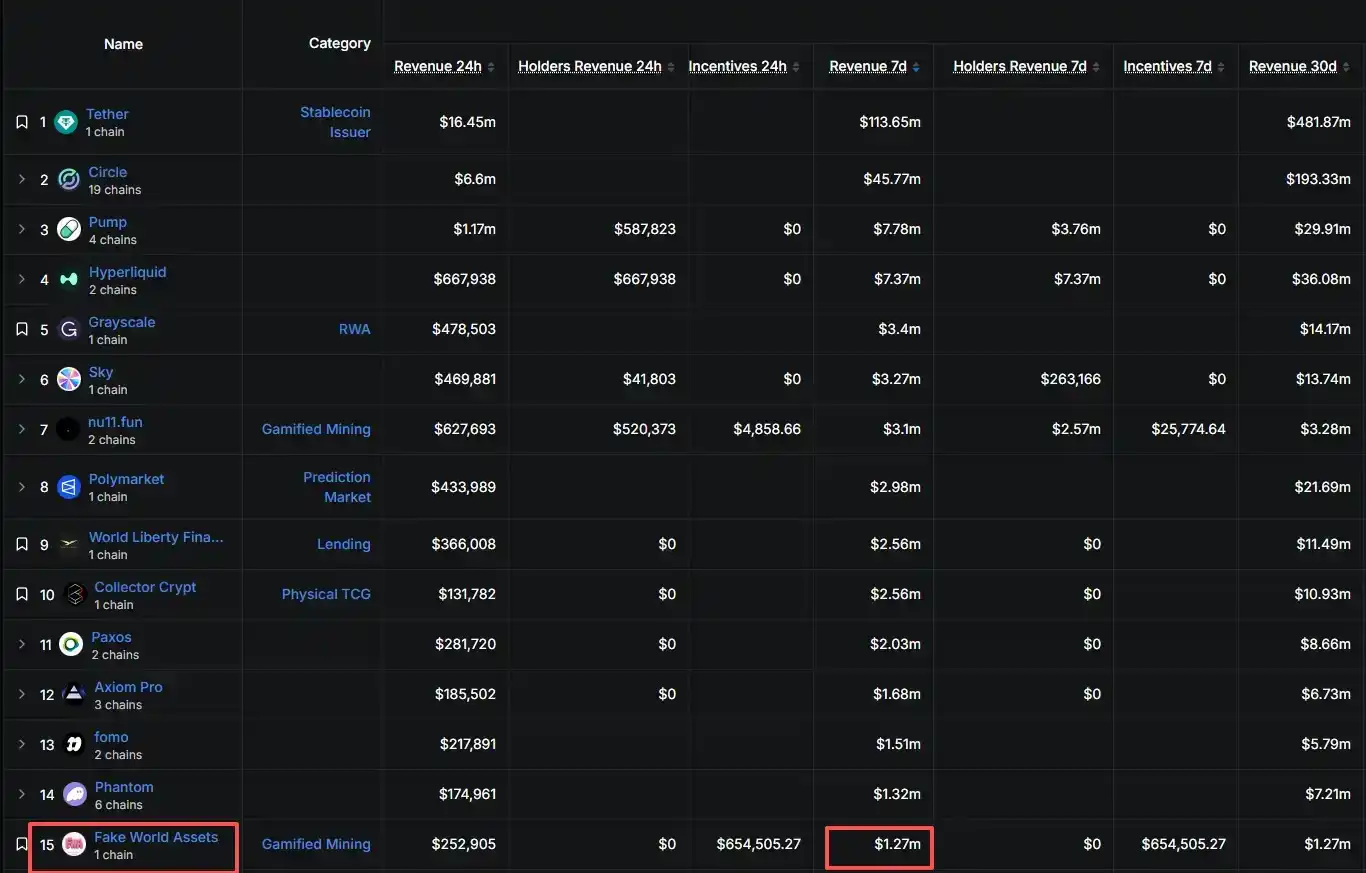
Simultaneously, the protocol token $FWA skyrocketed from an initial market cap of around $47,550 to a peak of approximately $38.8 million, an 800x golden dog. Meanwhile, while Collector Cards maintains strong revenue momentum, its token $CARDS has plummeted from a peak near $90 million market cap a month ago to just around $28.87 million.

Why?

FWA's Gameplay

The team behind FWA, TokenWorks, should be familiar. Their previous big hit was "PunkStrategy," which reached a $300 million market cap in a month.

But TokenWorks doesn't always hit a home run. Their last project, TTT (Ten Thousand Tokens), launched around the later stages of the Uniswap v4 hook hype. Its core gameplay was a Launchpad where you needed an NFT to launch a token. There were 10,000 NFTs total, meaning only 10,000 tokens could be launched on the platform. Fees were distributed among token launchers, all NFT holders, and the protocol.

As it failed to produce popular tokens, the NFTs plummeted shortly after launch.

I initially missed FWA too, thinking it was just a simple "NFT gacha" game. But it designed a token flywheel, enabling $FWA to become ponzinomic.

The $FWA token cannot be purchased directly from the outside. To get this token, you must "roll the gacha."
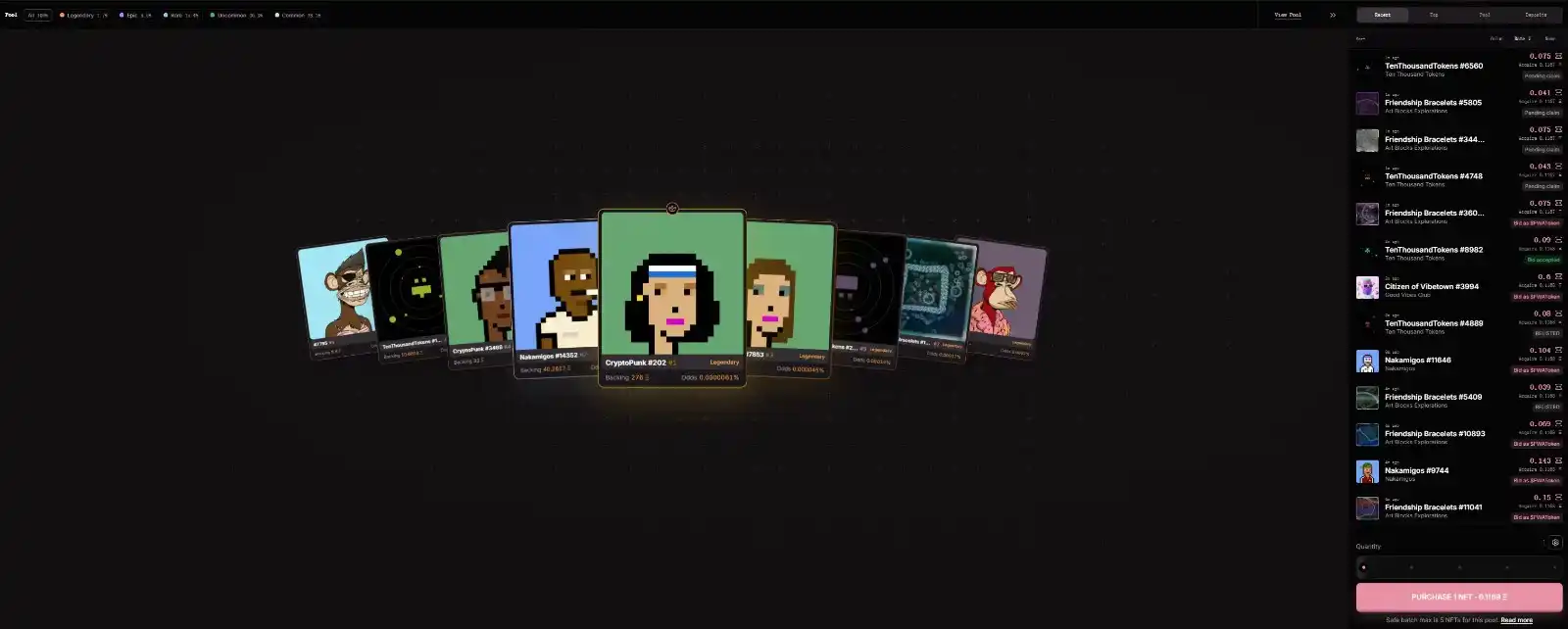
The NFTs in its pool are deposited voluntarily by players. When depositing an NFT, players must also deposit ETH as bilateral liquidity. Essentially, each player depositing assets opens their own pool.

The more ETH deposited, the lower the probability the paired NFT gets drawn. Take this CryptoPunks as an example, it's paired with 276 ETH, corresponding to a mere 0.0000061% chance of being drawn, meaning you'd need over 10 million draws to get it. Since the protocol launched on July 3rd, there have only been 73,884 total draws, averaging just over 3,000 per day.
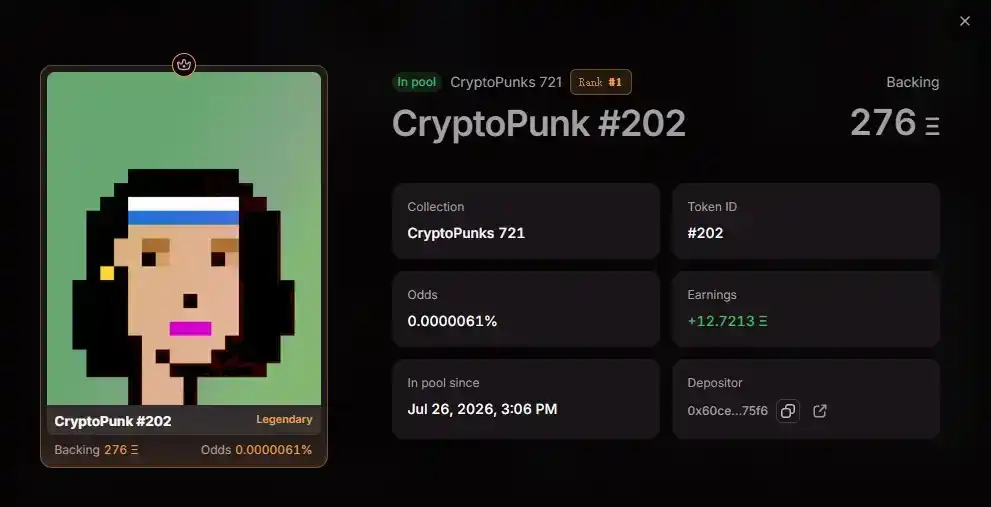
We can also see this CryptoPunks depositor has earned 12.7213 ETH in just over a day. This income comes from:

- Each draw deducts a fixed 1% fee.

- If someone draws a desirable NFT and keeps it, 1% of the income generated from that depositor's pool is deducted.

- Most players draw mediocre NFTs and immediately sell them back to the depositor at an 85% discount; this price difference forms income.

How much each player depositing NFTs and ETH earns doesn't depend on the deposited amount, but on how long their NFT survives in the pool. As long as the deposited NFT isn't drawn, it keeps sharing profits. Once drawn, dividends stop, and a new NFT needs to be deposited.

To ensure survival in the pool, you need to deposit more ETH, incentivizing the pool to grow thicker.

We can clearly summarize: this is essentially an NFT AMM overlaid with a gacha mechanism.

FWA's Flywheel

The most interesting part about the protocol token $FWA is that it cannot be bought directly from the outside. To get this token, you must genuinely play this NFT gacha machine.

50% of the total token supply was used for initial liquidity, 30% for emissions in the first half-month after launch (daily distribution of 1% each to asset depositors and gacha players), and 20% for early snapshot airdrops.

The broadest way to acquire $FWA is by drawing gacha. As mentioned, when you draw an unwanted NFT, you can sell it back to the depositor at an 85% discount. At this point, you can choose to receive ETH back or $FWA (the protocol automatically buys $FWA with the ETH you would have received).

Most players choose to receive $FWA after selling back unwanted NFTs. Data shows that in the past 7 days, up to 82.3% of operations chose to immediately sell back for $FWA, especially in the very early days when the token price hadn't surged. Recently, as $FWA price rose to highs and entered correction, the choice to receive ETH after immediate sell-back has gradually increased, but receiving $FWA still accounts for over 60% of daily choices.
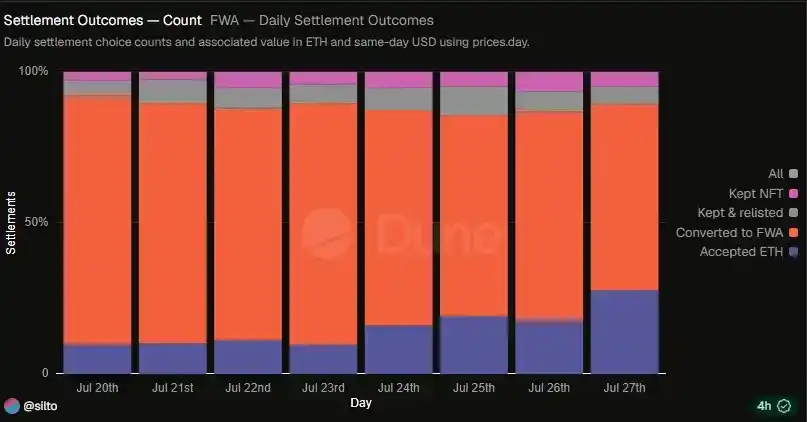
If we directly calculate the acquisition cost of $FWA, we find each draw is negative expected value. The cost of acquiring $FWA through gacha is actually higher than the daily $FWA price, representing a premium purchase.
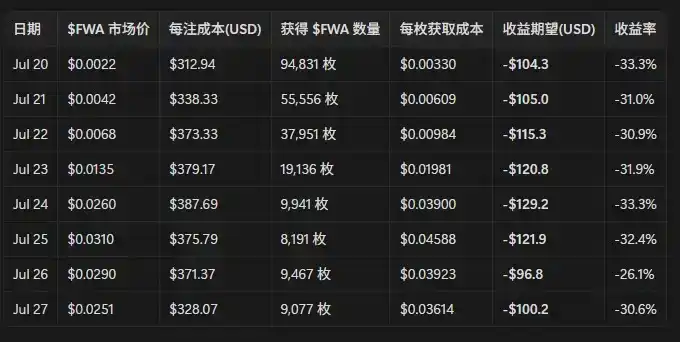
However, if you held the acquired $FWA instead of selling immediately, operations between July 20-23 were printing money like crazy. This isn't much different from grinding Blur airdrops despite Offer wear and tear back in the day; it's betting on the token's future rise, trading time for potential. But there's a difference: this is a game with a much shorter, more attention-focused cycle. Once the mechanism is discovered and gains attention, as long as new entrants keep drawing, substantial buy-side pressure for $FWA converts. Later entrants continuously boost the portfolio value of earlier $FWA holders.

This is also why FWA surpassed Collector Cards' token market cap in such a short time. Both core gameplays are gacha, core revenues are discount price differences from immediate buybacks. Collector Cards' theme (Pokémon cards) might even attract a broader audience than NFTs, with better profit performance. However, Collector Cards' token utility is heavily criticized by the community. Besides project buybacks (details undisclosed due to the Clarity Act not passing), Collector Cards' token has almost zero utility.

Even pump.fun's massive daily buybacks weren't fully recognized by the market, let alone Collector Cards' weaker buyback efforts.

Conclusion

FWA's flywheel is unlikely to be sustainable long-term. When the token price rises, everyone rushes in to draw, praising this great innovation saving NFTs. But once the price corrects, when the inherent loss from drawing can't be covered—let alone generate excess returns—by $FWA's continuous rise, the protocol will gradually be forgotten, and the NFT "great revival" will come to an abrupt halt.

However, the more valuable lesson is that profitability is a narrative easily forgotten in the crypto market. If we understand the relationship between attention and buy-side conversion, we might avoid many situations of being caught at the peak.


İlgili Sorular

QAccording to the article, what is the Fake World Assets (FWA) protocol and how did it perform in its first week?

AAccording to the article, Fake World Assets (FWA) is a new protocol on the Ethereum mainnet that introduced a 'loot box' or gacha mechanism for NFTs. Within just over a week of its launch, its revenue reached approximately $1.3 million, ranking 15th on the crypto application revenue chart for the past 7 days. Its token, $FWA, also saw massive growth, rising from an initial market cap of about $47,550 to a peak of around $38.8 million, representing an 800-fold increase.

QHow does a player acquire the $FWA token, and what is the special mechanism behind this acquisition method?

AThe $FWA token cannot be purchased directly from external markets. The primary way to acquire it is by participating in the protocol's 'loot box' mechanism. Players spend ETH to 'pull' (or draw) an NFT from a pool. If they are unhappy with the NFT they receive, they can immediately sell it back to the original depositor at an 85% discount. At this point, the player can choose to receive the refund in ETH or have the protocol automatically use that ETH to purchase $FWA for them. This design forces most buy pressure for $FWA to come from within the protocol's own gameplay loop.

QExplain the income mechanism for a user who deposits an NFT and ETH into the FWA protocol pool.

AA user who deposits an NFT and paired ETH into the FWA pool creates their own liquidity pool. Their income is generated from the fees paid by other players who 'pull' from the pool. Specifically, 1% of the cost of each pull goes to the protocol. More importantly, when a player receives an unwanted NFT and sells it back at an 85% discount, that 15% price difference becomes the depositor's income. The depositor continues to earn this income for as long as their specific NFT remains in the pool (i.e., is not 'pulled' by another player). To increase the longevity of their NFT in the pool and thus their earning period, depositors are incentivized to pair their NFT with more ETH, which lowers its probability of being drawn.

QHow does the article compare the $FWA token model with that of Collector Cards ($CARDS), and what does it identify as a key weakness of $CARDS?

AThe article compares the two by noting that both protocols share a core 'loot box' gameplay and generate revenue from the discount applied when unwanted items are sold back. However, it highlights a fundamental difference in their token utility. While $FWA has an intrinsic buy mechanism and utility tied directly to the protocol's gameplay (players effectively purchase it at a premium through the draw-sellback cycle), $CARDS suffers from a lack of clear utility. Its primary proposed utility—protocol buybacks—was criticized for being poorly disclosed and insufficient to drive sustained value. The article suggests that even significant buybacks (like those from pump.fun) are often not enough for the market, making $CARDS's model weaker than $FWA's integrated flywheel.

QWhat is the article's final conclusion about the long-term sustainability of the FWA protocol's economic model?

AThe article concludes that the FWA protocol's economic flywheel is likely unsustainable in the long term. It relies heavily on a continuous influx of new users and a rising $FWA token price. When the token price is increasing, players are willing to accept the inherent loss from the 'loot box' draws because their $FWA holdings appreciate. However, once the token price stops rising or begins to fall, the economic losses from participating in the draws will no longer be offset, leading to a decline in participation and a collapse of the protocol's activity. The model's success is described as being tightly coupled with short-term market attention and speculative momentum.

İlgili Okumalar

Thanks to Dice Rolls, Bitcoin Keys Are Stored Offline, But Not Everyone Will Do It

The article discusses using dice rolls to generate secure Bitcoin wallet seeds, providing entropy independent of potentially flawed hardware random number generators. It explains that each fair dice roll offers about 2.585 bits of entropy, with around 50 rolls needed for a standard 12-word seed phrase and 99+ recommended for higher security. This method gained attention after a vulnerability was revealed in some Coldcard hardware wallets, where a faulty firmware RNG (dating back to 2021) compromised generated keys. The analysis notes that while a dice-generated main seed was safe from this specific flaw, other Coldcard functions (like creating paper wallets, backup keys, or passwords) could still be vulnerable if they used the defective RNG. The piece argues that while dice-based entropy is technically robust, the manual process is error-prone, tedious, and unrealistic for most new users, who might make mistakes in recording or inputting rolls. It concludes that while manual entropy generation should remain an option for advanced users, the long-term goal is to develop reliable, user-friendly hardware and software that securely generates randomness without requiring specialized knowledge. Coldcard users are advised to check their firmware version and replace any secondary secrets (like paper wallet keys) created with vulnerable devices, while also considering multi-signature setups with devices from different manufacturers for added security.

cryptonews.ru4 saat önce

Thanks to Dice Rolls, Bitcoin Keys Are Stored Offline, But Not Everyone Will Do It

cryptonews.ru4 saat önce

İşlemler

Spot
活动图片




