Hoskinson Denies Cardano Exit Rumors: ‘I’m Not Leaving’

bitcoinist2026-06-05 tarihinde yayınlandı2026-06-05 tarihinde güncellendi

Özet

Cardano founder Charles Hoskinson dismissed rumors of his departure, clarifying in a June 4 livestream that he is only stepping back from public communication, not resigning from the project. This followed community concern after his "taking a break" post on X. Hoskinson cited an unsustainable level of online toxicity, with nearly one-third of replies to his posts being hostile or abusive, making meaningful engagement nearly impossible. While acknowledging X's role in crypto information flow, he stated the psychological cost is too high. He emphasized his focus remains on technological development like RealFi, Midnight, and research, not on ADA's price. Hoskinson described a "tale of two Cardanos": significant protocol advancements versus poor market performance leading critics to label it a failure. He called for the community to resolve this dissonance by moving discussions away from X, rethinking incentives, and developing a new shared roadmap. He was critical of the Cardano Foundation's lack of accountability. Hoskinson announced he will take time away from public videos and social media to reflect, but will continue working on Midnight. He stated he will only engage in channels where he is treated with respect and dignity.

Cardano founder Charles Hoskinson rejected speculation that he is leaving the ecosystem, saying in a June 4 livestream that he is stepping back from public-facing communication but not resigning from Cardano. The comments came after his brief “taking a break” post on X triggered concern across the community and inquiries from journalists

Hoskinson opened the livestream by directly addressing the rumors. “I wanted to make a quick video to remind everybody that I am okay,” he said. “I’m not suicidal. I’m not leaving the ecosystem or resigning from Cardano and running around.”

The clarification followed a wave of speculation after Hoskinson signaled he would take time away from social media. He said the reaction reflected a broader problem with the communication environment around Cardano, especially on X, where he argued productive engagement has become nearly impossible.

Hoskinson Says Online Toxicity Has Become Unsustainable

Much of Hoskinson’s livestream focused on what he described as a hostile social media environment. He cited an analysis of roughly 130 replies to his recent comments, saying nearly one-third were hostile, abusive, or profanity-laden and that some showed signs of coordinated targeting.

“Every tweet, about 30% of all replies is hostile, negative, and it’s categorized this way,” Hoskinson said. “It’s really impossible to meaningfully engage and want to be there in those types of platforms with people. So I wanted to leave last year and I thought for sure I’d be out.”

Hoskinson said X remains difficult to abandon because it is still one of the few platforms where crypto-native information moves quickly and directly. Still, he argued that the psychological cost of staying in that environment had become too high, adding that he does not want to be in a communication medium where personal attacks dominate a significant share of engagement.

He also drew a sharp distinction between his continued work on Cardano-related technology and the public expectation that he should be responsible for ADA’s market performance.

“What I’m not passionate about is making the price of ADA go up so that speculators can dump it and go on to the next thing,” Hoskinson said. “I’m just not. It’s never been my passion. I’ve never accepted that role. I’ve never once told you that that is my job.”

Hoskinson said he remains focused on work including RealFi, making Bitcoin programmable, proofs, privacy, Midnight, and broader research. But he said the community has to decide whether Cardano is primarily about science, philosophy, and real-world impact, or whether it is increasingly defined by price frustration.

Cardano Founder Calls For New Roadmap

Hoskinson described what he called “the tale of two Cardanos”: one in which the protocol, engineering base, decentralization, and research stack have advanced significantly since 2021, and another in which market performance has led critics to label the project a failure.

“We’re massively ahead of where we were in 2021,” he said. “Massively. We’ve done things that we could only have dreamed of when I started the project. Leios testnet is starting June 23rd. I think when you look at it from a price appreciation, we’re in the toilet. We’re at 18 cents. It’s a dead and failed project.”

That gap, he argued, has produced a “cognitive dissonance” that Cardano’s community must resolve. Hoskinson said the ecosystem needs to leave X as its primary venue for discussion, rethink incentives for builders, change parts of its management culture, and develop a new roadmap that gives participants a shared destination.

He was particularly critical of the Cardano Foundation, arguing that ADA holders lack meaningful accountability mechanisms over its board, priorities, and staffing. He called the structure “the worst mistake” of his career, contrasting it with Input Output, where he said the community can vote against proposals.

Hoskinson said he will take time away from public videos, interviews, X, and other social channels while continuing to work on Midnight. He said he intends to reflect, recover, and later propose ideas for Cardano’s future, ranging from incremental reforms to more radical changes.

“I could certainly be part of it, but you know what my red lines are,” he said. “I have to be treated with respect and dignity and I am only going to live in channels that enforce that.”

At press time, ADA traded at $0.1589.
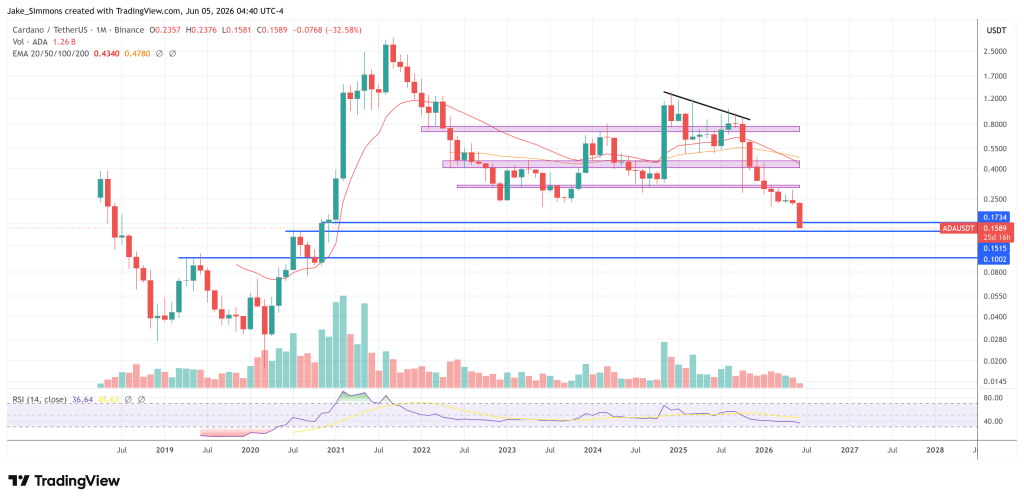
ADA keeps going lower, 1-month chart | Source: ADAUSDT on TradingView.com

İlgili Sorular

QWhat was the main reason Charles Hoskinson gave for stepping back from public communication?

AHe stated that the hostile and toxic social media environment, particularly on X, has become unsustainable, with a high volume of abusive replies making meaningful engagement nearly impossible.

QHow did Hoskinson clarify the purpose of his role regarding the price of ADA?

AHe clarified that he is not passionate about making the price of ADA go up for speculators, has never accepted that role, and his job is focused on technology, research, and real-world impact, not market performance.

QWhat did Hoskinson mean by 'the tale of two Cardanos'?

AHe described a gap between Cardano's significant technical and research progress since 2021 and its poor market price performance, which leads some to label it a failure, creating a 'cognitive dissonance' the community must resolve.

QWhat future changes did Hoskinson propose for the Cardano ecosystem?

AHe proposed that the ecosystem needs to leave X as its primary discussion venue, rethink incentives for builders, change management culture, develop a new shared roadmap, and address the lack of community accountability over the Cardano Foundation.

QWhat are Hoskinson's 'red lines' for his continued involvement with Cardano?

AHis red lines are that he must be treated with respect and dignity and will only participate in communication channels that enforce that standard.

İlgili Okumalar

Blockchain Has Finally Started to Sail into the Mainstream After 18 Years

Blockchain Finds Its True Path After 18 Years: Becoming the Financial Backbone for AI Agents and Autonomy This analysis explores a pivotal shift in the blockchain and crypto investment landscape, driven by the dominance of AI. Major venture capital firms, including Variant, Paradigm, Haun Ventures, and YZi Labs, are moving beyond pure "crypto" investment theses. They are expanding their focus to AI, robotics, and frontier tech, signaling that blockchain is no longer seen as a standalone sector but as an underlying infrastructure layer. The core argument is that blockchain's killer application may not be user-facing apps, but rather providing the economic rails for the coming wave of AI agents, autonomous robots, and automated systems. Key capabilities like self-custody wallets, programmable stablecoins for micropayments, on-chain identity, and verifiable smart contracts are positioned as essential for a future where machines conduct economic activity. The recent $1.4 billion investment by Tether (via its venture arm) in German robotics company NEURA Robotics exemplifies this, aiming to embed Tether's wallet tools directly into robots for autonomous transactions. While many "AI + Crypto" projects remain superficial, the article concludes that true value lies where crypto is a necessary component—enabling machine-to-machine payments, agent autonomy, verifiable data provenance, and open financial settlement for the AI era. For crypto venture capital, this convergence with AI represents both an adaptation to shifting capital flows and a potential path to unlocking the large-scale, non-speculative utility the industry has long sought.

marsbit19 dk önce

Blockchain Has Finally Started to Sail into the Mainstream After 18 Years

marsbit19 dk önce

Blockchain has finally begun sailing toward the main channel after 18 years

After 18 years of development, blockchain technology is beginning to move from a specialized niche into mainstream adoption, according to a recent industry analysis. The shift is reflected in the changing strategies of major crypto venture capital firms, which are expanding their focus beyond pure "digital ownership" towards broader themes like "autonomy." The report highlights that leading VC firms like Variant, Paradigm, Haun Ventures, and YZi Labs are broadening their investment mandates to include not only crypto but also artificial intelligence (AI), robotics, biotech, and other frontier technologies. This reflects a recognition that the isolated "crypto investment" narrative is losing appeal to limited partners (LPs) as capital and attention increasingly flow toward AI and other high-growth tech sectors. A key emerging thesis is that blockchain's most significant future application may not be as a consumer-facing product, but as the underlying economic and settlement infrastructure for the AI era. As AI agents and autonomous systems become more prevalent, they will require programmable, global, and low-cost payment networks (like stablecoins), verifiable digital identities, and secure wallets to manage transactions and assets on behalf of users. The investment by stablecoin issuer Tether into robotics company NEURA, with plans to integrate its wallet technology, is cited as a prime example of this convergence. However, the article cautions that simply labeling projects as "AI + Crypto" is insufficient. True value lies in integrations where blockchain technology is essential—such as enabling machine-to-machine micropayments, verifiable data provenance for AI, or transparent governance for autonomous organizations—rather than being a superficial marketing add-on. In conclusion, while AI currently dominates the tech narrative and capital flows, it may ultimately create the real-world, high-frequency demand that the crypto industry has long sought. For crypto VCs and projects, the path forward is to position blockchain not as a competing sector, but as a critical foundational layer powering autonomy and economic activity in an AI-driven future.

链捕手25 dk önce

Blockchain has finally begun sailing toward the main channel after 18 years

链捕手25 dk önce

Y Combinator Co-founder: How to Make a Billion Dollars?

The Y Combinator co-founder argues that becoming a billionaire by founding a successful startup is not only possible but demonstrably achievable without unfair or unethical practices. He disputes a politician's claim to the contrary, using the example of a founder whose company grew at 93% monthly solely through creating a product users loved and recommended. The core mechanism is exponential growth. A conservative 15% monthly growth rate compounds to a 4384x increase over five years, which can easily lead to billion-dollar valuations and founder wealth. The process depends on two key variables: the growth rate and the duration it can be sustained. A high growth rate stems from a great product that users naturally promote, while a long duration requires a large enough market. For aspiring founders, especially young ones, the simplest path is to build something they and their friends genuinely need. Young people's current needs often predict future mass-market trends. He advises against actively "searching" for ideas, as this tends to filter out unconventional but promising ones. Instead, inspiration should come from working on interesting projects with friends, as many iconic companies (e.g., Apple, Facebook) started this way. Ultimately, building a massively valuable startup is not about exploitation but empathy: deeply understanding a user group and building a product that significantly improves their lives. This, powered by exponential growth in a large market, is the legitimate path to immense wealth creation.

Foresight News27 dk önce

Y Combinator Co-founder: How to Make a Billion Dollars?

Foresight News27 dk önce

The 800V Voltage Standard Championed by Nvidia: Which Infrastructure Providers Stand to Benefit?

NVIDIA is actively promoting the 800VDC architecture as a key direction for its next-generation AI factories and high-power racks, particularly for the upcoming Rubin and Kyber platforms. The primary driver is the rapidly increasing power density of AI racks, with designs like GB200/GB300 NVL72 reaching 120-140kW and future systems potentially hitting 180-220kW. At such high power levels, traditional low-voltage power delivery becomes inefficient due to massive current, leading to significant copper use, cable bulk, heat, and power loss. The 800VDC standard aims to increase efficiency by transmitting power at higher voltage and lower current to the rack before stepping it down locally for GPUs. NVIDIA claims this can improve efficiency by up to 5%, reduce total cost of ownership (TCO) by up to 30%, and cut copper usage by approximately 45%. This shift redefines infrastructure roles, pushing power engineering to the forefront alongside GPU performance. Key beneficiaries and ecosystem partners highlighted include: 1. **Power Infrastructure Providers:** Companies like Vertiv, Schneider Electric, Delta Electronics (台达电), and Korean firms LS Electric and HD Hyundai Electric are involved in designing next-gen AI factory power distribution, rack power supplies, and backup systems. 2. **Power Semiconductors:** Suppliers of SiC/GaN devices, such as Infineon and STMicroelectronics, are better suited for high-voltage, high-efficiency conversion in this new architecture. 3. **Connectivity & Structure:** The focus shifts to high-reliability components like busbars, high-voltage connectors, and advanced PCBs that meet stricter insulation and safety requirements. 4. **Liquid Cooling & Rack ODM:** As power and heat density rise, liquid cooling becomes critical. Full-rack system integrators (e.g., Dell, Wiwynn, Wistron) must now demonstrate robust pre-delivery testing capabilities, including burn-in testing under full load, requiring significant power and cooling infrastructure in their factories. The transition is not immediate for all data centers but is targeted at high-density AI factories. NVIDIA’s 800VDC ecosystem is in a preparatory phase, with full-scale production expected to align with the 2027 launch of Kyber rack-scale systems. The investment thesis revolves around which companies can demonstrate proven product integration, customer validation, and reliable delivery of complete, high-power AI rack systems, making power, cooling, and testing capabilities new critical variables in the AI infrastructure value chain alongside GPUs.

marsbit48 dk önce

The 800V Voltage Standard Championed by Nvidia: Which Infrastructure Providers Stand to Benefit?

marsbit48 dk önce

İşlemler

Spot
Futures

Popüler Makaleler

ADA Nasıl Satın Alınır

HTX.com’a hoş geldiniz! Cardano (ADA) satın alma işlemlerini basit ve kullanışlı bir hâle getirdik. Adım adım açıkladığımız rehberimizi takip ederek kripto yolculuğunuza başlayın. 1. Adım: HTX Hesabınızı OluşturunHTX'te ücretsiz bir hesap açmak için e-posta adresinizi veya telefon numaranızı kullanın. Sorunsuzca kaydolun ve tüm özelliklerin kilidini açın. Hesabımı Aç2. Adım: Kripto Satın Al Bölümüne Gidin ve Ödeme Yönteminizi SeçinKredi/Banka Kartı: Visa veya Mastercard'ınızı kullanarak anında Cardano (ADA) satın alın.Bakiye: Sorunsuz bir şekilde işlem yapmak için HTX hesap bakiyenizdeki fonları kullanın.Üçüncü Taraflar: Kullanımı kolaylaştırmak için Google Pay ve Apple Pay gibi popüler ödeme yöntemlerini ekledik.P2P: HTX'teki diğer kullanıcılarla doğrudan işlem yapın.Borsa Dışı (OTC): Yatırımcılar için kişiye özel hizmetler ve rekabetçi döviz kurları sunuyoruz.3. Adım: Cardano (ADA) Varlıklarınızı SaklayınCardano (ADA) satın aldıktan sonra HTX hesabınızda saklayın. Alternatif olarak, blok zinciri transferi yoluyla başka bir yere gönderebilir veya diğer kripto para birimlerini takas etmek için kullanabilirsiniz.4. Adım: Cardano (ADA) Varlıklarınızla İşlem YapınHTX'in spot piyasasında Cardano (ADA) ile kolayca işlemler yapın.Hesabınıza erişin, işlem çiftinizi seçin, işlemlerinizi gerçekleştirin ve gerçek zamanlı olarak izleyin. Hem yeni başlayanlar hem de deneyimli yatırımcılar için kullanıcı dostu bir deneyim sunuyoruz.

1.4k Toplam GörüntülenmeYayınlanma 2024.12.10Güncellenme 2026.06.02

ADA Nasıl Satın Alınır

Tartışmalar

HTX Topluluğuna hoş geldiniz. Burada, en son platform gelişmeleri hakkında bilgi sahibi olabilir ve profesyonel piyasa görüşlerine erişebilirsiniz. Kullanıcıların ADA (ADA) fiyatı hakkındaki görüşleri aşağıda sunulmaktadır.

活动图片