"Considering the time cost, the return on investment for running a relay station is lower than going out and getting a job."
A few days ago, Sukie open-sourced the entire process of building her relay station, from server procurement and technical configuration to marketing and customer acquisition, writing it all into a tutorial. This post brought her dozens of new users on social media in a single day. We reached out to Sukie, hoping to talk with her about what things look like from the inside after actually having run this business.
The relay station industry has gone through a full cycle over the past year, from quietly making profits to cutthroat competition in a red ocean, and then to big players entering to reap the rewards. Beating previously reported on a station owner Mo who only served B2B clients ("After Claude Required Real-Name Verification, a Relay Station Owner's Reflections"). Her story revealed the daily operations of this business and the global disparity in AI access it touches. This time, the storyteller Sukie offers another perspective: Why didn't she make money even after someone with sound business acumen had successfully implemented technology, marketing, and compliance?
When the barrier to entry for a business is low enough for anyone to join, and profits are destined to be positive only through gray-area operations or ecosystem arbitrage, where exactly is the space left for independently operating, compliant relay stations?
Here is Sukie's account.
Accounts from Compliant Sources Are Just Expensive
Our account pool mainly comes from two sources: a partner provides some from Singapore, and we register some ourselves.
The ones we register ourselves follow the compliant path, using real payment methods and identity information. This type of account is costly and slow to acquire, but offers the best stability.
There are also accounts of questionable origin within the industry—some people buy stolen accounts, use fake identities, or even employ bots for bulk registration. They're cheap, but high-risk; once tracked and linked by the upstream platform, the entire account pool can be wiped out.
This is also why our costs can't come down—accounts from compliant sources are inherently expensive. This is a core contradiction in the relay station industry: either cheap but with compliance risks, or expensive but able to run long-term. We chose the latter.
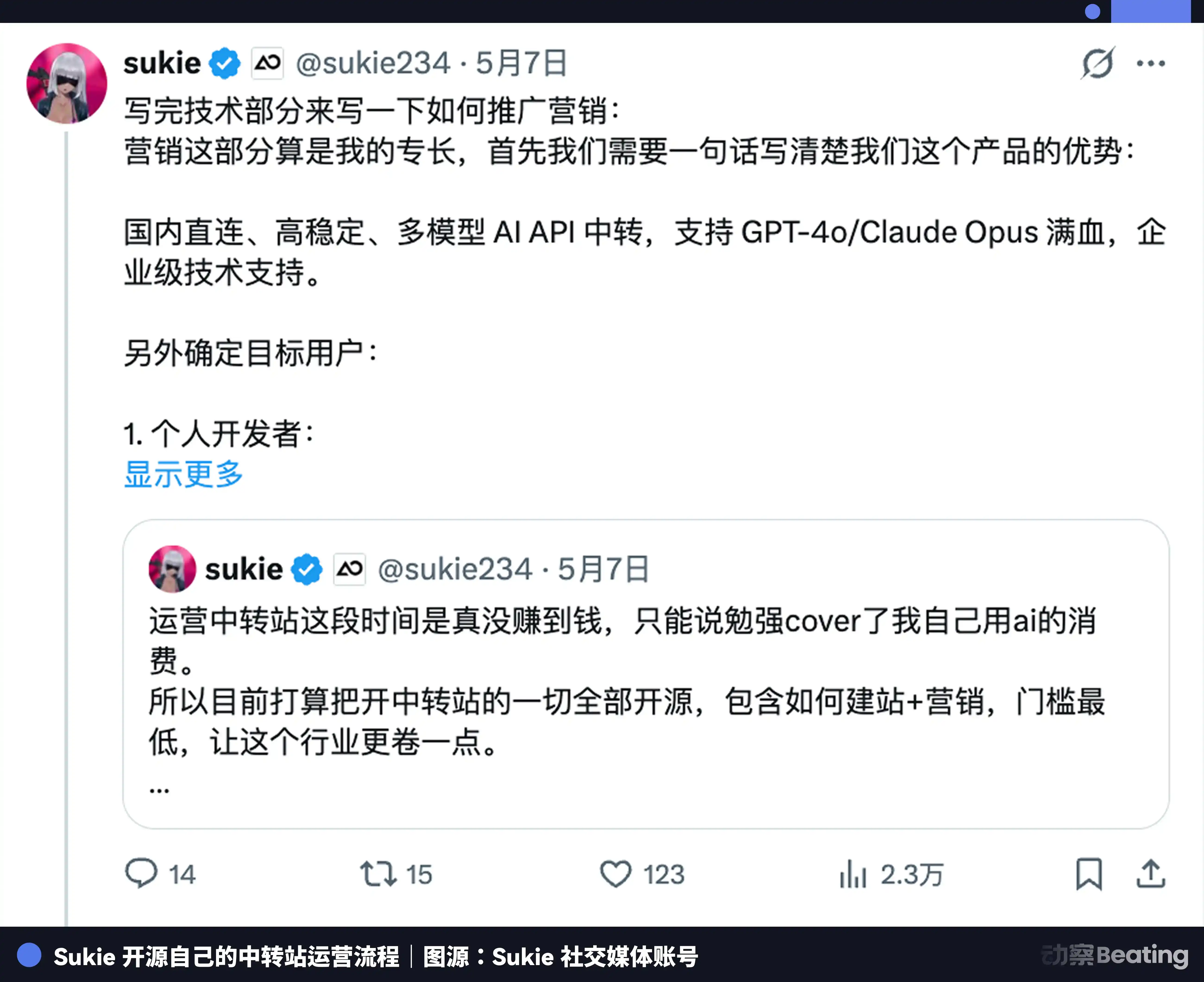
In 2024, the industry still had a gross profit margin of 30% to 40%. The top 20 scaled relay stations were basically all profitable. Competition was based on stability and customer service experience, not price.
The turning point came in the second half of 2025. Wave after wave of new players entered the market, each undercutting the previous price. First 20% off, then 30% off, 40% off, and by early 2026, some were offering 50% or even 70% off the official price.
The current state is that players willing to price with a healthy margin can't survive because users flee; those offering ultra-low prices also can't survive because costs can't be compressed to that level, relying on gray-area operations to sustain.
From an industry perspective, using an account pool from compliant sources, plus labor and server costs, the minimum pricing for profitability is roughly 70% to 80% of the official price. Below that range, either the account pool's origin is problematic, or they are burning through investor money.
10% of the official price—profitability through compliant means is impossible because the upstream account fees alone exceed 10%.
Word spreads in developer communities. Users attracted short-term by ultra-low prices, who discover issues with service quality, token count discrepancies, or inconsistent model outputs, will churn quickly. But when they leave, they take with them a distrust of the entire industry, harming the whole sector.
Earning RMB is Really Hard
My biggest mistake was choosing to earn RMB while being based in the US.
Our costs are settled in USD—account pools, servers, payment channels are all in USD—but our revenue is in RMB, coming from the most price-sensitive developer group in the Chinese market. Chinese users are extremely price-sensitive; their willingness and ability to pay are not on the same level as European or American clients.
Being in the US, I should have directly targeted European and American businesses, earning USD. Selling relay stations to the Chinese market neutralizes all the advantages of geographic location, instead suffering from both exchange rate and payment drawbacks.
There are issues with the payment chain, and pricing competition is fierce, but the fundamental reason is the low payment ceiling of the customer base itself.
The money earned is hard-earned. From buying servers to getting the relay station running, someone with basic technical knowledge can figure it out in a week or two. What truly consumes energy and money are the operational aspects.
The biggest drain is account pool maintenance. Accounts get banned, frozen; status needs monitoring daily, and new accounts need periodic replenishment. Typically, a medium-sized relay station has a pool of hundreds to thousands of accounts.
Upstream platforms' risk control policies, whether request patterns appear human, and the quality of account sources all influence ban rates. Combined, the overall account suspension rate is continuously rising. Some accounts survive for months, others get flagged by risk control on the day of registration.
The second drain is customer service. Relay station users are mostly developers with very specific questions, like why token counts don't match? Why is the response slow? Why is this model throwing errors today? Each has to be answered, or reputation will collapse.
Small and medium enterprises contribute the highest average order value, AI shelling entrepreneurs contribute the highest active usage volume, and individual developers contribute the largest user base but the lowest unit price.
The most difficult to serve are AI shelling entrepreneurs: extremely price-sensitive, comparing and migrating monthly with the lowest retention rates; request volume fluctuates wildly—a product suddenly trending can cause request volume to spike 100x in a day, crashing the account pool. Feedback is also swift; one "doesn't work well" in a developer community spreads much faster than with B2B clients.
The easiest to serve are actually SMEs with dedicated technical contacts: stable traffic, timely payments, requiring invoices and contracts; a few interactions can establish long-term cooperation.
Looking at channels, earning RMB is also harder. This time, I open-sourced the relay station methodology on X, pulling in dozens of new orders. Overseas developers' willingness to pay and decision speed are an order of magnitude higher than domestic. Community referrals and agent distribution have the best conversion because trust costs for relay stations are extremely high; recommendations from acquaintances are ten times more efficient than cold traffic.
SEO and Xiaohongshu (Little Red Book) are slow but steady channels. SEO users have the strongest purchase intent, but traffic is small, growth is slow, taking three to six months to show results. Xiaohongshu has high traffic, moderate conversion; users are mainly AI application-layer developers and early-stage entrepreneurs.
The worst return on investment comes from Douyin (TikTok) and Xianyu (Idle Fish). Douyin's algorithm is unfriendly to technical content; paying for ads yields less than organic growth. Xianyu users expect solutions for a few dozen RMB, but our cost structure doesn't allow such pricing—many inquire but few place orders, each inquiry consuming time.
The third is compliance and payments; cross-border collection requires careful handling of each transaction. For example, our academic clients require contracts, overseas clients use USD channels, domestic clients using RMB need entity and invoice solutions. Each client type has its own compliance process.
Another aspect is preventing free-riding (anti-fraud). Once open source or free trials are offered, scripts for bulk registration to harvest free tokens appear immediately, requiring weekly updates to defense strategies.
Newcomers most easily underestimate the details of these operational aspects. Low barriers mean rapid competition; rapid competition means no moat.
Let the Market Compete More Fiercely
Two weeks ago, Brother Sun (Justin Sun), Fu Sheng, and even the Trump family entered the relay station business. This business has reached an inflection point. Brother Sun focuses on privacy/anonymity plus the lowest prices online. Fu Sheng promotes an 15% discount across the board. The Trump family directly cuts 35%, with the most expensive package at $9,999 including a ticket to Mar-a-Lago.
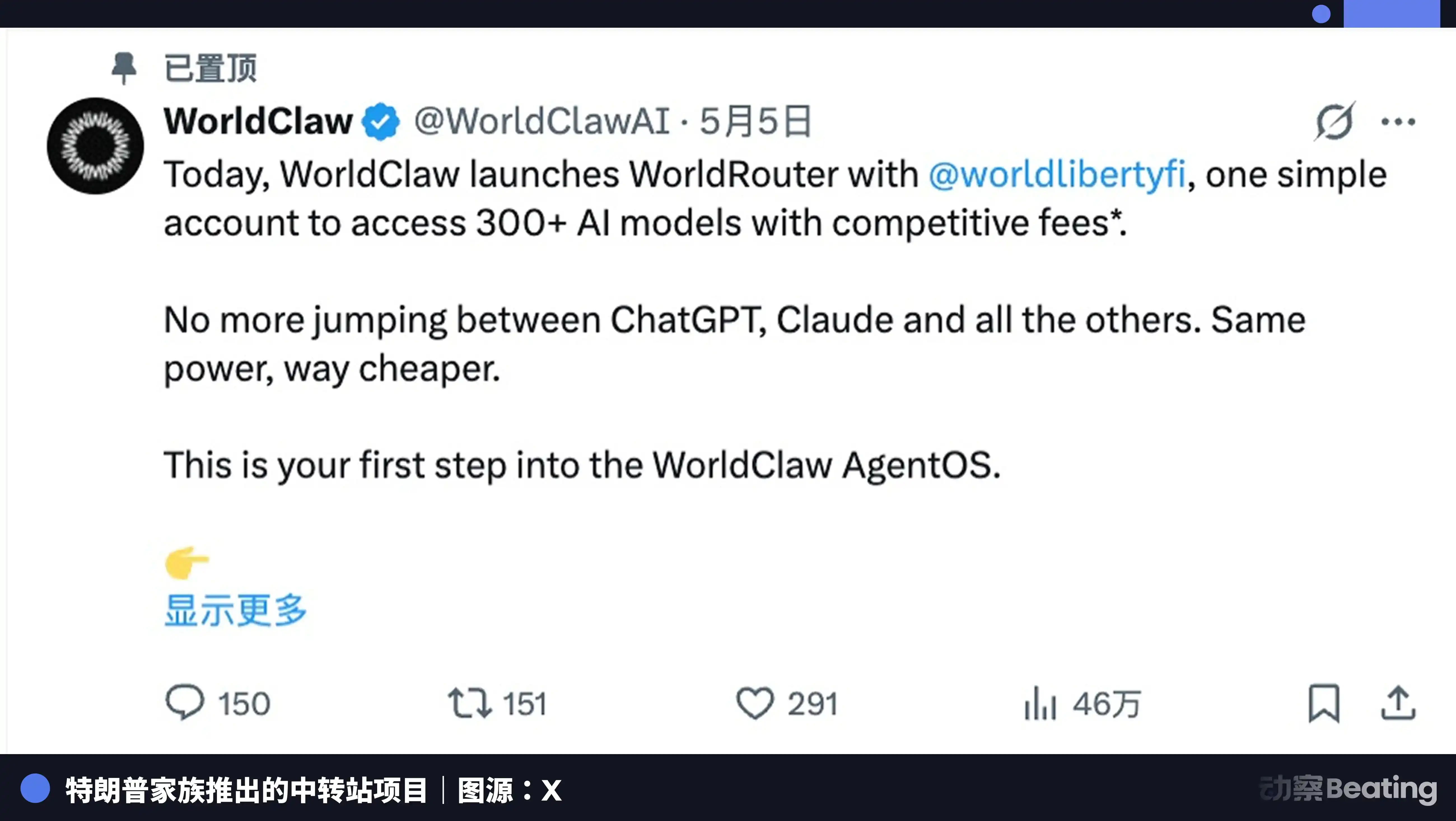
The three target completely different customer segments, but their essence is repackaging upstream model APIs and reselling them. None truly rely on the relay station price difference to survive.
Brother Sun's main dish is on-chain payment settlement; money collected through the relay station is settled via blockchain, essentially generating transaction volume for Tron. Fu Sheng's main dish is the story of Cheetah Mobile's business transformation, telling an AI story to the capital markets. The Trump family's main dish is WLFI tokens and the USD1 stablecoin; the relay station is just a traffic acquisition tool.
For these three parties, the relay station price difference is not the profit source at all. They can use the relay station at a loss to acquire users, then make money from the users through the ecosystem, tokens, and branding.
That's why this business is unfriendly to individuals. People making money in the industry are either exploiting information asymmetry through gray-area operations, or using the relay station to feed a larger business. We fit into neither category.
This is also why I chose to make the relay station business public. On one hand, it serves as marketing; the open-source post's reach these past couple of days far exceeds previous ad posts.
The second reason is industry contribution. Relay stations are heavily demonized; outsiders think they're all gray market, borderline, scams. But there are people doing this compliantly. By making the setup process public, we let more people know the technology isn't a black box.
The moat of this business was already thin, but maintained by high margins through information asymmetry by some black-box operators. After open-sourcing, even amateurs can build their own, eliminating the technical barrier premium of black-box players. What remains are real capabilities: account pool stability, customer service experience, compliance ability.
So the real meaning of "letting the industry compete more fiercely" is shifting the competition from price to service quality. For us, this moves the battlefield to a direction favorable to us.
Continuing to compete on price in the C2C retail battlefield is meaningless. We open-source the tools, letting small players build their own, allowing us to focus on high-margin clients in niche markets.
However, I advise friends still wanting to enter this field: don't jump in lightly.
If you just want to earn some extra cash, find it useful for yourself, and can sell to a few friends around you, you can give it a try. The technical barrier isn't high; running one for personal convenience can also cover server costs.
If you want to treat this as a full-time startup project, don't do it. High-end players have their own ecosystems behind them; ultra-low-price players use gray methods. You can't compete on price if you're doing it compliantly.
If you're already in the game, then focus on niche markets, like B2B, academic institutions, or overseas markets.
There are so many more worthwhile directions to invest in within the AI industry; no need to bet on a track with no moat.
A relay station is just an entry ticket, not the destination.