From Code to Cognition: A Ten-Thousand-Word Guide to the Evolution of the Robot Brain

marsbit2026-06-07 tarihinde yayınlandı2026-06-07 tarihinde güncellendi

Özet

"From Code to Cognition: The Evolution of Robot Brains" The journey of robotic intelligence has shifted dramatically from manually coded systems to AI-driven brains. For decades, robots relied on layered software stacks—perception, state estimation, planning, control—each handcrafted. While predictable, they lacked adaptability. The 2010s saw deep learning revolutionize perception (e.g., object detection) and control (via reinforcement learning), but learned skills remained narrow. The arrival of Large Language Models (LLMs) marked a turning point. LLMs acted as high-level planners, interpreting natural language instructions and generating sequences of actions for traditional robotic systems to execute. However, true integration came with Visual-Language-Action (VLA) models, which fused vision, language, and motion prediction into a single network. Pioneered by models like RT-2 and open-source projects like OpenVLA, VLAs enable robots to reason and act directly from visual input and commands. The most advanced humanoid robots now employ a "dual-brain" architecture: a slow-thinking, large VLA (System 2) for reasoning and planning, and a fast-reacting, small network (System 1) for high-frequency motion control, sometimes with an even lower-level System 0 for balance. This split balances cognition with the physics of real-time movement. Computation is split between onboard hardware (e.g., NVIDIA Jetson) for safety-critical control loops and cloud/edge servers for non-critica...

Author: Matt White, Global AI Chief Technology Officer, Linux Foundation

Compiled by: Felix, PANews
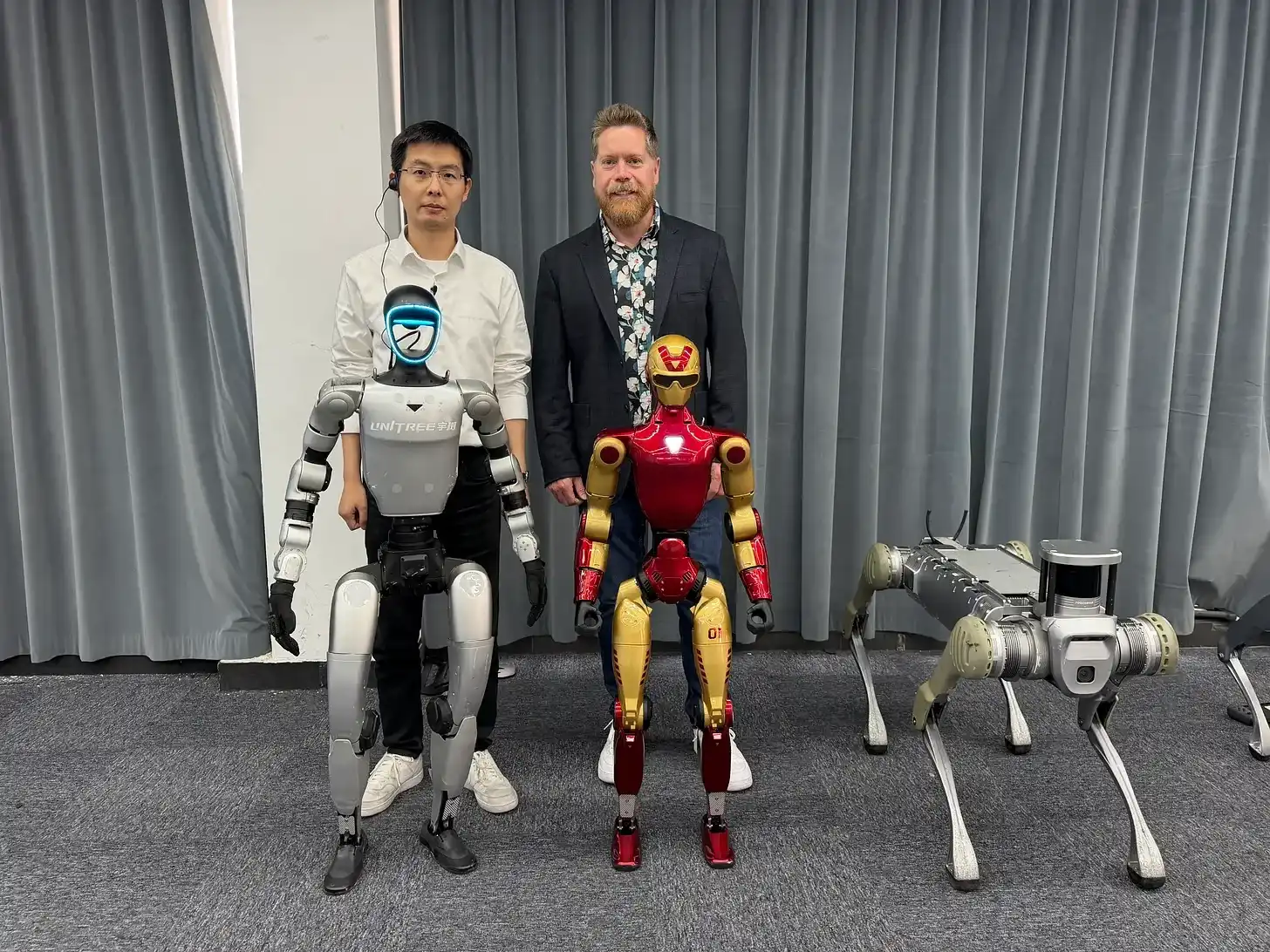
Wang Xingxing (CEO of Unitree) and Matt White

A few weeks ago in Shanghai, a traveling companion (someone intelligent, observant, and who follows the news, but not deeply familiar with robotics) asked a question over dinner that had been anticipated throughout the trip.

"Those robotic dogs we see running around, the humanoid robots performing kung fu on the demo stage at Unitree's office, and the robot arms folding clothes we saw. How do they do it? Are they powered by large language models (LLMs)? How does this actually work? Is there some kind of language model controlling their movements?"

It's a great question, and frankly: yes, in a way, but the real story is far more interesting. The robots you see on social media are not ChatGPT in a metal shell. They run on a technology stack (multiple layers of AI working together). This stack has changed more in the past three years than in the previous thirty. Language models are part of it. Vision models, motion models, behavior trees, classic control loops, and an emerging family of systems called "world models" are also crucial components. And "world models" might be the most significant development of all.

This is a long article. It will start from the beginning, walk through each major transformation step by step, and arrive at the current stage: where robots can not only react to the world but also imagine it.

One: The Pre-LLM Era: When Robots Were Just Software

For decades, building a robot meant writing a massive amount of code, and almost none of it involved learning.

Classic industrial robots were carefully constructed towers of meticulously designed modules. Like the orange robotic arms welding Toyota chassis in the 1990s or Boston Dynamics' BigDog in the early 2000s.

  • Perception: Filtering camera feeds, performing edge detection, using geometric matching to identify workpiece positions.
  • State Estimation: Combining wheel encoders, gyroscopes, and accelerometers (sensor fusion) to determine the robot's position and speed.
  • Planning: Given a target pose, computing a collision-free path within a known map using algorithms like A* or RRT.
  • Control: At the lowest level, PID controllers adjusting motor torque hundreds or thousands of times per second to follow that path.

These layers were often written by different people in different labs and painstakingly stitched together. Behaviors (e.g., "if the cup is red, pick it up; otherwise, wait") were encoded as state machines or behavior trees: flowcharts for the robot to follow step-by-step.
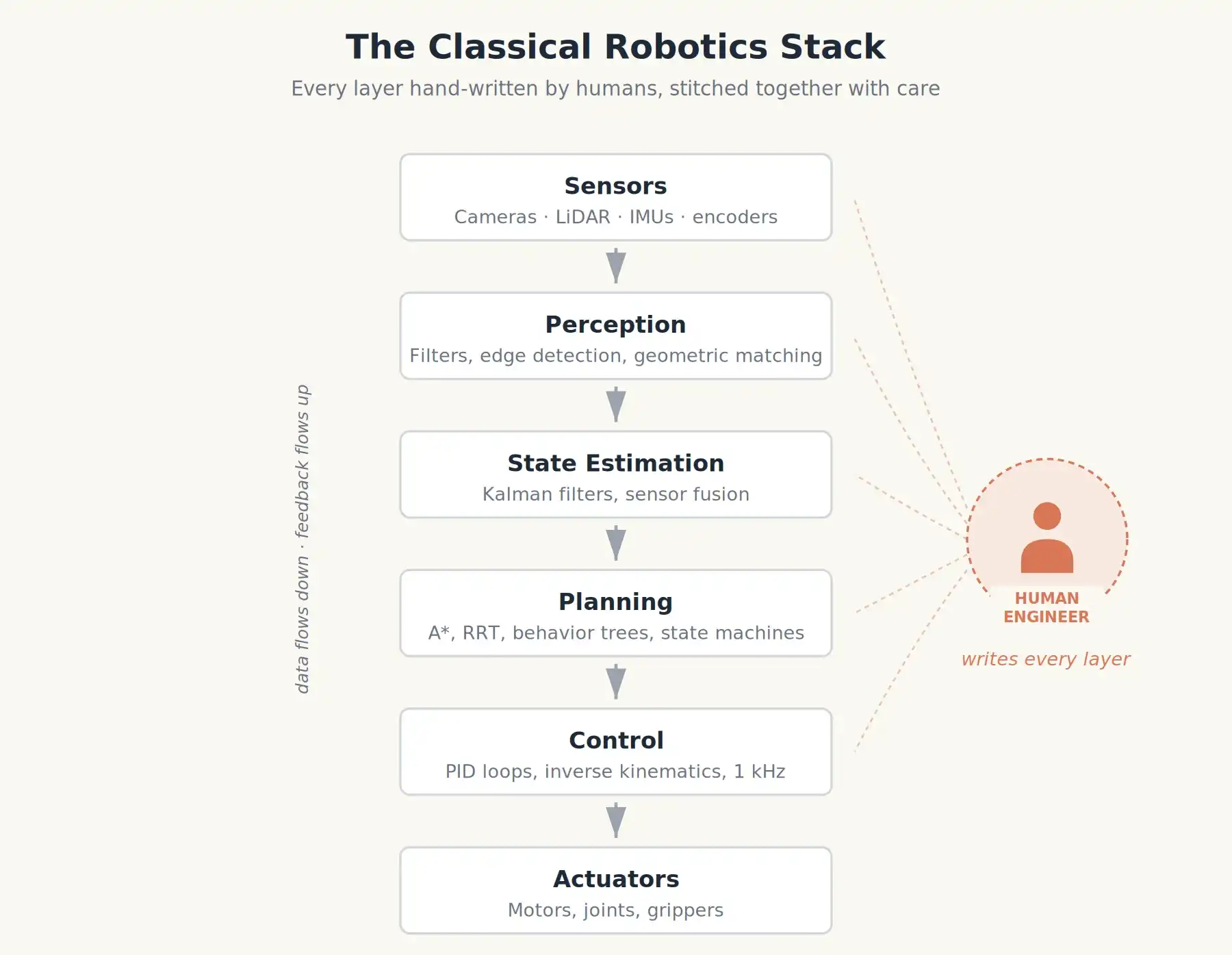
The advantages of this approach are obvious. It's predictable and meets safety standards. This is why your car has functional ABS brakes.

The disadvantages are equally obvious. Such a robot is only as smart as the scenarios the engineer envisioned. Put it in a new factory, under new lighting, or with a new cup color, and it breaks. Its ability to generalize is almost zero.

Two: Machine Learning Quietly Steps In

In the 2010s, deep learning began tackling the perception layer. Convolutional neural networks (CNNs) that beat humans at ImageNet image classification could be retrained to detect grasp points on objects, segment furniture in a room, or recognize human poses. Suddenly, the top "perception" layer of the stack didn't need handcrafting; you could just train it.

Then, learning crept into the "control" layer. Researchers from UC Berkeley, DeepMind, and OpenAI showed that reinforcement learning (letting a robot agent try millions of times in simulation and reinforcing what works) could produce surprisingly dexterous gaits, hand-object manipulation (OpenAI's one-handed Rubik's Cube solve in 2019 was a milestone), and locomotion strategies adaptable to different terrains.

A parallel line of research was imitation learning, often called behavior cloning: record hundreds of attempts of a human teleoperating a robot on a task, then train a neural network to predict what action the human would take given what the robot sees.

The key point in all this: each learned policy was too narrow. Train a network to pick up a red block, and it doesn't know what to do with a yellow cup. Train it to walk on grass, and it falls on tile. Generalization remained the unsolved problem.

It's worth noting that an infrastructure emerged during this period that still underpins almost everything today: ROS, the Robot Operating System (first released in November 2007). ROS is not an operating system in the Windows or Linux sense, but a middleware framework, a universal robot plumbing system. It allows "camera nodes," "navigation nodes," "arm controller nodes," and dozens of others to publish and subscribe to messages over a shared bus.

The current version, ROS2, runs at the bottom layer of the vast majority of research and commercial robots worldwide, from Stanford labs to Chinese humanoid robot startups. When people talk about a robot's "operating system," they almost always mean ROS2 plus the various perception, planning, and control packages running on top of it.
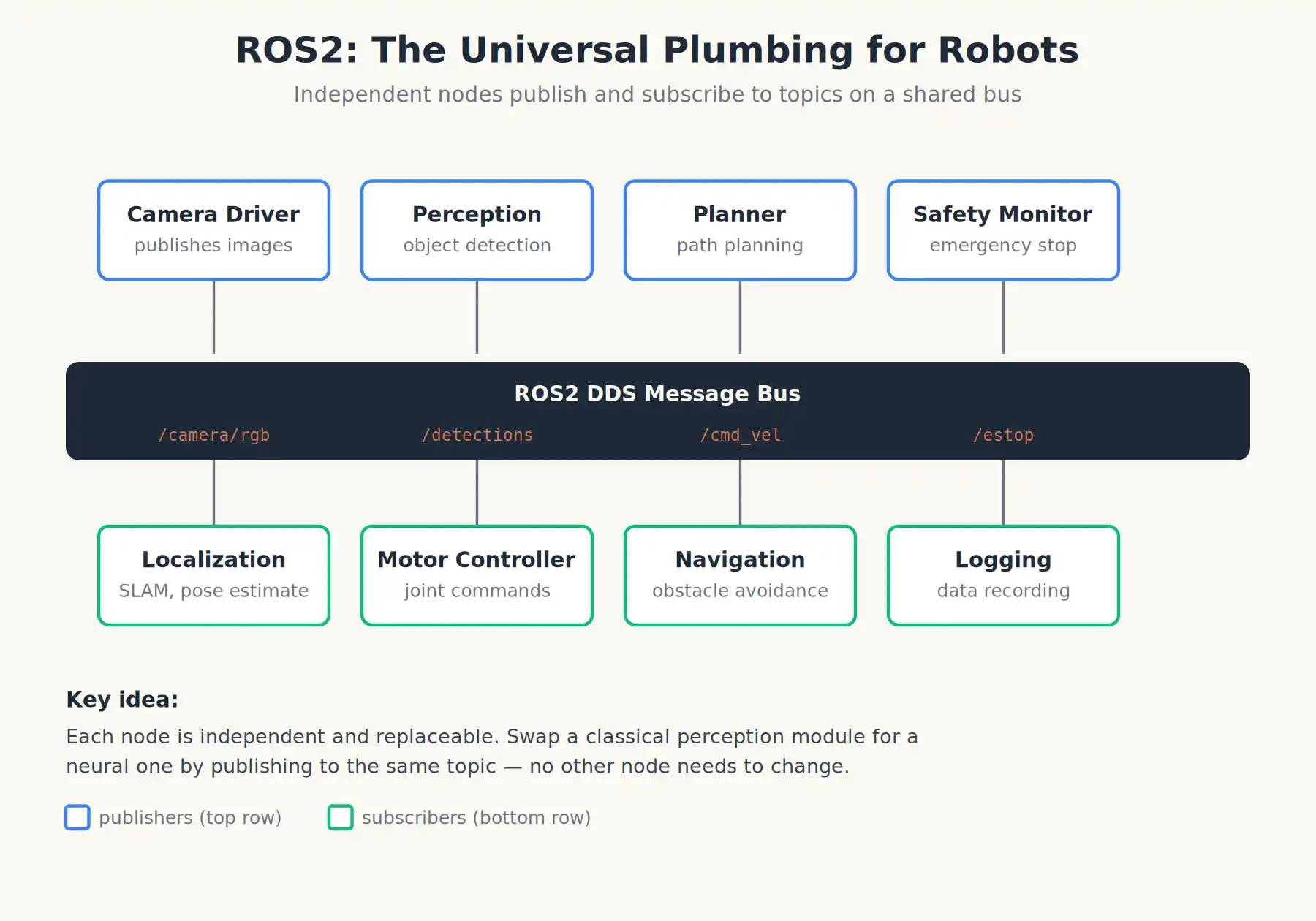
ROS2: It's not the OS, but the universal plumbing that lets disparate robot software talk to each other

Three: LLMs for Robotics

Then came ChatGPT.

Suddenly there was this thing: the LLM. It could read simple English instructions, do multi-step reasoning, write code, and call functions. Roboticists realized almost instantly: this was the missing piece they had struggled with for years. The hardest part of getting a robot to do something useful in a home or office often wasn't motor control, but human-robot interaction: how does a human tell the robot what to do, and how does the robot decompose that goal into atomic actions it already knows how to perform?

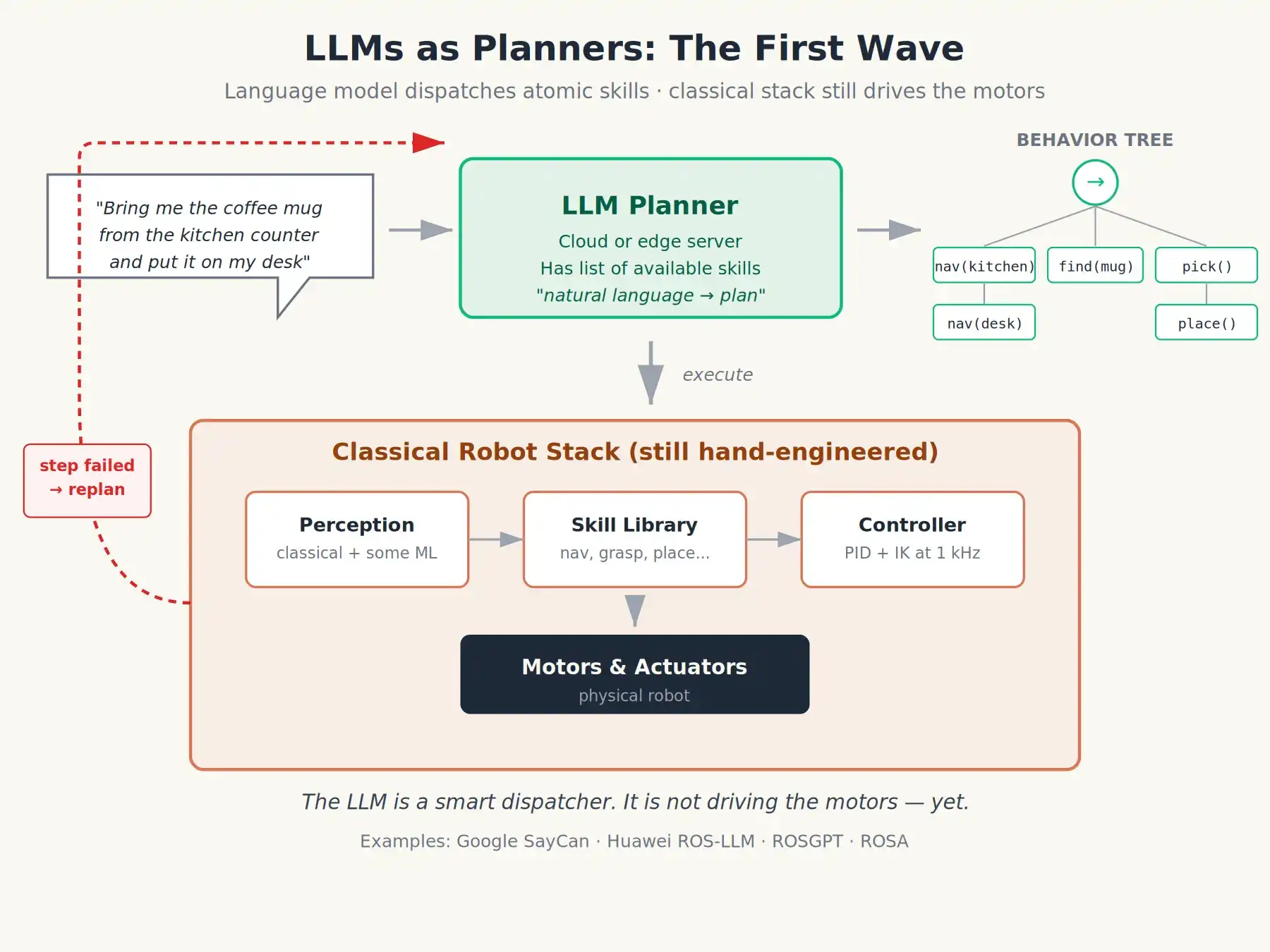
The first wave of applying LLMs to robotics was to treat the language model as a natural language compiler sitting on top of ROS. The pattern:

  1. User says in English: "Bring the coffee mug from the kitchen counter to my desk."

  2. LLM generates a plan based on a list of available atomic skills for the robot: a sequence of function calls, a state machine, or a behavior tree written in XML.

  3. ROS2 nodes execute the plan step by step. If a step fails, the failure is reported back to the LLM for re-planning.

Google's SayCan project in 2022 was a very clean version of this idea: the LLM proposed skills, a separate "affordance" model scored the likelihood of each skill succeeding right now, and the robot picked the combination with the highest joint score. Open frameworks like ROS-LLM, ROSGPT, and ROSA, led by Huawei Research labs, popularized this pattern.

This was indeed a huge leap. Suddenly, you could tell a robot "clean the table, put recyclables in the blue bin," and it would attempt something sensible. But note the remaining issues: the language model is still at the planning layer. The actual motion commands are still generated by those painstakingly designed or narrowly trained controllers underneath. The LLM is just an intelligent dispatcher; it's not driving.
Four: Vision-Language-Action Models (VLA), When the Brain Starts Driving
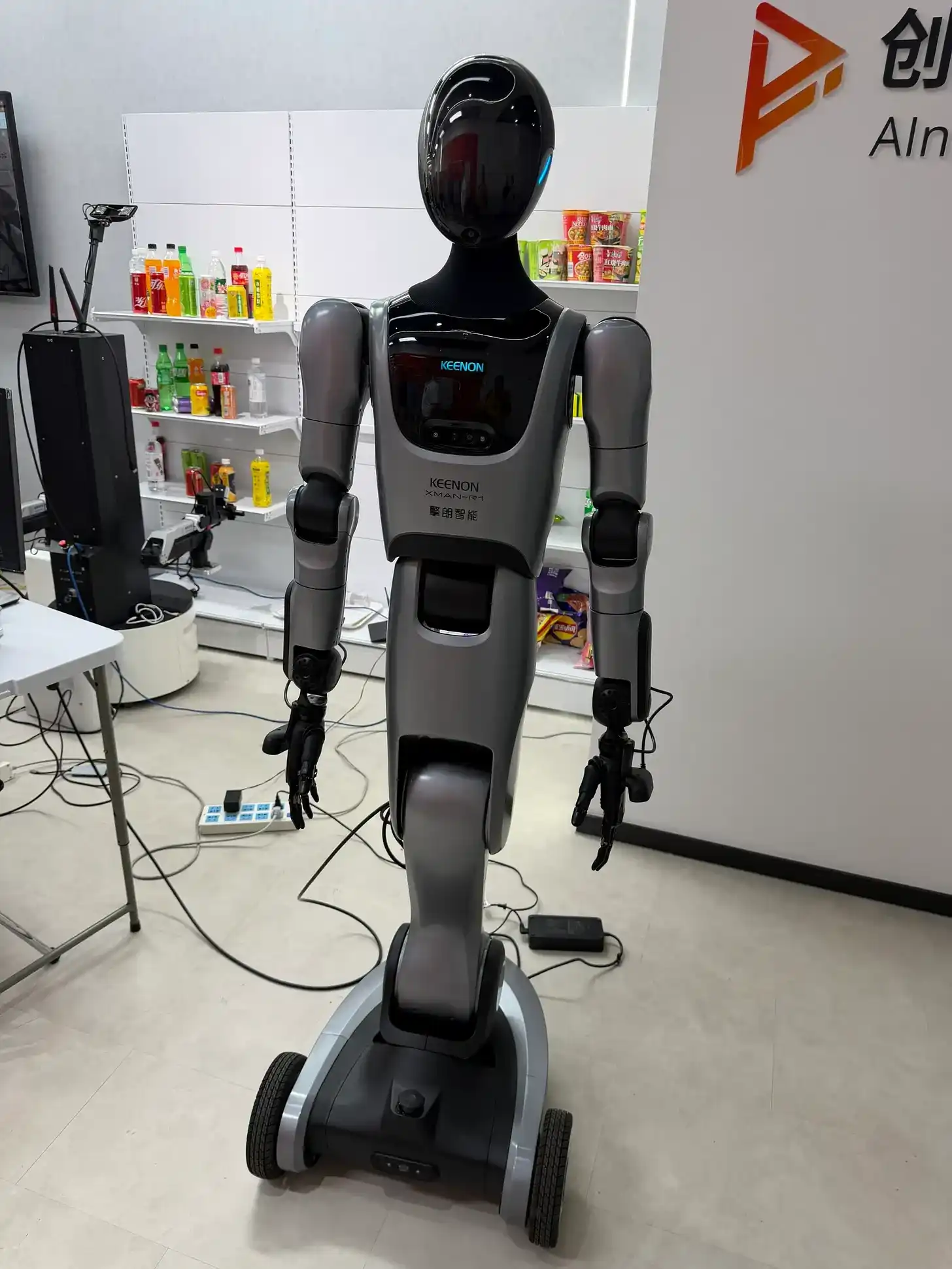
Keenon XMAN-R1 robot picking medicine from shelves in an automated pharmacy at Beijing Galbot. For just $100k

The next leap was harder and more important. Researchers asked a more ambitious question: What if the model could not just plan but also directly generate actions? What if you fed camera images and language instructions directly into a neural network and got back the next millisecond's joint movements?

This is the Vision-Language-Action model (VLA). It is now the dominant paradigm for humanoids and quadrupeds.

The first widely known vision-language robot was Google DeepMind's RT-2 in 2023. The cleverness was this: take a large vision-language model (trained for image captioning and Q&A) and continue training it on robot demonstration data, but treat robot actions as just another token to predict. The same neural network that could output "cat sits on mat" could now output a series of tokens encoding "move right paw forward 3 cm, close gripper, lift 5 cm." Reasoning and action were in the same model.

Then, in mid-2024, a team led by Stanford released OpenVLA, an open-source 7-billion-parameter VLA model trained on the Open X-Embodiment dataset, a collection of over a million training episodes from 21 different research labs across 22 different robot bodies. For the first time, someone outside Google could download a generalist robot model and start hacking. It changed the field overnight.

Today, leading VLAs, though few, are rapidly evolving:

  • π0 and π0.5 from Physical Intelligence: Excellent at task adaptation.
  • NVIDIA Isaac GR00T N1.7: Open weights, commercial license, designed for humanoids, the model most Chinese hardware companies are currently fine-tuning with their own data.
  • Figure AI's Helix and newer Helix-02: Proprietary, but architecturally significant.
  • AgiBot's Genie Envisioner: A Chinese world-model-based platform.
  • SmolVLA, NORA, ACoT-VLA, CogACT: A growing crop of VLAs from academia exploring different design directions.

How VLAs Work (No Math)

Think of a VLA as fusing three input streams into one output stream.

First stream is vision. RGB cameras (sometimes depth sensors or lidar), sometimes tactile sensors on fingertips, processed by a vision encoder (usually a Transformer model like DINOv2 or SigLIP) that compresses each image into a few hundred "vision tokens" summarizing what the robot sees.

Second stream is language. Your instruction ("hand me the screwdriver") gets tokenized just like in ChatGPT.

These two streams are concatenated and fed into a Transformer "backbone" (often a small open-source language model like Qwen3 or Llama). This backbone does the reasoning, combining what it sees with what it's asked.

Third stream: action, out the other end. This is where architectures diverge:

  • Discrete action tokens: The model directly generates tokens that decode to joint angles or end-effector positions, just like ChatGPT generates words. Simple but can be jerky at high frequency.
  • Diffusion or flow-matching action head: A separate tiny network takes the backbone's output and denoises a smooth trajectory of joint positions, like an image diffusion model but for motion. This is what π0 does, producing smoother, more natural actions.
  • Action chunking: Predicts not the next single command but the next half-second of commands all at once, smoothing out jitter.
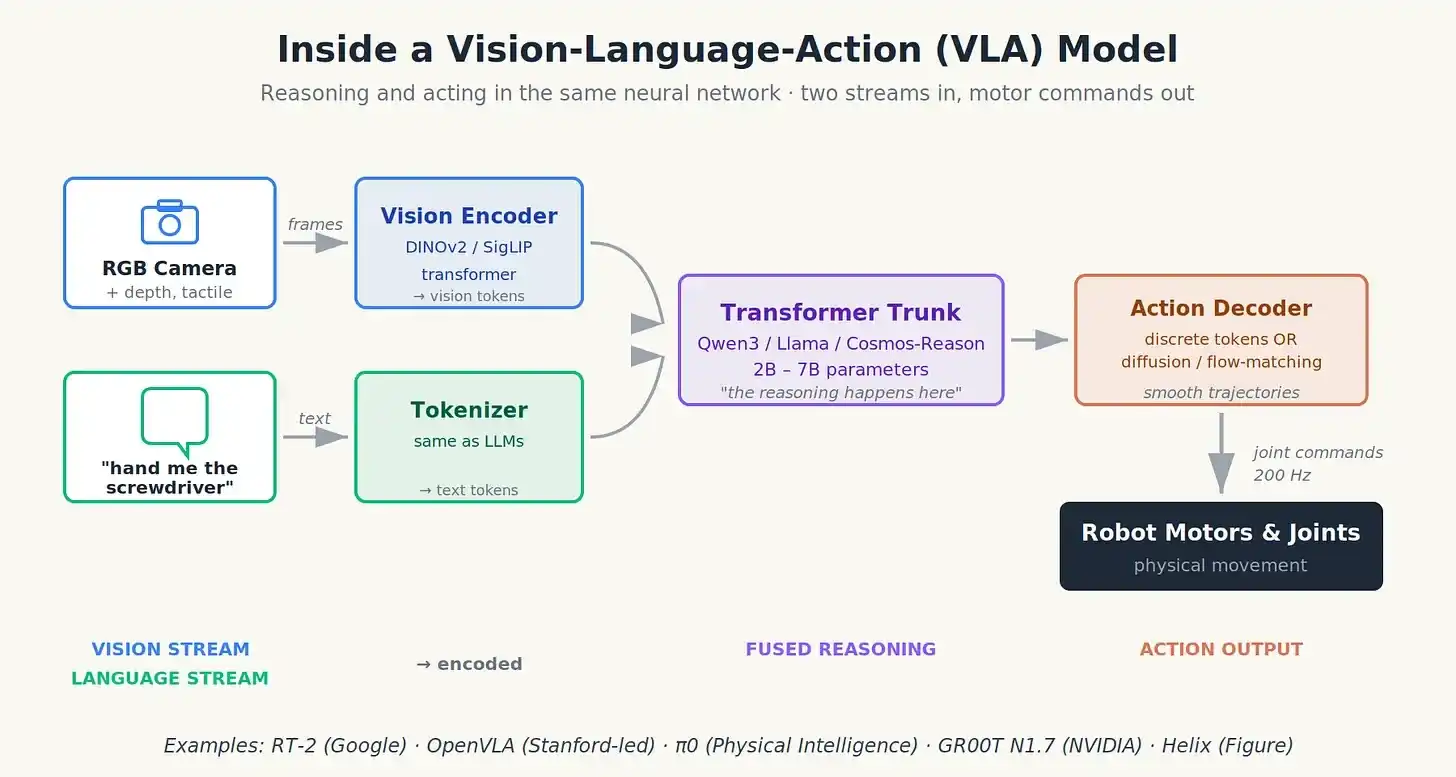
In a VLA model: two input streams in, motion commands out, reasoning and action fused in one network.

This is the crucial architectural shift: reasoning and action are no longer separate. Teaching a neural network to recognize a cup also teaches it how to grasp it. This coupling is what gives VLAs the generalization their predecessors lacked.

Five: The Two-Brain Strategy, How LLMs and VLAs Work Together

Here's a detail rarely explained clearly in marketing. The best-performing humanoid robots today don't run a single VLA system; they run two models at different speeds talking to each other. This is sometimes called the dual-system or System 1 / System 2 architecture, borrowing from Daniel Kahneman's psychology framework that humans have a fast, intuitive brain and a slow, deliberate thinking brain.

Figure AI's Helix made this design classic, and now it (and its variants) is copied almost everywhere. Crucially, NVIDIA's GR00T N1.7 uses this design, as do most Chinese humanoids. The structure:

  • System 2 (S2): The slow-thinking brain. A ~7-billion-parameter vision-language model running at about 7–9 Hz (7 to 9 times per second). Its job is to observe the scene, parse the instruction, do multi-step reasoning ("the bowl is behind the cereal box; I need to move the box first"), and emit high-level intents—often a compact set of internal vectors, not words.
  • System 1 (S1): The fast-reacting brain. A much smaller (~80-million-parameter) visuomotor policy model running at 200 Hz. It takes S2's intent vectors plus the latest sensor data and outputs continuous joint commands. It does no real "thinking," just reacts.

Recently, Figure's Helix-02 added a System 0. It sits beneath the dual brains, a reflex layer, not a third cognitive layer. This is a 10-million-parameter network running at 1 kHz, handling low-level balance and whole-body coordination, replacing over a hundred thousand lines of hand-coded C++ motion control. Think of S0 as a learned spinal cord: it doesn't reason or plan, just keeps the body upright and coordinated while thinking happens above.
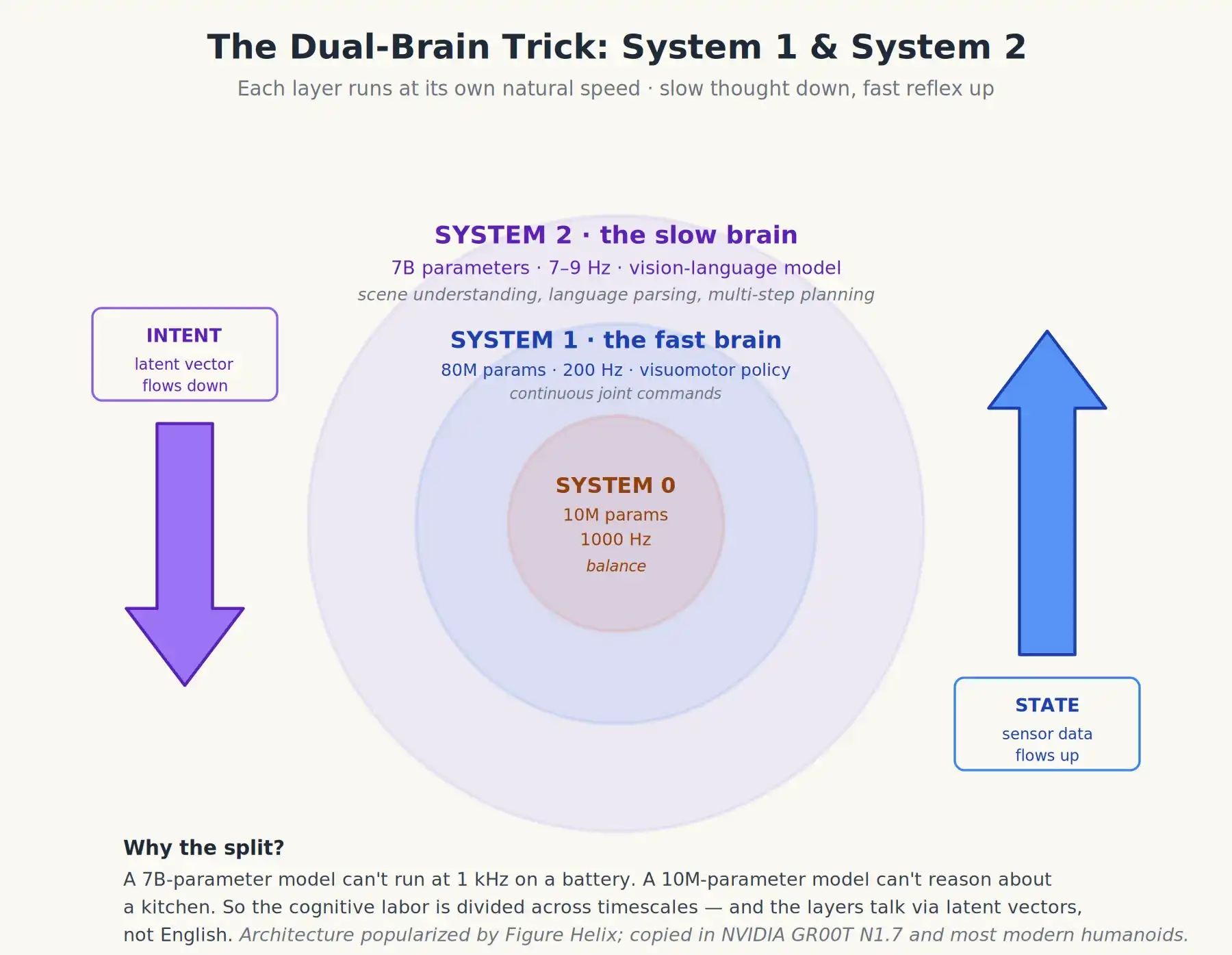
The dual-brain architecture of a modern humanoid: System 2 thinks slow, System 1 reacts fast—with a System 0 reflex layer beneath for balance, contact, and whole-body coordination

This division stems from physics. If motion commands are issued only every 200 milliseconds (the speed of a large VLA), the robot moves like it's underwater. Motion command updates must be faster than the natural oscillation of the joints they control, meaning hundreds to thousands of updates per second. No 7-billion-parameter Transformer model can run that fast on a battery-powered robot.

So, cognition is split: a big, slow model thinks; a tiny, fast model acts. They don't talk in English but in learned latent vectors: the slow model emits an abstract goal, and the fast model knows how to interpret it.

Six: Cloud, Edge, and Where the "Brain" Lives

Where does all this computation actually happen?

Today, there's a strong, almost ideological consensus across robotics teams that safety-critical control loops must run locally. Two reasons:

Latency. Round-trip over WiFi or cellular is optimistically 30-80 ms. Motion commands need updates every 1-5 ms. That network loop simply doesn't work.

Reliability. Robots operate in factories, warehouses, kitchens, hospitals. Networks drop. If a lost Wi-Fi signal stops the robot, it's a safety hazard.

So, the modern split is roughly:

Onboard (local), on something like an NVIDIA Jetson Thor or AGX Thor module (~2,000 TFLOPS, 128 GB RAM, 40–130 W):

  • All of S0/S1: balance, locomotion, fine motor control.
  • The VLA itself (System 2), increasingly quantized to FP8 or FP4 to fit hardware constraints. Models in the 2B to 7B parameter range can now run on-device.
  • Perception, sensor fusion, and safety monitors that can override anything else.

Cloud or remote server (if present):

  • Conversational interfaces ("Hey robot, what should I cook for dinner?"): Latency-tolerable.
  • Fleet learning: Thousands of robots send teleoperation data back to a server to aggregate into the next model version.
  • Large-scale, long-horizon planning, potentially using frontier-scale models.
  • Operator dashboards and monitoring.

There's also a growing middle layer: local edge servers in the factory or warehouse, communicating with a robot fleet over a local network with single-digit millisecond latency. Larger LLMs might live here, doing high-level scheduling a single robot doesn't need to manage itself.

China's humanoid robot wave is built on this assumption: Unitree, AgiBot, XPeng IRON, Fourier, EngineAI. Their robots have onboard compute (often Jetson, sometimes domestic chips like Huawei Ascend), with the cloud used for fleet learning and conversational interfaces, not control loops.
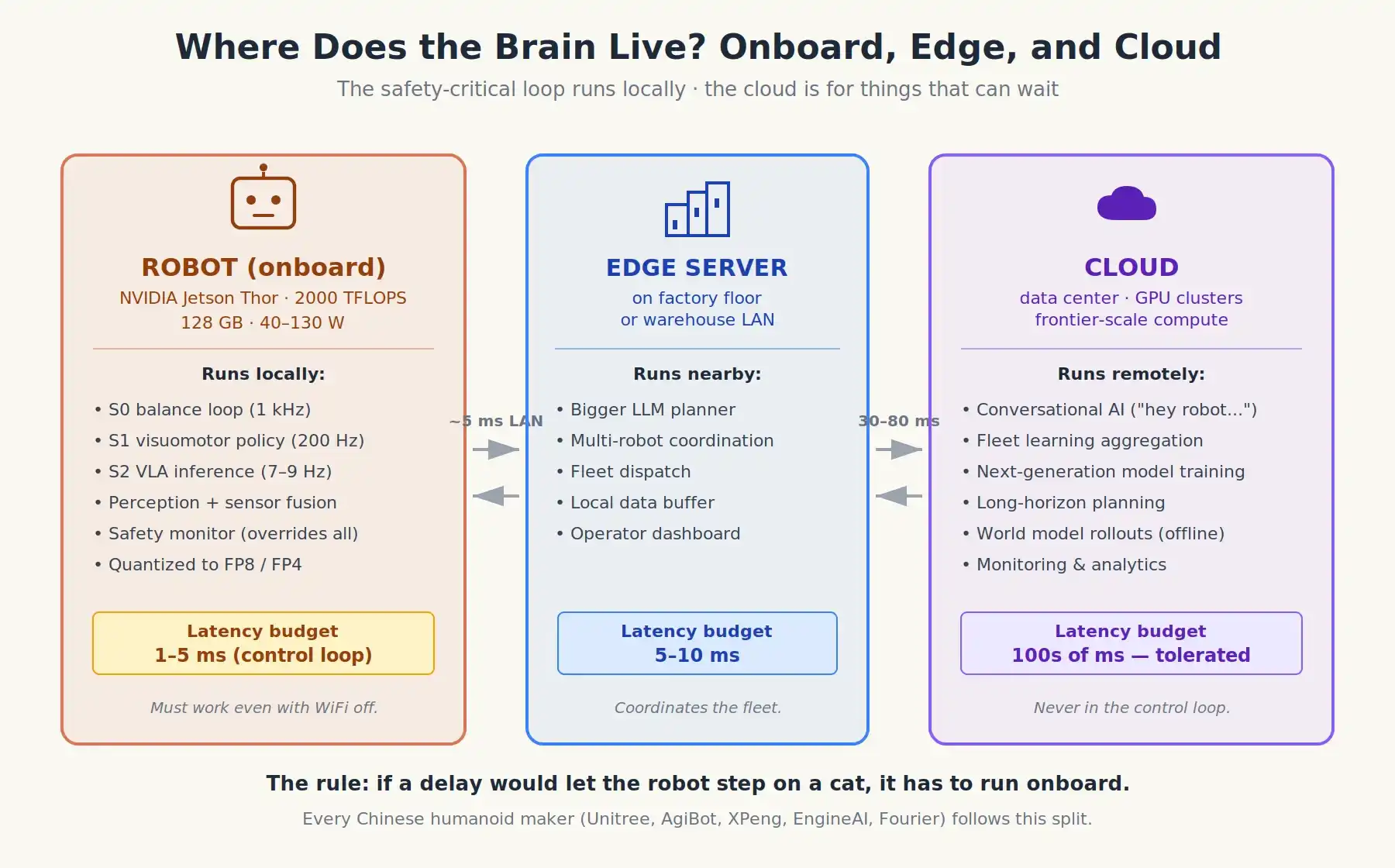
Where the robot brain actually lives: safety-critical loops are local, cloud for things that can wait

Seven: Why Open-Source Models Are Quietly Becoming the Center of Gravity

If you only watched demos, you'd think the field was dominated by a few well-funded US companies. The reality is more complex. The speed of physical AI progress is largely set by open-source weight models anyone can download and fine-tune.

The list is short but significant:

  • OpenVLA (Stanford): The first open-source 7B generalist robot model.
  • NVIDIA Isaac GR00T (N1, N1.5, N1.7): Open weights forthcoming, commercial license upcoming, trained on tens of thousands of hours of human egocentric video. GR00T N1.7, released March 2026, will make its dual-system architecture free for anyone with a humanoid.
  • Physical Intelligence's π0: Weights released for research.
  • NVIDIA Cosmos: Open-world foundation models.
  • AgiBot World: Large open-source dataset of teleoperated humanoid demos from a Shanghai startup.
  • Hugging Face's LeRobot: An open library that has become the gathering place for all of the above.
  • Mimic robotics' mimic-video: An open-source video-to-action model with 10x sample efficiency over traditional VLAs.

This matters for two reasons. First, a robotics startup doesn't need to spend tens of millions pre-training a foundation model: they can take GR00T or π0 and fine-tune it with their own robot's data. This is what Unitree, EngineAI, Booster, Galbot, and dozens of smaller Chinese companies do. It's why a company with a few hundred employees can produce a talking, walking, shirt-folding humanoid: they're standing on the shoulders of an open stack.

Second, open-source models are the only realistic path to safety. If a fully closed model runs inside a robot on some factory floor, with zero external visibility into its reasoning, that's a regulatory nightmare. Open models let auditors, researchers, and operators actually inspect what the robot was trained on.

Eight: What's Still Broken

If you've seen enough robot demo videos, you've also seen plenty of robot fail videos. The current generation of LLM+VLA robots is genuinely impressive but also genuinely limited. Here's what's broken:

  • Mid-task recovery. VLAs handle unexpected variation better than anything before. But when things truly go wrong (mis-grab, object rolls, human walks into workspace), getting back on track is still weak. Robots will mindlessly repeat failed actions.
  • Sample efficiency. Training a VLA from scratch requires tens of thousands of hours of teleoperation data. A human learns to use a new tool in minutes. This efficiency gap is huge.
  • Cross-embodiment generalization. A model trained on a Franka arm in a Stanford lab doesn't perfectly transfer to a Unitree humanoid in a Shenzhen warehouse. The bodies are different.
  • Long-horizon tasks. Any behavior requiring over 30-60 seconds of coherent action with multiple sub-goals tends to drift. "Make me breakfast" remains out of reach.
  • Physical common sense. VLAs are trained to imitate, not to understand. They don't truly understand that knocking over a cup of water will spill it. They've just seen examples and predict what happens next via pattern matching.
  • Spatial reasoning. Despite being multimodal, they are surprisingly weak at tasks like "go around the obstacle, not through it" or "stack these things without toppling."

This final cluster of weaknesses is driving the field to bet on a very different kind of model.

Nine: World Models

Imagine this: Instead of training a robot to predict actions, train it to predict the consequences of actions.

A world model is a neural network that, given the current world state (often a video or sequence of frames) and a proposed action, predicts what the world will look like next. Simply, think of it as a learned video predictor with a steering wheel. You show it the last second of camera feed and say "robot moves arm forward 10 cm," and it generates a realistic video of what the next second will look like.

Why is this important?

Because once you have a world model, the robot can think before it acts. It can imagine three or four different candidate actions, predict their outcomes, score them, and pick the best one—all before any motor moves. This is how a chess engine works: it doesn't memorize moves; it simulates futures. This capability never existed for physical robots before because we never had a model accurate enough to simulate the messy real world.
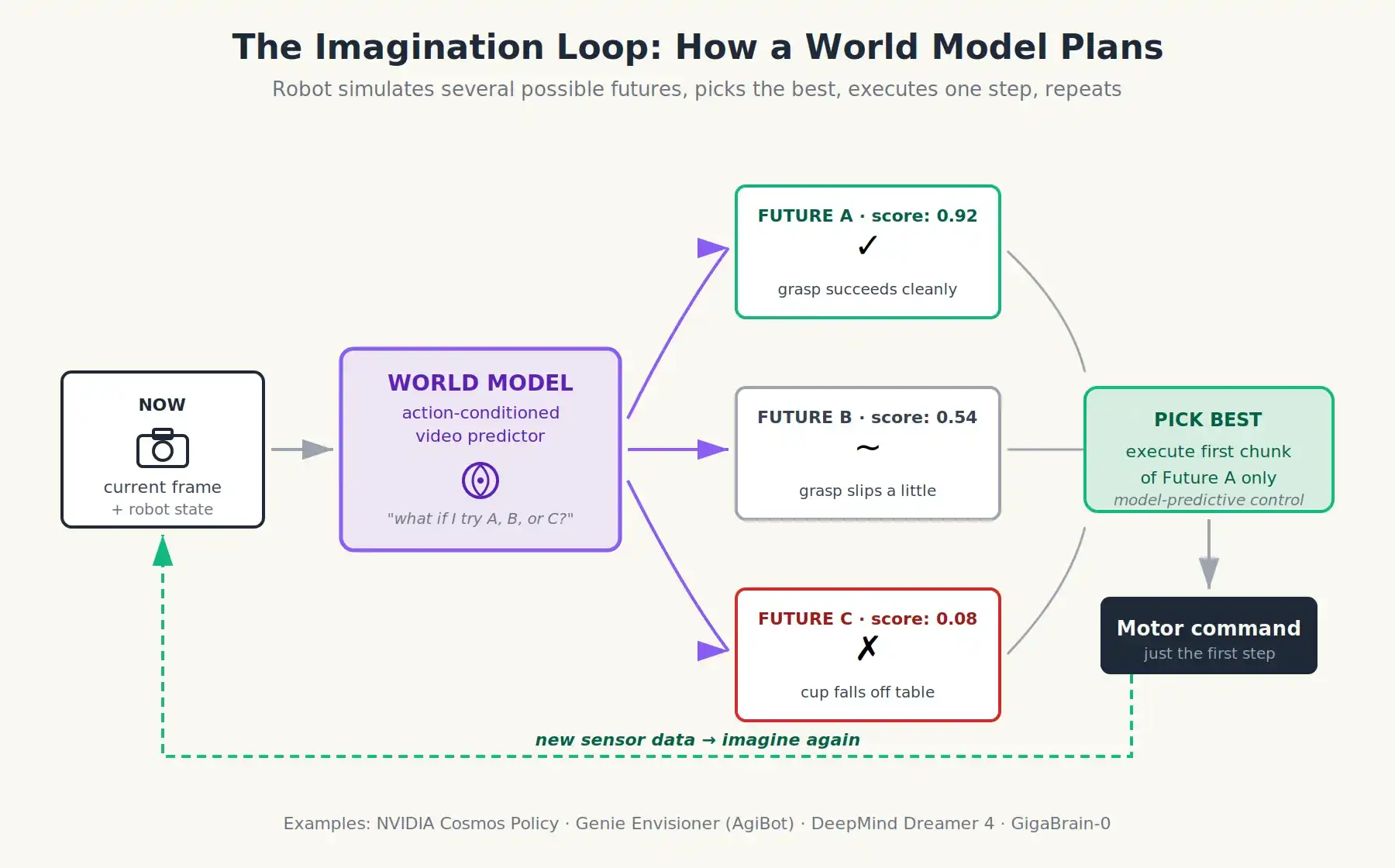
World models let a robot simulate multiple possible futures, score them, and pick the best one before any motor moves

What does a world model look like in 2026?

The state-of-the-art world models are diverse but rapidly evolving. Here are a few:

  • NVIDIA Cosmos: A suite of open-world foundation models, including Cosmos Predict 2.5 (generative), Cosmos Transfer 2.5 (controllable simulation), Cosmos Reason 2 (vision-language reasoner for robotics), and the newest Cosmos Policy, which goes further by fine-tuning the world model to output actions for control directly. Cosmos is trained on hundreds of thousands of GPU-hours of video data (Cosmos Predict 2.5 is the world model in this family).
  • DeepMind Genie 3: An interactive world model that can generate fully navigable environments from text prompts at 24 fps, running stably for minutes. Initially built for game environments.
  • Meta V-JEPA 2: Pretrained on over a million hours of web video, then action-conditioned with just 62 hours of robot video. Achieves 80% zero-shot pick-and-place success on real robot arms across different labs with no task-specific training. The "JEPA" approach is architecturally distinct from others.
  • DeepMind Dreamer 4: Learned to collect diamonds in Minecraft (a 20k-step task) using only offline data, no environment interaction. Proof that real reinforcement learning in imagined worlds is possible.
  • AgiBot's Genie Envisioner: A unified world model platform from China, trained on over 3,000 hours of real-world humanoid operation video. It can generate both predicted rollout trajectories and executable action trajectories. AgiBot uses NVIDIA Cosmos Predict 2 as a backbone, fine-tuned with its own data. This is exactly the "open stack + own data" pattern described earlier.
  • Toyota Research Institute's Cosmos-based world model: For teleoperation data augmentation and navigation.
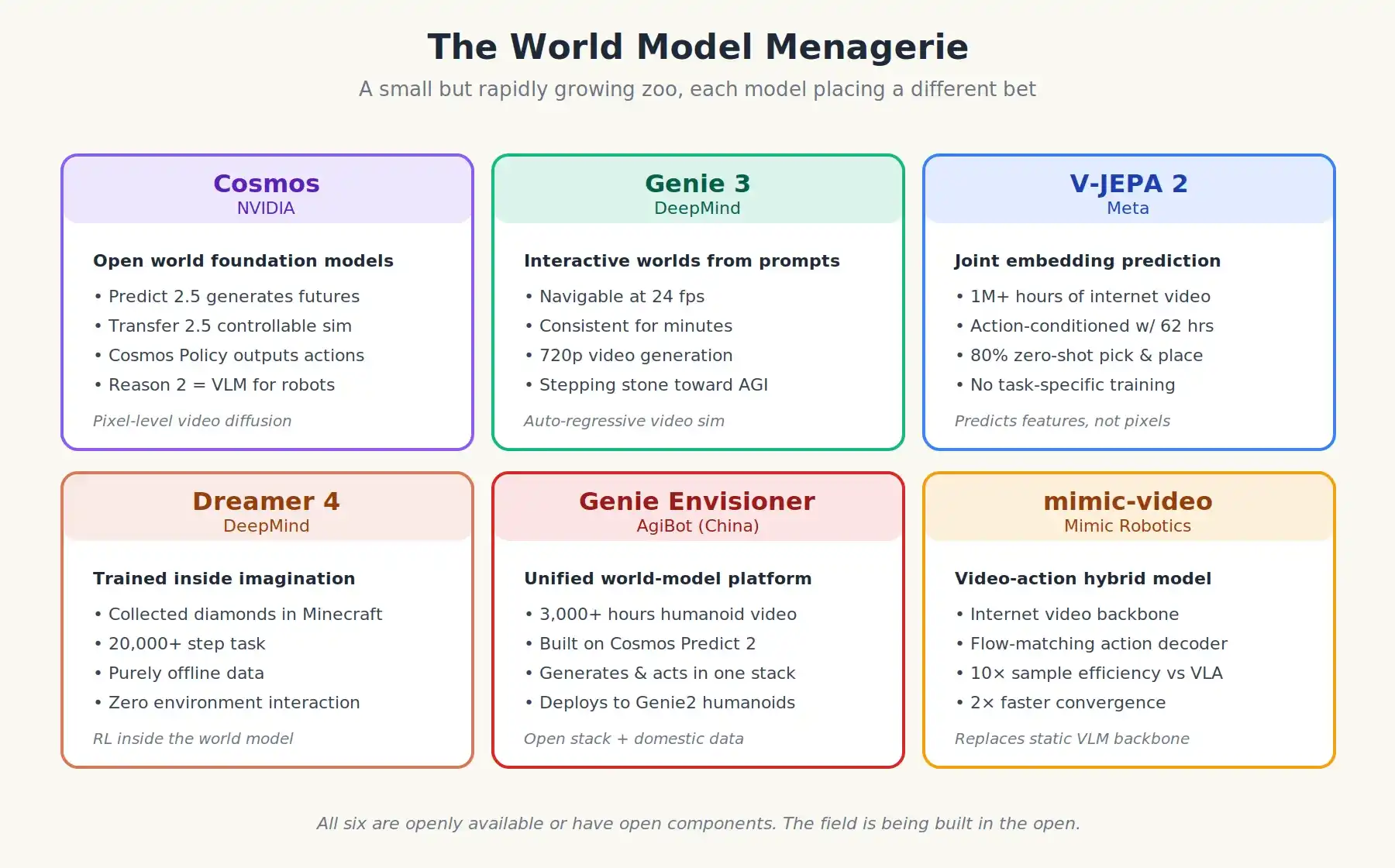
Six most important world models 2025-2026, each proposing a different idea about how machines should learn physics.

Ten: Alternative Architectures, Because the Field Isn't Settled

There's no standard way to build a world model. The architecture war is one of the most interesting debates in AI right now, directly impacting what robots will be able to do. Three camps to watch:

Pixel-level video diffusion (Cosmos/Sora school): Use diffusion models to predict the actual pixels of future frames. Pros: doubles as a synthetic data generator, can render novel robot demos that never happened. Cons: expensive, sometimes unphysical, and predicting pixels you'll never see is wasteful.

Joint-Embedding Predictive Architecture, JEPA (LeCun school): Don't predict pixels; predict the abstract representation of the next frame. Discard texture details, keep the semantic essence of what's in the scene. Pros: efficient, focused on what matters for action. Cons: harder to use. V-JEPA, V-JEPA 2, and new JEPA-VLA hybrids explore this space.

Latent action world models (Genie/Dreamer school): Learn how to compress whole videos into a latent "action language" that captures behavioral structure, then train the world model to predict the next latent state given the next latent action. Pros: lets you train on web video with no actions, then add a small amount of real robot data. Cons: latent actions are uninterpretable to humans, complicating safety analysis.
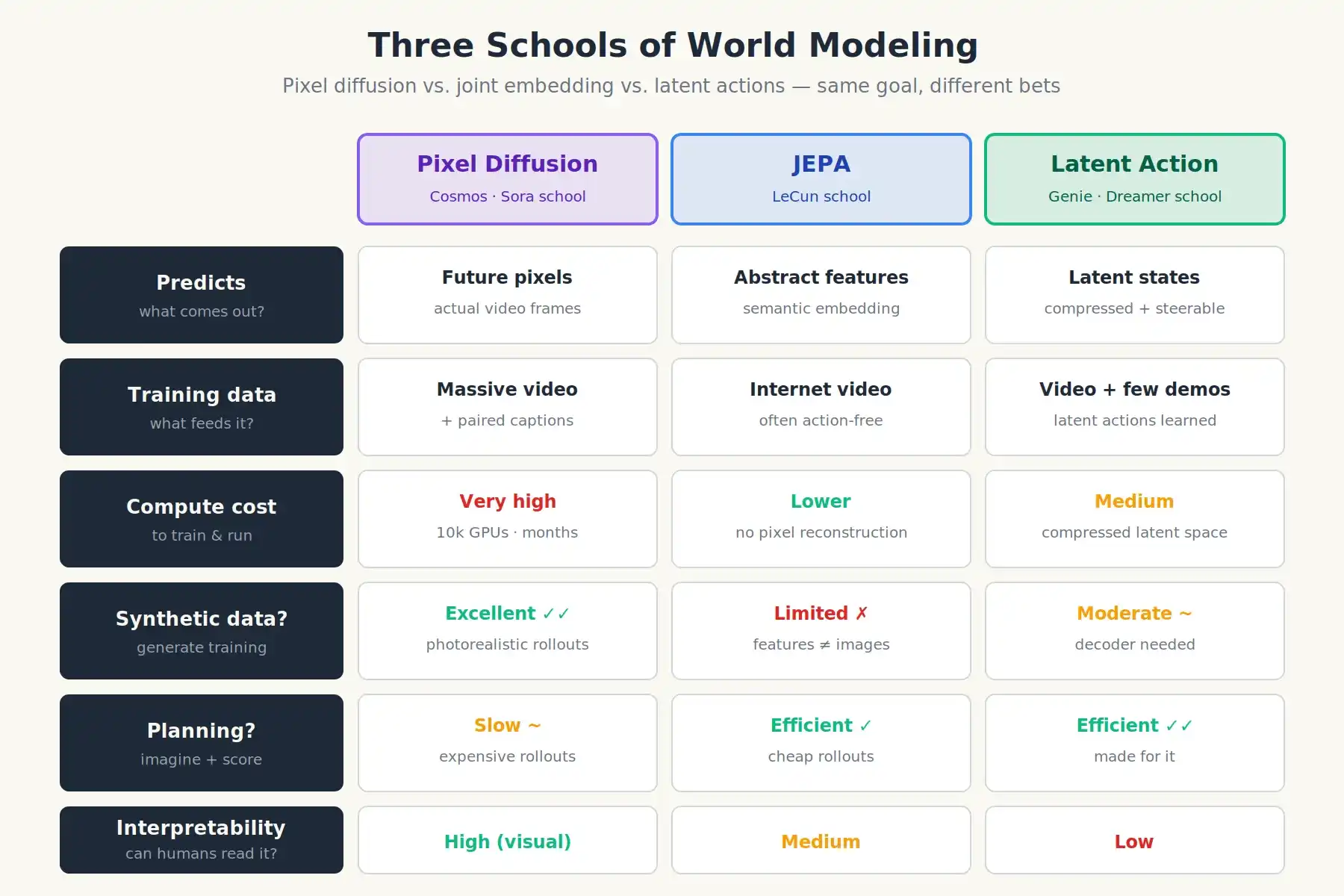
Pixel diffusion, JEPA, and latent action: same goal, wildly different ways to build a world model

Eleven: World-Model-Based Robots in Practice

If you fast-forward a few years, the architecture of a frontier humanoid robot might look like this:

A VLA with a world model riding on top. When the robot encounters a new situation, it does something like:

  • VLA proposes a few candidate next actions (it's still the policy).
  • World model takes each candidate action and simulates 1-3 seconds of imaginary video.
  • Value critic scores based on imagined outcomes: cup grasped? something fell? human bumped?
  • Robot picks the highest-scoring action and executes only its first part.
  • Real sensor data flows back; loop repeats.

This is model-predictive control, a technique used for decades to stabilize rockets and quadrotors, but with a learned world model replacing hand-derived physics equations. Its scalability comes from the world model being pre-trained on millions of hours of video, not because someone wrote Navier-Stokes equations for the kitchen.

The benefits compound:

  • Improved recovery. If a grasp slips, the world model can imagine multiple corrective paths and pick the most promising.
  • Better generalization. A world model trained on web video has seen orders of magnitude more "physics" than any robot teleoperation dataset.
  • Controllable long-horizon planning. Plan in imagination, not in reality.
  • Smaller sim-to-real gap. Instead of training in a home-built simulator (e.g., Isaac Sim, Newton physics engine) and hoping it transfers, train in a simulator that was trained to match real video. So the gap is smaller.
  • Explosion of synthetic data. A world model can generate almost-for-free millions of different robot trajectories across different lighting, materials, and object configurations. This solves the field's biggest bottleneck.

Plus, it has a crucial safety advantage. A robot that can simulate consequences can refuse dangerous actions: not because of a pre-written rule, but because it foresees a human might get hurt.
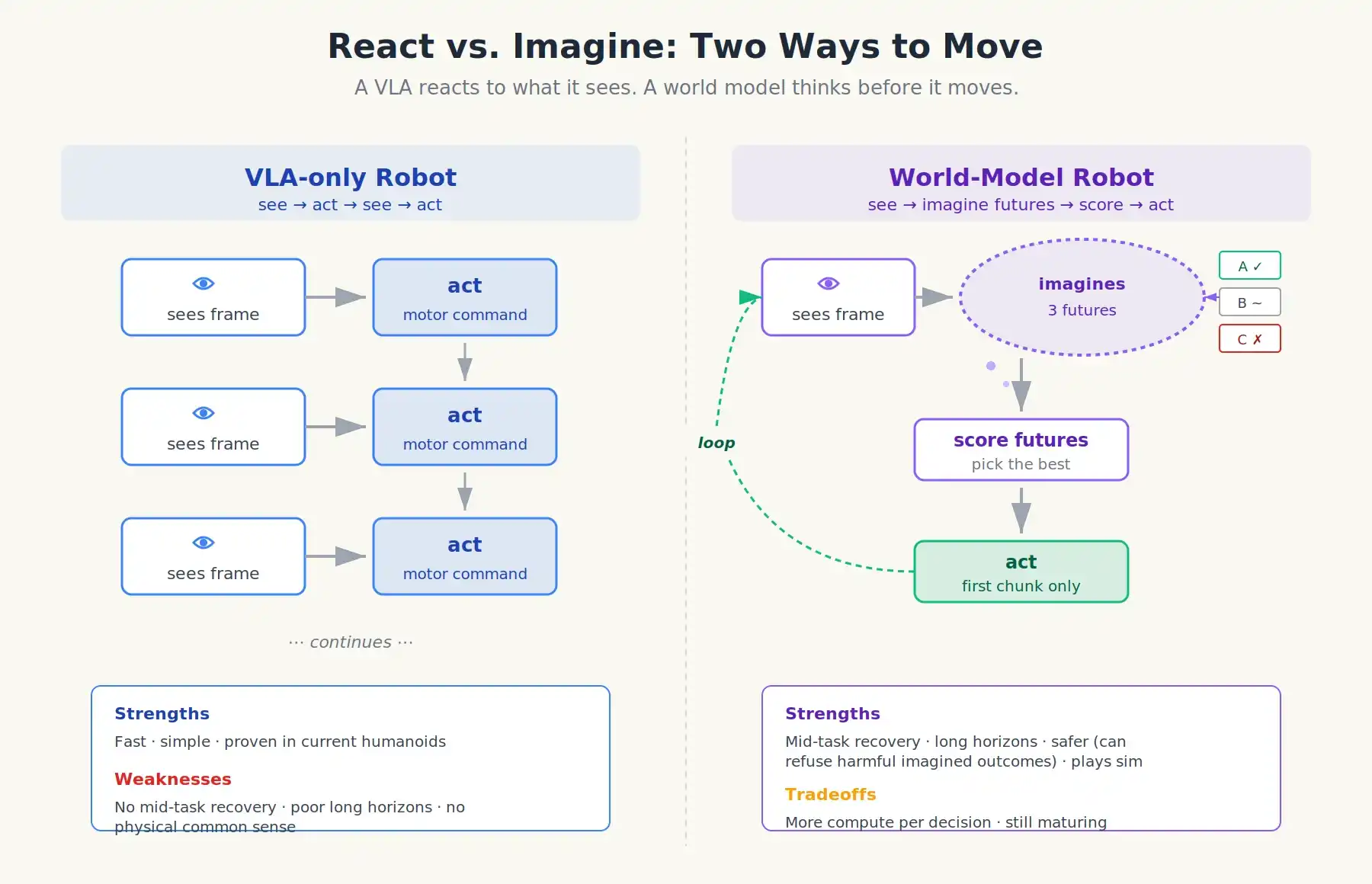
Two ways to move: VLA reacts to what it sees; world-model robot thinks before it moves

Twelve: Things You Should Also Know

Data is the real bottleneck: All the architectural innovation in the world doesn't help if you can't feed the model. Today, teleoperation (humans in VR puppeteering robots) is the primary technical choke point. A robotics company's moat is increasingly its data collection pipeline, not the model itself. AgiBot has warehouses full of operators. NVIDIA's GR00T N1.7 dexterity scaling law shows more human first-person video directly, predictably improves robot dexterity. This is also where China has structural advantages: lower-cost data collection labor, more permissive deployment environments, and state coordination of supply chains.

Simulation is a parallel universe. NVIDIA's Isaac Sim, the new open-source Newton physics engine (v1.0 to be official in April 2026), and the Omniverse platform let companies train robots in millions of parallel simulated worlds without ever deploying in reality. Most of what looks like "robot intelligence" is actually cultivated in simulation and then ported to hardware.

Economics are starting to show. Unitree delivered ~5,500 humanoids in 2025 and targets 10k-20k in 2026. Average price dropped from ~$85k to ~$25k in two years. Unitree's R1 is $5,900. Noetix Bumi is launching at $1,400. Humanoid hardware is approaching consumer electronics pricing while the AI inside still lags the demos. That gap will close, and when it does, volumes will shift the entire industry.

Failure modes look weird. When LLM-based robots fail, they fail in ways traditional robots can't: confidently doing the wrong thing, "hallucinating" capabilities, getting stuck in dialogue loops with their own planner. The traditional robotics world is quite skeptical, and rightly so, insisting learned systems must be safety-monitored and behavior-bounded. The most reliable deployed robots today are hybrids: VLA brains inside hand-designed safety cages.

The "ChatGPT moment" narrative is a useful but misleading metaphor: Jensen Huang keeps telling everyone the ChatGPT moment for robots is here. He says that because NVIDIA sells shovels and picks. The more honest version is: we're roughly in the GPT-2 era for physical AI. It's powerful, it wows you; it's not powerful enough for unattended deployment. It's iterating fast, but the breakout moment isn't viral explosion, it's a slow, steady upward slope.

Conclusion
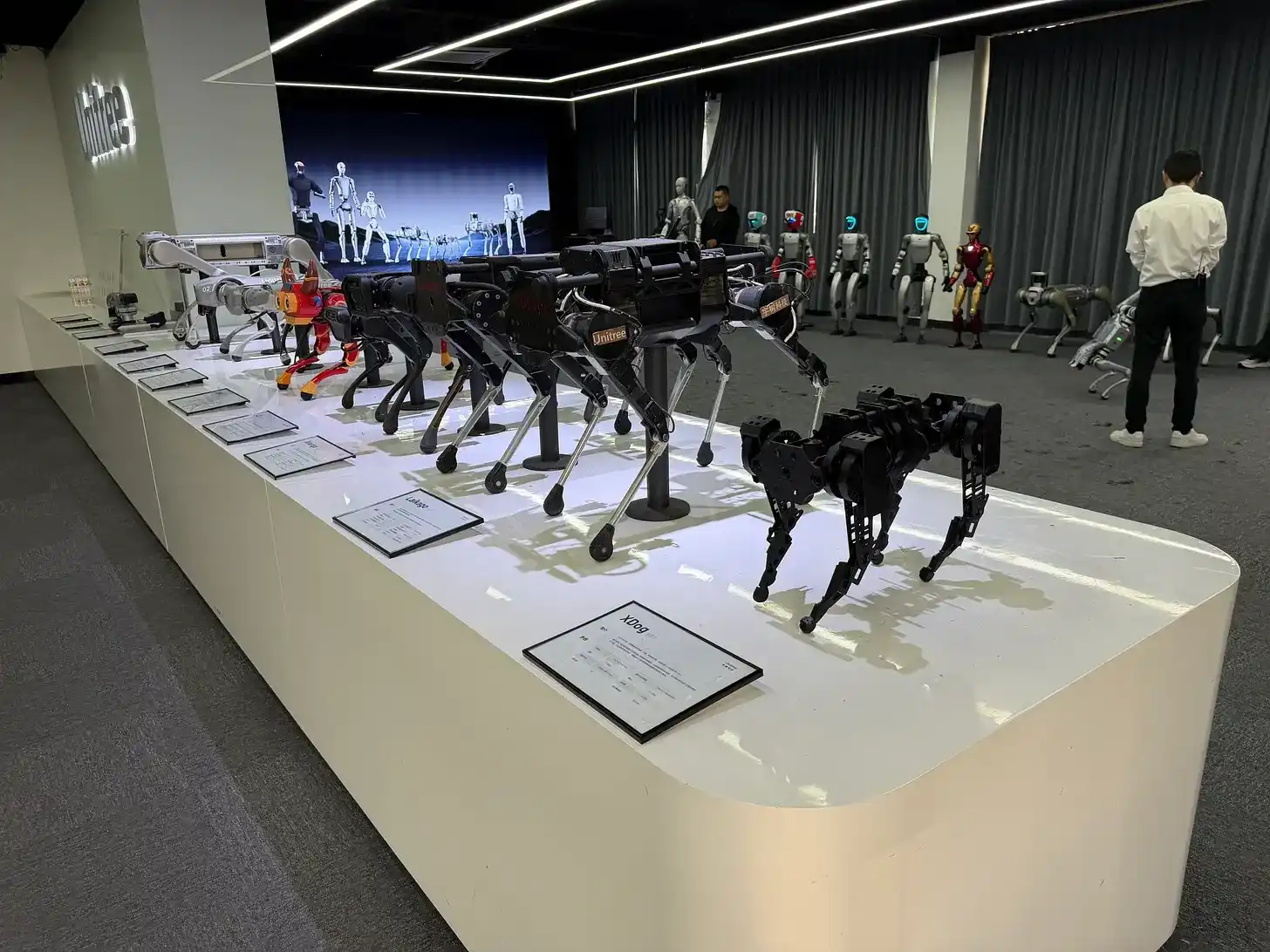
The evolution of Unitree's quadrupeds (right to left)

In the demo seen at Unitree's office, five G1 humanoids performing kung fu were meticulously choreographed, fine-tuned with an onboard VLA-style controller, and overseen by teleoperators to ensure everything worked. It wasn't fully autonomous at its core. But the entire pipeline: perception, planning, motion control, is being replaced by neural networks. Two years from now, the same robots will do the same routine without choreography because they've pre-imagined the whole routine and picked the best version.

The entire progression this article describes—from hand-coded controllers to learned perception to LLM planners to VLAs to dual-system architecture and eventually to world models—is actually the slow migration of where robot intelligence lives. It started in the engineer's head, then moved to hand-written code, then into the perception layer, into the planner, into the policy. And now it's finally moving toward the model that learns the world itself.

Each shift makes robots more general, more adaptable, more useful. If the world-model shift works, it will genuinely empower them: enough that the question stops being "what can robots do?" and becomes "what should we have them do?"

Related reading: A Rundown of Over 30 Humanoid Robot Companies: Who Will Stand Out in 2026?

İlgili Sorular

QWhat were the key limitations of robots before the advent of large language models (LLMs)?

ABefore LLMs, robots operated on a carefully handcrafted software stack, relying on manual code for perception (e.g., edge detection), state estimation (sensor fusion), planning (algorithms like A*), and control (e.g., PID controllers). While predictable and safe for known scenarios, these robots had almost zero generalization ability. They would fail in new environments, under different lighting, or with unseen objects. Their intelligence was limited to exactly what the engineer had pre-programmed, and they lacked the ability to parse natural language instructions or decompose complex tasks.

QWhat are Visual-Language-Action Models (VLAs), and why do they represent a significant architectural shift in robotics?

AVisual-Language-Action Models (VLAs) are neural networks that fuse visual data (from cameras) and language instructions into a single model that directly outputs low-level robot action commands (e.g., joint movements). This integrates reasoning and action generation into one network. Unlike earlier systems where a separate planner (like an LLM) would output high-level plans for lower-level controllers to execute, VLAs directly translate 'what they see' and 'what they are asked' into 'how to move.' This coupling enables far better generalization, as learning to recognize an object and learning how to manipulate it are part of the same training process.

QWhat is the 'dual-brain' or System 1 / System 2 architecture commonly used in modern humanoid robots?

AThe 'dual-brain' architecture, popularized by systems like Figure AI's Helix and used in NVIDIA's GR00T, separates cognitive processing into two specialized, communicating models. System 2 is a large, slow-thinking VLA (e.g., 7B parameters) running at ~7–9 Hz. It observes the scene, parses instructions, and performs high-level reasoning, outputting abstract 'intent' vectors. System 1 is a small, fast-reacting visuomotor policy (~80M parameters) running at 200 Hz. It takes the intent vectors and real-time sensor data to produce smooth, continuous joint commands. This division addresses physics constraints: fast action updates are needed for stability, but large models are too slow for real-time control.

QWhat is a World Model in robotics, and what potential advantages does it offer over VLAs?

AA World Model is a neural network trained to predict the future state of the world (e.g., the next video frames) given the current state and a proposed action. Instead of just reacting, a robot with a world model can 'imagine' or simulate the consequences of multiple candidate actions before executing any. This enables 'thinking before acting.' Key advantages include: improved recovery from failures (by simulating corrective paths), better generalization (trained on vast amounts of video data), feasibility of long-horizon planning (in simulation), reduced sim-to-real gap, and the ability to generate massive amounts of synthetic training data. It also offers a safety advantage by allowing the robot to foresee and potentially avoid dangerous outcomes.

QAccording to the article, why are open-source models and frameworks critically important for the current robotics ecosystem?

AOpen-source models and frameworks are crucial for two main reasons. First, they dramatically lower the barrier to entry. Startups and research labs don't need to spend tens of millions of dollars pre-training a foundation model from scratch. They can take open-weight models like NVIDIA's GR00T or Stanford's OpenVLA and fine-tune them with their own robot's data, accelerating development. This is the strategy used by many Chinese humanoid companies. Second, they are seen as essential for safety and auditability. A completely closed-source 'black box' model running a robot in a factory presents a regulatory nightmare. Open models allow researchers, auditors, and operators to inspect what the robot has been trained on and how it might reason.

İlgili Okumalar

Has the 'Digital Gold' Narrative for BTC Failed?

**Title: Has the "Digital Gold" Narrative for Bitcoin Failed?** The article argues that Bitcoin's "digital gold" narrative remains valid despite a recent sharp price decline (from a peak near $126k in Oct 2025 to briefly under $61k in Feb 2026). It presents a long-term investment framework based on three core points: **1. Viewing Bitcoin as an Asset:** Bitcoin is presented as a superior potential store of value compared to gold. Key arguments are its absolute scarcity (21 million cap), superior portability, and transparent auditability via its public ledger. While acknowledging its current use in early, volatile stages (~3-4% global adoption), the author draws parallels to the early, disruptive phases of the internet and e-commerce. **2. Understanding the Recent Downturn:** The current ~50% correction is framed as a predictable, consensus-driven cycle following its post-halving peak (the 2024 halving preceded the Oct 2025 high). A crucial factor is a historic "changing of hands": the influx of new institutional buyers via ETFs allowed early, low-cost holders (miners, OG believers) to take profits. The author notes that while severe, Bitcoin's historical drawdowns (e.g., 93% in 2011, 77% in 2021-22) have been progressively smaller, suggesting maturing holder structure and decreasing volatility over time. **3. The Long-Term Perspective:** The long-term thesis hinges on Bitcoin capturing a portion of gold's market value. With Bitcoin's market cap at ~$1.4 trillion (at $70k) versus gold's ~$20 trillion, significant upside potential exists if the "digital gold" narrative is partially realized. However, the author strongly cautions that short-term risks remain, the bottom is unpredictable, and high volatility is inherent. The real risk is not Bitcoin failing but poor personal position management (over-leverage, wrong capital) and a lack of deep understanding, which can force investors out during severe downturns. The conclusion uses Amazon's 95% crash post-2000 dot-com bubble and subsequent 42x recovery as an analogy. The ultimate question is not if Bitcoin's price will rise, but if an investor's strategy and conviction can withstand the volatility to see the long-term play out. The recent divergence (gold up, Bitcoin down) is posed not as a narrative failure, but as potential evidence of this ongoing, painful transition from a speculative asset to a mainstream allocation.

marsbit2 saat önce

Has the 'Digital Gold' Narrative for BTC Failed?

marsbit2 saat önce

Has BTC's 'Digital Gold' Narrative Failed?

The article discusses Bitcoin's "digital gold" narrative, its recent price drop, and long-term outlook through the perspective of "Jason". It argues the narrative is not a failure but that Bitcoin represents a superior, new asset class due to its fixed supply (21 million), portability, and auditability. The piece compares its current ~3-4% global adoption rate to early internet/e-commerce, suggesting significant growth potential. Regarding the 2025-2026 price decline (from ~$126k to briefly under $61k), the author views it as a predictable, consensus-driven sell-off within Bitcoin's ~4-year cycle post-halving, exacerbated by a major "handover" from early, low-cost holders to new institutional buyers via ETFs. A key observation is that historical peak-to-trough drawdowns have lessened over time (e.g., 93% in 2011 to ~50% in 2026), indicating maturing volatility as holder structure changes. For the long term, the author uses a simple framework: Bitcoin's total market cap (~$1.4T at $70k) is only about 7% of gold's (~$20T). Even capturing 30-50% of gold's value would imply substantial upside. However, the article strongly cautions against viewing this as investment advice, emphasizing extreme volatility and the critical importance of risk management, position sizing, and deep fundamental understanding to survive severe drawdowns. It concludes by drawing a parallel to Amazon's 95% crash in 2000 and subsequent 42x recovery, stressing that the key is surviving market cycles to realize long-term potential.

链捕手2 saat önce

Has BTC's 'Digital Gold' Narrative Failed?

链捕手2 saat önce

AI Bubble Is Bursting

The AI Bubble is Bursting: A Necessary Purge on the Path to Ubiquitous Intelligence Market volatility has reignited debates about an AI bubble, with figures like Ray Dalio pointing to high valuations. However, this parallels the dot-com bubble, which, despite its crash, laid the physical infrastructure for today's internet era. The current AI investment frenzy, with tech giants planning trillions in infrastructure spending far outstripping current AI application revenues, appears similarly imbalanced. This 'bubble' is seen as an inevitable phase for a disruptive technology, paying the "innovation tax." Critically, AI inference costs have plummeted over 99.7% since 2023, making intelligence nearly free at the margin. This hasn't reduced spending but has instead unlocked massive new demand, as seen in enterprise AI cloud expenditure tripling. This follows the Jevons Paradox: efficiency gains lead to greater total consumption. The market is now entering a cleansing phase, weeding out speculative ventures lacking real moats. The deeper shift is a move from capital expenditure (CapEx) on hardware to value creation in operational expenditure (OpEx) through AI applications that solve real industry problems. While infrastructure valuations are high, rapid earnings growth from widespread AI adoption across sectors—from manufacturing and finance to law and healthcare—may digest these valuations over time. Ultimately, this creative destruction will leave behind robust infrastructure and optimized models, cheaply powering an AI-augmented future for all industries, much as the internet became indispensable after its own bubble burst. The core productive potential remains undiminished.

链捕手2 saat önce

AI Bubble Is Bursting

链捕手2 saat önce

İşlemler

Spot
Futures

Popüler Makaleler

GROK AI Nedir

Grok AI: Web3 Döneminde Konuşma Teknolojisini Devrim Niteliğinde Yenilik Giriş Hızla gelişen yapay zeka alanında, Grok AI, ileri teknoloji ve kullanıcı etkileşimi alanlarını birleştiren dikkate değer bir proje olarak öne çıkıyor. Ünlü girişimci Elon Musk'ın liderliğindeki xAI tarafından geliştirilen Grok AI, yapay zeka ile etkileşim şeklimizi yeniden tanımlamayı hedefliyor. Web3 hareketi devam ederken, Grok AI, karmaşık sorgulara yanıt vermek için konuşma yapay zekasının gücünden yararlanmayı amaçlıyor ve kullanıcılara sadece bilgilendirici değil, aynı zamanda eğlenceli bir deneyim sunuyor. Grok AI Nedir? Grok AI, kullanıcılarla dinamik bir şekilde etkileşimde bulunmak üzere tasarlanmış sofistike bir konuşma yapay zeka sohbet botudur. Birçok geleneksel yapay zeka sisteminin aksine, Grok AI, genellikle uygunsuz veya standart yanıtların dışında kabul edilen daha geniş bir sorgu yelpazesini benimsemektedir. Projenin temel hedefleri şunlardır: Güvenilir Akıl Yürütme: Grok AI, bağlamsal anlayışa dayalı mantıklı yanıtlar sağlamak için sağduyu akıl yürütmeyi vurgular. Ölçeklenebilir Denetim: Araç yardımı entegrasyonu, kullanıcı etkileşimlerinin hem izlenmesini hem de kalite için optimize edilmesini sağlar. Resmi Doğrulama: Güvenlik en önemli önceliktir; Grok AI, çıktılarının güvenilirliğini artırmak için resmi doğrulama yöntemlerini entegre eder. Uzun Bağlam Anlayışı: AI modeli, kapsamlı konuşma geçmişini saklama ve hatırlama konusunda mükemmel bir performans sergileyerek anlamlı ve bağlamsal olarak farkında tartışmaların yapılmasını kolaylaştırır. Saldırgan Dayanıklılık: Manipüle edilmiş veya kötü niyetli girdilere karşı savunmalarını geliştirmeye odaklanarak, Grok AI kullanıcı etkileşimlerinin bütünlüğünü korumayı hedefler. Özünde, Grok AI sadece bir bilgi alma cihazı değil; dinamik diyalogu teşvik eden, etkileyici bir konuşma partneridir. Grok AI'nın Yaratıcısı Grok AI'nın arkasındaki beyin, otomotiv, uzay yolculuğu ve teknoloji gibi çeşitli alanlarda yenilikle özdeşleşen Elon Musk'tır. Yapay zeka teknolojisini faydalı yollarla geliştirmeye odaklanan xAI çatısı altında, Musk'ın vizyonu, yapay zeka etkileşimlerinin anlaşılmasını yeniden şekillendirmeyi amaçlıyor. Liderlik ve temel etik, Musk'ın teknolojik sınırları zorlamaya olan bağlılığı tarafından derinden etkilenmektedir. Grok AI'nın Yatırımcıları Grok AI'yi destekleyen yatırımcılarla ilgili spesifik detaylar sınırlı kalmakla birlikte, projenin kuluçka merkezi olan xAI'nin, esasen Elon Musk tarafından kurulduğu ve desteklendiği kamuya açık bir şekilde kabul edilmektedir. Musk'ın önceki girişimleri ve mülkleri, Grok AI'nın güvenilirliğini ve büyüme potansiyelini daha da artıran sağlam bir destek sağlar. Ancak, şu anda Grok AI'yı destekleyen ek yatırım fonları veya kuruluşlarıyla ilgili bilgiye kolayca erişim sağlanamamaktadır; bu da potansiyel gelecekteki keşif alanını işaret etmektedir. Grok AI Nasıl Çalışır? Grok AI'nın operasyonel mekanikleri, kavramsal çerçevesi kadar yenilikçidir. Proje, benzersiz işlevselliklerini kolaylaştıran birkaç son teknoloji ürünü teknolojiyi entegre eder: Sağlam Altyapı: Grok AI, konteyner orkestrasyonu için Kubernetes, performans ve güvenlik için Rust ve yüksek performanslı sayısal hesaplama için JAX kullanılarak inşa edilmiştir. Bu üçlü, sohbet botunun verimli çalışmasını, etkili bir şekilde ölçeklenmesini ve kullanıcılara zamanında hizmet vermesini sağlar. Gerçek Zamanlı Bilgi Erişimi: Grok AI'nın ayırt edici özelliklerinden biri, X platformu (önceden Twitter olarak biliniyordu) aracılığıyla gerçek zamanlı verilere erişim yeteneğidir. Bu yetenek, yapay zekaya en son bilgilere erişim sağlar ve diğer yapay zeka modellerinin gözden kaçırabileceği zamanında yanıtlar ve öneriler sunmasına olanak tanır. İki Etkileşim Modu: Grok AI, kullanıcılara “Eğlenceli Mod” ve “Normal Mod” arasında seçim yapma imkanı sunar. Eğlenceli Mod, daha eğlenceli ve mizahi bir etkileşim tarzı sağlarken, Normal Mod, kesin ve doğru yanıtlar vermeye odaklanır. Bu çok yönlülük, çeşitli kullanıcı tercihlerine hitap eden özelleştirilmiş bir deneyim sağlar. Özünde, Grok AI performansı etkileşimle birleştirerek, hem zenginleştirici hem de eğlenceli bir deneyim yaratmaktadır. Grok AI'nın Zaman Çizelgesi Grok AI'nın yolculuğu, gelişim ve dağıtım aşamalarını yansıtan önemli dönüm noktalarıyla işaretlenmiştir: İlk Geliştirme: Grok AI'nın temel aşaması, modelin ilk eğitim ve ince ayarının yapıldığı yaklaşık iki ay boyunca gerçekleşmiştir. Grok-2 Beta Yayını: Önemli bir ilerleme olarak, Grok-2 beta duyurulmuştur. Bu sürüm, sohbet etme, kodlama ve akıl yürütme yetenekleriyle donatılmış iki versiyon—Grok-2 ve Grok-2 mini—sunmuştur. Halka Açık Erişim: Beta geliştirmesinin ardından, Grok AI X platformu kullanıcılarına sunulmuştur. Telefon numarasıyla doğrulanan ve en az yedi gün aktif olan hesap sahipleri, sınırlı bir versiyona erişim sağlayarak teknolojiyi daha geniş bir kitleye ulaştırmaktadır. Bu zaman çizelgesi, Grok AI'nın kuruluşundan kamu etkileşimine kadar sistematik büyümesini kapsar ve sürekli iyileştirme ve kullanıcı etkileşimine olan bağlılığını vurgular. Grok AI'nın Ana Özellikleri Grok AI, yenilikçi kimliğine katkıda bulunan birkaç ana özelliği kapsamaktadır: Gerçek Zamanlı Bilgi Entegrasyonu: Güncel ve ilgili bilgilere erişim, Grok AI'yı birçok statik modelden ayırarak, etkileyici ve doğru bir kullanıcı deneyimi sağlar. Çeşitli Etkileşim Tarzları: Farklı etkileşim modları sunarak, Grok AI çeşitli kullanıcı tercihlerine hitap eder ve yapay zeka ile konuşurken yaratıcılığı ve kişiselleştirmeyi teşvik eder. Gelişmiş Teknolojik Altyapı: Kubernetes, Rust ve JAX kullanımı, projeye güvenilirlik ve optimal performans sağlamak için sağlam bir çerçeve sunar. Etik Tartışma Dikkati: Görüntü üreten bir işlevin dahil edilmesi, projenin yenilikçi ruhunu sergiler. Ancak, aynı zamanda tanınabilir figürlerin saygılı bir şekilde tasvir edilmesi ve telif hakkı ile ilgili etik konuları da gündeme getirir—bu, yapay zeka topluluğunda süregelen bir tartışmadır. Sonuç Konuşma yapay zekası alanında öncü bir varlık olarak Grok AI, dijital çağda dönüştürücü kullanıcı deneyimlerinin potansiyelini kapsar. xAI tarafından geliştirilen ve Elon Musk'ın vizyoner yaklaşımıyla yönlendirilen Grok AI, gerçek zamanlı bilgiyi gelişmiş etkileşim yetenekleriyle birleştirir. Yapay zekanın neler başarabileceği konusunda sınırları zorlamayı hedeflerken, etik konulara ve kullanıcı güvenliğine odaklanmayı sürdürmektedir. Grok AI, sadece teknolojik ilerlemeyi değil, aynı zamanda Web3 manzarasında yeni bir konuşma paradigmasını da temsil eder ve kullanıcılara hem yetkin bilgi hem de eğlenceli etkileşim sunma vaadinde bulunur. Proje gelişmeye devam ederken, teknolojinin, yaratıcılığın ve insan benzeri etkileşimin kesişim noktasında nelerin başarılabileceğinin bir kanıtı olarak durmaktadır.

379 Toplam GörüntülenmeYayınlanma 2024.12.26Güncellenme 2024.12.26

GROK AI Nedir

ERC AI Nedir

Euruka Tech: $erc ai ve Web3'teki Hedefleri Üzerine Bir Genel Bakış Giriş Blockchain teknolojisi ve merkeziyetsiz uygulamaların hızla gelişen manzarasında, her biri benzersiz hedefler ve metodolojilerle yeni projeler sıkça ortaya çıkmaktadır. Bu projelerden biri, kripto para ve Web3 alanında faaliyet gösteren Euruka Tech'tir. Euruka Tech'in, özellikle $erc ai token'ının ana odak noktası, merkeziyetsiz teknolojinin büyüyen yeteneklerinden yararlanmak için tasarlanmış yenilikçi çözümler sunmaktır. Bu makale, Euruka Tech'in kapsamlı bir genel görünümünü, hedeflerini, işlevselliğini, yaratıcısının kimliğini, potansiyel yatırımcılarını ve Web3'teki daha geniş bağlam içindeki önemini keşfetmeyi amaçlamaktadır. Euruka Tech, $erc ai Nedir? Euruka Tech, Web3 ortamının sunduğu araçlar ve işlevsellikleri kullanan bir proje olarak tanımlanmaktadır ve operasyonlarında yapay zekayı entegre etmeye odaklanmaktadır. Projenin çerçevesine dair spesifik detaylar biraz belirsiz olsa da, kullanıcı etkileşimini artırmayı ve kripto alanındaki süreçleri otomatikleştirmeyi amaçlamaktadır. Proje, yalnızca işlemleri kolaylaştırmakla kalmayıp, aynı zamanda yapay zeka aracılığıyla öngörücü işlevsellikleri de entegre eden merkeziyetsiz bir ekosistem yaratmayı hedeflemektedir; bu nedenle token'ının adı $erc ai'dir. Amaç, büyüyen Web3 alanında daha akıllı etkileşimleri ve verimli işlem işleme süreçlerini kolaylaştıran sezgisel bir platform sunmaktır. Euruka Tech'in Yaratıcısı Kimdir, $erc ai? Şu anda, Euruka Tech'in arkasındaki yaratıcı veya kurucu ekip hakkında bilgi verilmemiştir ve bu durum biraz belirsizdir. Bu veri eksikliği, ekibin geçmişi hakkında bilgi sahibi olmanın genellikle blockchain sektöründe güvenilirlik oluşturmak için gerekli olduğu endişelerini doğurmaktadır. Bu nedenle, somut detaylar kamuya sunulana kadar bu bilgiyi bilinmeyen olarak sınıflandırdık. Euruka Tech'in Yatırımcıları Kimlerdir, $erc ai? Benzer şekilde, Euruka Tech projesinin yatırımcıları veya destekleyen organizasyonları hakkında mevcut araştırmalarla kolayca sağlanan bir bilgi yoktur. Euruka Tech ile etkileşimde bulunmayı düşünen potansiyel paydaşlar veya kullanıcılar için kritik bir unsur, kurumsal finansal ortaklıklar veya saygın yatırım firmalarından gelen destekle sağlanan güvencedir. Yatırım ilişkileri hakkında açıklamalar olmadan, projenin finansal güvenliği veya sürdürülebilirliği hakkında kapsamlı sonuçlar çıkarmak zordur. Bulunan bilgilere paralel olarak, bu bölüm de bilinmeyen durumundadır. Euruka Tech, $erc ai Nasıl Çalışır? Euruka Tech için detaylı teknik spesifikasyonların eksik olmasına rağmen, yenilikçi hedeflerini göz önünde bulundurmak önemlidir. Proje, yapay zekanın hesaplama gücünden yararlanarak kripto para ortamında kullanıcı deneyimini otomatikleştirmeyi ve geliştirmeyi hedeflemektedir. AI'yi blockchain teknolojisiyle entegre ederek, Euruka Tech otomatik ticaret, risk değerlendirmeleri ve kişiselleştirilmiş kullanıcı arayüzleri gibi özellikler sunmayı amaçlamaktadır. Euruka Tech'in yenilikçi özü, kullanıcılar ile merkeziyetsiz ağların sunduğu geniş olanaklar arasında kesintisiz bir bağlantı yaratma hedefinde yatmaktadır. Makine öğrenimi algoritmaları ve AI kullanarak, ilk kez kullanıcı zorluklarını en aza indirmeyi ve Web3 çerçevesindeki işlem deneyimlerini düzene sokmayı amaçlamaktadır. AI ve blockchain arasındaki bu simbiyoz, $erc ai token'ının önemini vurgulamakta ve geleneksel kullanıcı arayüzleri ile merkeziyetsiz teknolojilerin gelişmiş yetenekleri arasında bir köprü işlevi görmektedir. Euruka Tech, $erc ai Zaman Çizelgesi Maalesef, Euruka Tech hakkında mevcut olan sınırlı bilgiler nedeniyle, projenin yolculuğundaki önemli gelişmeler veya kilometre taşları hakkında detaylı bir zaman çizelgesi sunamıyoruz. Genellikle bir projenin evrimini haritalamak ve büyüme eğrisini anlamak için değerli olan bu zaman çizelgesi şu anda mevcut değildir. Önemli olaylar, ortaklıklar veya işlevsel eklemeler hakkında bilgiler belirgin hale geldikçe, güncellemeler kesinlikle Euruka Tech'in kripto alanındaki görünürlüğünü artıracaktır. Diğer “Eureka” Projeleri Üzerine Açıklama Birden fazla projenin ve şirketin “Eureka” benzeri bir isimlendirmeye sahip olduğunu belirtmek önemlidir. Araştırmalar, robotlara karmaşık görevler öğretmeye odaklanan NVIDIA Research'ten bir AI ajanı gibi girişimleri, ayrıca eğitim ve müşteri hizmetleri analitiğinde kullanıcı deneyimini geliştiren Eureka Labs ve Eureka AI'yi tanımlamıştır. Ancak, bu projeler Euruka Tech'ten farklıdır ve hedefleri veya işlevleri ile karıştırılmamalıdır. Sonuç Euruka Tech, $erc ai token'ı ile birlikte, Web3 manzarasında umut verici ancak şu anda belirsiz bir oyuncuyu temsil etmektedir. Yaratıcısı ve yatırımcıları hakkında detaylar açıklanmamış olsa da, yapay zekayı blockchain teknolojisiyle birleştirme konusundaki temel hedefi ilgi odağı olmaktadır. Projenin, gelişmiş otomasyon aracılığıyla kullanıcı etkileşimini teşvik etme konusundaki benzersiz yaklaşımları, Web3 ekosistemi ilerledikçe onu farklı kılabilir. Kripto piyasası gelişmeye devam ederken, paydaşların Euruka Tech etrafındaki gelişmelere dikkat etmeleri önemlidir; belgelenmiş yeniliklerin, ortaklıkların veya tanımlanmış bir yol haritasının gelişimi, önümüzdeki dönemde önemli fırsatlar sunabilir. Şu an itibarıyla, Euruka Tech'in potansiyelini ve rekabetçi kripto manzarasındaki konumunu açığa çıkarabilecek daha somut içgörüler beklemekteyiz.

351 Toplam GörüntülenmeYayınlanma 2025.01.02Güncellenme 2025.01.02

ERC AI Nedir

DUOLINGO AI Nedir

DUOLINGO AI: Dil Öğrenimini Web3 ve AI İnovasyonu ile Entegre Etmek Teknolojinin eğitimi yeniden şekillendirdiği bir çağda, yapay zeka (AI) ve blok zinciri ağlarının entegrasyonu dil öğrenimi için yeni bir ufuk açmaktadır. DUOLINGO AI ve ona bağlı kripto para birimi $DUOLINGO AI ile tanışın. Bu proje, önde gelen dil öğrenme platformlarının eğitimsel yeteneklerini merkeziyetsiz Web3 teknolojisinin faydalarıyla birleştirmeyi hedefliyor. Bu makale, DUOLINGO AI'nın temel yönlerini, hedeflerini, teknolojik çerçevesini, tarihsel gelişimini ve gelecekteki potansiyelini incelerken, orijinal eğitim kaynağı ile bu bağımsız kripto para girişimi arasındaki netliği korumaktadır. DUOLINGO AI Genel Görünümü DUOLINGO AI'nın temelinde, öğrenicilerin dil yeterliliğinde eğitimsel kilometre taşlarına ulaşmaları için kriptografik ödüller kazanabilecekleri merkeziyetsiz bir ortam oluşturma hedefi yatmaktadır. Akıllı sözleşmeler uygulayarak, proje beceri doğrulama süreçlerini ve token tahsislerini otomatikleştirmeyi amaçlamakta, şeffaflık ve kullanıcı sahipliğini vurgulayan Web3 ilkelerine uymaktadır. Model, dil edinimindeki geleneksel yaklaşımlardan ayrılarak, token sahiplerinin kurs içeriği ve ödül dağıtımları üzerinde iyileştirmeler önermesine olanak tanıyan topluluk odaklı bir yönetişim yapısına dayanmaktadır. DUOLINGO AI'nın bazı dikkat çekici hedefleri şunlardır: Oyunlaştırılmış Öğrenme: Proje, dil yeterlilik seviyelerini temsil etmek için blok zinciri başarıları ve değiştirilemez tokenleri (NFT'ler) entegre ederek, katılımcıları motive eden dijital ödüller sunmaktadır. Merkeziyetsiz İçerik Üretimi: Eğitmenler ve dil meraklılarının kendi kurslarını katkıda bulunmalarına olanak tanıyarak, tüm katkıda bulunanların fayda sağladığı bir gelir paylaşım modeli oluşturmaktadır. AI Destekli Kişiselleştirme: Gelişmiş makine öğrenimi modellerini kullanarak, DUOLINGO AI dersleri bireysel öğrenme ilerlemesine uyacak şekilde kişiselleştirmekte, köklü platformlarda bulunan uyarlamalı özelliklere benzer bir deneyim sunmaktadır. Proje Yaratıcıları ve Yönetişim Nisan 2025 itibarıyla, $DUOLINGO AI'nın arkasındaki ekip takma isimler kullanmaktadır; bu, merkeziyetsiz kripto para alanında sıkça görülen bir uygulamadır. Bu anonimlik, bireysel geliştiricilere odaklanmak yerine kolektif büyümeyi ve paydaş katılımını teşvik etmek amacıyla tasarlanmıştır. Solana blok zincirinde dağıtılan akıllı sözleşme, geliştiricinin cüzdan adresini not etmekte, bu da yaratıcıların kimliğinin bilinmemesine rağmen işlemlerle ilgili şeffaflık taahhüdünü simgelemektedir. Yol haritasına göre, DUOLINGO AI, Merkeziyetsiz Otonom Organizasyon (DAO) haline gelmeyi hedeflemektedir. Bu yönetişim yapısı, token sahiplerinin özellik uygulamaları ve hazine tahsisleri gibi kritik konularda oy kullanmalarına olanak tanımaktadır. Bu model, çeşitli merkeziyetsiz uygulamalarda bulunan topluluk güçlendirme ethosu ile uyumlu olup, kolektif karar verme sürecinin önemini vurgulamaktadır. Yatırımcılar ve Stratejik Ortaklıklar Şu anda, $DUOLINGO AI ile bağlantılı olarak kamuya açık tanımlanabilir kurumsal yatırımcılar veya risk sermayedarları bulunmamaktadır. Bunun yerine, projenin likiditesi esas olarak merkeziyetsiz borsa (DEX) kaynaklıdır ve bu, geleneksel eğitim teknolojisi şirketlerinin finansman stratejileriyle keskin bir zıtlık oluşturmaktadır. Bu tabandan gelen model, merkeziyetsizliğe olan bağlılığını yansıtan topluluk odaklı bir yaklaşımı işaret etmektedir. DUOLINGO AI, beyaz kitabında, kurs tekliflerini zenginleştirmeyi amaçlayan belirsiz “blok zinciri eğitim platformları” ile işbirlikleri kurmayı planladığını belirtmektedir. Belirli ortaklıklar henüz açıklanmamış olsa da, bu işbirlikçi çabalar, blok zinciri yeniliğini eğitim girişimleri ile birleştirmeyi amaçlayan bir stratejiyi ima etmektedir ve çeşitli öğrenme yollarında erişimi ve kullanıcı katılımını genişletmektedir. Teknolojik Mimari AI Entegrasyonu DUOLINGO AI, eğitimsel tekliflerini geliştirmek için iki ana AI destekli bileşen içermektedir: Uyarlanabilir Öğrenme Motoru: Bu sofistike motor, kullanıcı etkileşimlerinden öğrenmekte olup, büyük eğitim platformlarından gelen özel modellere benzer. Belirli öğrenici zorluklarını ele almak için ders zorluğunu dinamik olarak ayarlamakta ve zayıf alanları hedeflenmiş alıştırmalarla pekiştirmektedir. Konuşma Ajanları: GPT-4 destekli sohbet botlarını kullanarak, DUOLINGO AI kullanıcıların simüle edilmiş konuşmalara katılmalarına olanak tanıyarak, daha etkileşimli ve pratik bir dil öğrenme deneyimi sunmaktadır. Blok Zinciri Altyapısı $DUOLINGO AI, Solana blok zincirinde inşa edilmiş kapsamlı bir teknolojik çerçeve kullanmaktadır: Beceri Doğrulama Akıllı Sözleşmeleri: Bu özellik, yeterlilik testlerini başarıyla geçen kullanıcılara otomatik olarak token ödülleri vermekte, gerçek öğrenim sonuçları için teşvik yapısını güçlendirmektedir. NFT Rozetleri: Bu dijital tokenler, öğrenicilerin kurslarının bir bölümünü tamamlamak veya belirli becerileri ustalaşmak gibi ulaştıkları çeşitli kilometre taşlarını simgelemekte ve bunları dijital olarak takas etmelerine veya sergilemelerine olanak tanımaktadır. DAO Yönetişimi: Token sahibi topluluk üyeleri, anahtar öneriler üzerinde oy kullanarak yönetişime katılabilir, bu da kurs teklifleri ve platform özelliklerinde yeniliği teşvik eden katılımcı bir kültürü kolaylaştırmaktadır. Tarihsel Zaman Çizelgesi 2022–2023: Kavramsallaştırma DUOLINGO AI için temel, dil öğrenimindeki AI ilerlemeleri ile blok zinciri teknolojisinin merkeziyetsiz potansiyeli arasındaki sinerjiyi vurgulayan bir beyaz kağıdın oluşturulmasıyla başlar. 2024: Beta Lansmanı Sınırlı bir beta sürümü, popüler dillerdeki teklifleri tanıtarak, erken kullanıcıları token teşvikleri ile ödüllendirir ve projenin topluluk katılım stratejisinin bir parçası olarak sunulmaktadır. 2025: DAO Geçişi Nisan ayında, tokenlerin dolaşıma girmesiyle tam bir ana ağ lansmanı gerçekleşir ve topluluk, Asya dillerine ve diğer kurs gelişmelerine olası genişlemeler hakkında tartışmalara başlar. Zorluklar ve Gelecek Yönelimleri Teknik Engeller Hırslı hedeflerine rağmen, DUOLINGO AI önemli zorluklarla karşı karşıyadır. Ölçeklenebilirlik, AI işleme ile merkeziyetsiz bir ağı sürdürme maliyetleri arasında denge kurma konusunda sürekli bir endişe kaynağıdır. Ayrıca, merkeziyetsiz bir teklif arasında kaliteli içerik üretimi ve moderasyonu sağlamak, eğitim standartlarını koruma konusunda karmaşıklıklar yaratmaktadır. Stratejik Fırsatlar İleriye dönük olarak, DUOLINGO AI, akademik kurumlarla mikro yeterlilik ortaklıkları kurma potansiyeline sahiptir ve dil becerilerinin blok zinciri ile doğrulanmış onaylarını sağlamaktadır. Ayrıca, çapraz zincir genişlemesi, projenin daha geniş kullanıcı tabanlarına ve ek blok zinciri ekosistemlerine erişim sağlamasına olanak tanıyabilir, böylece birlikte çalışabilirliğini ve erişimini artırabilir. Sonuç DUOLINGO AI, yapay zeka ve blok zinciri teknolojisinin yenilikçi bir birleşimini temsil etmekte olup, geleneksel dil öğrenim sistemlerine topluluk odaklı bir alternatif sunmaktadır. Takma isimli geliştirme süreci ve ortaya çıkan ekonomik modeli bazı riskler taşısa da, projenin oyunlaştırılmış öğrenme, kişiselleştirilmiş eğitim ve merkeziyetsiz yönetişim konusundaki taahhüdü, Web3 alanında eğitim teknolojisi için bir yol haritası aydınlatmaktadır. AI gelişmeye devam ederken ve blok zinciri ekosistemi evrim geçirirken, DUOLINGO AI gibi girişimler, kullanıcıların dil eğitimi ile etkileşim biçimlerini yeniden tanımlayabilir, toplulukları güçlendirebilir ve yenilikçi öğrenme mekanizmaları aracılığıyla katılımı ödüllendirebilir.

398 Toplam GörüntülenmeYayınlanma 2025.04.11Güncellenme 2025.04.11

DUOLINGO AI Nedir

Tartışmalar

HTX Topluluğuna hoş geldiniz. Burada, en son platform gelişmeleri hakkında bilgi sahibi olabilir ve profesyonel piyasa görüşlerine erişebilirsiniz. Kullanıcıların AI (AI) fiyatı hakkındaki görüşleri aşağıda sunulmaktadır.

活动图片