Opus 5 Game Prompt Goes Viral, 3A Masterpiece Replicated in 24 Hours

marsbit2026-07-29 tarihinde yayınlandı2026-07-29 tarihinde güncellendi

Özet

Opus 5 Game Prompt Goes Viral, 3A-Style Game Replicated in 24 Hours An Opus 5 prompt for game development has gone viral on X (formerly Twitter). The "challenge loop" method instructs the primary AI agent to decompose a task, assign sub-agents to specialized work, and crucially, add a "judge" agent to compare outputs against real 3A games. If results fall short, they are sent back for improvement in a continuous loop until quality standards are met. Using this prompt, developer Anshu built a space exploration game prototype, *The Long Silence*, in just 24 hours. He started by instructing Opus 5 to create a basic browser-based game using Three.js, then issued a 24-hour "visual enhancement" order. The AI worked autonomously through multiple agents, with the judge agent comparing screenshots to games like *Starfield*. The final game is playable in a browser. The prompt's success sparked a trend. Others have used it to create prototypes for a kart-racing game and a "Claudepunk 2077." The method also works with other models like GPT-5.6 Sol, though Opus 5 performed best. This approach leverages Opus 5's strengths in long-horizon planning and iterative self-correction, adding a strict validation mechanism to push its capabilities. The phenomenon demonstrates how advanced AI models are enabling rapid, autonomous game prototyping.

Wow! Recently, an Opus 5 game prompt went viral on X!

Millions are watching online. With this cheat code in hand, AI games start to replicate infinitely...

The most impressive part is that a netizen named Anshu, working alone for 24 hours, built a clone of "Outer Wilds" from scratch!

The logic behind the Prompt is also quite simple:

The main Agent breaks down the task, sub-Agents handle the work, plus an independent Agent acts as a supervisor to "PUA" them.

Basically, if the visuals aren't as good as similar games, they get automatically sent back for revisions. The AI only gets to clock out once the quality meets the standard.

The results are fantastic—

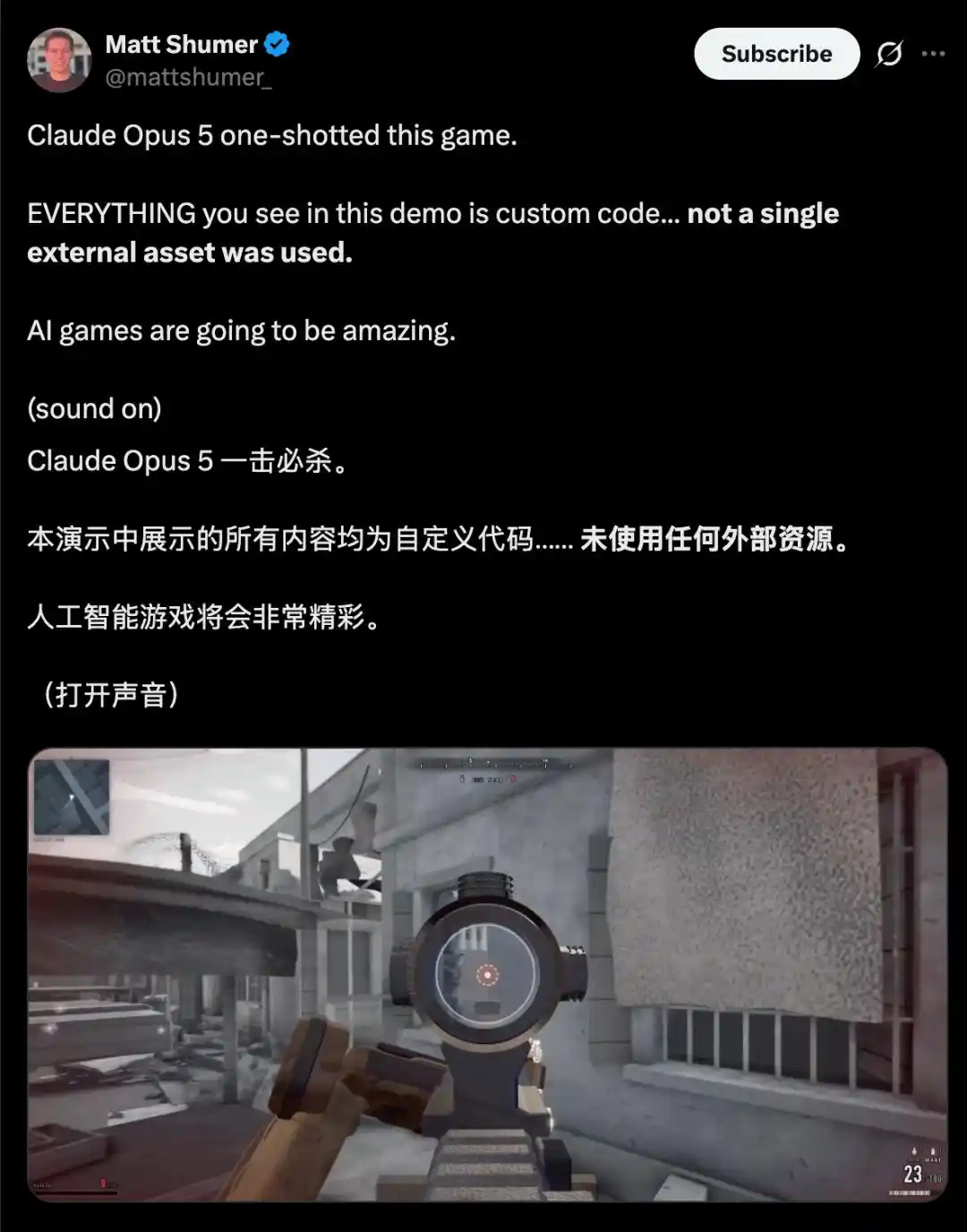
The original creator, Matt Shumer, directly crafted a "Call of Duty" Opus 5 version, with all textures, animations, and sounds AI-generated.

And! He didn't use any external assets!
Working Non-stop for 24 Hours

This internet-famous Prompt was officially named "The Challenge Loop" by its author, Matt Shumer:

I need you to create a first-person shooter game with visual quality on par with the latest "Call of Duty" series... You need to iteratively process each content item in a loop, while assigning dedicated sub-Agents to perform visual verification, ensuring the overall visuals meet 3A game standards... The system must use blind side-by-side comparison to judge which work has superior visuals.
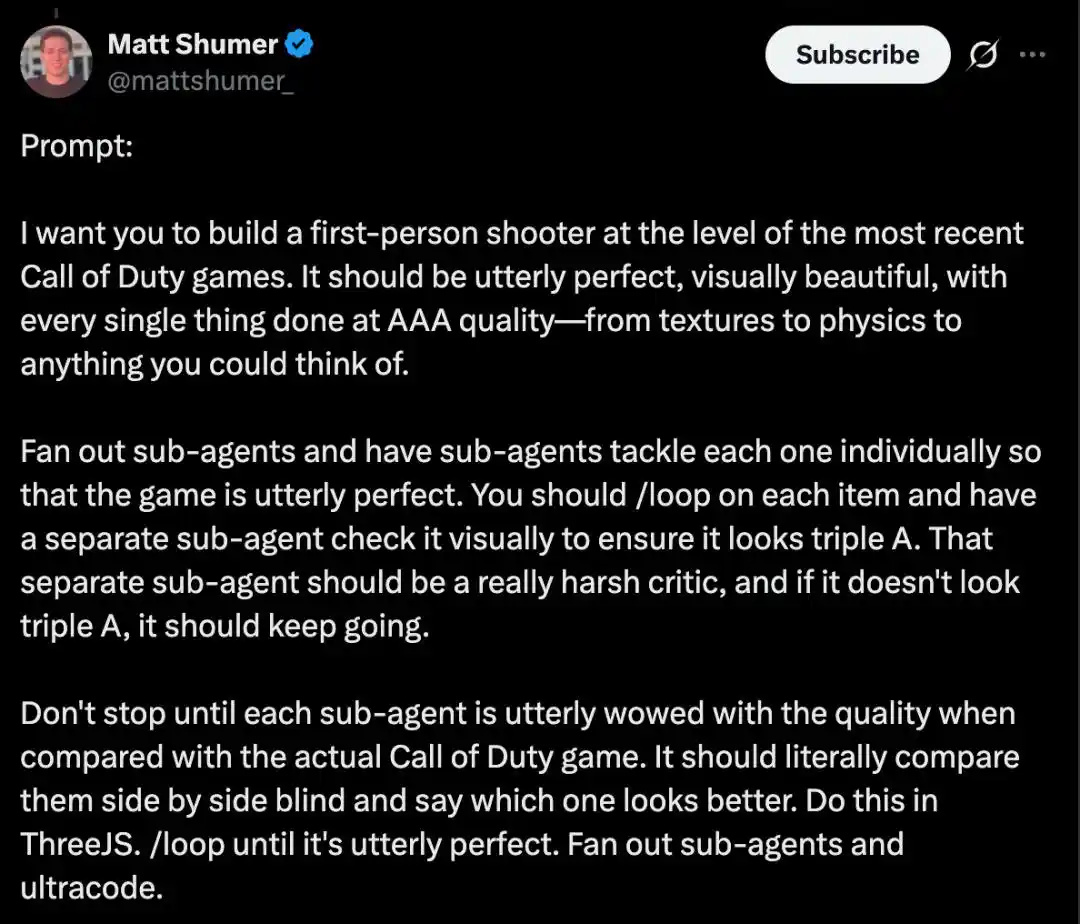
In simple terms, the main Agent, after receiving the task objective, will break it down into several parts on its own. Then, it will assign a specialized production Agent for each part.

The first half of the instruction is almost identical to the common multi-Agent game development process. The key is the newly added acceptance phase:

The judge Agent will inspect the results and compare them with a chosen real-world reference. If the generated result is inferior to a real 3A game, it needs continuous revision and optimization.

Of course, it's impossible for it to truly match a 3A masterpiece yet. At this point, the user needs to stop it in time, using this prompt only as an extreme pressure tactic to push Opus 5's autonomous planning and long-range iterative capabilities.

That's exactly how netizen Anshu's 24-hour space exploration game, "The Long Silence", came about:
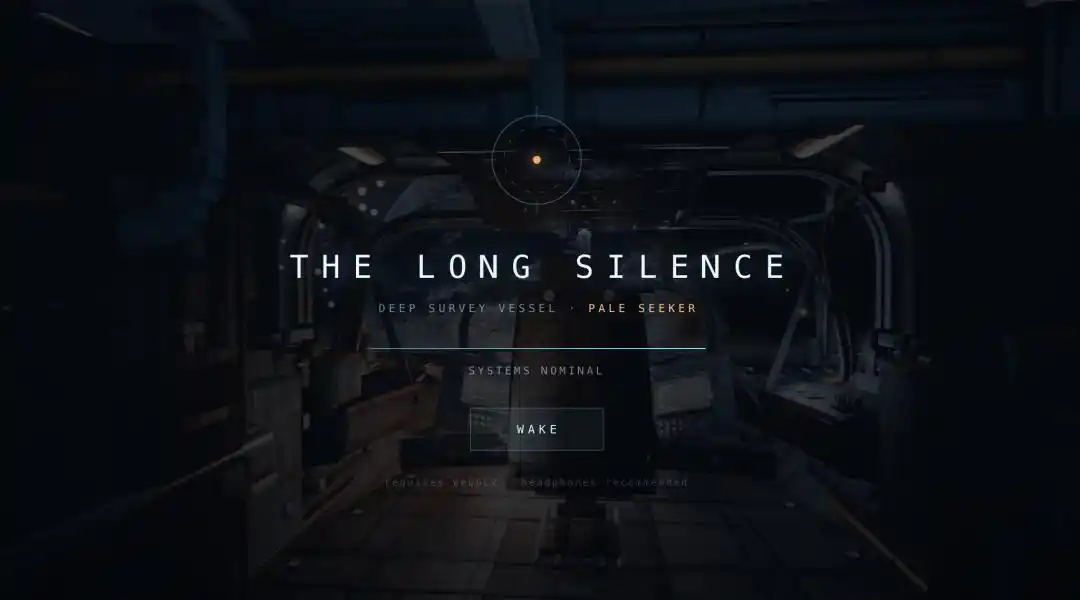
The specific production process is divided into several stages:

Step 1: Instruct Opus 5 to create a space exploration game using Three.js.

The user only needs to provide basic goals, such as the player being able to walk around and pilot a spaceship in the game, the visuals shouldn't look too plastic, and it should run as stably as possible in a browser at 60 FPS.

Everything else—the game's world view, technical architecture—is left for Opus 5 to decide.

Regarding assets, after installing the Blender MCP, Claude Code will find tools on its own for modeling.
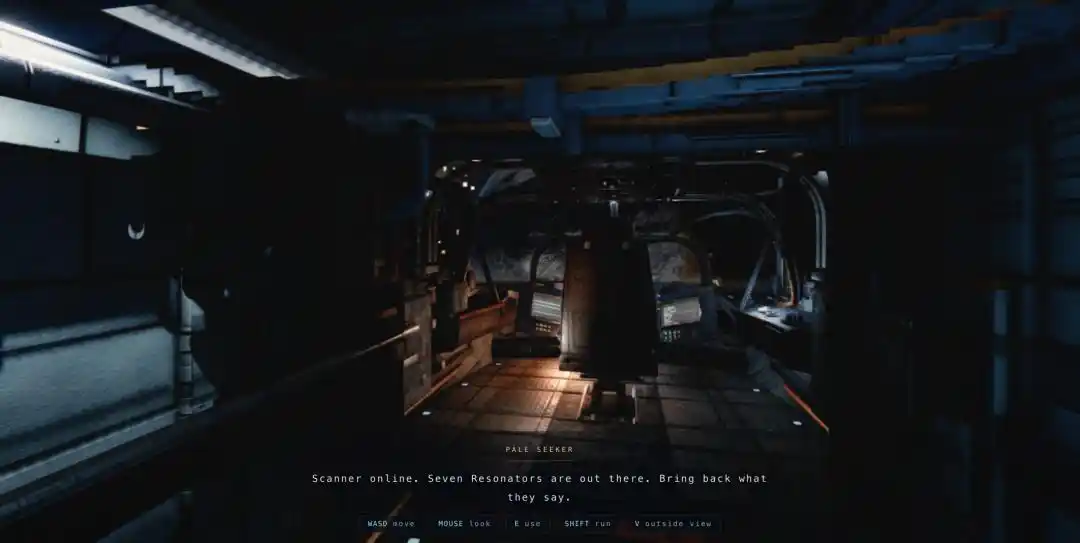
Step 2: Once the first playable version is ready, give Opus 5 a continuous 24-hour goal to comprehensively improve the visual effects.

At this point, multiple sub-Agents start working in parallel to boost efficiency; the judge Agent will compare game screenshots item by item with 3A space games like "Starfield." During this period, Opus 5 is not allowed to secretly lower its judgment standards.

Author Anshu reminds us to also give Opus 5 a carrot appropriately here:

You have the ability to achieve this goal—do your best, don't give up. (doge)
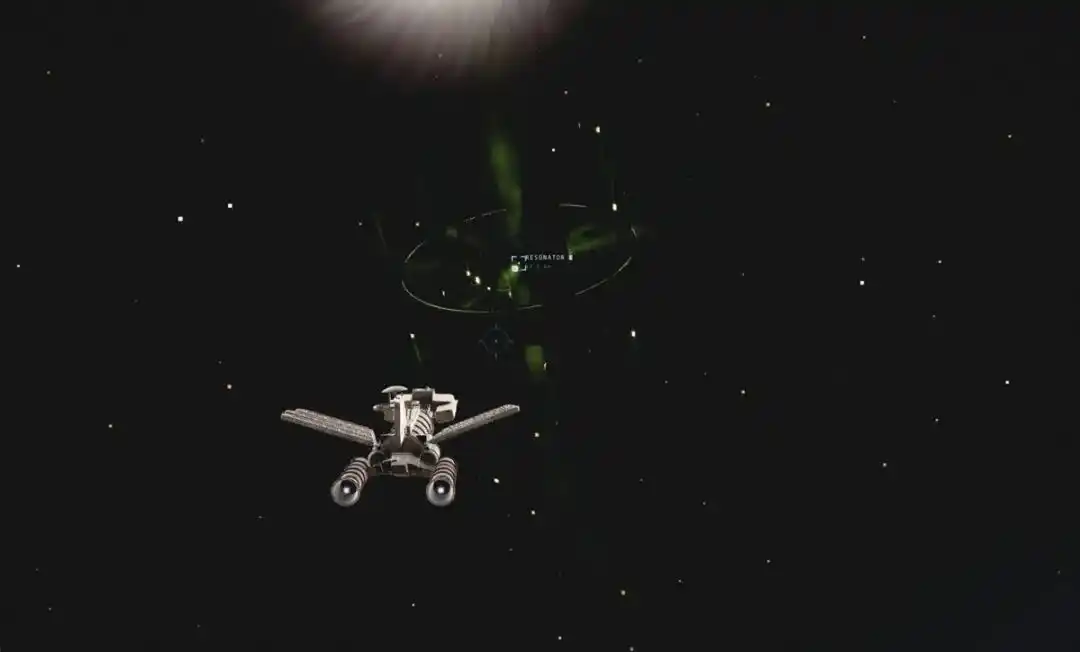
Step 3: Manual optimization + generating skill.

Anshu would check the progress via phone and, when the model spent too much time on planetary scenes, would request it to adjust its priorities.

After stopping the run, he used other Claude instances to fix rendering issues, clean up the code, and complete the deployment.

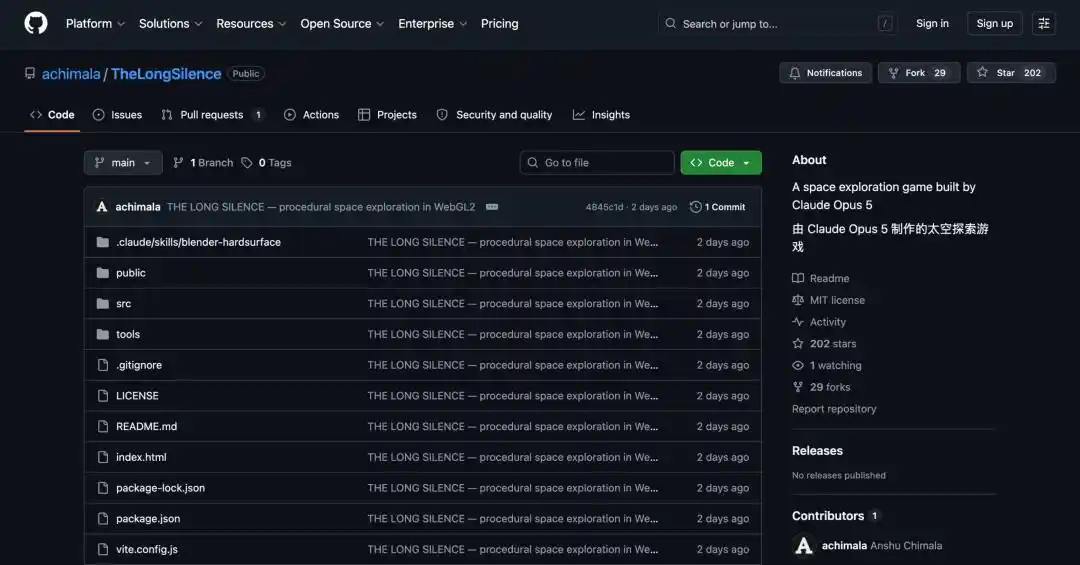
Finally, he asked Opus 5 to summarize its experience into a skill and put it on GitHub.

According to the open-source repository, Opus 5 even created its own set of acceptance tools during the review process, including 17 mandatory verification steps. The tool scripts would also automatically capture different scene comparisons and frame rate statistics, as well as analyze exposure data.
BTW, the game can now be played directly on the web (https://longsilence.anshu.dev/). I just tried it myself, and my review consists of only three words:

Mind! Blowing! Game!

Netizens Collectively Copy Homework and Build Upon It

From one to ten, ten to a hundred, this prompt directly fueled the Opus 5 game craze.

Open your eyes, and it's time to play!

Netizen Ryan Campbell used this method to iterate on a go-kart game. Opus 5 continuously improved local rendering, mobile performance, controls, and camera. The finished product can also be played directly in a browser.

Netizen Yogi Suria directly used it to create Claudepunk 2077......
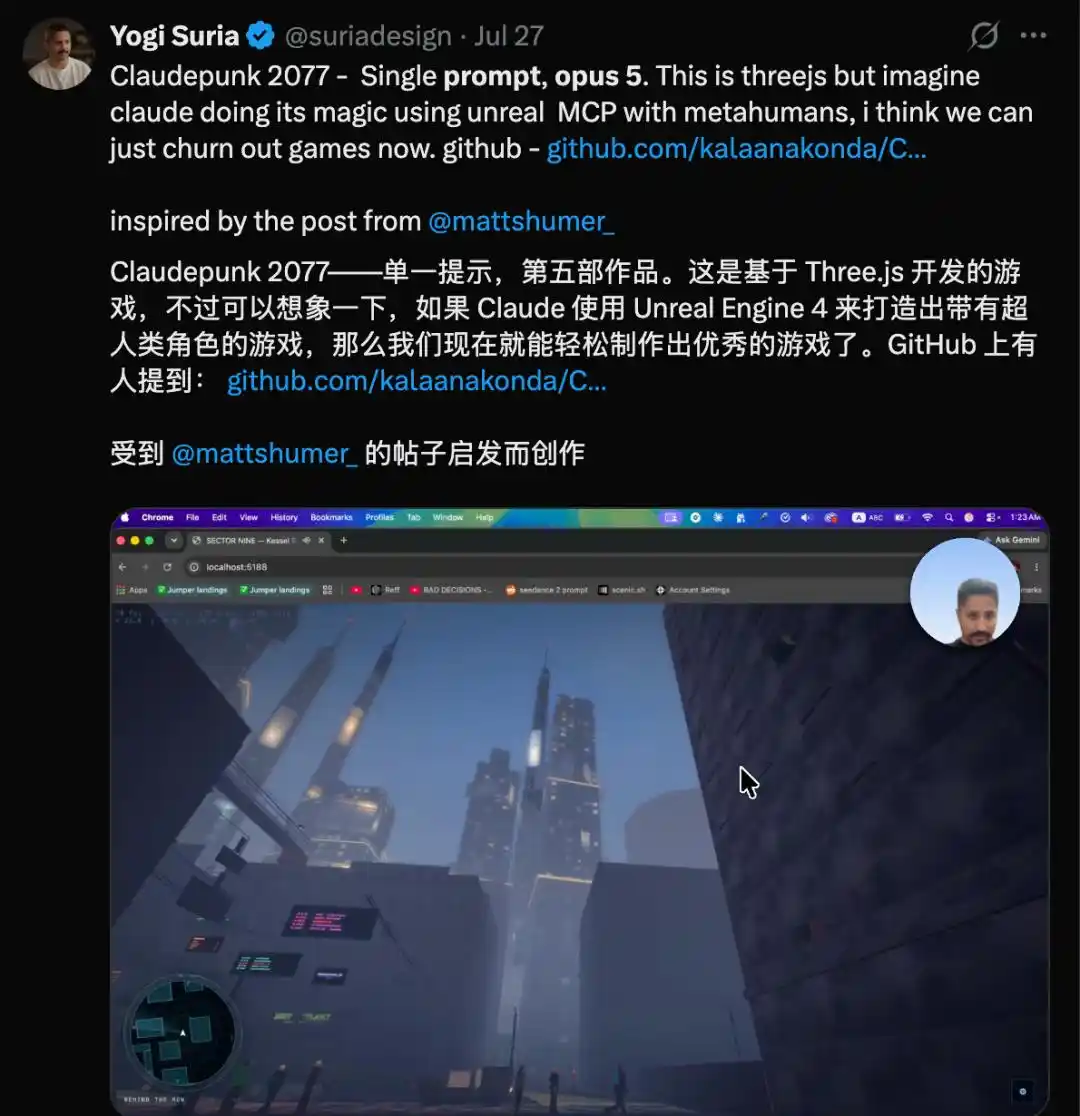
The same instructions migrated to GPT-5.6 Sol also work quite well, only slightly inferior to Opus 5~
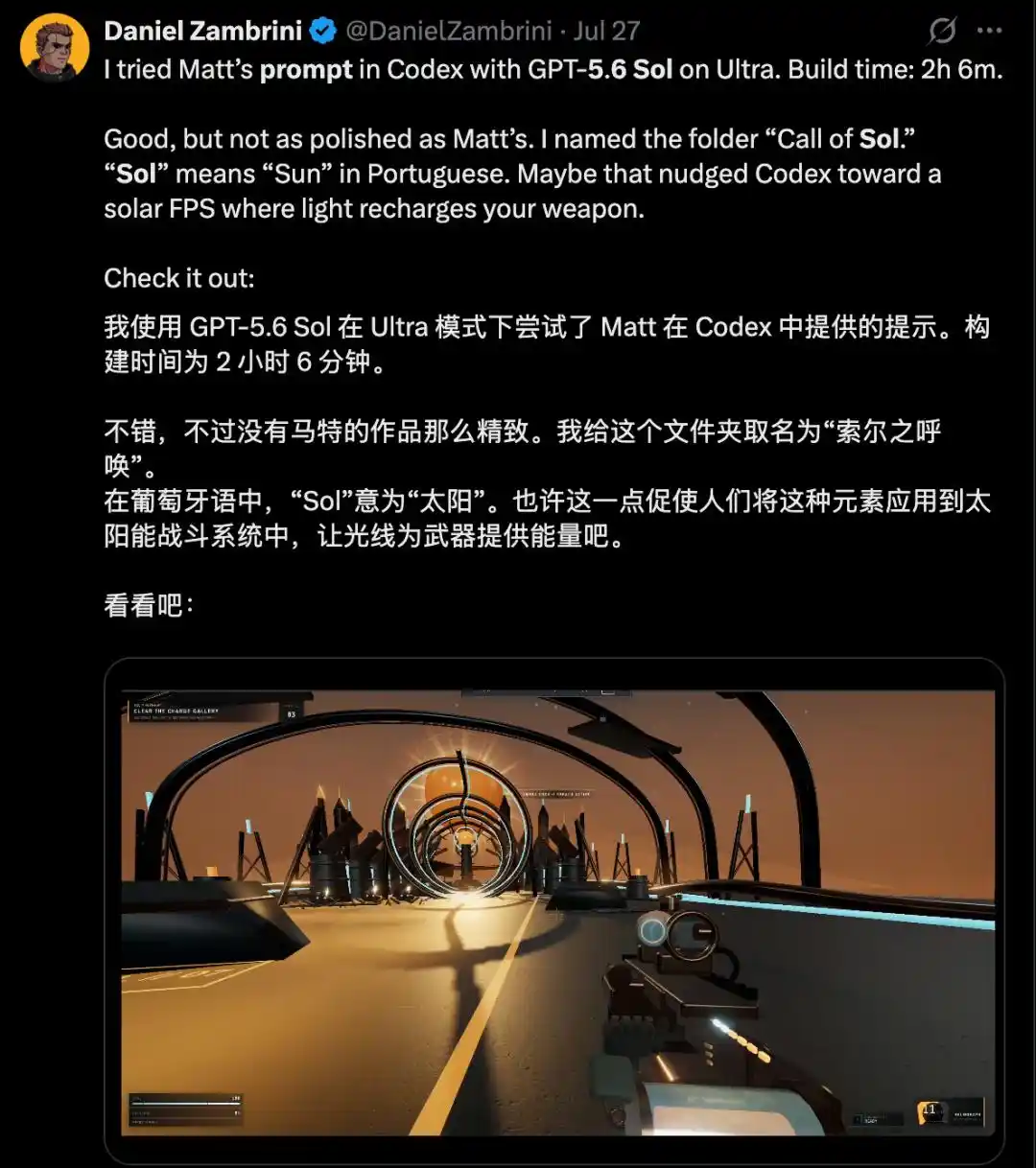
Clearly, the existence of the judge Agent amplifies the model's utility, allowing different developers to create various types of game prototypes with it.

This also aligns with the ability emphasized by Anthropic (A社) when releasing Opus 5: the model is better suited for long-term, multi-step work, and is more willing to check results, identify errors, and iterate continuously.

From this perspective, the Challenge Loop prompt is more like applying a stricter correction mechanism to Opus 5's existing capabilities.

As for Matt Shumer, the inventor of this method, he is an AI entrepreneur and investor himself.

In February of this year, he went viral in the tech circle with a long article titled "Something Big Is Happening," accumulating over 80 million views.

The article argued that the public's perception of cutting-edge model capabilities severely lags behind the actual experience of AI practitioners.

And this Opus 5 game trend just provided Matt's judgment with additional samples.

Reference Links:

[1]https://x.com/anshuc/status/2081801979131818412

[2]https://x.com/mattshumer_/status/2081830214384886228

[3]https://x.com/mattshumer_/status/2081054356405731740

This article is from the WeChat public account "Qubit," author: Follows Cutting-Edge Tech

İlgili Sorular

QWhat is the core principle behind the viral Opus 5 game prompt described in the article?

AThe core principle is a 'Challenge Loop' system. A main Agent decomposes the development task into subtasks and assigns them to specialized sub-Agents. A key innovation is an independent 'judge' or 'reviewer' Agent that continuously evaluates the generated content by comparing it to real AAA game benchmarks. If the output doesn't meet the standard, it's sent back for iteration until quality is achieved, forcing the AI to plan and iterate long-term.

QWhat specific achievement did the user Anshu accomplish using this prompt methodology?

AAnshu used the Opus 5 prompt methodology to create a playable space exploration game called 'The Long Silence' in just 24 hours, starting from scratch. The game is a simplified clone inspired by 'Outer Wilds' and is built using Three.js to run in a web browser.

QWhat are the three main steps Anshu followed in the 24-hour game development process?

AStep 1: Set a basic goal for Opus 5 to create a space exploration game using Three.js, letting the AI decide on world-building and technical architecture. Step 2: Issue a 24-hour continuous goal to drastically improve visual quality. Sub-Agents work in parallel while a judge Agent compares screenshots to AAA titles like 'Starfield'. Step 3: Manually optimize priorities, fix rendering issues, clean code, deploy the game, and finally have Opus 5 summarize the experience into a reusable skill.

QHow did the 'judge' or 'reviewer' Agent ensure quality during development, according to the article?

AThe judge Agent enforced quality by conducting blind A/B comparisons between the AI-generated game assets/screenshots and those from real, high-quality AAA games (like 'Call of Duty' or 'Starfield'). If the AI's output was deemed inferior, it was automatically sent back for revision. The Opus 5 model even created its own validation tool with 17 mandatory checkpoints for this process.

QWhat broader implication does the success of this 'Challenge Loop' prompt suggest about advanced AI models like Opus 5?

AIt suggests that advanced models like Opus 5 possess significant capabilities for long-term, multi-step planning, self-correction, and iterative work that the general public may underestimate. The prompt acts as a strict correction mechanism that unlocks and amplifies these inherent abilities, allowing non-experts to rapidly prototype complex projects like video games by providing a structured, high-standard framework for the AI to operate within.

İlgili Okumalar

Critical Moments in Bitcoin: Cost Zones That Demand Attention Have Been Identified!

Analytics firm Glassnode reported that reduced expectations for U.S. interest rate cuts, along with pricing in possible rate hikes, have suppressed risk appetite in the cryptocurrency market. The Fed's interest rate decisions are crucial for market direction. U.S. Treasury yields have surpassed returns from crypto carry trades, leading investors to favor cash and low-risk interest-bearing instruments over crypto assets. A strong U.S. dollar further weakens marginal demand for crypto. Bitcoin is currently trading below its most intensive cost basis level, with approximately $69,000 identified as the breakeven zone and significant resistance for short-term investors. For a stronger recovery, Bitcoin needs to reclaim the $69,000 threshold with increased trading volume. Renewed active demand for spot Bitcoin ETFs is also deemed critical. According to Glassnode, the current Bitcoin decline represents the shallowest bear market in terms of price drawdown depth to date. However, based on previous cycle durations, this downturn may not be over yet. Spot trading volumes have fallen to multi-year lows, and sell-side order books have thinned, though many buy orders are placed significantly below current prices. Glassnode's risk indicator, Vector, signaled "risk off," suggesting a capital preservation mindset. The current market structure is being driven more by macroeconomic factors like monetary policy, bond yields, and dollar strength than by crypto-sector developments. Losing Bitcoin's support range of $62,000-$68,000, coupled with renewed exchange inflows, could negate the recovery scenario. Conversely, more favorable monetary policy, increased trading volume, a Bitcoin recovery above $69,000, and a resumption of spot ETF buying could signal a market turnaround.

cryptonews.ru1 saat önce

Critical Moments in Bitcoin: Cost Zones That Demand Attention Have Been Identified!

cryptonews.ru1 saat önce

Breaking News: Full Detailed Rationale and Explanation of the Fed's Interest Rate Decision Released!

As expected, the Federal Reserve kept its key interest rate unchanged at 3.50-3.75 percent, marking the fifth consecutive meeting without a rate change. The Federal Open Market Committee's (FOMC) decision passed with a 9-3 majority vote. Cleveland Fed President Loretta Mester, Minneapolis Fed President Neel Kashkari, and Dallas Fed President Lorie Logan dissented, voting in favor of a 25 basis point rate hike. This was the first meeting since 2016 where three regional Fed presidents voted against holding rates steady, signaling growing influence among members advocating for tighter monetary policy to combat inflation. The Fed's statement noted that economic activity has been expanding at a solid pace despite high uncertainty, partly due to Middle East conflicts. It highlighted that growth in productivity and investment remained strong, employment gains have aligned with labor force growth, and the unemployment rate has remained relatively stable. The Fed also committed to maintaining ample reserves in the banking system. The statement emphasized that inflation remains above the Fed's 2% target. It noted that supply shocks, including in the energy sector, are adding to inflationary pressures. The Committee stated it will continue to closely monitor incoming data and risks in pursuit of its price stability goal. The dissenting members argued that the target range for the federal funds rate should have been increased by 25 basis points.

cryptonews.ru1 saat önce

Breaking News: Full Detailed Rationale and Explanation of the Fed's Interest Rate Decision Released!

cryptonews.ru1 saat önce

İşlemler

Spot
活动图片