Is WEEX TradFi Reliable? What You Should Know Before Your First Trade of U.S. Stock Tokens

marsbit2026-07-19 tarihinde yayınlandı2026-07-19 tarihinde güncellendi

Özet

In recent years, cryptocurrency users have expanded their focus beyond Bitcoin and Ethereum to include popular traditional financial (TradFi) assets like Nvidia, Apple, and Tesla stocks. This shift raises key questions: What do these TradFi assets represent on crypto trading platforms? How do they differ from traditional stock ownership? And how can users assess the reliability of platforms offering such products? TradFi products, such as those offered by WEEX TradFi (including NVDA, MSFT, AAPL, TSLA, and QQQ tokens), are blurring the lines between crypto and traditional markets. They allow users to trade based on the price movements of traditional assets within a familiar digital asset trading environment. However, it's crucial to understand that trading a "stock token" is not equivalent to owning the actual stock. Users are participating in price speculation, not gaining shareholder rights like dividends or voting. A key feature of these products is 7x24 trading, offering flexibility beyond traditional market hours. While convenient, this also introduces unique risks, such as potential liquidity gaps and volatility when underlying markets are closed. For users evaluating TradFi products, reliability hinges on transparency and risk management. Critical factors include understanding the product mechanism, how prices track the underlying assets, and the associated risks—especially when using leverage. Popular stocks and indices are still subject to company performance, macr...

In recent years, the focus of Crypto users has been quietly shifting. A few years ago, the most discussed topics on trading platforms were Bitcoin, Ethereum, and various emerging crypto assets. However, as global financial markets become increasingly interconnected, more and more traders are beginning to pay attention to popular assets in traditional markets, such as Nvidia, Apple, Microsoft, Tesla, as well as the Nasdaq index, gold, and others.

This change has also brought about a new question: What exactly do these traditional financial assets mean when they appear on crypto trading platforms? What is the difference between U.S. stock tokens offered by exchanges and traditional stock market investments? For users encountering TradFi products for the first time, is the platform reliable, and what aspects should they consider when making a judgment?

These are, in fact, the most pressing concerns for the growing number of Crypto users entering the TradFi space.

From Digital Assets to Traditional Markets: Trading Boundaries Are Evolving

In the past, the Crypto market and traditional financial markets largely existed as two relatively independent systems.

Investing in U.S. stocks typically meant opening a securities account and executing trades through a broker; participating in the crypto asset market relied more on digital asset trading platforms. These two systems differed significantly in terms of account structures, trading hours, and asset types.

However, with the trend of global asset digitization, this boundary is gradually blurring.

More and more traders wish to observe broader global market opportunities within the familiar environment of digital asset trading. This is a key reason why TradFi (Traditional Finance) related products have garnered attention in recent years.

For Crypto users, TradFi is not simply about bringing traditional stocks onto a trading platform; it offers a new way to connect with the markets. It allows users to monitor price movements of global stocks, indices, and commodity markets through a more familiar trading experience.

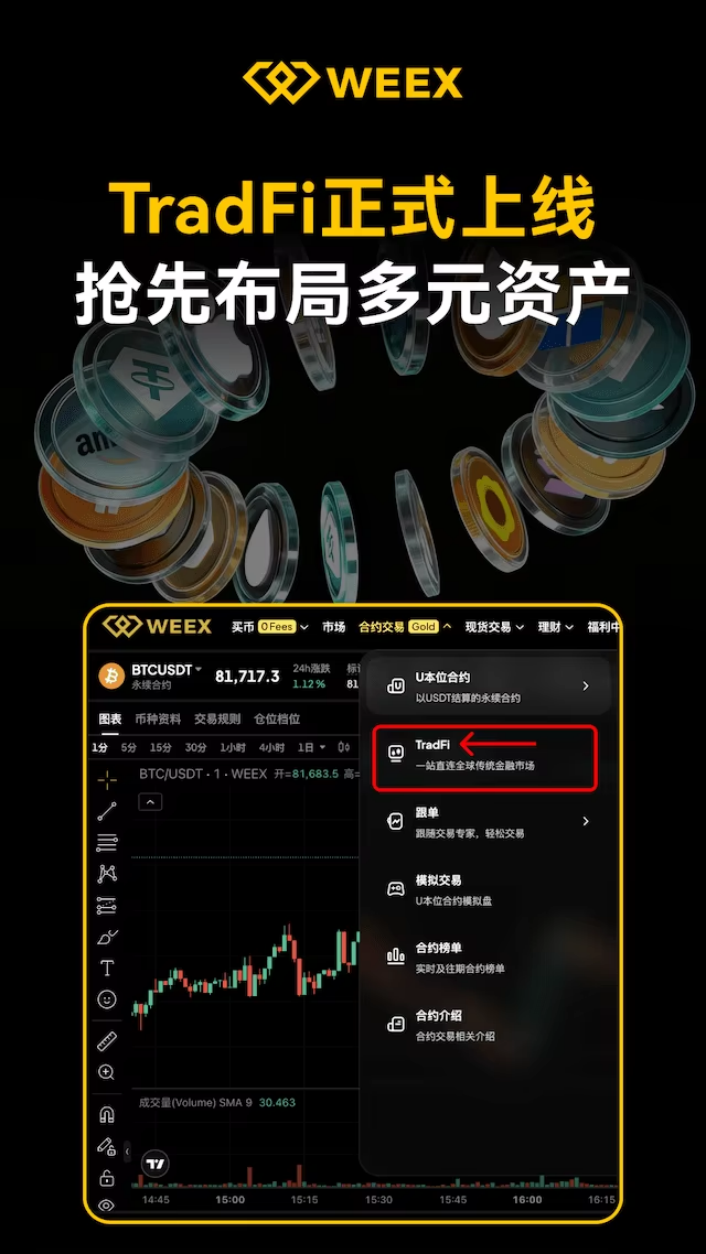
WEEX TradFi introduced related products under this trend, currently supporting trading of popular U.S. stock tokens including NVDA (Nvidia), MSFT (Microsoft), AAPL (Apple), TSLA (Tesla), QQQ, and more, while also covering some traditional financial market assets.
Trading U.S. Stock Tokens Is Not Equivalent to Holding Traditional Stocks

Many users encounter a similar question when first dealing with U.S. stock tokens:

"I'm trading a Nvidia token, does that mean I own Nvidia stock?"

This is actually the most crucial step in understanding TradFi products.
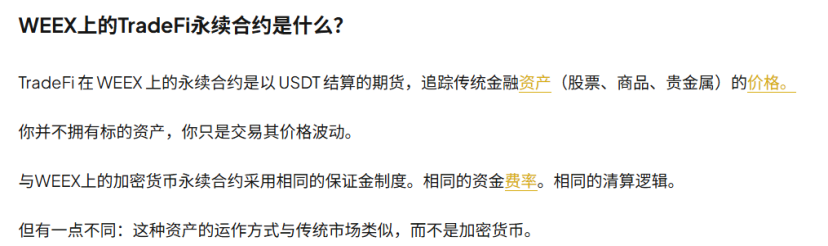
Traditional stock investment essentially involves purchasing shares of a listed company through a securities account; investors may enjoy shareholder rights such as dividends and voting. U.S. stock token products on trading platforms primarily facilitate trading based on the price movements of the related assets. Users participate in price volatility, not traditional stock ownership.

Therefore, while both U.S. stock tokens and stock investment are related to the asset prices of listed companies, they represent different product forms.

Understanding this point is very important because for many users, the first step in judging whether a trading product is reliable is not looking at marketing, but confirming what exactly they are trading.

For users accustomed to Crypto trading, the value of U.S. stock tokens lies in providing a method closer to the digital asset trading experience, allowing them to follow price changes of popular assets in traditional markets without needing to completely switch to another investment system.

7x24-Hour Trading: Bringing a New Trading Experience to Traditional Assets

Another frequently asked question is: U.S. stock markets typically have fixed trading hours, so why can TradFi products be traded around the clock?

This reflects the difference between traditional financial trading models and digital trading models.

Traditional stock markets are subject to exchange opening and closing schedules, while digital trading products can offer more flexible trading hours to users through different trading mechanisms.

For Crypto users, this model aligns more with their long-established trading habits. Important global market news doesn't always occur during U.S. stock market hours, so a more flexible trading mechanism can help users stay abreast of market changes promptly.

However, extended trading hours do not mean the disappearance of risk.

Factors such as market liquidity and price volatility can still change during traditional market closures. While enjoying the convenience of trading, users also need to understand the potential market differences across various trading periods.

A truly mature trading experience is not just about having more trading opportunities, but also about enabling users to fully understand the risks behind those opportunities.

Judging the Reliability of TradFi Products: Transparency and Risk Management Are Equally Important

For any financial product, reliability isn't just about how many assets a platform offers; more importantly, it's about whether users can clearly understand the product rules.

The same applies to U.S. stock token trading.

Users need to focus on several core questions: What is the mechanism of the trading product? How does the price track the related asset? What are the risks during trading? If using leverage, how should positions be managed?

These factors directly impact the trading experience.

Especially in the Crypto market, some users are already accustomed to a high-volatility environment, but traditional financial assets also carry price fluctuation risks. Popular tech stocks like Nvidia and Tesla can be affected by company performance, industry trends, and macro-environmental factors; index and commodity assets are also influenced by interest rates, policies, and global economic changes.

Therefore, trading TradFi assets is not simply about adding a trading entry; it requires users to build a more comprehensive understanding of risk.

While WEEX TradFi offers a variety of traditional asset trading options, it also aims to help users access global markets through a more familiar trading method. However, for any trader, understanding the product and its risks remains the most crucial step before participating in the market.

TradFi Is Becoming a New Gateway Connecting Crypto with Global Markets

Looking at market trends, the assets attracting Crypto users' attention are continuously expanding.
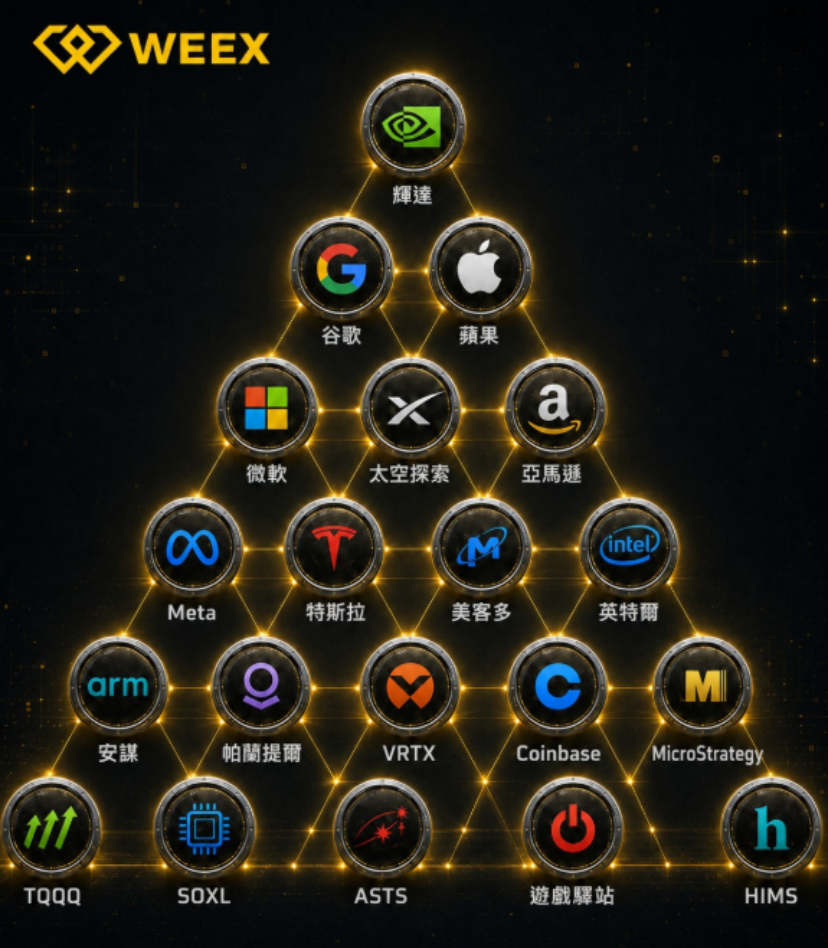
In the past, a trader might only have focused on BTC price changes; today, the factors influencing market movements are increasingly complex. The development of the AI industry, the performance of U.S. tech stocks, dollar policies, and the global macro-environment can all affect the interconnections between different assets.

This is why more and more traders are starting to pay attention to traditional financial assets.

Future market participants may no longer simply distinguish between "Crypto investors" and "traditional investors." As financial infrastructure continues to converge, more users will likely want to understand a broader range of global assets within the same trading environment.

For users trading U.S. stock tokens for the first time, reliability does not come from a simple promise, but from an understanding of the product mechanism, awareness of risks, and a comprehensive assessment of the trading platform's capabilities.

WEEX TradFi aims to provide users with a trading gateway that connects digital assets with traditional markets, allowing them to explore more global asset opportunities in a familiar environment.

And for the entire industry, the fusion of TradFi and Crypto may have just begun.

İlgili Sorular

QWhat is the key difference between trading U.S. stock tokens and traditional stock ownership?

ATrading U.S. stock tokens on a crypto platform allows users to speculate on the price movements of traditional assets like stocks, but it does not confer actual ownership of the underlying shares or associated shareholder rights such as dividends or voting. Traditional stock investment involves buying company shares through a brokerage account, granting those rights.

QHow does the trading experience for U.S. stock tokens differ from traditional stock markets regarding time?

AU.S. stock token trading on platforms like WEEX TradFi typically offers 24/7 trading, unlike traditional stock markets which operate within fixed exchange hours. This provides more flexibility for users to react to global news and aligns with the continuous trading habits common in the crypto market.

QWhat should a user first understand when evaluating the reliability of a TradFi product on a crypto platform?

AA user should first understand the specific product mechanism: how the token tracks the underlying asset's price, the trading rules, and the associated risks (like market volatility and, if applicable, leverage risks). Reliability comes from platform transparency and the user's comprehensive risk awareness, not just the range of assets offered.

QAccording to the article, what broader trend is driving the emergence of TradFi products in the crypto space?

AThe trend is the blurring of boundaries between crypto and traditional financial markets. Crypto users are seeking to access a wider range of global assets (like stocks and indices) within the familiar digital trading environment. TradFi products serve as a new gateway connecting crypto users to these traditional market opportunities.

QWhat is one important consideration mentioned for crypto users trading traditional financial assets via tokens?

AUsers must build a more comprehensive risk awareness. Traditional assets like tech stocks or indices are subject to different risk factors (e.g., company earnings, macroeconomic policies, global economic shifts) compared to typical crypto assets. Trading them is not just about adding a new option, but understanding and managing these specific risks.

İlgili Okumalar

Funding Weekly | Crypto.com Secures $400M Investment, CeFi and Stablecoin Sectors Continue to Attract Capital

Crypto Weekly Investment Recap: Funds Converge on CeFi, Stablecoins, and AI Last week's crypto and AI investment landscape saw significant capital concentration, with a few large deals dominating. **Crypto/Web3 Highlights (July 13-19):** Total investment exceeded **$812 million** across 17 deals. Key trends: * **Centralized Finance (CeFi) & Stablecoins** remained a major magnet, led by **Crypto.com**'s massive **$400 million** raise from Citadel Securities, valuing the exchange at $20B. * **Infrastructure & Tools** saw 7 deals, including **Cyclops** ($20M for stablecoin payments) and **ADI Chain** ($50M for stablecoin settlement infrastructure). * **DeFi** had 2 deals, such as AI-native DEX **Quote Trade** ($4M). * Other notable raises: API broker **Alpaca** ($135M), cross-border platform **Flex** ($70M), treasury firm **ORANGE JUICE** ($40M), and prediction market **Pascal** ($9M). * **Acquisitions:** Keyrock bought BlockFills' trading unit, SBI Holdings acquired Singapore exchange Coinhako, and MoonPay bought startup Glide. **AI & Robotics Highlights:** Investment momentum in AI remained very strong. * Nvidia-backed AI cloud service **Fireworks** raised a massive **$1.5 billion** at a $17.5B valuation. * In robotics, **Walden Robotics** (spun out from Toyota) secured **$300 million**, and Chinese humanoid firm ****逐际动力** **(Climax Dynamics) raised nearly **$200 million** in a Pre-IPO round. * Other significant AI raises included Indian programming platform **Emergent** ($130M) and drone company **Brinc** ($125M), backed by Sam Altman. Overall, the trend shows capital flowing heavily into established crypto financial services, stablecoin infrastructure, and large-scale AI/robotics commercialization.

marsbit58 dk önce

Funding Weekly | Crypto.com Secures $400M Investment, CeFi and Stablecoin Sectors Continue to Attract Capital

marsbit58 dk önce

The Gentlest Bear Market? BTC Bears Exit, ARK and Bitwise Collectively Bullish

**Title: The Mildest Bear Market? BTC Shorts Exit, ARK and Bitwise Collectively Bullish** Bitcoin continues to consolidate around $75,000 while Ethereum struggles near $1,900. Market data shows $116 million in liquidations over 24 hours, with $62.7 million from short positions, and the Fear & Greed Index remains at 35 (Fear). According to Polymarket, there's a 33% probability BTC falls below $50,000 this year. ARK Invest's Q2 2026 Bitcoin report notes technical weakness but identifies potential bottoming signals, including a record high in long-term holder supply, suggesting selling exhaustion. Bitwise's Juan Leon calls this the "structurally mildest bear market" on record, with a ~50% drawdown from highs, less severe than past cycles. He highlights institutional accumulation and a shift in investor dialogue from survival to entry points. Technical analysis from Bit suggests a potential C-wave low may have formed, with an ideal bottoming range between $50,000-$55,000. However, glassnode's CryptoVizArt warns that failure to break $66,000 could signal a local top, as new buyer accumulation is concentrated there. Analyst Darkfost identifies a critical support band between $59,000-$70,000, where 50% of BTC's circulating supply has changed hands. Notably, trader Doctor Profit announced closing all crypto short positions—including BTC shorts from $115k-$125k and over 100 altcoin shorts—for significant profit. He has begun a phased accumulation of Bitcoin spot starting at $64,000, reversing his previous $40k-$50k target, citing structural positives like regulatory clarity and institutional adoption. He argues the anticipated September/October bottom may arrive earlier than the herd expects.

Foresight News1 saat önce

The Gentlest Bear Market? BTC Bears Exit, ARK and Bitwise Collectively Bullish

Foresight News1 saat önce

The Evolution of Order in the AI & Web3 Era: The Competitive Dimensions and Exploratory Path of m&W

The article explores the evolution of order in the AI & Web3 era, framing the competition around establishing new foundations for human-AI collaboration. It argues that as AI Agents become core economic participants, the existing Web3 infrastructure—focused on assets, identity, and decentralized governance—is insufficient. The core challenge shifts to building trust, assessing complex contributions, and creating fair value distribution among diverse human and AI actors. The analysis positions the m&WDAO project within this landscape by comparing it to existing paradigms: Colony (human-centric DAO governance), SingularityNET (AI service exchange), Gitcoin Passport (Sybil-resistant identity), and Farcaster/Lens (open social graphs). m&W's distinct path, termed EcoFi (Ecological Finance/Order), aims to integrate these layers. Its three-phase evolution is outlined: 1) **m&W 1.0: Credit Anchoring** - filtering high-quality "Builder" nodes and converting their contributions into non-transferable SBTs (Soulbound Tokens) as a bedrock of trust. 2) **m&W 2.0: Collaborative Economy** - deploying the EcoFi protocol to enable verified, complex task collaboration with a hybrid AI/human judgment system for valuation and dispute resolution, creating a closed-loop value system. 3) **m&W 3.0: Intelligent Order** - where human-originated SBT credit enables trusted AI Agent "digital twins" to participate in a mature human-AI co-creation economy. The conclusion asserts that while other projects solve discrete problems (proving identity, governing contributions, exchanging AI capabilities), m&W's ultimate mission is to address the foundational question of a new socio-economic order for the coming era of human-AI collaborative networks.

链捕手1 saat önce

The Evolution of Order in the AI & Web3 Era: The Competitive Dimensions and Exploratory Path of m&W

链捕手1 saat önce

İşlemler

Spot
活动图片