Over the past decade, digital computing centered around GPUs has dominated the AI field. Larger clusters, higher bandwidth, more powerful GPUs, and denser data centers seem to be the mainstream path towards next-generation AI.
However, as model parameters scale towards trillions, the industry has frequently begun mentioning "energy consumption," raising an even more fundamental question: If AI continues to expand in its current way, where will the electricity come from?
Undoubtedly, AI's "electricity bill" and energy consumption have gradually evolved from operational costs to a "structural bottleneck" constraining the entire industry's development.
Facing this imminent energy crisis, former Databricks AI chief, Silicon Valley legendary entrepreneur Naveen Rao, steps into the spotlight with his new deep-tech startup Unconventional AI.
Today, Unconventional AI officially announced the launch of its first model, Un-0, an image generation model driven by an "analog coupled oscillator system," which can be seen as a sample of an emerging physics-based computational foundation. On ImageNet 64×64, Un-0 achieves an FID of 6.74, with quality already approaching the level of some mainstream traditional image generation methods when they were first released.
Naveen Rao calls it "the first large-scale generative model built using physics as a computational primitive."
"This marks a 'Hello World' moment for physics-based models. We leverage the natural time-evolving behavior of a physical system to perform the computation for us. The end result is a completely new way of building computers, with the potential for significant improvements in energy efficiency."
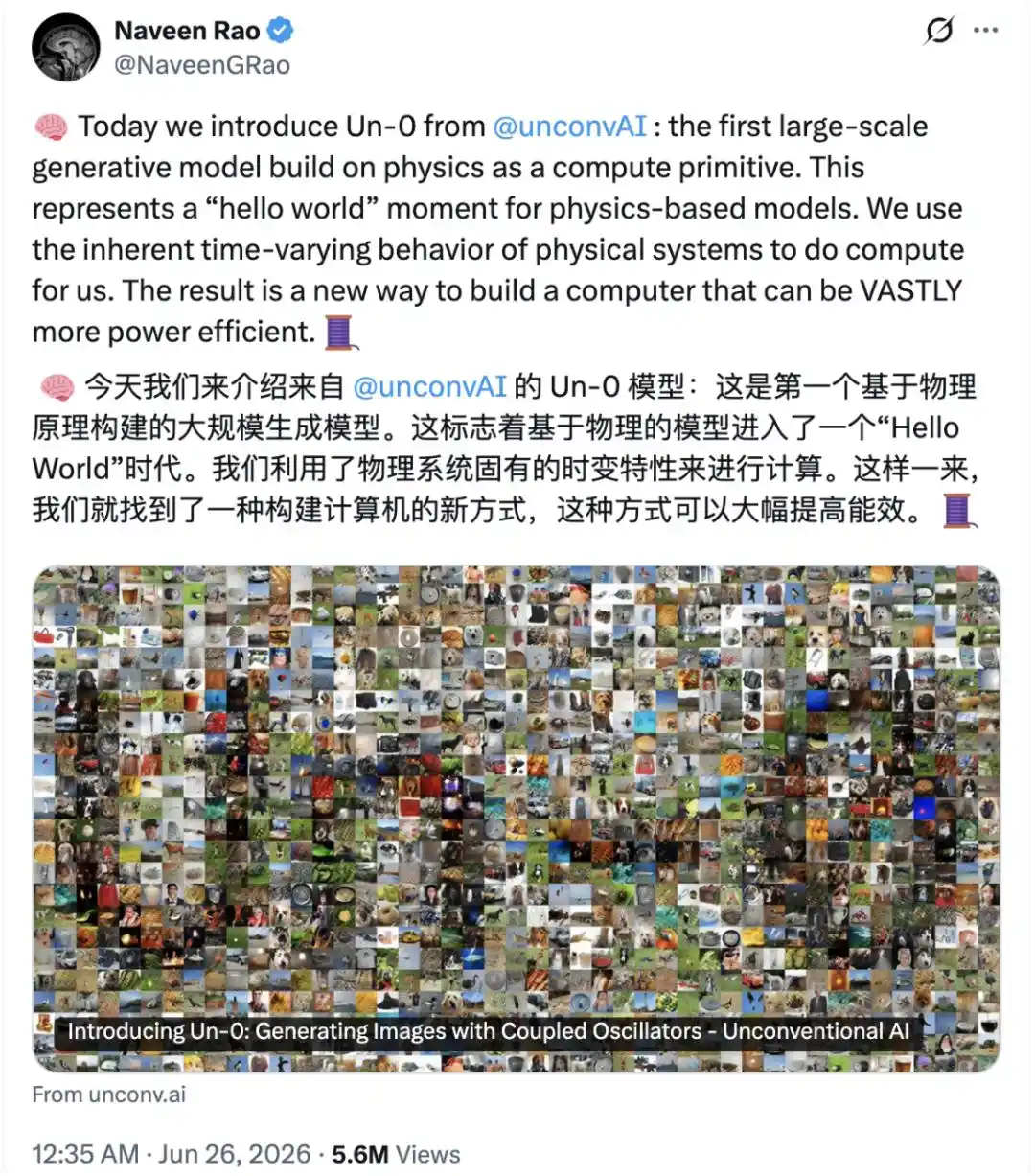
Furthermore, in an interview with media, Naveen Rao set an even bolder "small goal": potentially reducing AI inference energy consumption to one-thousandth of existing systems in the future.
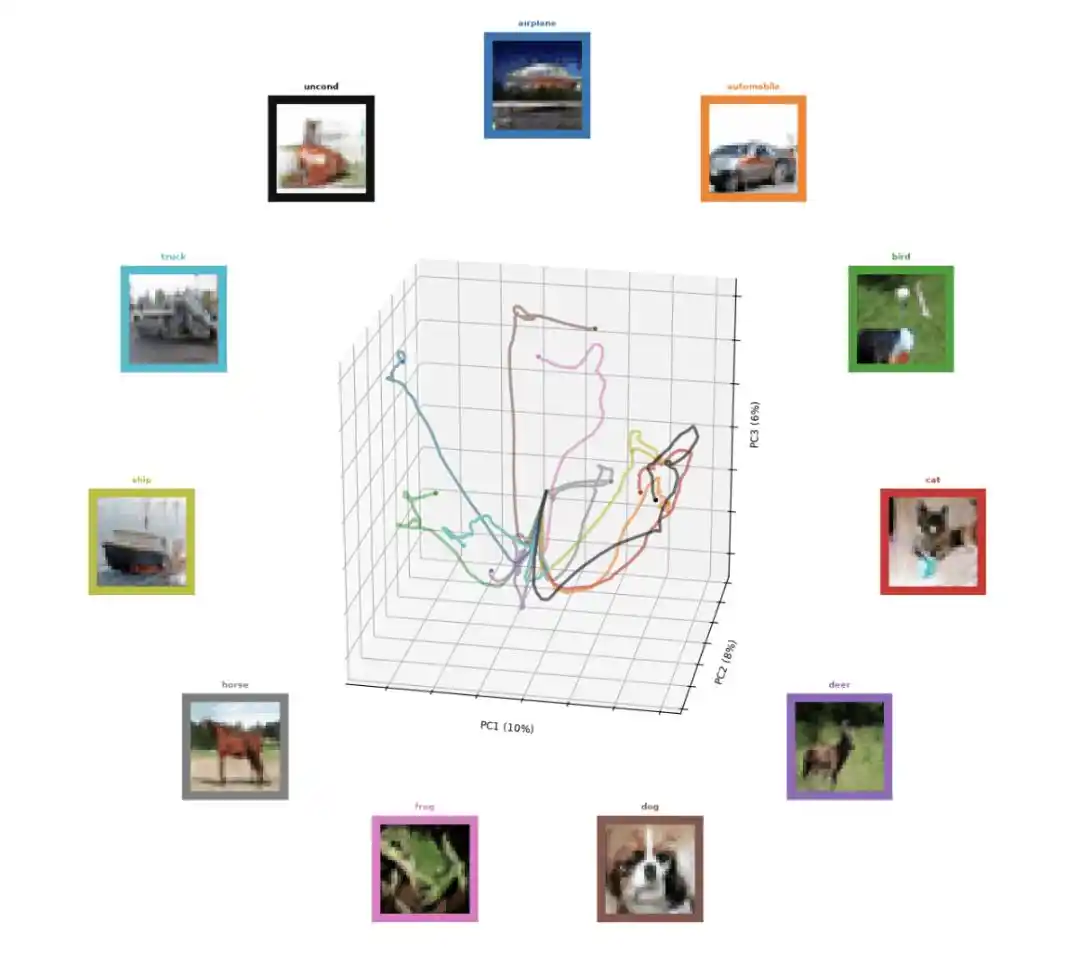
Sample trajectories showing the evolution of the Un-0 generation process over time. The color of each line corresponds to a similarly colored box, which is labeled with a category and shows the gradual image generation process for that category over time.
The official released a blog post introducing Un-0. Let's take a closer look.
Un-0's Starting Point: Re-doing AI Computation with Physical Systems
Unconventional AI states that their goal is to build a new type of computer that uses the laws of physics to perform computation, hoping that modern AI can run with far less energy than today's machines, targeting roughly a 1000x reduction in energy consumption.
Therefore, they posed a question: Can we train a physical dynamical system to generate images on a scaled-up task?
Today, the most powerful AI models are largely traditional deep networks, especially models based on the Transformer architecture. But beyond this mainstream path, there has long been research attempting to leverage the dynamic behavior of physical systems to improve energy efficiency, such as noise, time-varying signals, voltages, and currents in analog circuits. These methods don't compute with traditional digital numbers but utilize the evolutionary process of the physical system itself.
Examples include neuromorphic computing, Hopfield networks, Reservoir Computing, as well as more recent developments like Hamiltonian Networks, Liquid Networks, Neural Wave Machines, Thermodynamic Computing, and Kuramoto Oscillators.
Un-0 is a new attempt along these unconventional computational paths. But the core challenge is: to leverage these alternative computing methods, AI tasks must be effectively mapped onto the dynamic processes of a physical system. What Un-0 aims to validate is whether modern AI workloads can be run on a physical substrate and ultimately be more efficient than today's hardware.
How Un-0 Works
The official suggests imagining two metronomes ticking side by side, as shown in the image below.
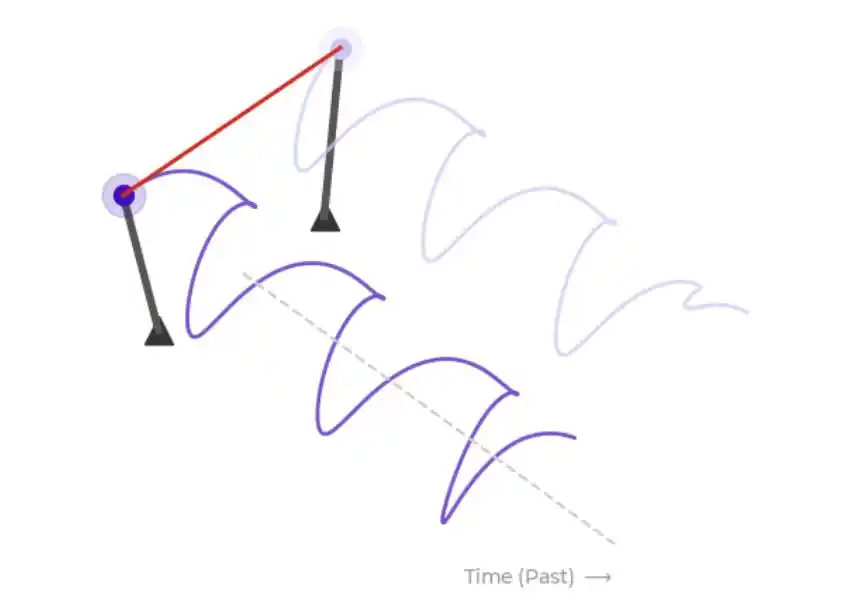
Each metronome has a "phase" at any given moment, which is the current position of its pendulum within its swing cycle. If two metronomes are placed on the same table, they can influence each other through the table's surface. Depending on the strength of this interaction, or coupling strength, they may gradually synchronize or enter a state of anti-phase synchronization.
This is the basic concept of an oscillator: each oscillator has its own phase and tends to rotate at its own natural frequency, but it is also influenced by neighboring oscillators.
Extending this from two to thousands of oscillators makes the system much more interesting. A large number of oscillators, with different coupling strengths between them, can self-organize into certain patterns through their interactions, as shown below.
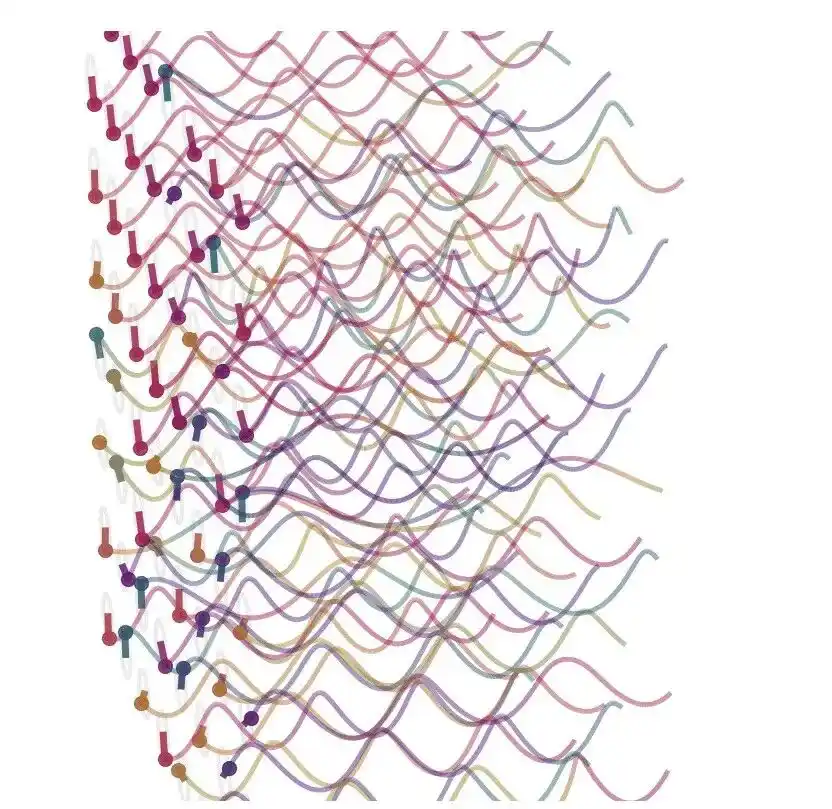
Un-0's computational engine is precisely such a large-scale oscillator ensemble, with the coupling strengths between oscillators being the model's main learnable parameters.
These coupled oscillators are typically modeled as "Kuramoto oscillators."
Specifically, the motion of each oscillator follows a simple rule that continuously applies over time: it rotates according to its own natural frequency, while also being pulled and shifted by the influence of all other oscillators.
The following ordinary differential equation (ODE) describes how these oscillators evolve over time:

Each oscillator i carries a phase

∈[0,2π), where

represents its natural frequency. The matrix

specifies the coupling strengths, determining how strongly oscillator j pulls or pushes oscillator i towards or away from synchronization.
What Un-0 needs to learn are precisely the coupling matrix K and the natural frequencies ω, which together define the physical system itself.
Unconventional AI gives two reasons for choosing oscillators:
- The first reason comes from the brain: Rhythmic activity and synchronization phenomena are widespread in the brain. For a long time, it has been thought that these phenomena might be involved in computational processes, such as binding disparate features into a coherent perception, controlling information exchange between brain regions, and organizing the temporal structure of neural spikes. Coupled oscillators are among the simplest mathematical models to describe such behavior, making them a natural fit as a foundation for neurally-inspired computing models.
- The second reason is more engineering-oriented: Oscillators can be implemented as a physical circuit primitive. Unconventional AI believes it's possible to directly implement coupled oscillator systems in CMOS or other physical substrates, allowing the physical behavior of the system itself to compute the dynamical evolution.
The bet behind Un-0 is: If physical laws can directly compute AI workloads, then the future execution substrate could be very different from today's GPUs.
Un-0's Model Architecture
Generating an image with Un-0 roughly involves five steps:
- Random Initialization: Set the phases of all oscillators to random angles (similar to random noise in diffusion models).
- Input Category Guidance: Use a smaller set of "conditioning oscillators" to input a category label (e.g., "volcano," "daisy"), guiding the main oscillator pool to evolve in a specific direction.
- Let Physics Run Naturally: Release the system, allowing the oscillators to interact and evolve under physical dynamics until they stabilize.
- Capture a Snapshot: At a specific time T, record the phases of all oscillators, forming a latent space numerical grid.
- Render Pixels: Use a traditional decoder, which accounts for less than 13% of the model's parameters, to convert the phase grid into the final image pixels.
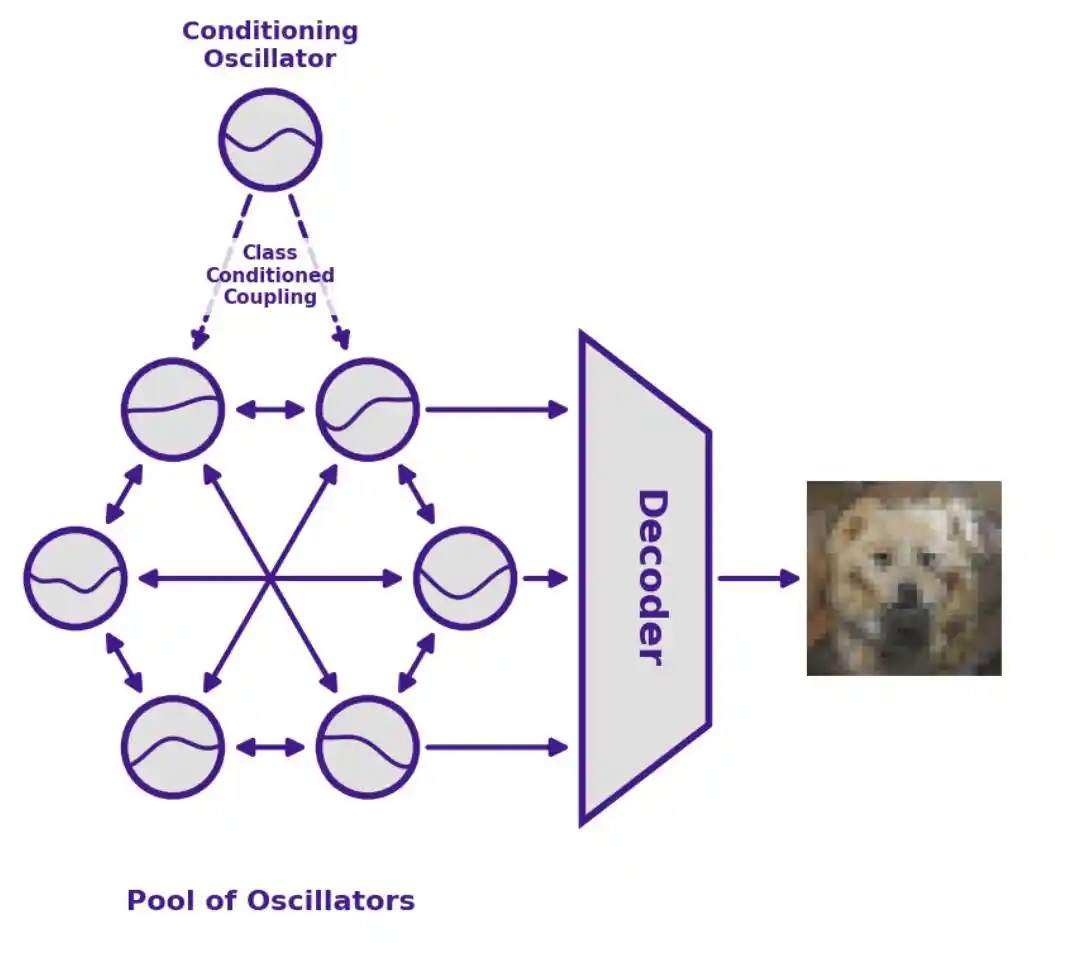
Coupled oscillators evolve over time under the influence of the learned coupling relationships. A unidirectional low-rank category conditioning matrix exists from the conditioning oscillators to the main oscillator pool to inject category information. At time point T, a decoder reads the oscillator states to generate an image. By sampling different initial conditions multiple times, the corresponding image distribution can be generated.
During training, the model primarily learns three types of parameters: how oscillators couple with each other (matrix K); the natural frequency

of each oscillator; and the weights of the decoder. Overall, the oscillator system takes on the computation that might otherwise be done by traditional neural network layers.
Unconventional AI explains that this architecture was chosen to give the dynamical system itself maximum freedom to perform the computation.
In the forward pass during training, the model only needs to set the coupling matrix, oscillator frequencies, and initial phases, then let the dynamical system evolve, and finally read the image latent variables.
This differs from dynamic generative methods like diffusion models and Flow Matching. Diffusion and Flow Matching typically explicitly guide how the dynamical system should evolve during training, whereas Un-0's approach is more like observing only the final generated samples and then optimizing the entire dynamical system through a loss function.
The trade-off is that it requires a more complex loss function because the training signal primarily comes from the generated samples themselves.
How is Un-0 Trained?
Unconventional AI trained models of three different sizes on CIFAR-10 and ImageNet 64×64 respectively, with the following results:

Training results on CIFAR-10

Training results on ImageNet 64×64
From the results, as the number of oscillators increases, the model's FID score continues to improve. The largest ImageNet 64×64 model uses 16,384 oscillators, totaling approximately 322 million parameters, and achieves an FID of 6.74.
In terms of training method, a newly proposed "Drifting Loss" function was used, combined with the DINOv2 feature extractor and the AdamW optimizer for end-to-end training.
For evaluation, on CIFAR-10, 50,000 generated samples were used and compared with CIFAR-10 reference statistics using standard packages and evaluation procedures. For ImageNet 64×64, 50,000 generated samples were also used, and FID was calculated via the ADM evaluation suite.
In terms of computing power, all CIFAR-10 models were trained on 1 B200 GPU, while all ImageNet 64×64 models were trained on 8 B200 GPUs. The largest CIFAR-10 model training consumed 20 B200 hours, and the largest ImageNet 64×64 model training consumed 640 B200 hours.
The official stated that the training bottleneck primarily comes from computing the "Drifting Loss" function, which requires using a traditional image feature extractor and computing across multiple feature views.
Where Does Un-0 Stand in the Field of Image Generation?
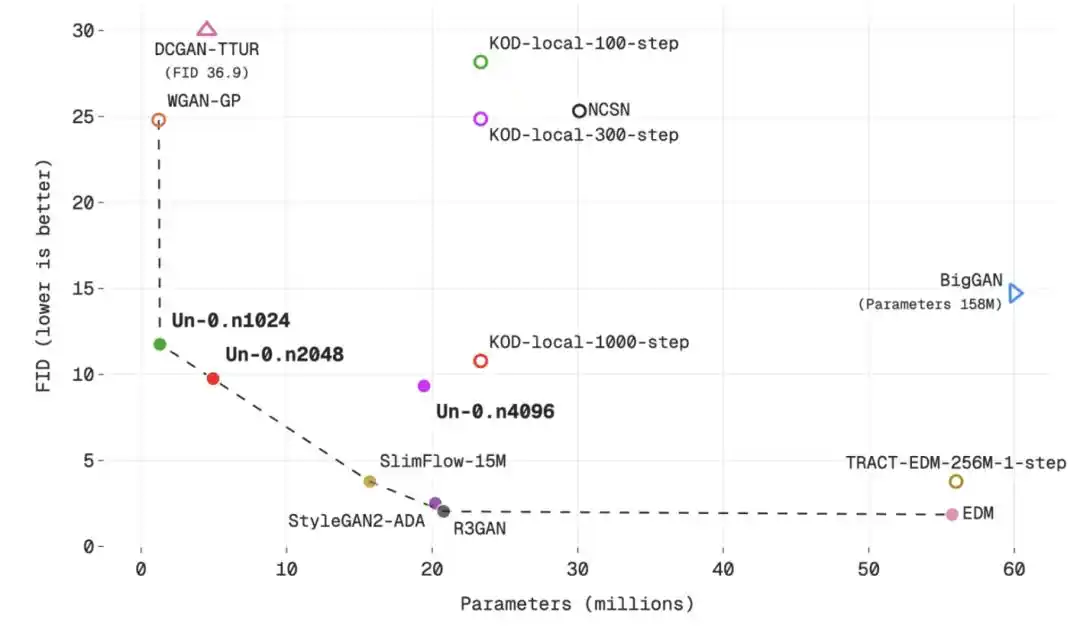
To better showcase Un-0's performance, Unconventional AI placed Un-0 on a "generation quality vs. parameter count" curve, comparing it with both traditional and unconventional models.
Parameter count vs. FID value in the CIFAR-10 dataset
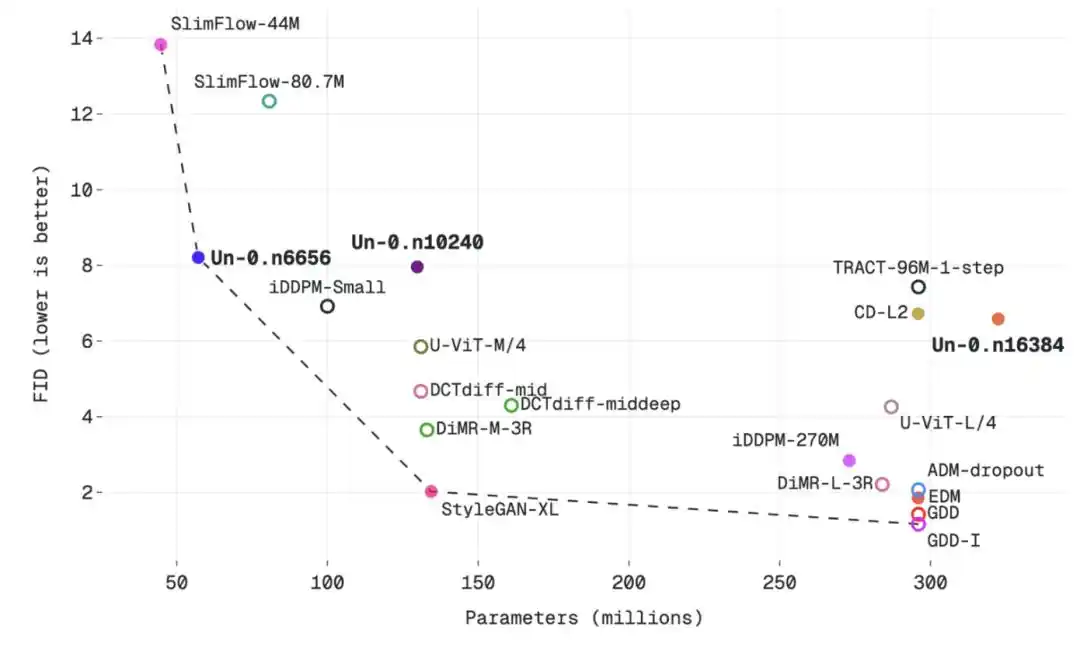
Parameter count vs. FID value for 64×64 images
The conclusion is: Un-0's quality is already comparable to, and in some comparisons even better than, some early traditional generators, such as NCSN, DCGAN-TTUR, WGAN-GP, BigGAN, iDDPM, Consistency Models, and TRACT. However, it still lags behind later high-performance traditional models, such as EDM and GDD.
In other words, Un-0 is not the strongest image generation model currently; it is more like the starting point of a new path. Its performance is already close to the level of many classic generative models when they were first proposed, but catching up to the latest frontier of the traditional path requires continuous optimization in algorithms, architecture, and physical primitives.
Overall, Un-0 demonstrates the feasibility of using physical dynamical systems for modern, large-scale AI image generation. Although its performance under software simulation has not yet reached the peak of conventional AI, it opens a promising path towards future "unconventional AI hardware" with thousand-fold energy efficiency...
Naveen Rao also emphasized that the emergence of Un-0 shows that "computation is not a uniquely human invention." It exists everywhere in nature and the physical world. All physical processes of physical entities involve a time dimension, but today's computing systems do not truly utilize this.
"What we are developing is precisely this time dimension."
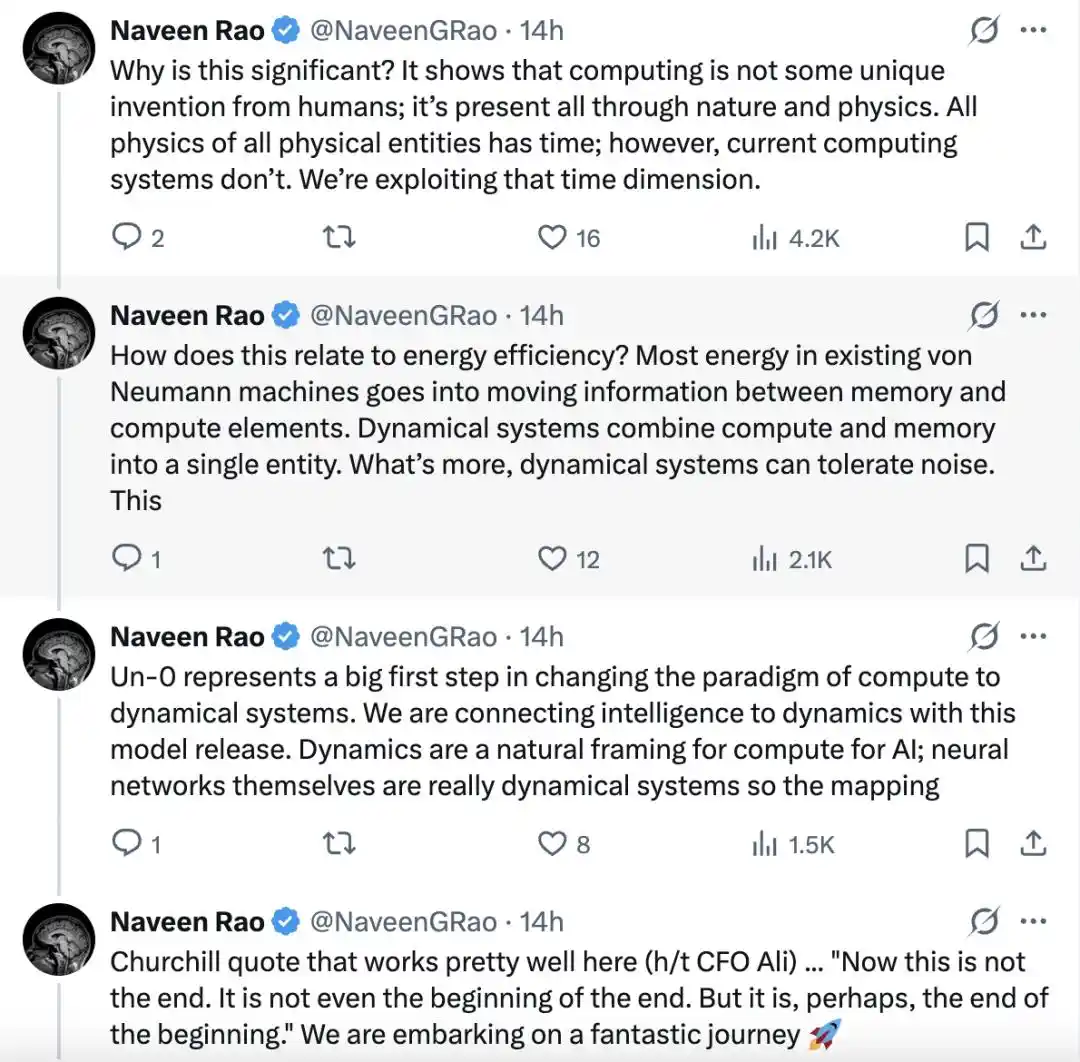
The connection to energy efficiency lies in this: In current von Neumann architecture machines, most energy is consumed shuttling information between memory and computation units, whereas dynamical systems merge computation and memory into the same entity. More importantly, dynamical systems can tolerate noise, which further opens new opportunities to save communication energy.
Un-0 represents an important first step in shifting the computational paradigm towards dynamical systems. "With this model release, we are connecting intelligence with dynamics." For AI computation, dynamics is a natural expressive framework, and neural networks can essentially be viewed as dynamical systems, so the mapping between the two becomes more direct.
"There is no abstraction like linear algebra in the brain, so in a sense, we are bypassing the middleman."
Under the post, many users expressed anticipation.
"The improvement in performance efficiency is actually huge. If this technology can be widely adopted, many locally-run applications could become feasible."

"If this technology hits the market, it would be an incredibly advanced brain technology."

Reference Links:
https://x.com/NaveenGRao/status/2070184079199494583
https://unconv.ai/blog/introducing-un-0-generating-images-with-coupled-oscillators/
https://techcrunch.com/2026/06/25/databricks-former-ai-chief-thinks-he-can-cut-ais-power-bill-by-1000x/
This article comes from the WeChat public account "Almost Human" (ID: almosthuman2014), author: Focus on AI.