0.7nm Process Chip Emerges, Moore's Law Lives On

marsbit2026-06-26 tarihinde yayınlandı2026-06-26 tarihinde güncellendi

Özet

IBM has unveiled the world's first sub-1-nanometer (0.7nm) chip technology, integrating nearly 100 billion transistors into an area the size of a fingernail. This breakthrough doubles the transistor density of current 2nm chips and promises a 50% performance gain or a 70% improvement in power efficiency. The achievement is powered by IBM's "NanoStack" architecture, a pioneering 3D design featuring vertically stacked nanosheet transistors. This evolution from FinFET and Gate-All-Around (GAA) technologies offers superior electrostatic control. IBM has demonstrated the technology's viability with functional CMOS inverters and a 40% area reduction in SRAM, crucial for AI chip data bandwidth. Addressing the critical power consumption challenges in AI computing, this advancement extends the roadmap for chip miniaturization. While IBM does not manufacture chips itself, it licenses its process technology to partners. The company projects that NanoStack-based chips could enter production within the next five years, potentially sustaining Moore's Law for another decade.

Is Moore's Law saved?

IBM unveiled the world's first 0.7 nanometer chip process node, integrating nearly 100 billion transistors on a chip the size of a fingernail, achieving a density double that of 2nm chips.

Previously, TSMC's most advanced process was 2nm, which had been difficult to advance beyond for years.

NVIDIA CEO Jensen Huang had repeatedly declared Moore's Law dead, but now there is finally a turning point.
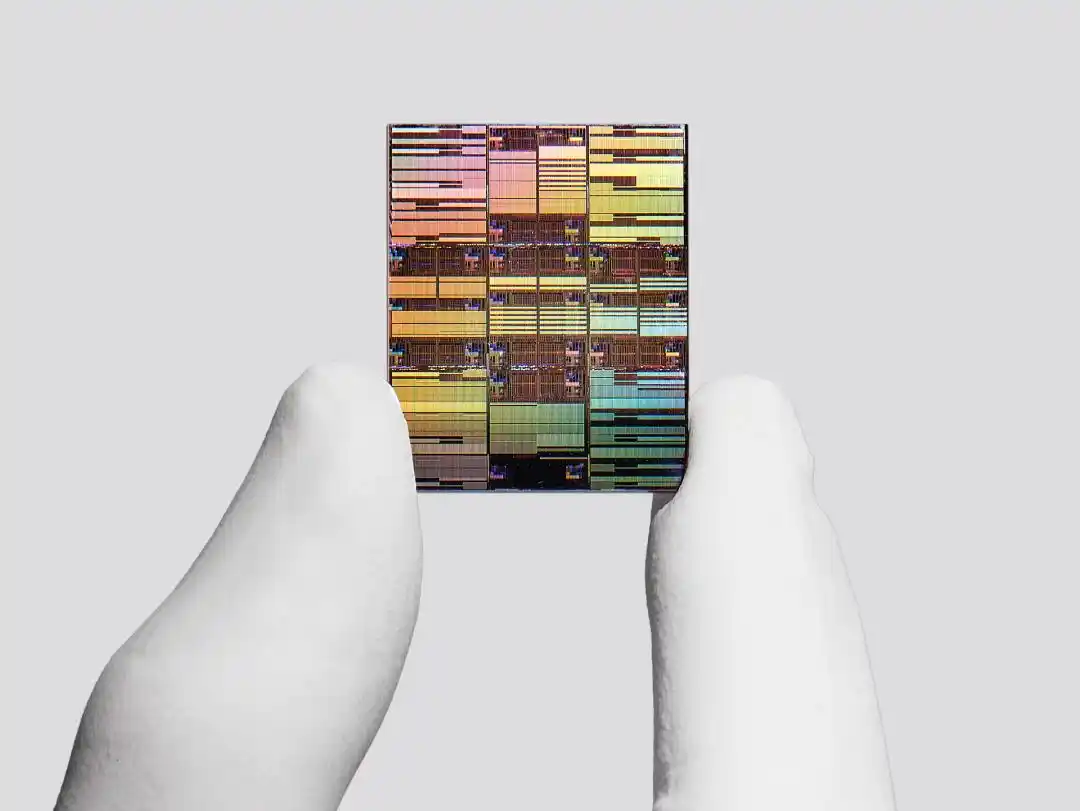
0.7 nanometers, or 7 angstroms, marks the first time human-made transistors have broken through the 1 nanometer threshold, approaching the scale of individual atoms (0.1-0.5 nanometers).

Compared to the 2nm process, it can deliver either a 50% performance improvement or a 70% increase in power efficiency; one or the other.

NanoStack Architecture Arrives

The core of this breakthrough is IBM's "NanoStack" architecture, the industry's first 3D vertically stacked transistor design based on nanosheets.

To understand NanoStack, one must first review the path chip architecture has taken in recent years.

In the 7nm and 10nm era, the mainstream solution was FinFET (Fin Field-Effect Transistor) with the gate wrapping around the channel on three sides to control current. Below 5nm, FinFET's leakage issues became increasingly severe and unsustainable.

In 2017, IBM introduced the Gate-All-Around (GAA) nanosheet technology, where the gate completely surrounds the horizontally stacked nanosheet channel on all four sides, significantly enhancing electrostatic control. This became the technical foundation for its 2nm chip and was subsequently adopted by mainstream manufacturers like TSMC and Samsung.

At the end of 2021, IBM and Samsung jointly announced the VTFET (Vertical-Transport Field-Effect Transistor), which changed the current flow direction from horizontal to vertical. Simulation data showed it could either double performance or reduce power consumption by 85% compared to a similarly sized FinFET solution.

This NanoStack is a further extension of the above roadmap.

Its method is:

Take two wafers with nanosheet transistors, invert one and place it on top of the other, bonding them via an ultrathin dielectric bonding layer to form a vertically interconnected 3D structure. Each layer can use different material combinations, allowing n-type and p-type transistors to be independently optimized without interference.
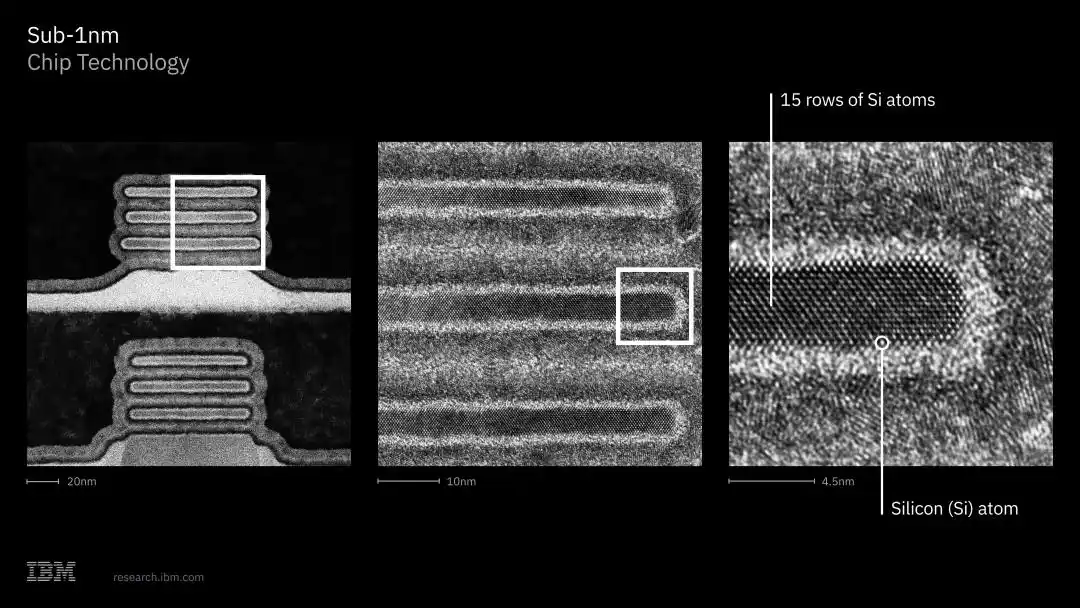
IBM has already completed validation in the lab, demonstrating CMOS integration, dual-channel engineering capabilities, and a fully functional CMOS inverter with switching performance meeting expectations, confirming that this technology can be manufactured and support real computation.

At the VLSI 2026 symposium, IBM further showcased NanoStack's performance on SRAM: a 40% area reduction. SRAM is a core component of on-chip cache, which has long been extremely difficult to scale down. This progress is particularly crucial for the high-bandwidth data pathways required by AI chips.

"Nobody Wants to Pay the Electricity Bill"

Huiming Bu, vice president of chip research at IBM Research, stated: Everyone wants higher performance, but nobody wants to pay the electricity bill.

This is the reality facing the current AI computing power race. The energy consumption of AI chips has evolved from a technical issue to an infrastructure problem, with some data center projects experiencing construction delays due to insufficient power supply.

The 70% power efficiency improvement offered by the 0.7nm technology directly addresses this demand.

However, IBM itself no longer manufactures or sells chips. It develops manufacturing process technologies at its research center in Albany, New York, and then licenses them to chip manufacturers.

Past licensees have included Samsung and the newly formed Japanese semiconductor company Rapidus. Huiming Bu declined to disclose potential customers for the 0.7nm technology.

Regarding competing solutions, the Belgian research institute Imec is advancing another 3D architecture scheme, building transistor structures through layer-by-layer stacking, which has attracted attention from several chip manufacturers.

For mass production, IBM's given timeline is: NanoStack technology could achieve mass production within the next five years at the earliest.

IBM's semiconductor roadmap predicts that with the NanoStack architecture, chip scaling can continue for at least another decade.

References:

[1]https://newsroom.ibm.com/2026-06-25-ibm-debuts-worlds-first-sub-1-nanometer-chip-technology

This article is from the WeChat public account "QbitAI", author: Meng Chen

Trend Kriptolar

İlgili Sorular

QWhat is the name of the new architecture that enabled IBM's 0.7nm chip breakthrough?

AThe new architecture is called 'NanoStack'. It is the industry's first three-dimensional, vertically stacked transistor design based on nanosheets.

QAccording to the article, what is a key challenge that the improved energy efficiency of the 0.7nm process aims to solve?

AIt aims to address the growing AI compute power consumption, which is evolving from a technical issue into an infrastructure problem. This is because some data center projects face construction delays due to insufficient power supply, and users want higher performance without significantly higher electricity bills.

QHow does IBM's 0.7nm chip compare to a 2nm chip in terms of performance or energy efficiency?

ACompared to a 2nm process, the 0.7nm technology offers a choice: it can provide either a 50% performance improvement or a 70% increase in energy efficiency.

QWhat significant milestone does the 0.7nm (7 Angstrom) transistor represent in semiconductor manufacturing?

AIt represents the first time a human-made transistor has broken the 1-nanometer threshold, bringing its scale close to that of individual atoms (0.1-0.5 nanometers).

QWhat is IBM's estimated timeline for the NanoStack technology to reach mass production?

AIBM's timeline suggests that the NanoStack technology could enter mass production as early as within the next five years.

İlgili Okumalar

Google's 'Reasoning King' Also Departs for Meta, Originally Recruited by Fei-Fei Li

"Google's 'King of Reasoning' Leaves for Meta, Quietly Departing After Over Eight Years. Denny Zhou, a key figure behind Google's AI reasoning advancements including work showcased by CEO Sundar Pichai, has joined Meta's MSL as a research scientist. His low-profile move, discovered via a LinkedIn update, occurred months before the high-profile departures of Noam Shazeer to OpenAI and Nobel laureate John Jumper to Anthropic. Zhou was originally recruited to Google by Fei-Fei Li's China center initiative after nearly 11 years at Microsoft. This is part of a significant talent drain at Google, with top researchers like Shazeer (co-author of the Transformer paper) and Jumper (AlphaFold lead) recently leaving for rivals. Reports suggest internal friction is a contributing factor, particularly around Google's strategic shift. The company has reportedly formed a high-priority 'AI Coding Strike Team,' involving co-founder Sergey Brin, to urgently bridge the gap in AI coding agents, potentially reallocating resources and focus away from other research directions like DeepMind's 'world model' AGI approach. This pivot towards commercially-proven coding applications may have influenced departures, as hinted by Shazeer's comment about his compute allocation being given to another team. Meanwhile, Meta continues to bolster its team, also recently hiring UC Berkeley professor and 'security godmother' Dawn Song, along with her startup Virtue AI team, as a VP of AI research."

marsbit44 dk önce

Google's 'Reasoning King' Also Departs for Meta, Originally Recruited by Fei-Fei Li

marsbit44 dk önce

How Did Hundreds of Billions of Dollars Flow into SpaceX After Its Index Inclusion on June 26th? Will SpaceX Experience a Massive Price Surge?

Will SpaceX ($SPCX) stock surge when billions in passive index fund money flows in on the effective date? A common retail investor belief is that a massive wave of buying will hit on July 6th, when SpaceX joins the Nasdaq-100, potentially causing a huge price spike. However, the reality is far more complex and less dramatic. The anticipated billions are not controlled by a single entity but are spread across hundreds of passive fund managers (e.g., BlackRock, Vanguard) whose sole mandate is to minimize "tracking error." They aim to buy shares at prices as close as possible to the index's closing price on the effective date, not to aggressively drive the price up. There are two key index inclusion scripts: 1) For the Russell US Index (effective June 26th at close), buying is compressed into the final minutes via Market-On-Close (MOC) orders. 2) For the Nasdaq-100 (announced June 26th, effective July 6th), a 10-day window creates a layered game. Arbitrage funds buy early, betting on selling to passive funds later. Some index funds "front-run" by accumulating shares gradually before the deadline. The bulk of passive funds execute large MOC orders at the July 6th close, often trading directly with arbitrageurs. A critical wildcard is SpaceX's limited free float due to a standard 180-day post-IPO lockup. To avoid causing a massive price spike by competing for scarce shares on the open market, large funds will likely use off-exchange methods: 1) Negotiating large block trades (over-the-counter) with major holders. 2) Using derivatives like total return swaps with locked-up shareholders to gain economic exposure without physically buying the stock. Most of the index-driven buying will thus happen invisibly, not on public exchanges. For retail investors, trying to front-run these sophisticated flows is risky. More viable strategies include: waiting for post-inclusion volatility to subside before establishing a long-term position, or employing options strategies like selling strangles to profit from elevated, but potentially overstated, implied volatility around the event. In conclusion, while price appreciation may occur in the days following the announcement due to arbitrage and front-running activity, a single-day "explosive pump" on July 6th is highly unlikely. The major index fund buying will be executed efficiently and discreetly, often away from public markets, turning the anticipated climax into a well-orchestrated, anti-climactic settlement.

marsbit57 dk önce

How Did Hundreds of Billions of Dollars Flow into SpaceX After Its Index Inclusion on June 26th? Will SpaceX Experience a Massive Price Surge?

marsbit57 dk önce

İşlemler

Spot

Popüler Makaleler

CHIP Nasıl Satın Alınır

HTX.com’a hoş geldiniz! USD.AI (CHIP) satın alma işlemlerini basit ve kullanışlı bir hâle getirdik. Adım adım açıkladığımız rehberimizi takip ederek kripto yolculuğunuza başlayın. 1. Adım: HTX Hesabınızı OluşturunHTX'te ücretsiz bir hesap açmak için e-posta adresinizi veya telefon numaranızı kullanın. Sorunsuzca kaydolun ve tüm özelliklerin kilidini açın. Hesabımı Aç2. Adım: Kripto Satın Al Bölümüne Gidin ve Ödeme Yönteminizi SeçinKredi/Banka Kartı: Visa veya Mastercard'ınızı kullanarak anında USD.AI (CHIP) satın alın.Bakiye: Sorunsuz bir şekilde işlem yapmak için HTX hesap bakiyenizdeki fonları kullanın.Üçüncü Taraflar: Kullanımı kolaylaştırmak için Google Pay ve Apple Pay gibi popüler ödeme yöntemlerini ekledik.P2P: HTX'teki diğer kullanıcılarla doğrudan işlem yapın.Borsa Dışı (OTC): Yatırımcılar için kişiye özel hizmetler ve rekabetçi döviz kurları sunuyoruz.3. Adım: USD.AI (CHIP) Varlıklarınızı SaklayınUSD.AI (CHIP) satın aldıktan sonra HTX hesabınızda saklayın. Alternatif olarak, blok zinciri transferi yoluyla başka bir yere gönderebilir veya diğer kripto para birimlerini takas etmek için kullanabilirsiniz.4. Adım: USD.AI (CHIP) Varlıklarınızla İşlem YapınHTX'in spot piyasasında USD.AI (CHIP) ile kolayca işlemler yapın.Hesabınıza erişin, işlem çiftinizi seçin, işlemlerinizi gerçekleştirin ve gerçek zamanlı olarak izleyin. Hem yeni başlayanlar hem de deneyimli yatırımcılar için kullanıcı dostu bir deneyim sunuyoruz.

406 Toplam GörüntülenmeYayınlanma 2026.04.21Güncellenme 2026.06.02

CHIP Nasıl Satın Alınır

Tartışmalar

HTX Topluluğuna hoş geldiniz. Burada, en son platform gelişmeleri hakkında bilgi sahibi olabilir ve profesyonel piyasa görüşlerine erişebilirsiniz. Kullanıcıların CHIP (CHIP) fiyatı hakkındaki görüşleri aşağıda sunulmaktadır.

活动图片