Fields Medalist Stumped, Claude Solves 78-Year Mystery, Possibly the Most Important AI Achievement in Mathematics

marsbit2026-08-24 tarihinde yayınlandı2026-08-24 tarihinde güncellendi

Özet

A 78-year-old mathematical problem—whether the six-dimensional sphere (S6) admits a complex structure—has been answered affirmatively in just three days by Harvard mathematician Levent Alpöge with the assistance of Claude, an AI system. The work constructs an explicit complex manifold X and rigorously proves it is diffeomorphic to S6, bypassing decades of inconclusive theoretical debate. Previous attempts by distinguished mathematicians, including Fields Medalist Michael Atiyah, had fallen short. The 108-page proof details a novel geometric construction: starting with a (3,4,∞) triangle group acting on the upper half-plane to form a base sphere with three singular points, then attaching a family of complex 2-tori over most points. The three singularities are filled using distinct classical techniques (Mumford's toric degeneration and Kodaira's logarithmic transformations with multiplicities 3 and 4). The resulting compact complex threefold X is shown to be simply connected with trivial fundamental group, matching the homology of S6. Applying established results by Smale, and Kervaire & Milnor, it is concluded that X is indeed the standard smooth 6-sphere. This achievement is part of a rapid series of breakthroughs by Alpöge using Claude, including a claimed counterexample to the 87-year-old Jacobian conjecture in July and significant progress on the Riemann zeta function in early August. Experts note that while prior AI contributions involved searching or combining existing...

A century-old puzzle that remained unsolved for 78 years was cracked in just three days!

The question was whether a complex structure exists on the 6-dimensional sphere, a problem dating back to 1948. The answer is now: yes.

The solution was presented by Harvard mathematician Levent Alpöge and Claude.
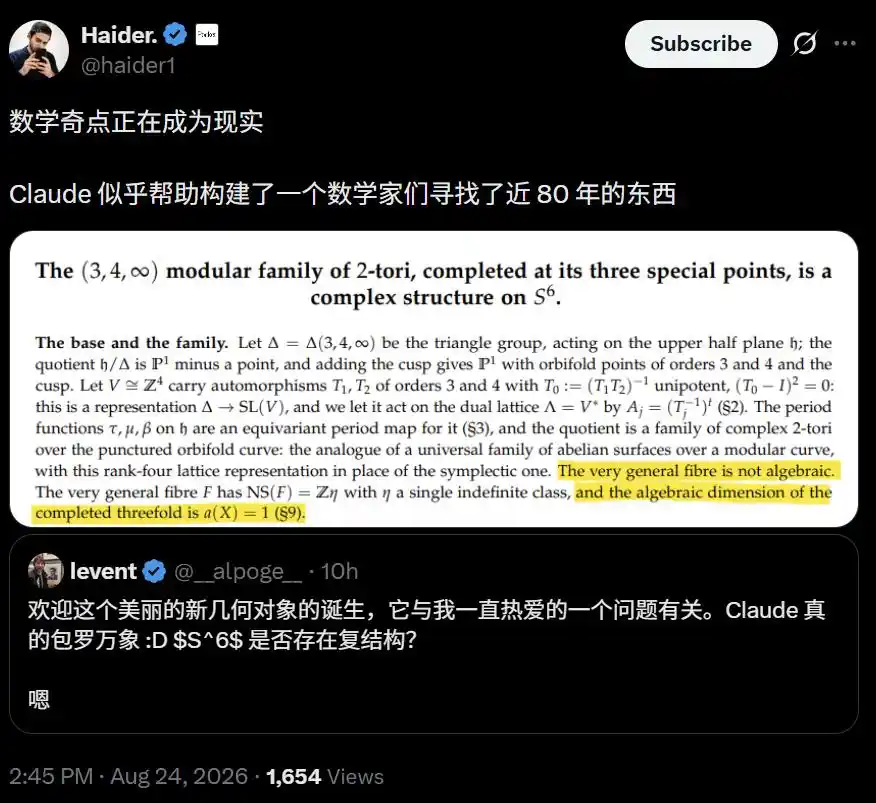
What's even more remarkable is the method they used to break through.

They bypassed the well-trodden paths followed for decades and directly constructed the object, then pointed to it and declared, 'This is the complex structure on S6.'

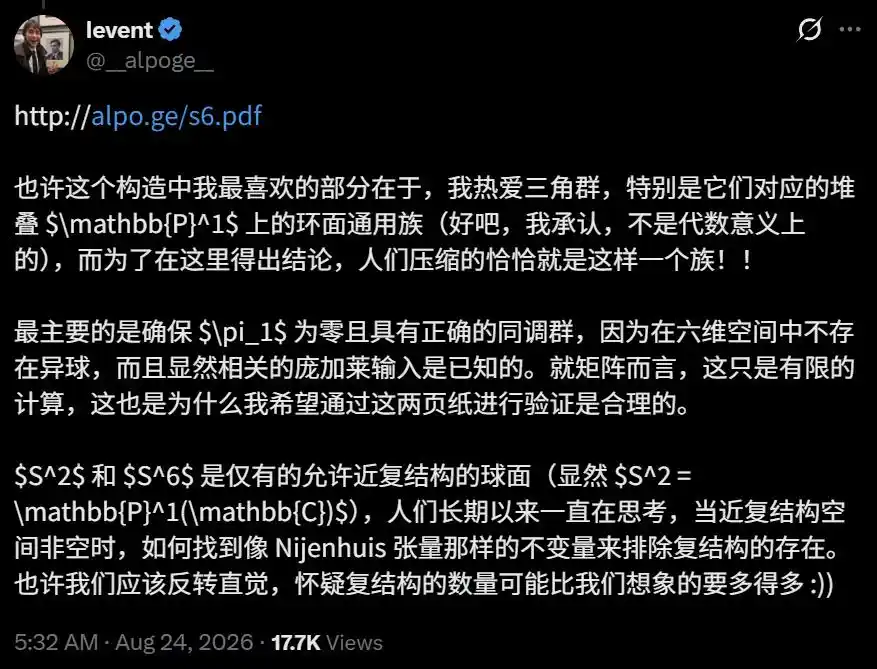
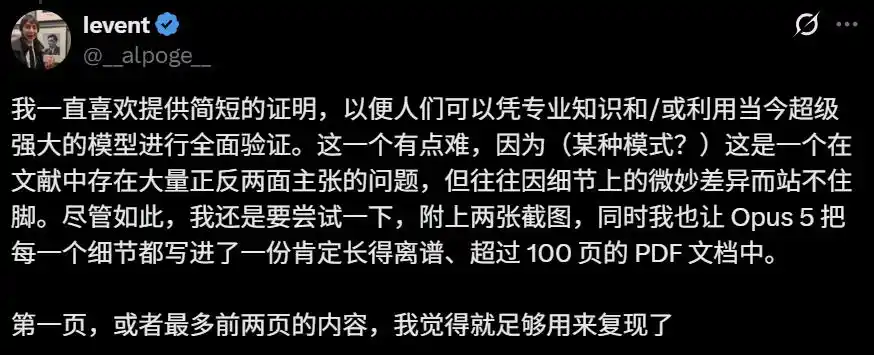
When Alpöge announced it on X, his opening line sounded more like announcing the arrival of a new life—

Welcome this beautiful new geometric object into the world.
Over 70 Years, All Hanging on This One Sphere

Among all spheres, only two qualify to discuss complex structures: S2 and S6; others were ruled out long ago.

S2 is no surprise; it's the most fundamental building block in complex geometry.
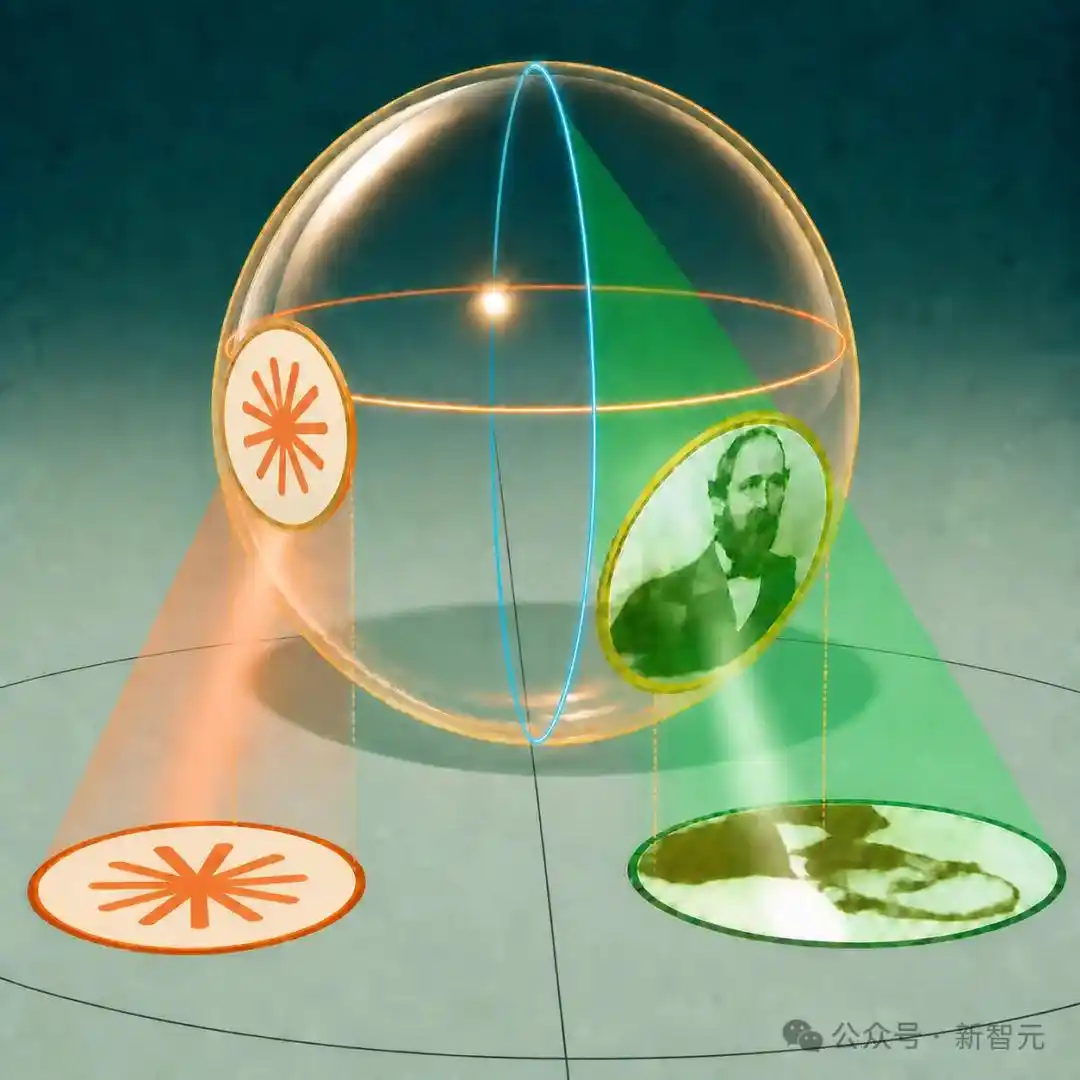
So, for over 70 years, all eyes were fixed on this sole candidate, S6.

Some claimed it existed, while others swore it absolutely did not, but both sides stumbled.
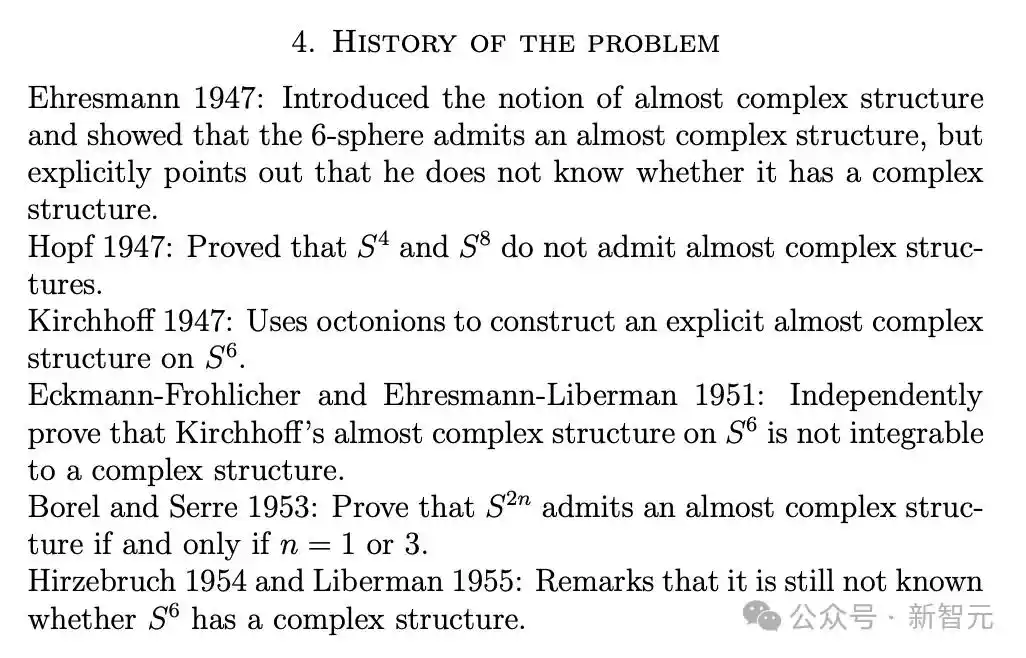
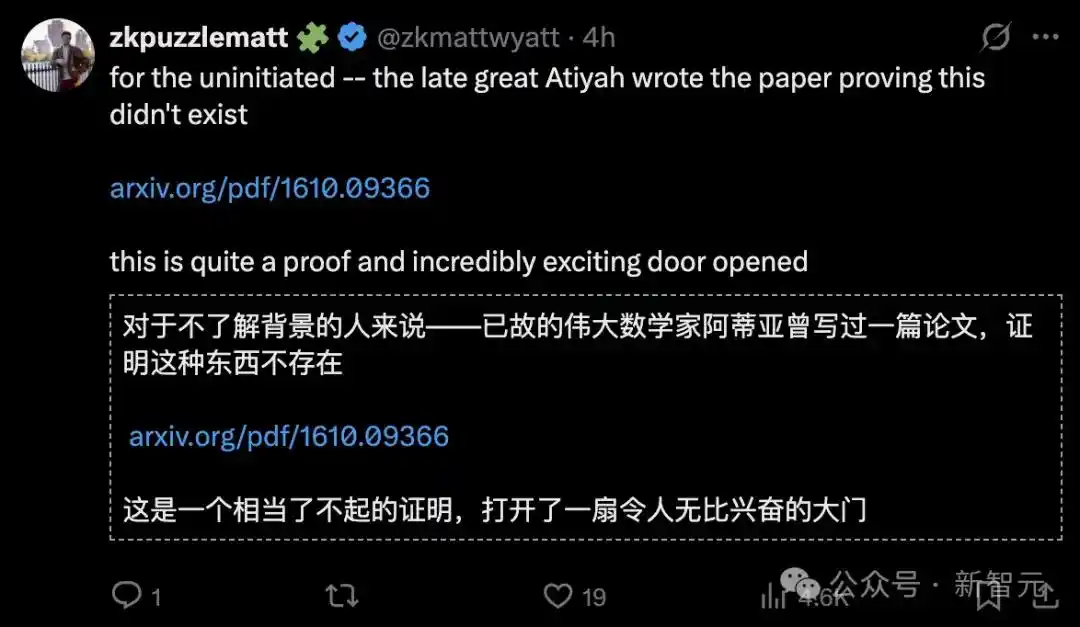
For example, Michael Francis Atiyah, one of the greatest living mathematicians and a Fields Medalist, claimed to have solved it in 2016, but his proof was found to have gaps.
Master mathematician Shiing-Shen Chern also studied this problem in his later years.

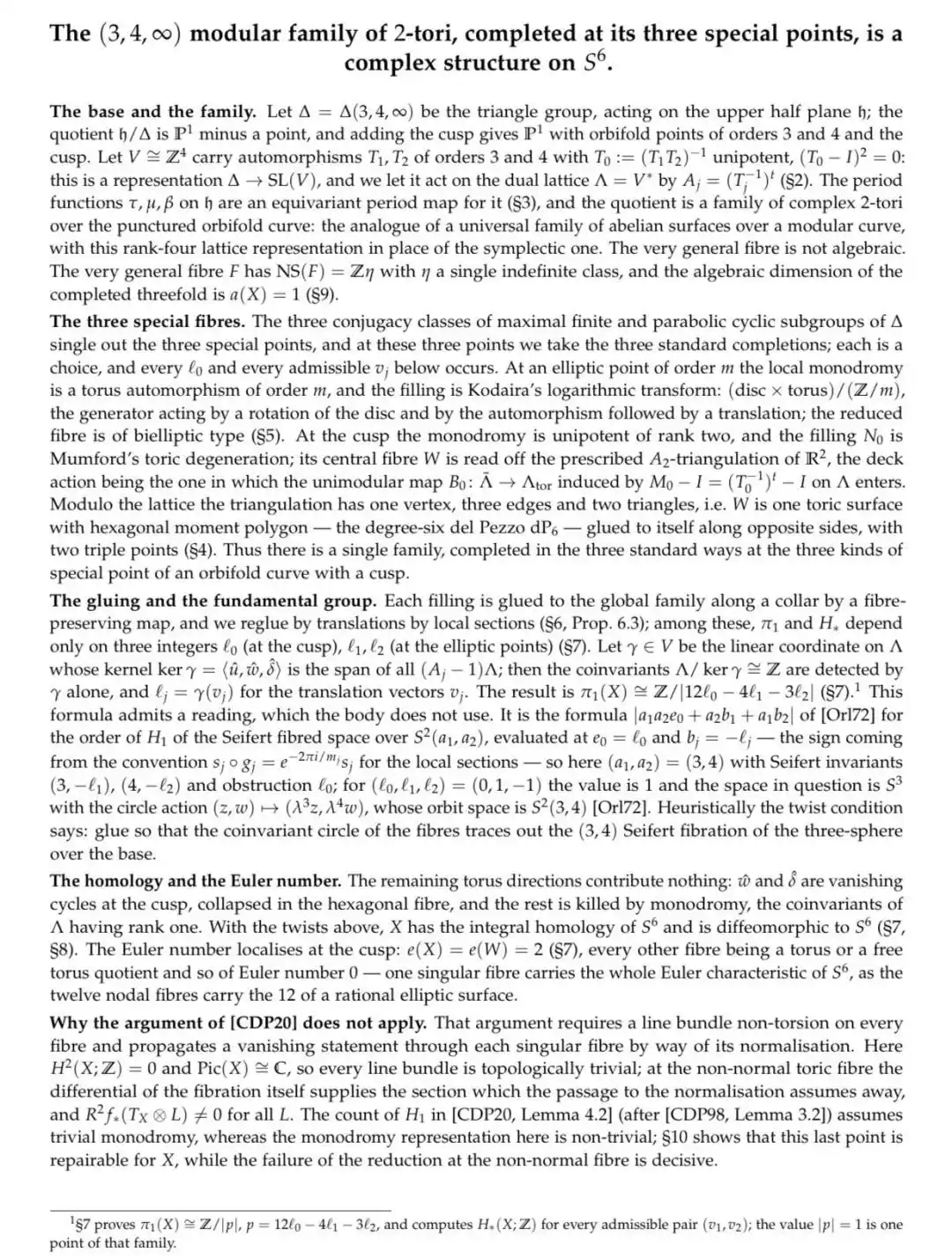
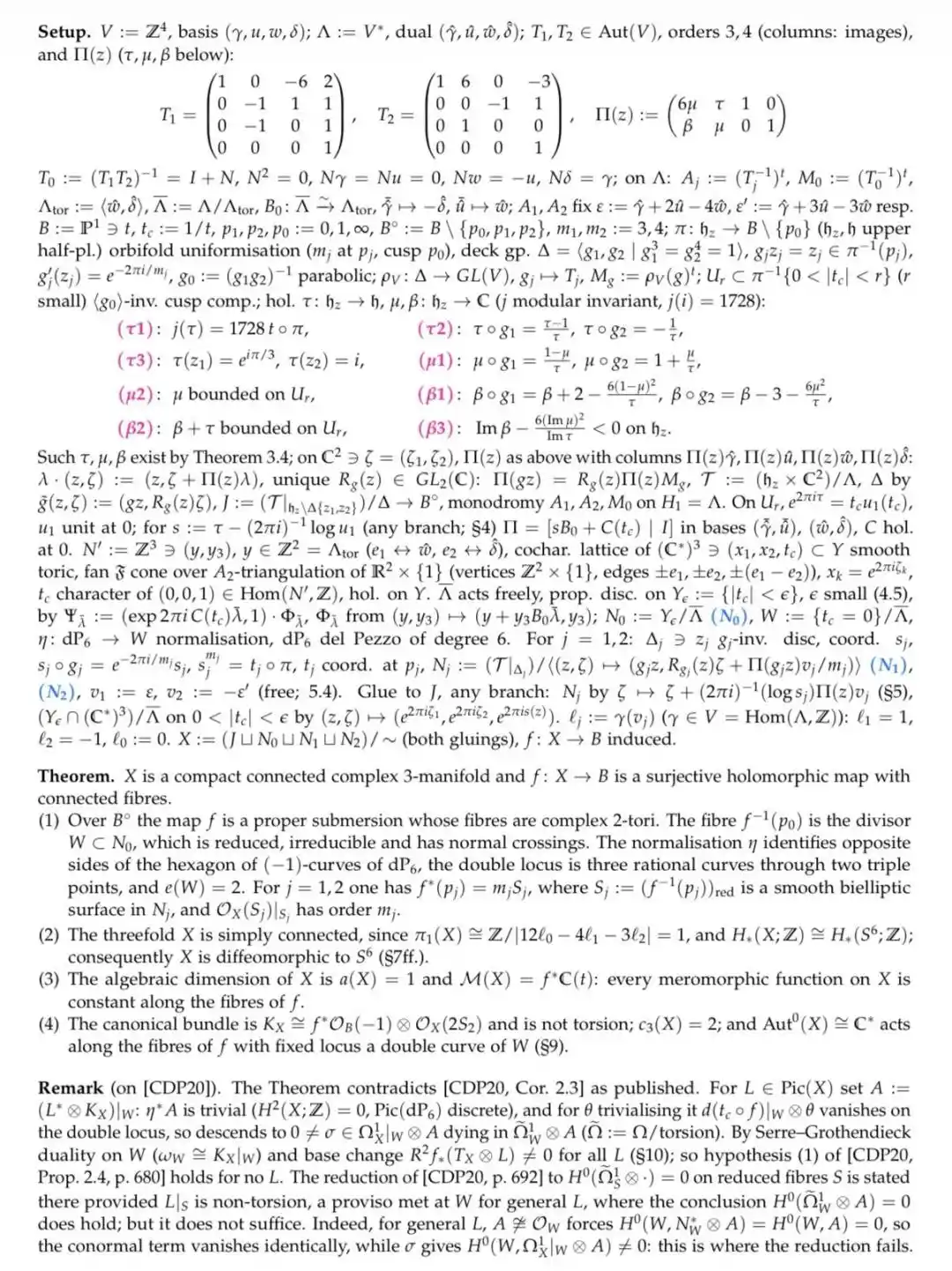
What Alpöge presented this time is a hefty 108-page document.

Every matrix, coordinate chart, and gluing method used in the construction is laid out in black and white.

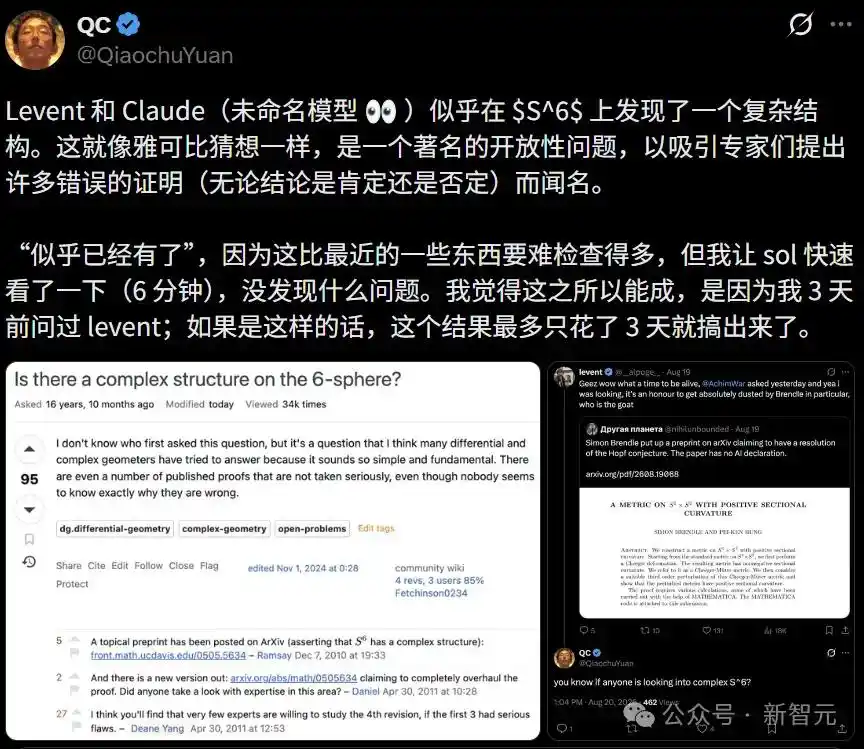
Mathematician Qiaochu Yuan deliberately tried to find flaws using GPT-5.6 Sol. After scrutinizing it for 6 minutes, he found none.

Undeterred, he examined it for another 15 minutes but still couldn't find any issues; instead, he gained a deeper understanding of the argument.

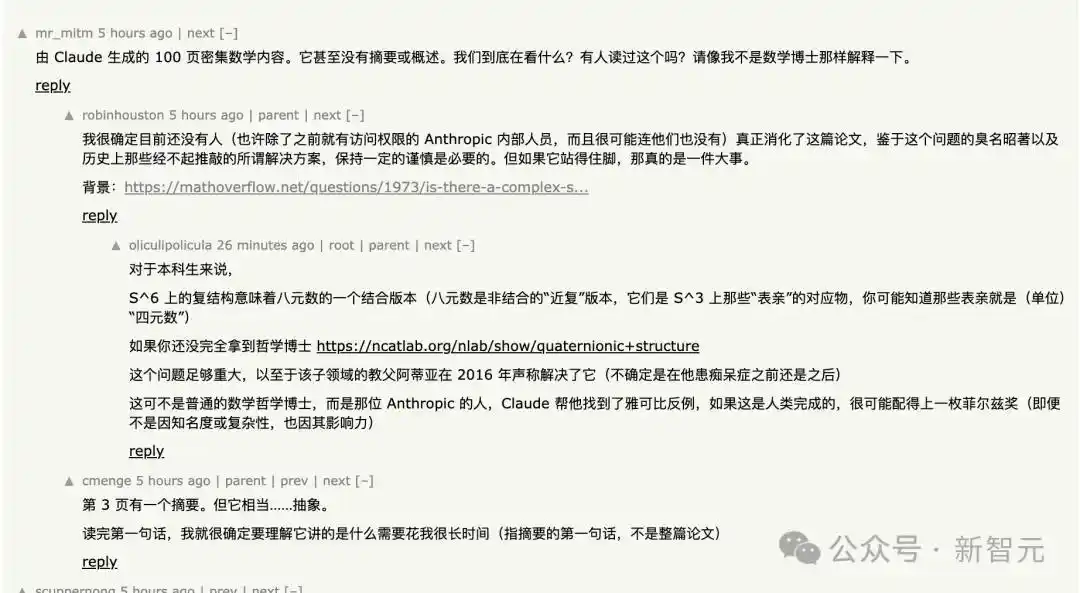
Sol concluded that if these 108 pages hold their ground, this could be the most significant AI achievement in mathematics to date.
If this work were purely human, it would likely win a Fields Medal, if not for its difficulty or fame, then at least for its impact.
Three Integers That Decided the Fate of the Problem

So, how exactly was this new object constructed?

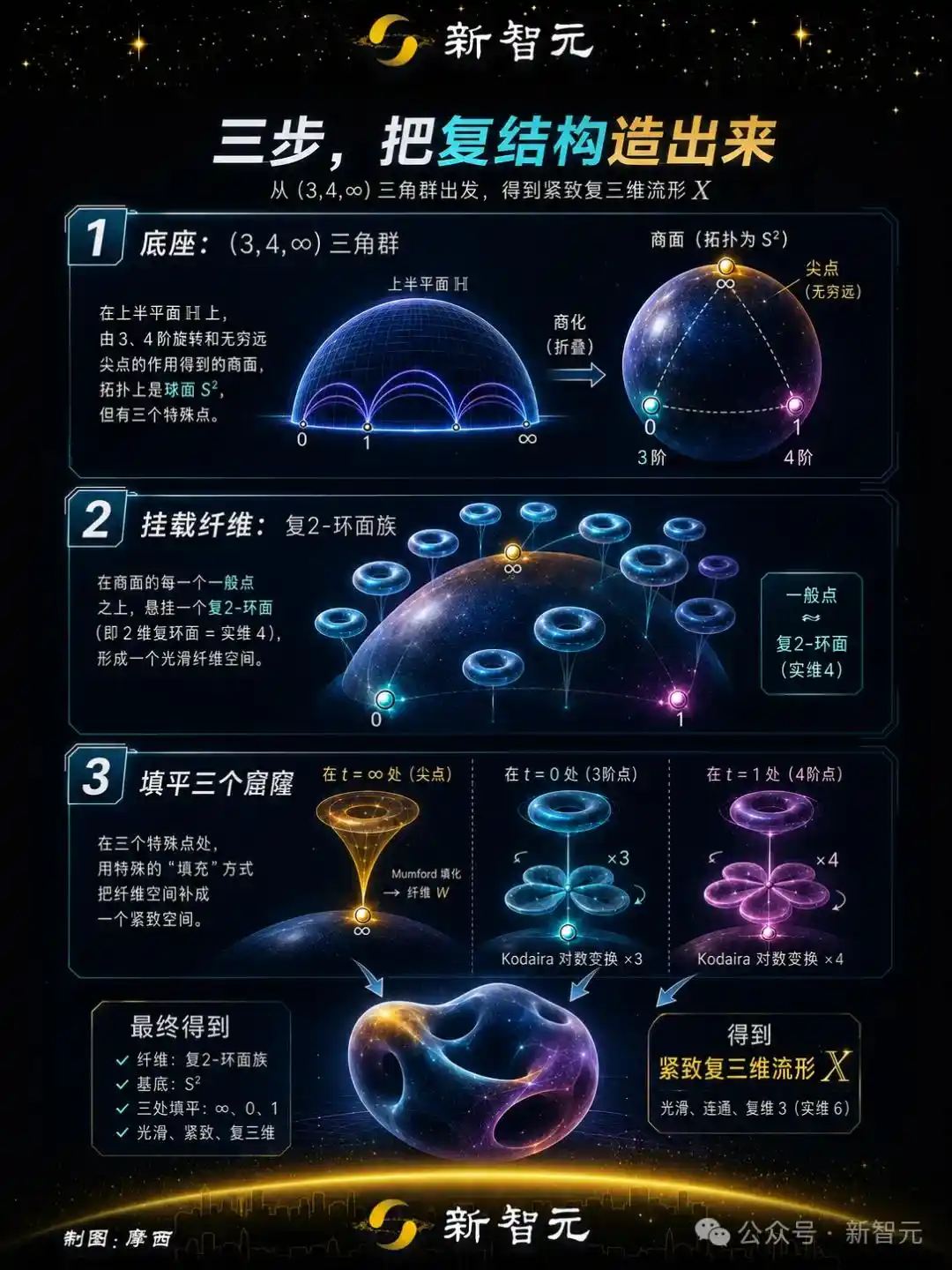
Step 1: Lay the foundation.

Take a (3,4,∞) triangle group and use it to tessellate the upper half-plane. The resulting shape, intuitively, is a sphere.

However, this sphere has three special points pinned to it: a point of order 3, a point of order 4, and a cusp, located at t = 0, t = 1, and t = ∞, respectively.

Alpöge didn't hide his favoritism, stating outright that the triangle group and the family of tori attached to it were his proudest touch.

Step 2: Attach tori to the foundation.

At every point on the base except for the three special ones, attach a complex 2-torus, a structure that is 2-dimensional over the complex numbers (4-dimensional over the reals).

This object attached above a point is called the fiber at that point. The whole X is constructed fiber by fiber in this manner.

After this step, the spots above the three special points remain empty, effectively punching three holes in the sphere.

Step 3: Fill the three holes.

Filling these holes means assigning a fiber to each of these vacant points and stitching them together to form a complete compact manifold.

The clever part is that the three holes are not filled using the same method; each hole precisely falls within the scope of a classical filling technique.

The cusp at t = ∞ is filled using Mumford's toric degeneration; the fiber inserted there is called W, obtained by taking a hexagon boundary of a degree 6 del Pezzo surface and gluing opposite edges in pairs.

The remaining points at t = 0 and t = 1 are filled using Kodaira's logarithmic transformation, with multiplicities 3 and 4, matching the orders 3 and 4 of the base points.

The moment the three holes are filled, a compact complex threefold named X comes into existence.
The Object Is Constructed, But Is It S6?

At this point, X is a perfectly legitimate complex manifold, but the interrogation isn't over.

Section 7 of the paper rigorously computes the fundamental group of X: π1(X) ≅ Z / |12l0 − 4l1 − 3l2|.

Roughly speaking, the fundamental group tells you if there are unavoidable holes in the space. Any loop drawn on a sphere can be contracted to a point, so the sphere's fundamental group is trivial.

The three integers (l0, l1, l2) in the formula record the twisting of the fibers when filling the three holes.

Substituting (0, 1, −1) gives 12×0 − 4×1 − 3×(−1) = −1, whose absolute value is firmly 1.

Z modulo 1 is the trivial group. The fundamental group vanishes here, satisfying the first condition matching X with the sphere.

Since X itself is simply connected, its integral homology matches S6 exactly. Applying the Hurewicz and Whitehead theorems, it is indeed a homotopy 6-sphere. Combined with Smale's generalized Poincaré conjecture from 1961, it is homeomorphic to S6.

Finally, only the smooth structure remains to be verified.

In topology, homeomorphism does not imply diffeomorphism. Two objects might look identical, but the ways calculus works on them might not align. Such imposters have a special name: exotic spheres.

Fortunately, as early as 1963, Kervaire and Milnor settled this account: the six-dimensional world is clean, having exactly zero exotic spheres. In contrast, seven dimensions can produce up to 28 of them.

Thus, homeomorphism here directly upgrades to diffeomorphism. X's true identity is S6.

The Solver Wasn't Originally a Complex Geometer

Alpöge is a Junior Fellow at the Harvard Society of Fellows and concurrently a postdoctoral researcher at Anthropic. His primary field is number theory and arithmetic geometry; he doesn't typically wade into the waters of complex geometry.

Yuan revealed that just three days before solving this problem, he had discussed this deadlock with him.

From Finding Answers to Creating Answers

Solving a 70-year-old problem in three days is already absurd enough.

But this was actually the third time within 35 days.

July 20: Alpöge, using Claude Fable 5, produced a fatal counterexample to the Jacobian conjecture, a problem posed in 1939 that had remained unsolved for 87 years.

Only three weeks later, on August 10: An unreleased research version of Claude, whose identity remains undisclosed, increased the proven proportion of zeros of the Riemann zeta function lying on the critical line from 41.6% to 67.2%.

In that computational battle, it mobilized about 60 sub-agents, executed roughly 2400 shell commands, and consumed 31 million output tokens.

Then came August 24: this S6 result.

For the first two instances, you could still argue that the AI was merely a powerful search engine—one exploring known solution spaces for a counterexample, the other forcibly stitching together two existing papers already in the literature.

This time, however, the nature fundamentally changed.

This geometric object did not previously exist; the model literally created it.

Justin Curry, Associate Professor of Mathematics and Statistics at the University at Albany, SUNY, stated plainly: If the proof holds, this is certainly the most impressive AI achievement in recent memory.
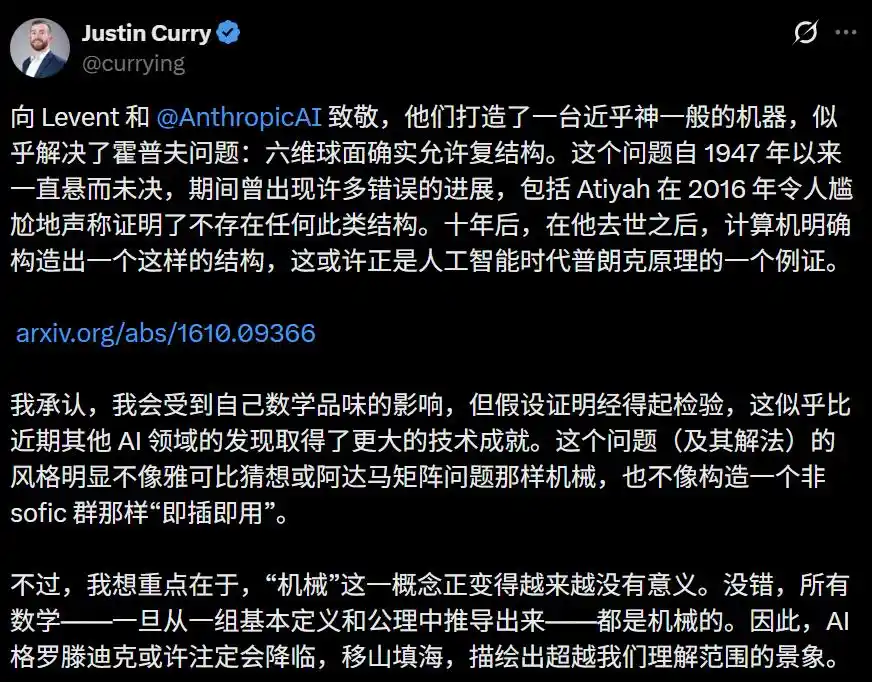
For the past 78 years, everyone was asking the same question: does a complex structure exist on S6?

From this moment on, the question might already be a different one.

How many more are hidden there?

Reference: https://alpo.ge/s6.pdf

This article is from the WeChat public account "Xinzhiyuan"; author: ASI Apocalypse; editor: Moses David


İlgili Sorular

QWhat is the key mathematical result presented in the article regarding the six-dimensional sphere?

AThe article presents a purported proof, achieved by mathematician Levent Alpöge and AI Claude, that the six-dimensional sphere (S6) admits a complex structure. This construction and proof is claimed to solve a 78-year-old open problem in mathematics.

QHow did the researchers approach the problem of S6's complex structure differently from previous attempts?

AInstead of following the traditional theoretical approaches to prove or disprove the existence of a complex structure on S6, they directly constructed a specific geometric object (a compact complex threefold X) and then mathematically proved that this object is diffeomorphic to S6.

QWhat role did the AI Claude reportedly play in this discovery according to the article?

AAccording to the article, Claude was a co-author and instrumental tool used by Levent Alpöge. The AI was heavily involved in the reasoning and computational processes that led to the construction and proof, working over a very short timeframe. This is presented as a landmark achievement in AI-assisted mathematical discovery.

QWhich other long-standing mathematical problems were mentioned as being tackled by Levent Alpöge and Claude in recent weeks?

AThe article mentions two other significant results achieved in a short period prior: 1) A counterexample to the 87-year-old Jacobian Conjecture (July 20). 2) Increasing the proven proportion of Riemann zeta function zeros on the critical line from 41.6% to 67.2% (August 10).

QWhy is proving the existence of a complex structure on S6 considered particularly difficult and significant?

AIt has been a major open question in complex and differential geometry for 78 years. Many renowned mathematicians, including Fields Medalist Michael Atiyah, attempted and failed to definitively answer it. The S2 sphere is the only other sphere known to have a natural complex structure, making S6 a unique and critical case. Solving it would fundamentally expand the understanding of complex geometry on spheres.

İlgili Okumalar

EIP-8363 Quantitative Review: Cutting Staking 'Subsidies' – What Does Ethereum Hope to Gain?

**EIP-8363 Quantitative Review: Reducing Staking "Subsidies" – What Does Ethereum Want in Return?** EIP-8363 proposes burning an increasing portion of validator rewards as the staking rate rises, reaching 100% burn when 50% of ETH is staked. This analysis models its impact on issuance, yield, and staking equilibrium, examines whether ETH's yield explains its price, quantifies the chain economy's reliance on this yield, and presents conclusions. Key findings: 1. **EIP-1559 Burns Are Ineffective:** Post-merge, burning (via base fees) has collapsed by 98% and now offsets only 2.4% of new ETH issuance, making issuance policy Ethereum's sole remaining supply lever. 2. **EIP-8363's Real Impact:** At the current ~42.2M ETH staked, the proposal would cut issuance by ~58.6% and staking APR by ~56.4%, removing ~633k ETH ($1.55B) in annual dilution (0.53% of market cap). It's not zero issuance; that would require 43% more ETH staked. 3. **Self-Limiting Mechanism:** The design has a built-in equilibrium. At reasonable required returns (e.g., 2%), the system stabilizes at ~26% staking rate and ~0.48% annual inflation. 4. **Yield vs. Price:** No detectable statistical relationship exists between changes in staking yield and ETH price returns over 43 months. The natural 37% yield decline since 2023 did not drive price action. 5. **Chain Economy Dependence:** While LSTs like wstETH form ~34% of collateral in major lending markets, their utility as collateral remains if yield is positive. The direct revenue hit to protocols like Lido is significant (~50% of fee income) but not systemic. Staking-focused ETFs represent only 0.19% of ETH supply. 6. **Core Conflict:** The debate masks a zero-sum redistribution: cutting ~$1.55B in annual issuance transfers value from concentrated staking intermediaries (LST/LRT protocols, leverage players) to the dispersed majority of non-staking ETH holders. 7. **Outlook:** The proposal is economically sound for ETH's scarcity but politically difficult due to concentrated opposition. It is unlikely to pass in its current form.

marsbit11 dk önce

EIP-8363 Quantitative Review: Cutting Staking 'Subsidies' – What Does Ethereum Hope to Gain?

marsbit11 dk önce

Pharos Introduces On-Chain Institutional-Grade U.S. Corporate Bond Credit, Expanding Its RealFi Asset Portfolio

Pharos Network has launched the pRNH Vault, introducing institutional-grade US corporate high-yield bond exposure to its on-chain RealFi (Real World Finance) ecosystem. Developed by the R25 protocol, the vault provides qualified users access to a tokenized portfolio of high-yield corporate debt, broadening Pharos's asset offerings beyond stablecoins and cash-equivalents. The vault's underlying asset is the NYLIM Anemoy US High Yield Corporate Bond separate account (HYB), managed by New York Life Investment Management (NYLIM) and tokenized in collaboration with Anemoy and Centrifuge. Users can deposit USDC into the vault to receive pRNH tokens, representing indirect ownership of the HYB portfolio, which targets an annualized yield of approximately 7%. The structure offers programmability and composability for on-chain financial applications. Pharos views this move as a key evolution from basic asset tokenization towards building a dynamic marketplace where institutional assets can be actively discovered, evaluated, and utilized programmatically. The pRNH Vault architecture incorporates agent-assisted functionalities for credit screening, liquidity monitoring, and on-chain operations, signaling tighter integration between real-world finance and intelligent on-chain systems. To support this vision, Pharos employs a technical stack including the SALI engine for parallel execution, modular SPNs, protocol-level compliance, ZK-KYC/AML, and native AI agent support. The network positions itself as the "value discovery layer" for the agent economy, aiming to make real-world value, smart agents, and institutional assets widely accessible. The pRNH launch adds a core credit asset to this ecosystem and serves as a practical test case for its infrastructure.

marsbit27 dk önce

Pharos Introduces On-Chain Institutional-Grade U.S. Corporate Bond Credit, Expanding Its RealFi Asset Portfolio

marsbit27 dk önce

İşlemler

Spot
活动图片