China's 'Bio DeepSeek' Emerges: 4 Oxford Prodigies Let AI Take Over Life Science
China's 'Biology DeepSeek' Emerges: Four Oxford Alumni Aim to Let AI Take Over Life Sciences
Following DeepSeek-V4-Flash's global impact, a Chinese counterpart for life sciences has arrived. Jindu Bio, founded by four Oxford University alumni, has developed GeneLLM, a multi-omics large language model. Published in top journals *Nature Communications* and *Advanced Science*, GeneLLM is the first model pre-trained directly on raw omics data, aiming to understand the "language" and "system" of life.
GeneLLM treats the four RNA bases (A, U, G, C) as fundamental tokens, learning from raw sequencing data without relying on pre-defined annotations. It uses a Transformer architecture to predict the next base, processing trillions of RNA reads. With versions ranging from 1.5 billion to 30 billion parameters, it achieves high accuracy in disease prediction with significantly lower-cost, shallow-depth sequencing, making precision medicine more accessible.
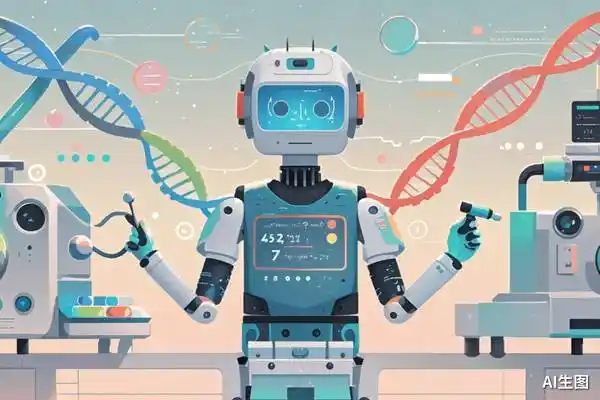
Beyond the model, Jindu Bio is building BioFord Harness, an infrastructure to connect AI with physical labs. This system translates scientific intent into executable commands for various lab equipment, manages scheduling, and creates a data feedback loop. Its platform features five collaborative AI agents for literature review, experimental design, scientific reasoning, lab scheduling, and data analysis, drastically speeding up research cycles. Crucially, it turns all experimental data—including failures—into valuable learning material.
The founding team combines expertise in bioengineering, AI, computational biology, and business. After initial challenges in securing funding, the company completed four financing rounds in 2023 following China's national push for "AI+" initiatives, supported by prominent investors like Sequoia Capital China and Gaotegaj Investment.
In the broader AI for BioScience landscape, Jindu carves a unique niche. Unlike digital-only AI scientists or capital-intensive fully automated labs, it focuses on the "last mile" of infrastructure—orchestrating the entire research workflow by bridging AI models with existing laboratory hardware. Its long-term vision is to build an intelligent operating system for life sciences, defining a new, scalable paradigm for scientific discovery.
marsbit35 dk önce