吴杰庄议员:香港正大力拥抱Web3以及Web3从业者

火币资讯2022-12-02 tarihinde yayınlandı2022-12-02 tarihinde güncellendi

Özet

距10月31号香港发布《虚拟资产发展的政策宣言》已经过去1个月,即使在行业低潮期,香港吴杰庄依然认为:香港正大力拥抱Web3以及Web3从业者

距10月31号香港发布《虚拟资产发展的政策宣言》已经过去1个月。在《宣言》落地一个月后,行业开始出现逆风。12月1日晚21:00,“对话港府,布局未来——频繁暴雷之下,香港新政能否继续落地”的线上论坛在火必Live和多家平台同步直播。火必全球顾问孙宇晨、Nano Labs创始人Jack孔、火必联合创始人杜均等多位Web3行业代表与全国政协委员吴杰庄、香港财经事务及库税局副局长陈浩濂等香港嘉宾展开对话。
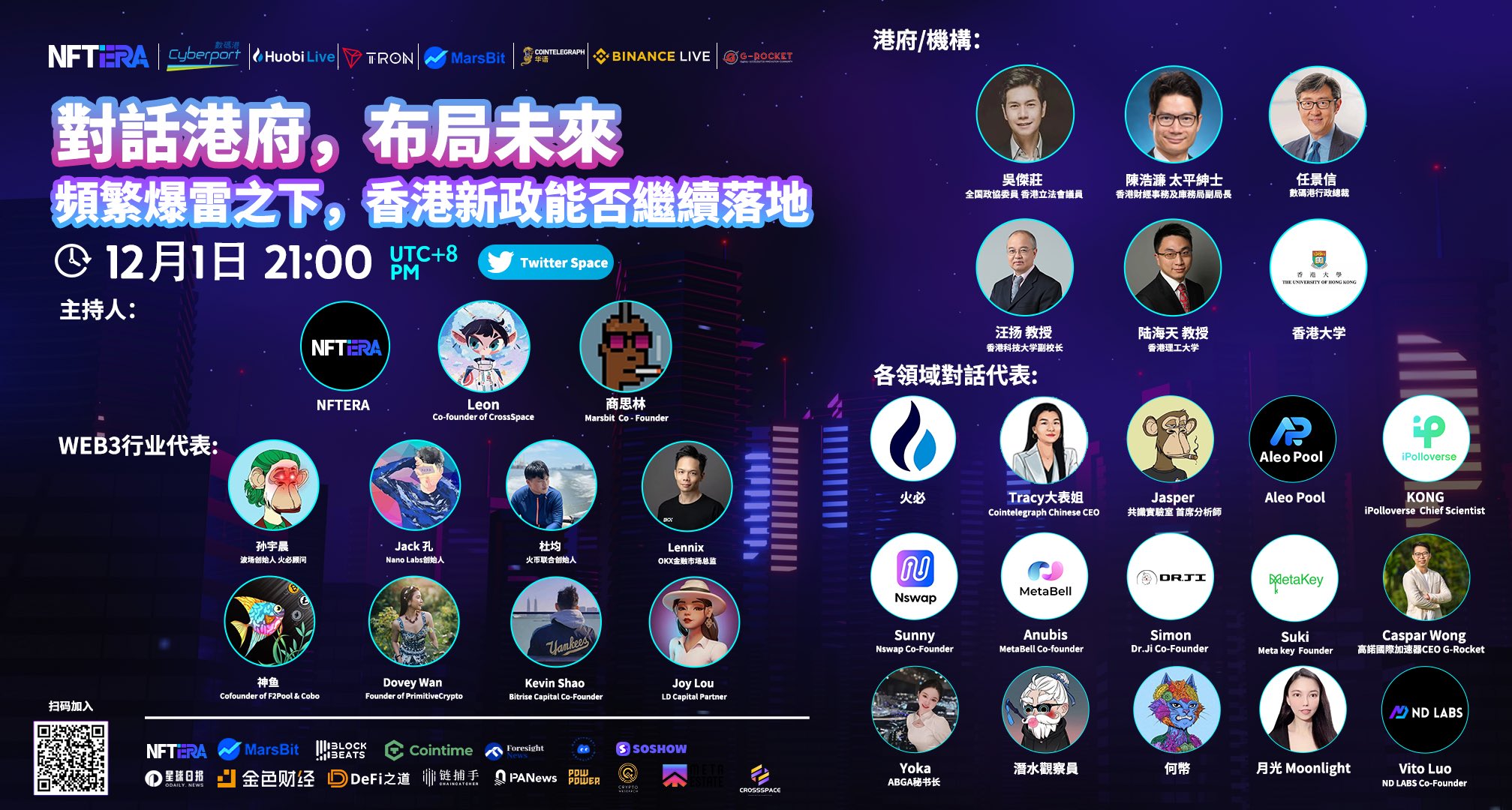
嘉宾信息:吴杰庄(Johnny Ng)香港立法会议员(选举委员会),香港青年联会前主席、全国政协委员、高锋集团董事局主席、香港艺术发展局大会委员、香港雇员再培训局委员。

0

主持人:当前世界各地的web3的builder和investor,都认为香港变化巨大且孕育着大机会,对香港成为数字虚拟资产中心的前景十分看好。过去一个月,港府密集的支持政策,是加密寒冬里难得的一把火。下面请吴杰庄议员致辞。

吴杰庄议员(Johnny Ng):一个月前,港府公布了香港虚拟资产发展的政策宣言。香港拥有背靠14亿人口的中国,毗邻新加坡和东南亚,同时拥有世界级的金融基建、金融监管的经验和卓有成效的法律等优势。

11月行业发展出现负面消息,某大所在一个星期之内倒闭,这也直接影响了整个行业。香港的宣言比较及时体现了有经验的监管的重要性。

监管容易,评估监管对于市场的影响也很重要,否则就是过度监管。港府在宣言里清楚的表明致力推动整个虚拟资产价值链的可持续发展。港府不止希望吸引企业来港,也关心企业的可持续发展,希望在港企业可以同时创造经济效益和社会效益。

当前香港对于虚拟资产也选择了几大重点支持方向,包括:发行、代币化、交易和支付平台、金融和资产管理。 除此之外,香港希望能有更多与实体经济的结合的技术能够在未来得到尝试。11月的金融科技周中,港府也勇于尝试,例如发行了NFT,这也融入了金融科技和Web3的社群互动的概念,我相信会有更多的类似创新正在发生。另外,港府也在推动绿色债券的代币化(STO)。最后,数码港元也在积极稳妥推进。

我在最近的立法会上咨询了陈局长,他认为香港的虚拟资产监管将清晰且开放。监管将在帮助从业者的同时保护投资者,我相信香港能做到这一点的。

香港在1月份有望举办大型的线下峰会,我们欢迎北美、新加坡、迪拜等地的华人从业者能在春节回家时路过香港,看一看香港的生机与活力。目前,香港已经完全解封,不用担心无法出门。也希望大家来的时候,看看有没有能在香港展业,最好数码港落地相应项目。

0

主持人:由于香港是中国的一部分且内地对Web3行业支持力度小。很多人质疑港府对于Web3政策的持续性,也担心香港是否真正能长期发展Web3行业?

吴杰庄议员(Johnny Ng):第一,香港的成功就是一国两制的成功。香港一方面背靠祖国的大的市场和人才,拥有无限的想象空间。我们既有国家举国体制集中力量办大事的优势带来的保障,也是走资本主义道路实施普通法的社会。

有朋友担心内地对于Web3发展不太鼓励,然后香港是不是也不行?习总书记在香港71回归时的发言里多次提到:香港的一国两制制度是非常好,要长期坚持。之前回归前说香港是50年不变,但是现在的说法是我们要长期坚持,可能以后都不用变。所以香港肯定会有和内地不同的政策。

一些大企业来港,愿意投资超过30年的项目,在和香港政府商谈的时候,香港政府答应当前政策在2047年后也不会变。

第二,香港外汇可以自由流动。这一点在08金融海啸中和97年亚洲金融危机都没有变过。

第三,经过长时间检验,香港是高度法制的地区。一方面,香港施行的普通法同金融业高度适配,另外,香港法制也被实践检验过。举个例子,2个月前香港政府输了被判败诉。起因就是:医生向某些不希望打疫苗的市民出具接种证明,政府出具行政命令要求将证明作废。经过某市民上诉,法院要求政府撤回该项行政命令。这客观证明香港法制的有效。

İlgili Okumalar

Tether Finally Gets Audited by a Big Four Firm, But USDT's Transparency Issues Are Far From Over

Tether announced that KPMG U.S. has completed its first independent audit of Tether International's financial statements as of December 31, 2025, issuing an unqualified opinion—the highest level of assurance. The audit confirms Tether's assets exceeded liabilities by $6.814 billion at that date, with physical verification of gold bars and examination of underlying records. This represents a significant step beyond the quarterly reserve attestations Tether previously received, moving to a full financial statement audit that examines internal controls, transaction sampling, and accounting policies. However, the article highlights several ongoing transparency questions. The full KPMG audit report has not been publicly released, preventing independent verification of details like asset classification or related-party transactions. The audit covers a specific entity, "Tether International, S.A. de C.V.," leaving the scope concerning Tether's complex corporate structure unclear. Furthermore, the $6.8 billion excess reserves confirmed for end-2025 had shrunk to approximately $4.1 billion by Q2 2026. Risks within the reserve composition, particularly concerning secured loans, persist even with an audit. The audit's data is also already 8 months old, while USDT's circulation has grown rapidly. Strategically, the audit is seen as a move to bolster Tether's position amid U.S. regulatory developments like the GENIUS Act, which mandates audits for stablecoin issuers but leaves a path for foreign entities like Tether. While the KPMG opinion is a strong credibility signal, the article concludes that full transparency and regulatory compliance require further steps, starting with the publication of the complete audit report.

marsbit17 dk önce

Tether Finally Gets Audited by a Big Four Firm, But USDT's Transparency Issues Are Far From Over

marsbit17 dk önce

After Tokenized U.S. Treasury Bonds, Tokenized Stocks Are Becoming the New Battleground for RWA

**Tokenized Stocks Emerge as the New RWA Battleground** Following the initial surge of tokenized U.S. Treasuries, the tokenized stock market is rapidly expanding in both scale and quality. Unlike the currently stagnating treasury tokenization market, tokenized stock offerings are seeing significant growth and attracting major players from traditional finance, fintech, crypto exchanges, and native Web3 platforms. The U.S. SEC has outlined a framework for tokenized securities, which applies to stocks: **Issuer-Sponsored Tokenized Securities** (direct tokenization by the issuer, inheriting all shareholder rights but with strict compliance, e.g., Securitize); **Custodial Tokenized Securities** (tokenization of custodied interests, e.g., DTCC, Ondo's recent IVV/MU tokens); **Linked Securities** (tokenized debt notes backed by the stock, offering price exposure and greater on-chain utility, e.g., Ondo, xStocks, Robinhood's new Stock Tokens); and **Security-Based Swaps** (tokenized derivatives contracts, e.g., Robinhood's earlier Classic Stock Tokens). Key platforms are pursuing different strategies: * **Securitize** leads with an issuer-sponsored model, ensuring full rights but limiting on-chain interactions via its compliance-enforcing DS Protocol. * **Ondo** and **xStocks** use the linked security structure for broad accessibility on CEXs and DeFi, though this fragments liquidity and excludes U.S. users. * **Robinhood** recently launched linked security-based Stock Tokens, leveraging its user base and new Robinhood Chain. * Traditional infrastructure giants like **DTCC**, the **NYSE**, and **Nasdaq** are actively developing pilots and platforms for tokenized settlement and trading. * **Coinbase** has announced plans for tokenized stocks, likely using a structure that offers on-chain utility while excluding U.S. customers. Despite different approaches, all players are converging on tokenized stocks as the next major catalyst for the RWA sector. The evolving regulatory landscape and market adoption will shape this competitive new battlefield.

marsbit1 saat önce

After Tokenized U.S. Treasury Bonds, Tokenized Stocks Are Becoming the New Battleground for RWA

marsbit1 saat önce

Nvidia Faces Collective Selling by Funds: What Are Private Equity Firms Sniffing Out?

Several prominent Chinese private equity funds, including Gaoyi Asset and Dantoo's Orient Harbor, made significant portfolio adjustments in Q2 2024, as revealed in their latest SEC 13F filings. The most notable move was a collective retreat from AI chip leader NVIDIA, with Gaoyi reducing its stake by over 70%, Jilin Asset selling out completely, and Orient Harbor trimming its holdings. This shift does not signal a loss of faith in the AI trend, but rather a change in investment focus from "expectation-driven" to "realization-driven" valuation. Capital is flowing from crowded, high-valuation names towards segments with clearer profitability visibility and better risk-reward profiles. The funds' new major conviction is Taiwan Semiconductor Manufacturing Company (TSMC), which Gaoyi built into its top holding. The thesis centers on TSMC's role as a critical bottleneck in the AI supply chain due to its dominance in advanced semiconductor manufacturing and, crucially, advanced CoWoS packaging capacity. As demand for AI chips explodes, TSMC's "must-pass" foundry services grant it significant pricing power, suggesting a potential migration of profits from chip designers to manufacturers. Simultaneously, both Gaoyi and Orient Harbor substantially increased positions in memory chip companies like Micron and SanDisk. The investment logic here is twofold: a cyclical recovery in the memory market combined with a new, structural growth driver from AI. High Bandwidth Memory (HBM), essential for AI processor performance, is supply-constrained and its production diverts capacity from standard DRAM and NAND, creating a broad-based pricing tailwind for the memory sector. The collective reduction in NVIDIA reflects a view that its massive prior gains have compressed its future upside potential ("lowered赔率"). The market now demands flawless execution and faces new risks like rising costs from TSMC and HBM suppliers, as well as competition from cloud companies' custom chips. The funds' reallocation highlights a broader thematic: as the AI boom matures, investment opportunities and excess profits are shifting along the supply chain—from design to the physical constraints of manufacturing and memory. The next phase of AI investing may be defined by pricing power derived from tangible bottlenecks like advanced packaging and HBM capacity.

marsbit1 saat önce

Nvidia Faces Collective Selling by Funds: What Are Private Equity Firms Sniffing Out?

marsbit1 saat önce

Reverse Turing Test: This 'Pure Handcrafted Large Model' Is Driving Netizens Crazy

An art project called ChatTJB, humorously billed as a "next-generation, single-operator Large Language Experience" (LLE), gained viral attention in San Francisco. Promoted via a billboard, its website mimicked a genuine AI service with a chat interface, documentation, and even a "Pro" subscription. The twist? It was entirely manual. A single person, named Tucker, personally read, thought about, and typed replies to thousands of user queries using his thumbs, even hand-drawing images. He coined terms like "human-powered reasoning layer" to describe this process, highlighting its inherent human limitations: speed depended on his alertness, capacity was strictly one conversation at a time, and errors were traceable to a specific individual. The project's popularity overwhelmed Tucker, forcing a pause on new users and leading to plans for a community version with volunteer "AIs" (Average Individuals). While initially a source of amusement, Tucker noted that some users began sharing genuine personal concerns, valuing the knowledge that a real person was attentively listening and responding. The project satirizes AI hype while underscoring the irreplaceable value of human connection and attention in an age of automated, scalable interactions. A similar platform, "Your AI Slop Bores Me," was mentioned, where users either submit requests or role-play as the "AI" to fulfill others' text or drawing prompts, further emphasizing the human element behind the interface. The core message: sometimes, knowing there's a real person on the other end is what truly matters.

marsbit1 saat önce

Reverse Turing Test: This 'Pure Handcrafted Large Model' Is Driving Netizens Crazy

marsbit1 saat önce

İşlemler

Spot
活动图片