XRP social activity soars to 3-month high as daily price rises 13%

Finbold2022-09-30 tarihinde yayınlandı2022-10-01 tarihinde güncellendi

Özet

The cryptocurrency market seems to be gaining steam again.

XRP social activity soars to 3-month high as daily price rises 13%

The cryptocurrency market seems to be gaining steam again, as most of its assets are back to trading in the green zone, including XRP, which has recorded gains in more than one area – social activity and price increase.

Specifically, XRP’s three-month social activity is on the rise, recording 1.95 billion social engagements from 9,424 social contributors as of September 29, 2022, according to the data and chart posted by crypto and stock market social intelligence platform LunarCrush.
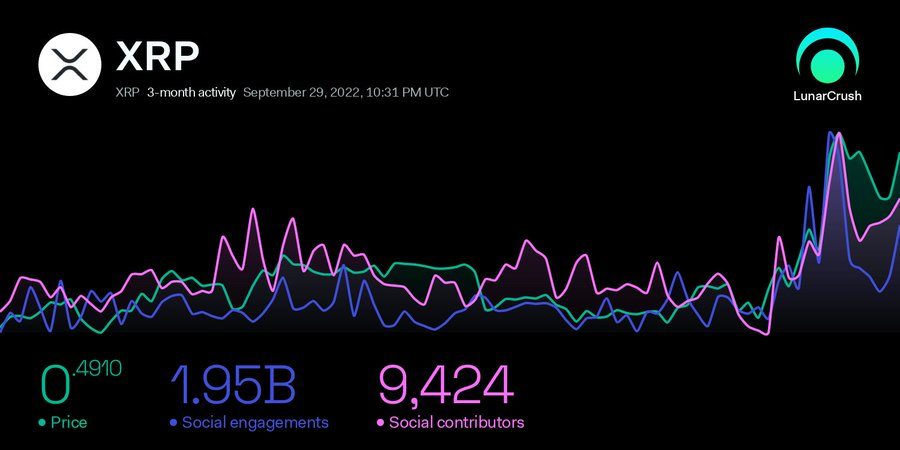
XRP 3-month activity. Source: LunarCrush As explained in the tweet, these figures represent an increase of 38% in social engagements and 8% in the number of social contributors over the period of three months. 
Major growth in three months and on the day
At the same time, the price of XRP has recorded significant increases as well, growing by nearly 59% over the three months leading up to September 30, according to data retrieved from CoinMarketCap. 
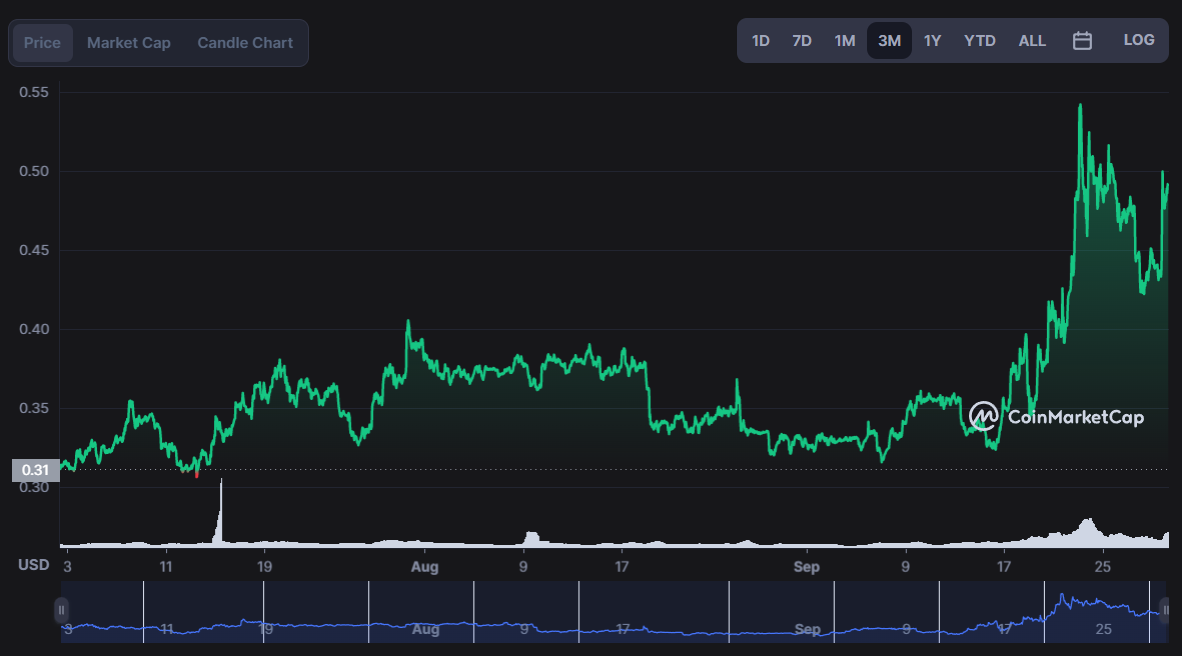
XRP 3-month price chart. Source: CoinMarketCap

As things stand, the price of XRP is currently $0.4926, which represents a 12.84% increase on the day, although still a decline of 7.9% across the previous week. Its market cap now amounts to $24.42 billion, making XRP the sixth-largest crypto by this indicator.
That said, the crypto community over at CoinMarketCap is bearish on the token’s near future, with votes estimating that the decentralized finance (DeFi) token would trade at $0.4166 by October 31, 2022, as Finbold reported.
XRP – a security or not?
Meanwhile, XRP is entangled in a widely publicized lawsuit that the United States Securities and Exchange Commission (SEC) launched against the token’s issuer, Ripple Labs, accusing it of illegally selling the crypto that the regulator considers a security.
Recently, Ripple’s defense team introduced an argument that the XRP tokens cannot be securities as there were no “investment contracts” involved in their issuance, which would give investors rights and force the issuer to act in their interest.
Court updates reflecting on the price
One of the reasons for the surge in the price of XRP could be the news of both sides requesting a summary judgment in the case, which would allow them to skip the trial phase and allow the judge to make a ruling.
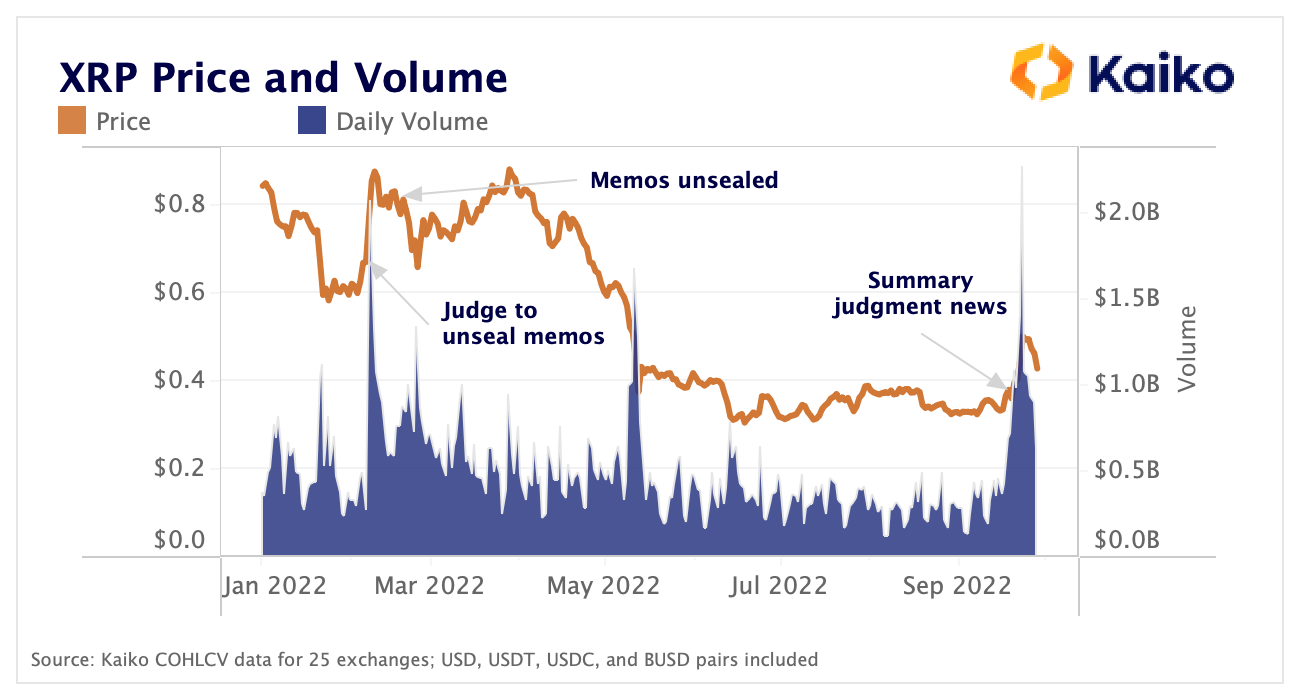
Effect Ripple v. SEC legal updates on XRP price and volume. Source: Kaiko Research Historically, the court updates on this case had a significant impact on the price of XRP, as well as its volume, according to the data shared with Finbold by the financial analytics platform Kaiko Research on September 29.

İlgili Okumalar

Beyond the Model Lies the Harness: Deepseek Enters the Arena, Why Has the Main Battlefield of China's AI Competition Shifted?

In mid-to-late May 2026, Deepseek internally established a new Harness team focused on code agent products, internally benchmarked against Anthropic's Claude Code. This move, marked by the formula "Model + Harness = Agent" in their job postings, signals a major shift in China's AI competition: the main battlefield is transitioning from developing large models to building toolchains and achieving workplace integration. Deepseek's direct involvement in Harness development aims to secure control over interface design and training data feedback loops, moving beyond open-sourcing powerful models. Harness, the runtime infrastructure for AI agents, handles everything beyond model reasoning—task orchestration, tool calling, context management, safety checks, and error recovery. It is crucial because agent products are not just outputs of model capability but also training grounds for it. Real-world task failures recorded by Harness can feed back into model training, creating a flywheel effect. Engineering Harness is more critical than optimizing prompts, as poor context management or error handling can drastically reduce agent success rates in multi-step, real-world scenarios. This shift is not isolated. Other major Chinese tech companies are also pursuing differentiated toolchain strategies. Tencent leverages its enterprise ecosystem (WeChat Work, Tencent Cloud) to build connectors for organizational-level AI collaboration and complex task delivery. Alibaba focuses on lowering automation barriers on the web with a front-end, browser-based GUI Agent framework, PageAgent. This diversification shows the industry recognizes that success lies not in a perfect general agent, but in vertically focused solutions built with robust engineering. The trend is validated by overseas success, such as Poland's Viktor, an AI coworker on Slack achieving $20M ARR by autonomously executing complex, multi-step tasks. This proves a shift in enterprise willingness to pay—from "AI-assisted generation" to "AI-autonomous execution." As Harness matures to provide safety guards and reliability, AI transitions from a human-supervised intern to an independent outsourcer. The competition now faces key engineering challenges: preventing "token explosion" through intelligent context compression, and building "thick frameworks" with features like sandbox isolation and checkpoint recovery for enterprise-grade stability. Geopolitical restrictions on tools like Claude Code further create a significant market vacuum for domestic solutions like Deepseek's Harness. For enterprises and developers, the focus must shift from comparing model benchmarks to evaluating a vendor's engineering capabilities, error recovery mechanisms, context management, and ecosystem compatibility when choosing AI products and platforms.

marsbit37 dk önce

Beyond the Model Lies the Harness: Deepseek Enters the Arena, Why Has the Main Battlefield of China's AI Competition Shifted?

marsbit37 dk önce

Soaring Export Data for Memory Chips, Market Is Redefining the Valuation Anchor for Memory Stocks

Korean storage export data for the first 20 days of June shows substantial year-on-year increases in both value and price-per-kilogram for categories like DRAM, NAND, and SSDs. This signals a potential shift beyond simple demand recovery, indicating rising prices and a product mix shift towards higher-value items, possibly influenced by AI infrastructure needs. A key point is that the surge in price-per-kilogram is not simply a uniform chip price hike. It reflects a combination of actual price increases and, more importantly, an export structure increasingly dominated by high-value-density products like HBM (High-Bandwidth Memory) and advanced DRAM, which are critical for AI servers. This suggests AI-driven demand may be spilling over from just HBM into broader memory markets. SK Hynix stands to benefit directly due to its leading HBM position. For Samsung and Micron, the implication is potential for greater margin elasticity if the tightness in high-end memory spreads to enterprise SSD and NAND prices. However, the storage sector remains cyclical. Risks include supply expansion, inventory changes, and potential slowdowns in broader AI capital expenditure. Ultimately, while the strong export data supports upward revisions for storage company earnings and fuels discussion of an "AI infrastructure bottleneck premium," a definitive valuation shift from a cyclical to a structural story depends on upcoming quarterly reports. Investors need confirmation from SK Hynix, Samsung, and Micron that improvements in average selling prices, product mix, and, crucially,毛利率 are sustained over multiple quarters.

marsbit2 saat önce

Soaring Export Data for Memory Chips, Market Is Redefining the Valuation Anchor for Memory Stocks

marsbit2 saat önce

İşlemler

Spot
Futures
活动图片