[Key interpretation] The top ten whales in XRP have significantly reduced their positions, and BTC volume shrinks for the first time

Huobi2022-09-26 tarihinde yayınlandı2022-09-27 tarihinde güncellendi

Özet

BTC investors' money holding cost decreased, and the trading volume shrank for the first time.

1. BTC turnover shows signs of shrinking

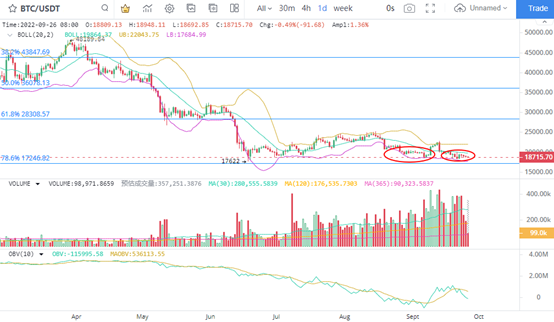
In the process of narrowing the price fluctuation space of BTC, although the cumulative decline has not significantly expanded, the market is on the eve of the change. As the trading volume retreats from its highest level in two years, the short-term trading volume shrinks, which means that BTC will change its position during the downward movement of the closing price. From the closing point, BTC's closing price on each trading day has been declining in recent years, apparently effectively falling below the lowest closing price of 18970 US dollars on June 18. At the same time, the focus of BTC investors' currency holdings has obviously retreated, and the current volume and price do not support the rapid rise of BTC.
2. The number of ETH sending addresses rebounds

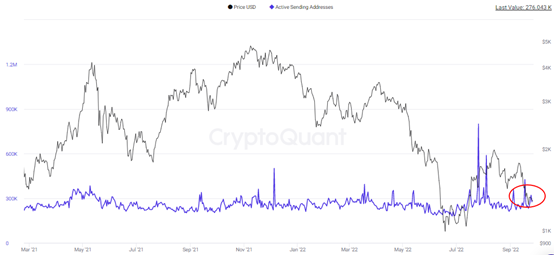
The number of active addresses of ETH has not changed much. During the period of small rebound, it is mainly due to the growth of the number of sending addresses. From the numerical point of view, the number of sending addresses rose to a short-term high of 321000 on September 24. Although the number rose, it was lower than 425000 on September 17. This shows that the number of ETH sent by investors is gradually decreasing. The gradual decline from 799000 on August 26 means that the market is in the period of adjustment.
3. The number of ETH receiving addresses is abnormally low

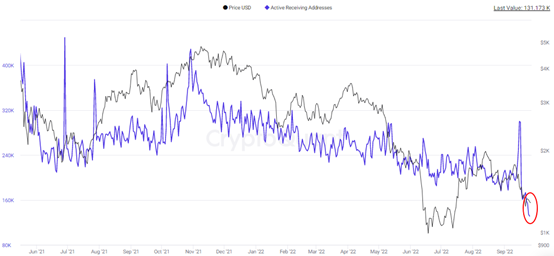
The number of receiving addresses of ETH is unusually low, which means that there is less adjustment to participate in the short-term transfer or transaction of ETH. Different from the number of sending addresses, the number of receiving addresses of ETH decreased, and fell back to the lowest of 131000 within one year on September 25, which means that OTC investors continue to reduce their market entry transactions, and the market adjustment expectation remains unchanged. Consistent with the trend of BTC, ETH's recent amplitude is small, but the closing price has been retreating, and the adjustment expectation remains unchanged.
4. XRP price short-term adjustment

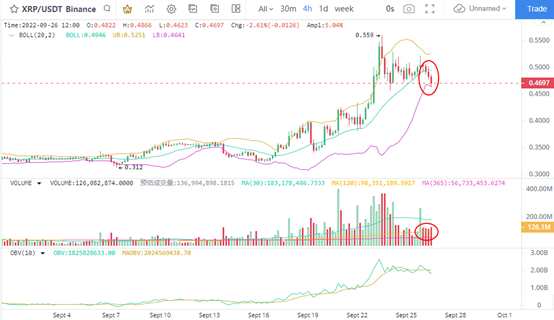
In the 4-hour K line chart, during the short-term retreat of XRP price, the price rebounded obviously under the Bollinger line. In terms of trading volume, the trading volume remained stable during the short-term continuous decline, and the selling pressure was effectively released. At present, the short-term pullback is dominated by low suction. Judging from the recent price trend, the support of US $0.45 and US $0.4 during the release of selling pressure can be properly paid attention to. On the message side, XRP
The news shows that the lawsuit between the Swiss currency and the SEC will probably be decided in December. At the same time, the market expectation is generally optimistic about XRP's judgment in the near future, which makes XRP's price fluctuate strongly in the near future.

On September 18, Ripple's defense lawyer James K. Filan said on Twitter that Brad Garlinghouse, CEO of Ripple Labs, had filed a motion for summary judgment in advance.

The next day, Caroline D. Pham, a member of the Commodity Futures Trading Commission, talked with Brad Garlinghouse. It was previously reported that Ripple and the SEC had asked the court to resolve their ongoing legal disputes.

The encryption community is optimistic about the possibility of compromise because Ripple Labs claims that there is no investment contract. Therefore, the summary judgment motion is considered a prudent strategy that may lead to a settlement with the SEC.

5. XRP's main currency holding and distribution

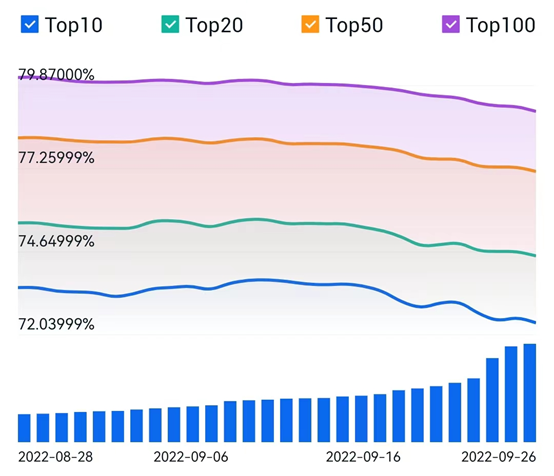
In terms of coin holding, the number of coins held at Whale's address has continued a clear downward trend recently, while XRP prices rose and fell in the same period, indicating that the spread of coin holding does not support the price rise. The number of XRP's top 10, top 20 and top 50 coins held in Xihong Temple decreased from 73%, 75% and 78% on August 28 to 72%, 74% and 77%, and the currency holding divergence trend was clear. Therefore, in terms of trading, in addition to focusing on the overall market strength and XRP litigation results, attention should be paid to adjusting risks in recent low absorption buying.

İlgili Okumalar

Annualized Revenue Exceeds $20 Billion, Kalshi Aims to Become the First Prediction Platform IPO?

Kalshi, a leading U.S. prediction markets platform, is reportedly in early, informal discussions for an Initial Public Offering (IPO). The company's annualized revenue now exceeds $2 billion, fueled by its dominance of over 90% of the domestic prediction market activity. This growth stems from a surge in trading volume—reaching a total of $52.7 billion—and an increase in fee rates, largely driven by sports event contracts like the NBA playoffs and the 2026 FIFA World Cup. Monthly active users are approximately 2 million. Kalshi recently raised $1 billion in a funding round led by Coatue Management, valuing the company at $22 billion. It has also expanded its offerings to include Bitcoin perpetual contracts and plans to launch a dedicated trading platform, Kalshi Pro. However, Kalshi's path to an IPO faces significant regulatory hurdles. The core risk involves jurisdictional conflicts, as multiple U.S. states are challenging its operations under local gambling laws. For instance, Arizona has filed criminal charges against the platform, while states like Kentucky have filed lawsuits. Kalshi and the Commodity Futures Trading Commission (CFTC) argue that its event contracts fall under exclusive federal jurisdiction as "swaps." The outcomes of these ongoing legal battles could critically impact Kalshi's core revenue and its IPO timeline. Analysts suggest that while an IPO could theoretically occur by late 2026, a more likely timeframe is late 2027 or 2028, contingent on resolving legal issues and favorable market conditions. If successful, its fundraising could significantly exceed $1 billion, given its current valuation and revenue multiple.

Foresight News3 dk önce

Annualized Revenue Exceeds $20 Billion, Kalshi Aims to Become the First Prediction Platform IPO?

Foresight News3 dk önce

Financing Weekly Report | 11 Public Financing Events, Stablecoin Payment Infrastructure Company Trace Finance Completes $32 Million Series A Round Led by CoinFund

Financing Weekly Report | 11 public funding events recorded, with a total scale exceeding $264 million. The stablecoin payment infrastructure sector remains a hot spot. Key Deals: - Trace Finance, a stablecoin payment infrastructure firm, raised $32 million in a Series A round led by CoinFund to expand in Latin America and Asia-Pacific. - Galaxy Ventures co-led a $140 million Series A round for Karta, a US credit card provider for global travelers without requiring an SSN. - Instant payment platform Interchecks completed a $50 million Series C round. - Paradigm led a $9 million Series A for Latin American cross-border payment app El Dorado. - Range, a stablecoin compliance startup, raised $8.3 million in an oversubscribed Series A. - RWA infrastructure project Renaiss raised $1.5 million to expand its on-chain collectibles platform. Sector Breakdown: - Infrastructure & Tools: 6 deals, including the above-mentioned Trace Finance, Range, and Renaiss. - Centralized Finance (CeFi): 3 deals, led by Karta's $140 million round. - DeFi: 1 deal – reinsurance protocol Re secured strategic investment from Coinbase Ventures. - Prediction Markets: 1 deal – K25.ai completed a $10 million Pre-A round from NewGen. Other notable transactions include digital asset depository RDC raising $7 million, ad-tech startup EarnOS securing $6 million, and a $1 million strategic investment in LitVM, a ZK Layer 2 for Litecoin. The report highlights sustained investor interest in stablecoin payment infrastructure, compliant on-chain finance, and real-world asset (RWA) tokenization.

marsbit45 dk önce

Financing Weekly Report | 11 Public Financing Events, Stablecoin Payment Infrastructure Company Trace Finance Completes $32 Million Series A Round Led by CoinFund

marsbit45 dk önce

When Transfers Become Truly Frictionless: How Sui Uses 'Zero Gas' to Become the Underlying Infrastructure for Stablecoin Payments

Title: Sui Launches Zero-Gas Stablecoin Transfers to Become the Foundation for Stablecoin Payments Sui has introduced a zero-gas fee feature for peer-to-peer stablecoin transfers, eliminating the need for users or businesses to hold separate SUI tokens to pay transaction costs. This innovation, built on a new underlying account architecture called Address Balances, significantly reduces validator processing costs for eligible transactions. Currently, the feature applies to a whitelist of stablecoins for transfers meeting a minimum amount, effectively preventing spam. This development aims to unlock mainstream payment use cases for stablecoins—such as everyday purchases, remittances, and subscriptions—by removing cost and complexity barriers. It is also positioned to benefit high-frequency micro-payments for AI agents and institutional B2B payments, reducing operational friction. Major custody provider Fireblocks has already announced support. The move follows Sui processing over $1 trillion in stablecoin transfer volume since August 2025. Looking ahead, Sui plans to enhance this infrastructure with protocol-level confidential transactions later in 2026, aiming to provide scalable, free, and privacy-preserving payments. Together, these advancements strengthen Sui's goal of becoming the default settlement layer for stablecoin payments.

marsbit46 dk önce

When Transfers Become Truly Frictionless: How Sui Uses 'Zero Gas' to Become the Underlying Infrastructure for Stablecoin Payments

marsbit46 dk önce

Ethereum Is Retracing the Path of the Internet and Linux: No One Yields, and the Neutral Party Ultimately Prevails

This article argues that Ethereum is following the historical path of open, neutral systems like the Internet and Linux, which eventually triumphed over proprietary, centrally-controlled alternatives. Major financial institutions like JPMorgan, Stripe, and Circle are building their own proprietary blockchains or networks (e.g., Tempo, Arc), but will never agree to build on a competitor's controlled infrastructure. This creates the perfect opportunity for Ethereum as the only neutral, credibly neutral settlement layer that no single entity controls. The piece draws parallels to the 1990s, when experts like Bill Gates predicted proprietary networks (from Microsoft, Oracle) would win over the open Internet, and when Sun Microsystems' Unix lost to the open-source "bazaar" development model of Linux. This model, described in Eric Raymond's "The Cathedral and the Bazaar," thrives on permissionless innovation where countless contributors improve the system, outpacing any centralized competitor. Ethereum embodies this through its decentralized development, broad validator distribution, and credible neutrality—rules that are transparent, equally applied, hard to change, and open to all. This has attracted over a million developers and major institutions like Coinbase, BlackRock, and JPMorgan, who choose Ethereum for its security, ecosystem, and sovereignty (the inability of any single party to change the rules). While proprietary chains offer initial speed and control, they inherit the downsides of both centralization and decentralization without the long-term innovation benefits. The article concludes that, just as open systems historically win, Ethereum is poised to become the foundational, neutral settlement layer for global finance.

marsbit56 dk önce

Ethereum Is Retracing the Path of the Internet and Linux: No One Yields, and the Neutral Party Ultimately Prevails

marsbit56 dk önce

İşlemler

Spot
Futures
活动图片