$6 Trillion in Assets On-Chain: Why Canton Network is Wall Street's New Darling

比推2026-01-09 tarihinde yayınlandı2026-01-09 tarihinde güncellendi

Özet

Canton Network is gaining significant traction as a blockchain platform focused on real-world assets, with reported support for over $6 trillion in on-chain assets and a daily transaction volume of $280 billion. Backed by major traditional finance institutions like DTCC and J.P. Morgan, it functions as an interoperability layer connecting independent networks ("cantons"), similar to Cosmos. The network relies on 13 permissioned "Super Validators" for consensus, many of which are operated by early investors. Canton uses a native utility token, Canton Coin (CC), which is burned as gas fees, creating deflationary pressure. Similar to Bitcoin, it employs a programmed halving schedule—the second halving is imminent, potentially reducing supply and impacting short-term token prices. While its privacy-focused, customizable design appeals to institutional players, concerns remain about centralized control and insider advantages, as Super Validators heavily influence token distribution and featured applications. The upcoming halving presents a speculative opportunity, but long-term value depends on sustainable network utility rather than supply shocks alone.

Source: Bankless

Author: Jack Inabinet

Original Title: How Canton Network Works


Canton Network is quickly becoming the latest focus in the cryptocurrency industry. Does this signal a brewing explosive opportunity in a new wave of L1 ecosystems?

This blockchain, focused on real-world assets, recently made headlines for its high-profile integration with traditional finance giants (including the Depository Trust & Clearing Corporation DTCC and JPMorgan Chase), claiming to support over $6 trillion in on-chain real-world assets and a daily trading volume of $280 billion.

Today, we will delve into the technical architecture and token economic model of the Canton Network to better understand the design logic of this groundbreaking network.

Super Validator-Led Technical Architecture

Canton is essentially an interoperability layer connecting independent networks (these networks are also called "cantons"), with a design philosophy similar to the model in the Cosmos ecosystem that allows independent chains to communicate directly.
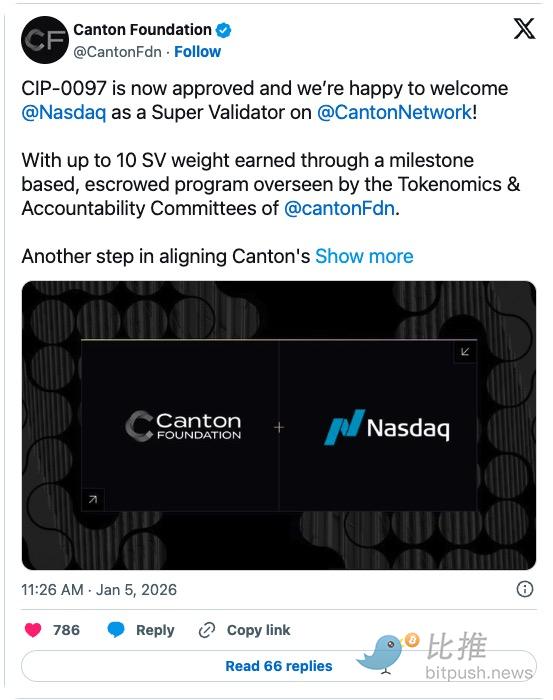
Regarding its consensus mechanism, the Canton Network is validated by an invite-only set of 13 "Super Validator" nodes, many of which are operated by the network's investors. One node is operated by the Canton Foundation, which is composed of early enterprise supporters, brand partners, and investors.

Most activity on the network occurs at the independent "canton" level, similar to how the Osmosis exchange in the Cosmos interoperability ecosystem aggregates the main liquidity and user activity. The validators of these independent cantons are responsible for processing all data on their independent "shard" and enjoy high flexibility in customizing the rules of that independent execution environment, including preferences for gas fees and data sharing.

Due to the inherently opaque design architecture adopted by Canton, the authenticity and sources of its published metrics (such as asset size and transaction volume) are difficult to verify independently.

However, representative independent application cases have emerged in the ecosystem: for example, the recently launched Temple Digital Group exchange, supported by YZi Labs, is operating as an independent Canton sub-network.

Token Economics

The Canton Network is built around its native utility token, Canton Coin (ticker CC), which is designed to "reward actual network usage rather than speculative behavior."

Similar to Ethereum, Canton burns tokens when users pay gas fees, creating deflationary pressure on CC. When the network is used for transactions, settlements, data synchronization, or asset transfers, all fees paid in CC are burned, permanently removed from circulation.

Similar to Bitcoin, Canton employs a programmatic token issuance curve, with regular halving events. New CC tokens can be continuously minted by various network participants by adding "measurable utility" to the network.
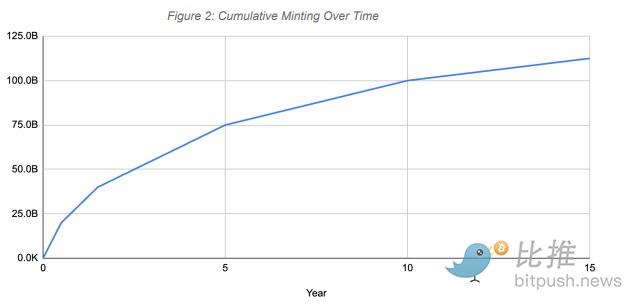
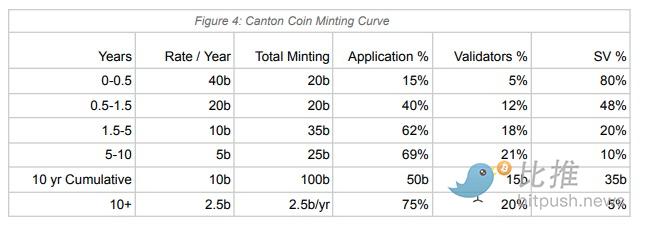
Currently, permitted Canton Super Validators (primarily early investors) are eligible for 48% of the CC issuance as a reward for maintaining global consensus. Validators receive 12% of the total CC supply, allocated mainly based on the value of Canton Coin transfers initiated by their users, and potentially rewarded based on node uptime if the minting cap allows.

Similar to Berachain, Canton also allocates tokens directly to applications in the form of gas fee rebates. "Featured" applications (which can be designated by Super Validators) can mint CC up to 100 times the burned fees, while non-featured applications can mint up to 80% of the burned fees.

It is worth noting that, at the time of writing, CC token minting is still proceeding according to the plan for years 0.5 to 1.5 in the chart below. However, with the second Canton halving scheduled to occur in just three days, the CC minting rate will soon be halved, and its distribution will be adjusted according to the plan for years 1.5 to 5 in the chart below.

For investors seeking trading opportunities, the supply reduction from the CC halving event may, through supply and demand dynamics, push the token price higher in the short term, regardless of the network's fundamental investment thesis.
Conclusion: A Glossy Narrative with Underlying Concerns

Canton undoubtedly presents a compelling investment story, but its potential opportunities are matched by outstanding questions.

Its highly configurable, privacy-focused design holds clear appeal for traditional finance giants, but the network's complex token economic structure and centralized control system introduce significant insider advantages, increasing the risk of imbalanced token distribution.

The permitted Super Validators, through their ability to designate "Featured" applications, continue to wield excessive influence over Canton's issuance. This means the flow of CC tokens will remain heavily controlled by insiders, even though this group's own issuance is set to decrease by approximately 80% within days.

The sudden rise of the Canton Network on the eve of its second halving adds another layer of suspense to the market. In the early halving phases, the supply shock effect is often most pronounced—while the upcoming emission cut for CC creates a clear catalytic opportunity for short-term trading, long-term investors should still view it with caution: the price impact from supply constriction should not be conflated with sustainable fundamental value.


Twitter:https://twitter.com/BitpushNewsCN

Bitpush TG Discussion Group:https://t.me/BitPushCommunity

Bitpush TG Subscription: https://t.me/bitpush

Original link:https://www.bitpush.news/articles/7601459

İlgili Sorular

QWhat is the Canton Network and why is it gaining attention in the cryptocurrency industry?

ACanton Network is a blockchain focused on real-world assets, gaining attention for integrating traditional finance giants like DTCC and JPMorgan, claiming to support over $6 trillion in on-chain real assets and process $280 billion in daily transaction volume.

QHow does Canton Network's technical architecture work, particularly regarding its consensus mechanism?

ACanton Network uses an interoperability layer connecting independent networks called 'cantons', with consensus managed by 13 invitation-only 'Super Validators' nodes, many operated by the network's investors, similar to how Cosmos enables direct communication between independent chains.

QWhat is the role of the native utility token Canton Coin (CC) in the network's economy?

ACanton Coin (CC) is used for paying gas fees, which are burned to create deflationary pressure. It features programmed token issuance with periodic halvings, and new CC can be minted by network participants who add measurable utility, with allocations to validators and featured applications.

QWhat are the potential risks and concerns associated with Canton Network's token economics and control structure?

AConcerns include centralized control by Super Validators who have significant influence over token distribution and featured applications, creating potential insider advantages and risks of imbalanced token allocation, despite the deflationary mechanisms and halving events.

QHow does Canton Network's upcoming halving event impact CC token supply and potential market effects?

AThe upcoming halving will reduce CC issuance by half, potentially creating short-term price increases due to supply shock, but long-term investors should distinguish between supply-driven price effects and sustainable fundamental value.

İlgili Okumalar

Polymarket's "2028 Presidential Election" Volume King Is... LeBron James???

An article from Odaily Planet Daily, authored by Azuma, discusses a peculiar phenomenon observed on the prediction market platform Polymarket regarding the "2028 US Presidential Election" event. Despite having a real-time probability of less than 1%, unlikely candidates such as NBA star LeBron James (with $48.41 million in trading volume), celebrity Kim Kardashian ($33.84 million), and even ineligible figures like Elon Musk ($23.14 million) and New York City Mayor Zohran Mamdani ($18.39 million) account for approximately 70% of the total trading volume. In contrast, high-probability candidates like Vice President JD Vance ($10.58 million), California Governor Gavin Newsom ($15.71 million), and Secretary of State Marco Rubio ($9.32 million) have significantly lower trading activity. The article explains that this counterintuitive trend is not driven by irrational speculation but by rational strategies. Polymarket offers a 4% annualized holding reward for certain markets, including the 2028 election, to maintain long-term pricing accuracy. This yield exceeds the current 5-year US Treasury rate (3.98%), attracting large investors ("whales") to hold "NO" shares on low-probability candidates for risk-free returns. Additionally, some users utilize a platform feature that allows converting a set of "NO" shares into corresponding "YES" shares for better liquidity or pricing efficiency, rather than directly buying "YES" shares for their preferred candidates. Thus, the seemingly absurd trading activity is strategically motivated.

marsbit20 dk önce

Polymarket's "2028 Presidential Election" Volume King Is... LeBron James???

marsbit20 dk önce

Dialogue with ViaBTC CEO Yang Haipo: Is the Essence of Blockchain a Libertarian Experiment?

"ViaBTC CEO Yang Haipo: Blockchain as a Hardcore Libertarian Experiment" In a deep-dive interview, ViaBTC CEO Yang Haipo reframes the essence of blockchain, arguing it is not merely a new technology or infrastructure but a hardcore libertarian experiment. This experiment, born from the 2008 financial crisis and decades of cypherpunk ideology, tests a fundamental question: to what extent can freedom and self-organization exist without centralized trust? The discussion highlights the experiment's verified outcomes. On one hand, it has proven its core value of censorship resistance, providing critical financial lifelines for entities like WikiLeaks and individuals in hyperinflationary or sanctioned countries via tools like stablecoins. However, Yang points out a key paradox: the most successful product, USDT, is itself a centralized compromise, showing users prioritize a less-controlled pipeline over pure decentralization. On the other hand, the experiment has exposed the severe costs of this freedom—a "dark forest" without safeguards. Events like the collapses of LUNA, Celsius, and FTX, resulting in massive wealth destruction and prison sentences for founders, underscore the system's fragility and the inherent risks of an unregulated environment. Yang observes that despite decentralized protocols, human nature inevitably recreates centralized power structures, speculative frenzies, and narrative-driven cycles (from ICOs to Meme coins), where emotion and belonging often trump technological substance. Looking forward, he believes blockchain's future is significant but niche. Its real value lies in serving specific, real-world needs for financial sovereignty and bypassing traditional controls, not as a universal infrastructure replacing all centralized systems. For the average participant, Yang's crucial advice is to cultivate independent judgment. True freedom is not holding a crypto wallet, but possessing a mind resilient to groupthink and narrative hype in a high-risk, often irrational market.

marsbit34 dk önce

Dialogue with ViaBTC CEO Yang Haipo: Is the Essence of Blockchain a Libertarian Experiment?

marsbit34 dk önce

İşlemler

Spot
Futures
活动图片