SK海力士Q2利润暴涨557%,股价却崩了

第一财经2026-07-29 tarihinde yayınlandı2026-07-29 tarihinde güncellendi

Özet

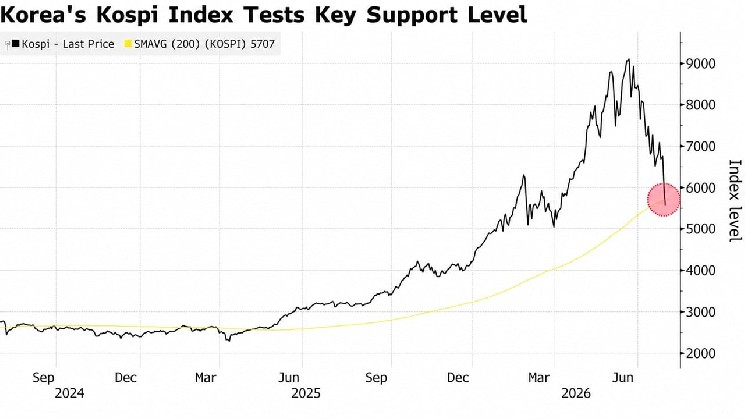
自今年6月以来,SK海力士市值已累计蒸发逾5000亿美元,单月最深跌幅一度抹去约45%的股票价值。当一家公司的利润创下历史之最,市场的反应却是抛售——这或许是本轮AI周期中,最值得深思的信号。

7月29日,SK海力士正式发布2026财年第二季度财报,交出创出历史新高的业绩。然而在财报公布的前一个交易日,SK海力士ADR大跌近9%,在韩国股市单日暴跌14.65%,今天韩国本地股开盘前一度下跌4.5%。

具体来说,SK海力士二季度营收达79.32万亿韩元,同比增长257%;营业利润达60.54万亿韩元,同比暴涨557%;净利润更是高达93.92万亿韩元,同比增长1242%。上半年累计营收首次突破100万亿韩元大关。
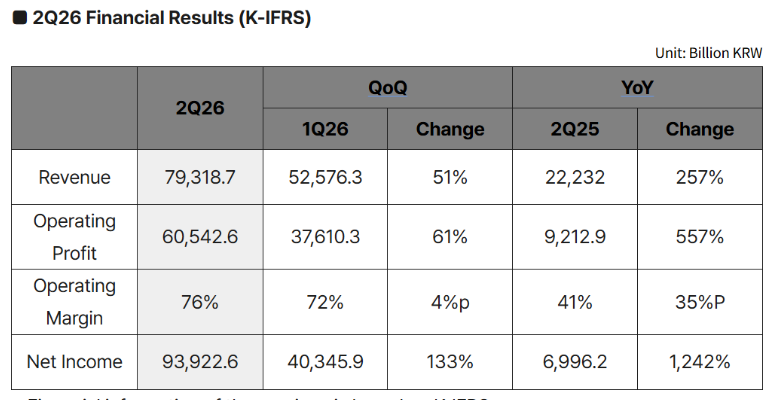
然而,这些数字并未满足市场预期。分析师此前预计营业利润约为64万亿韩元、营收约为84万亿韩元。

截至二季度末,SK海力士现金及现金等价物达88万亿韩元,环比增加33.6万亿韩元;总债务减少至18.6万亿韩元,净现金头寸扩大至69.4万亿韩元。

业绩为何“不及预期”?

在AI基础设施投资持续扩大、高性能AI服务器产品推动价格上涨的背景下,SK海力士的盈利质量其实极高,二季度营业利润率高达76%。但净利润率高达118%,是由于SK海力士确认约62万亿韩元规模的铠侠投资相关非经营收益,主要来自股权及可转债价值重估,及部分出售股权的非经营收益,并不能代表芯片业务真实盈利能力。

三项结构性因素导致业绩不及预期:

HBM销售占比偏高反成制约。当前半导体行业利润提升的主要驱动力来自通用DRAM价格飙升,而SK海力士的HBM产能占比较高,使其从中获益相对有限。

内存价格涨幅放缓。二季度通用DRAM环比涨幅约30%,NAND环比涨幅约50%-60%区间中段,均低于一季度的DRAM约60%、NAND约70%的涨幅水平。

长期供应协议锁定价格。市场分析认为,SK海力士通过长协锁定的销售额约占总量的50%(主要是HBM),这削弱了现货价格上涨带来的收益弹性。

韩国证券分析师此前也指出,SK海力士由于HBM占比高,平均销售价格增长低于市场平均水平。

对投资者而言,核心焦虑在于:“SK海力士遭遇‘利好兑现式下跌’。创纪录盈利未能满足市场更高期待,投资者开始关注HBM价格、AI资本开支持续性以及2027年之后供给扩张风险。”

HBM4已量产发货,下半年进入放量阶段

当然,AI内存仍是SK海力士最重要的增长主线。SK海力士表示,SK海力士宣布HBM4已于二季度实现量产发货,产品达到客户所需运行速度,具备行业领先的能效和成本竞争力,下半年将进一步扩大产量。对于上半年已完成样品出货的HBM4E,SK海力士采用了技术成熟且量产稳定的优化工艺。

HBM4将是英伟达下一代AI加速器平台的重要配套内存,作为英伟达核心供应商,SK海力士能否稳定交付HBM4,将直接影响其在AI内存市场的领先地位。

SOCAMM2 的销售额在第二季度大幅增长,基于 10nm 级第六代 (1c) 工艺技术的产品出货量也开始真正增长。

在需求端,SK海力士已与约10家客户敲定了多年的长期供应协议,并继续与其他主要客户谈判,以增强中长期业务稳定性。分析人士认为,B2B销售占比预计将从2017年的30%提升至2027年的70%,这将显著改善盈利质量与可预测性。

NAND转型提速

在NAND产品方面,SK海力士正加速向先进工艺节点转型,以强化其高容量、高性能产品组合。321层产品已成为总产量中占比最高的产品,计划年底前扩大至韩国本土产能约50%。企业级SSD需求同步走强,帮助提升NAND产品组合质量。

资本开支与供给过剩隐忧

SK海力士预计2026年资本开支将达到40万亿至50万亿韩元区间上沿,核心投入集中于HBM、先进DRAM及NAND新厂建设。

SK海力士正在加快M15X的量产计划,同时投资扩充产能,以期在2027年初龙仁一期洁净室投入使用后迅速提升产能。包括近期宣布的P&T7先进封装工厂、M17 NAND生产基地以及新建半导体产业集群在内的中长期投资计划,将根据客户需求和投资效率分阶段实施。

SK 海力士强调,公司将通过无缝地为中长期增长机会做好准备,同时保持资本支出纪律(CapEx Discipline),来增强其生产能力和财务健康。

自今年6月以来,SK海力士市值已累计蒸发逾5000亿美元,单月最深跌幅一度抹去约45%的股票价值。当一家公司的利润创下历史之最,市场的反应却是抛售——这或许是本轮AI周期中,最值得深思的信号。

编辑:芯智讯-浪客剑

(来源:芯智讯)
İlgili Okumalar

Renowned PE Firm Completes Exit

A leading global private equity firm has completely divested its stake in a Japanese memory storage giant. Bain Capital has sold all its shares in Kioxia, formerly Toshiba Memory, realizing approximately $17 billion in total proceeds. This transaction is reportedly one of the most successful exits in global private equity history. The divestment concludes a nearly decade-long investment that began in 2018. Bain led a consortium to acquire the then-Toshiba Memory business for $18 billion during a period of financial distress for its parent company, Toshiba. The investment initially faced challenges, including multiple postponed IPO attempts and a failed merger plan with Western Digital's flash memory business. The investment's fortunes reversed dramatically with the surge in demand for memory chips driven by the AI boom, particularly for High Bandwidth Memory (HBM). This led to a sharp increase in prices for DRAM and NAND flash memory. Consequently, Kioxia's stock price soared nearly 50-fold from its 2024 IPO price, briefly making it Japan's most valuable company in mid-2025. Bain began significantly reducing its stake in late 2025 and finalized the complete exit by July of this year. The report draws a parallel to the success of Changxin Memory Technologies (CXMT) in China, whose backers also demonstrated long-term patience. CXMT recently debuted on China's STAR Market with a market capitalization exceeding 3 trillion yuan ($412 billion), underscoring the massive returns possible in the semiconductor sector for committed, long-term investors.

marsbit4 dk önce

Renowned PE Firm Completes Exit

marsbit4 dk önce

Kospi Index Drops Below 5,600 Mark Amid Record-Breaking Double Trigger of Circuit Breaker, While Bitcoin Price Surpasses $64,000

South Korea's stock market experienced unprecedented volatility as both the Kospi and Kosdaq indices triggered circuit breakers for two consecutive days. The Kospi plunged over 8% on Wednesday, falling below 5,600 points, following an over 8% drop the previous day. This historic dual halt was primarily driven by massive sell-offs in heavyweight semiconductor stocks like Samsung Electronics and SK Hynix. The selling pressure persisted despite SK Hynix reporting a 557% surge in quarterly profit, as the results failed to meet inflated market expectations fueled by AI-driven demand, highlighting a disconnect between stock valuations and fundamentals. In contrast, Bitcoin diverged from the equity market downturn. After initially dipping to around $63,000 amid the Kospi's fall and broader macroeconomic concerns, it rebounded to surpass $64,400 within 24 hours, even as South Korea's second circuit breaker was triggered. This marks a second instance in a week where Bitcoin held ground during an AI-related stock sell-off, suggesting its previously tight correlation with semiconductor and tech stocks may be weakening. Analysts note the relationship is complex and driven by shared investor bases rather than direct causality. The ongoing pressure on chip stocks, which dominate the Kospi index, raises the risk of further market halts before stability can return.

cryptonews.ru8 dk önce

Kospi Index Drops Below 5,600 Mark Amid Record-Breaking Double Trigger of Circuit Breaker, While Bitcoin Price Surpasses $64,000

cryptonews.ru8 dk önce

İşlemler

Spot
活动图片