CLARITY Act Countdown: How Will the Crypto Market Fare If It Doesn't Pass Before the August Recess?

marsbit2026-07-05 tarihinde yayınlandı2026-07-05 tarihinde güncellendi

Özet

The CLARITY Act, a major US crypto market structure bill, faces a tight deadline before the Senate's August 10 recess. It must overcome final hurdles—negotiations on ethics provisions and law enforcement concerns—to secure the 60 votes needed for passage. Analysts warn that missing this window significantly lowers its chances in 2026, with prediction markets giving only a 40% probability of success this year. If the act fails to pass by the recess, the market is expected to react not with a crash but with continued "slow bleeding," particularly in premium products like ETFs. June saw record net outflows from US Bitcoin spot ETFs, partly attributed to this legislative uncertainty. Assets like XRP, which would receive permanent commodity classification under the act, stand to lose a "regulatory premium" on further delays. Bitcoin and Ethereum, already classified as commodities by regulators, face less direct impact, but DeFi innovation and institutional capital inflows would remain stifled by regulatory ambiguity. The path forward includes passing before the recess (a major catalyst), postponement to 2027 (prolonging uncertainty), or failure, requiring the bill to be reintroduced in the next Congress. Despite the stalled negotiations, the bill's advancement this far signals the US is closer than ever to resolving crypto regulatory clarity.

Author: Qin Xiaofeng, Odaily Planet Daily

The highly anticipated Digital Asset Market Structure Act (CLARITY Act) has unsurprisingly been delayed once again. Senator Cynthia Lummis previously stated that negotiators expected to finalize a compromise text around July 4th (U.S. Independence Day) and "advance it in July," but progress has clearly lagged.

Now, with the Senate's August 10th recess approaching, the window of opportunity is shrinking rapidly: the bill must meet the 60-vote threshold in the Senate (requiring at least 7 Democratic defections), be reconciled with the text from the Senate Agriculture Committee, merged with the House bill, and signed by the President—all within the next 25 working days. The timeline is extremely tight.

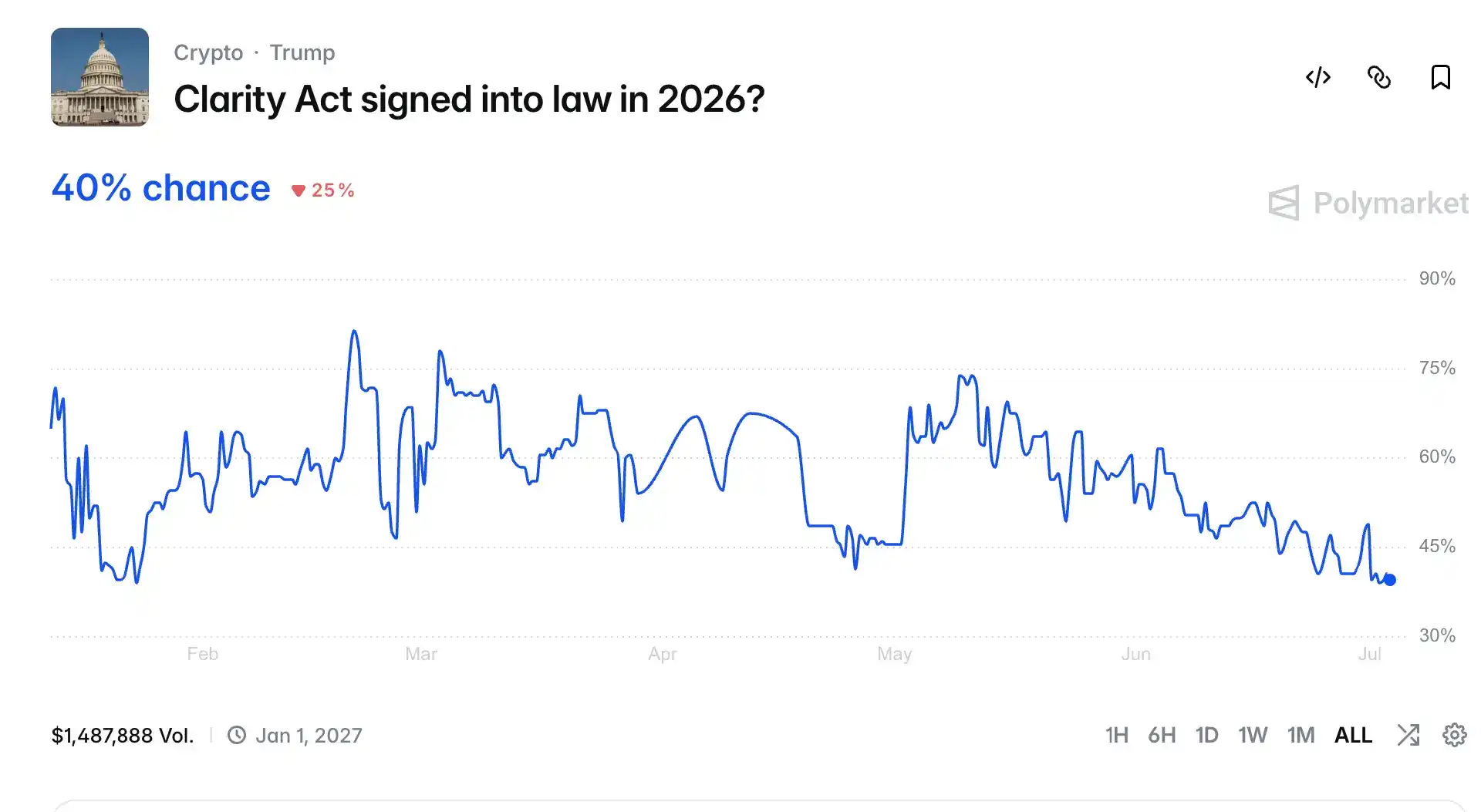
If the window before the August recess is missed, the probability of the CLARITY Act passing this year will further decrease. In fact, data from the prediction market Polymarket shows the probability of the bill passing this year is only 40%; Galaxy Digital has also lowered the probability of passage by 2026 to 50%.
I. Review of the Latest Progress on the CLARITY Act

The CLARITY Act is landmark crypto market structure legislation being advanced in the U.S. Congress, aiming to clarify the regulatory boundaries between the SEC and CFTC, provide a non-security pathway for decentralized tokens, and mandate registration and anti-money laundering obligations for digital commodity intermediaries.

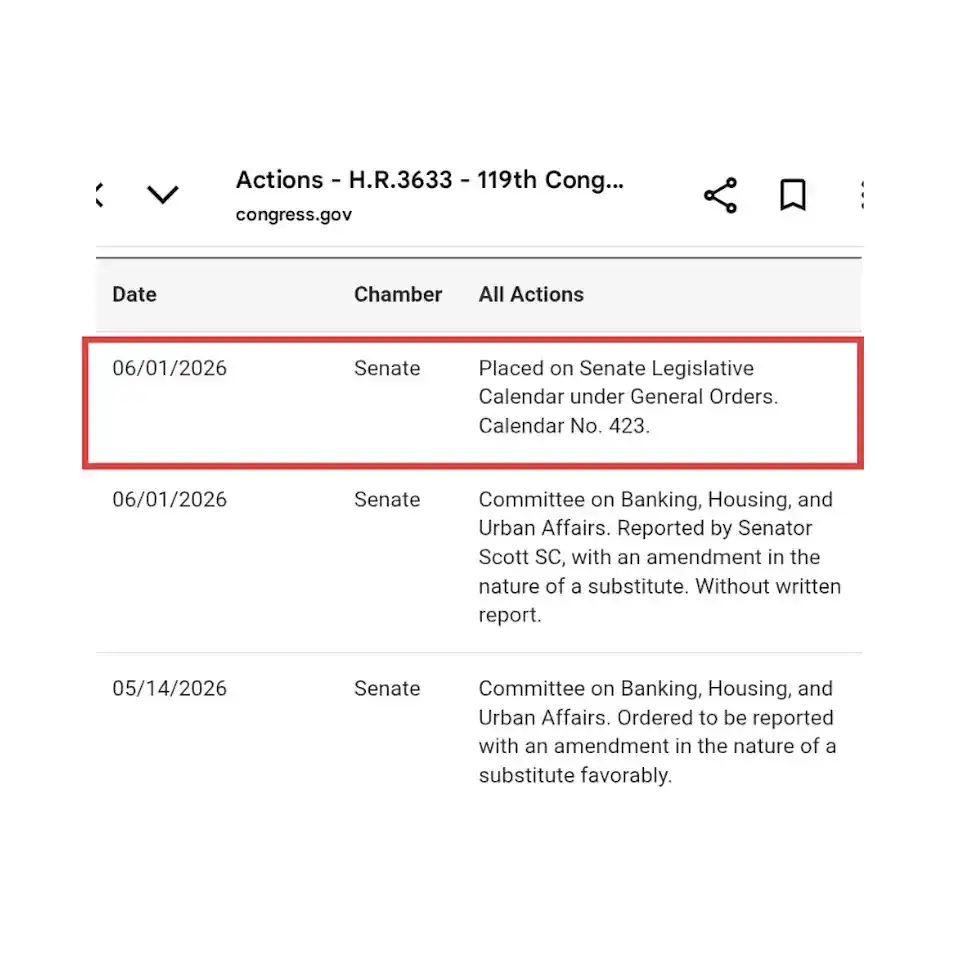
On July 17, 2025, the House of Representatives passed HR 3633, proposed by French Hill, with 294 votes in favor and 134 against, including over 70 votes from Democrats. On May 14, 2026, the Senate Banking Committee advanced and passed it with a 15-9 vote (supported by 13 Republicans and 2 Democrats). On June 1, 2026, the CLARITY Act was officially placed on the Senate legislative calendar (Calendar No. 423), qualifying for full consideration.

However, progress on the CLARITY Act throughout June was not smooth. On June 9th, negotiations over the ethics clause regarding the President's crypto holdings broke down, directly leading to some Democratic lawmakers softening their stance or imposing additional conditions, slowing the pace of the bill reaching the floor for debate. On June 10th, the White House held meetings with police and prosecutor groups. Afterwards, the enforcement battle over Section 604 (the developer protection clause) in the Blockchain Regulatory Certainty Act reached an impasse; if unresolved, law enforcement groups might lobby against it, and Democratic lawmakers might also vote against it for "insufficiently protecting consumers/combating crime."

In simple terms, the former is a "political/ethics hurdle," and the latter is an "enforcement/security red line." Together, they constitute the final two major obstacles before the CLARITY Act can "clear" the Senate. If these are not resolved, it will be difficult to gather the 60 votes and finalize the text, making it impossible to complete the legislation before the August 10th recess. These two sets of negotiations are the key "stumbling blocks" directly hindering the final advancement of the CLARITY Act, causing the July 4th target to be missed and the overall progress to stall. Negotiations are still trying to break the deadlock, but time is running very short.

Brian Gardner, Chief Washington Policy Strategist at Stifel Financial, stated that for the bill to pass in 2026, "it likely needs to pass the Senate by the end of July, preferably in June," and warned that if the Senate misses the recess deadline, the outlook would deteriorate significantly.
However, the market has largely lost hope for the bill's passage this year. Alex Thorn, Head of Galaxy Research, lowered his prediction for the bill passing in 2026 from 75% to 60% on June 5th, citing the increasingly tight Senate schedule. Data from the prediction market Polymarket shows the probability of the bill passing this year is only 40%.

II. What Will Happen to Crypto If the CLARITY Act Fails to Pass on Schedule?

According to CCN's analysis, if the CLARITY Act fails to pass before the August recess, the market's most likely reaction will not be a crash, but rather a "slow bleed through premium products." In fact, the poor performance of cryptocurrencies throughout June indicates that the market has already begun to reprice for legislative uncertainty. (Odaily Note: The premium products here mainly refer to various spot ETFs.)

Data shows that throughout June, U.S. spot Bitcoin ETFs saw cumulative net outflows of approximately $4.5 billion, equivalent to about 77,000 BTC being redeemed. This marks the largest monthly net outflow since the products launched in January 2024, surpassing the previous record from February 2025 (~$3.56 billion), setting the worst monthly record ever.

In fact, XRP might be the asset most directly and significantly affected by the bill, as it would permanently cement its commodity classification, eliminating the risk of reversible agency interpretation. In case of long-term delay or failure, XRP could lose some of its "regulatory premium."

Geoffrey Kendrick, Global Head of Digital Asset Research at Standard Chartered, forecasts an XRP target price of $8, contingent on the Senate fully passing the relevant bill and $4-8 billion in ETF inflows. JPMorgan predicts that if the bill passes, XRP ETFs could see $4.3-8.4 billion in inflows in the first year. Data shows that since the launch of XRP spot ETFs in November 2025, cumulative net inflows have been about $1.41 billion, with 84% from retail, while institutional inflows await clearer regulatory signals.

For Bitcoin, which was already classified as a commodity through a joint SEC-CFTC interpretation in March 2026, the CLARITY Act's main role would be to codify this reversible decision into permanent federal law. Even if the bill fails or is significantly delayed, Bitcoin's "digital gold" narrative is relatively robust, and the direct impact would be smaller.

The impact on ETH is similar to Bitcoin. Ethereum was also classified as a commodity via the joint interpretation. Failure of the bill could lead to prolonged compliance ambiguity for DeFi protocols, stifling innovation and capital inflows. Standard Chartered's Geoffrey Kendrick previously forecasted an ETH target price of $7,500 by the end of 2026 (later revised to $4,000), contingent on the passage of the relevant bills.

Kristin Smith, President of the Solana Policy Institute, stated that many asset allocators are actively exploring investments in digital assets but are holding back funds due to the lack of clear regulatory guidelines. The same principle applies to institutional DeFi; currently, DeFi projects are also on hold awaiting the outcome of Section 604.

III. What's the Path Forward?

Time is running short for the CLARITY Act to overcome the final hurdles. The following scenarios are possible:

  • First, Passage Before the August Recess: The biggest catalyst, likely triggering a significant price rebound, especially for XRP and related ETFs.
  • Second, Postponement to 2027: The scenario least desired by the market, extending the "slow bleed" process, with institutional capital continuing to wait on the sidelines.
  • Third, Failure and Pushing to the Next Congress: The CLARITY Act is currently in the 119th Congress. If the Senate floor vote, reconciliation, and final passage are not completed before the August 2026 recess, the entire process cannot conclude within this Congress. When the new Congress (120th, 2027-2028) begins, the bill must be reintroduced and go through the entire process of committee consideration, floor debate, etc., all over again.

The CLARITY Act is currently at a critical stage of being "on the cusp but stuck." Technically, it's on the Senate calendar, but political negotiations, the time window, and bipartisan support remain the biggest obstacles.

However, as Vincent Chok, CEO of First Digital, stated: "The fact that the CLARITY Act has reached the Senate floor vote itself shows the U.S. is closer than ever to resolving regulatory ambiguity... A successful vote would accelerate this process, but failure won't necessarily stop it. In fact, delays in the U.S. framework could create urgency and extend the time window for setting global standards, potentially positioning the U.S. as the de facto global digital asset hub."


Trend Kriptolar

İlgili Sorular

QWhat is the CLARITY Act and what are its primary objectives in regulating the US cryptocurrency market?

AThe CLARITY Act, officially the Digital Asset Market Transparency Act, is a landmark piece of U.S. crypto market structure legislation. Its primary objectives are to clarify the jurisdictional boundaries between the SEC and CFTC, provide a non-security pathway for decentralized tokens, and mandate that digital commodity intermediaries register and comply with anti-money laundering obligations.

QWhat are the two main political and procedural obstacles currently blocking the CLARITY Act's progress in the Senate?

AThe two main obstacles are: 1) A political/ethics threshold related to negotiations over a provision concerning presidential crypto holdings, which softened some Democratic support. 2) A law enforcement/safety red line concerning the developer protection clause (Section 604) in the related Blockchain Regulatory Certainty Act, which law enforcement groups oppose. These unresolved issues make it difficult to secure the necessary 60 votes for Senate passage.

QAccording to the article, what is the most likely market consequence if the CLARITY Act fails to pass before the August recess?

AThe most likely consequence is not a market crash, but a 'slow bleed' through premium products like spot ETFs. The article points to the record $4.5 billion in net outflows from US Bitcoin spot ETFs in June as evidence that the market is already repricing assets due to legislative uncertainty, and this trend would likely continue.

QWhy is XRP considered the asset most directly impacted by the fate of the CLARITY Act?

AXRP is most directly impacted because the Act would permanently codify its classification as a commodity into federal law, eliminating the risk of a reversible agency interpretation (like the SEC potentially re-classifying it as a security). Without the Act's passage, XRP could lose a portion of its 'regulatory clarity premium' that has been supporting its valuation expectations for an ETF and institutional inflows.

QWhat are the three potential future scenarios for the CLARITY Act outlined in the article if it does not pass before the August recess?

AThe three scenarios are: 1) Passage before the August recess (leading to a significant price rebound, especially for XRP). 2) Delayed to 2027, extending the period of market uncertainty and 'slow bleed'. 3) Failure in the current (119th) Congress, requiring the entire legislative process to restart from scratch in the next (120th) Congress beginning in 2027.

İlgili Okumalar

MSTR Discloses Sale of 3,588 Bitcoins, Stock Price Drops Over 5% at One Point During Trading

MicroStrategy, the world's largest corporate holder of Bitcoin, has significantly shifted its business model. Between June 29 and July 5, the company sold 3,588 bitcoins for approximately $216 million to fund quarterly dividends for its preferred stock. This marks its largest-ever Bitcoin sale and signals a strategic pivot: Bitcoin is transitioning from a "buy-and-hold" reserve asset to a liquidity management tool for the company. This move follows a recent authorization allowing Bitcoin sales when equity fundraising is less attractive. The announcement contributed to a more than 5% intraday drop in MicroStrategy's stock price, while Bitcoin fell to around $61,800—below the company's average holding cost of roughly $75,700. The sale represents a major departure from MicroStrategy's long-standing "never sell" commitment, which saw its first minor breach in May with a $2.5 million sale. The latest, hundred-times-larger transaction underscores growing financial pressures. Analysts note the company faces about $1.5 billion in annual preferred dividend obligations, far exceeding cash flow from its software business. As of July 5, MicroStrategy holds 843,775 bitcoins. Its current operational logic involves buying Bitcoin during favorable financing conditions and selling portions to cover dividends when needed, creating a flexible capital management cycle amidst a challenging market environment.

华尔街日报6 saat önce

MSTR Discloses Sale of 3,588 Bitcoins, Stock Price Drops Over 5% at One Point During Trading

华尔街日报6 saat önce

Q-Day Countdown: Will Quantum Computing End Cryptocurrencies?

Quantum Computing's Threat to Cryptocurrency: A Countdown to Q-Day Quantum computing, specifically Shor's algorithm, poses a fundamental threat to the public-key cryptography (e.g., ECDSA, RSA) that secures blockchain networks like Bitcoin and Ethereum. This critical juncture, known as Q-Day, is estimated to occur potentially within the next 5-15 years. The core vulnerability stems from the public and immutable nature of blockchains. Assets in addresses where the public key is already exposed on-chain (e.g., spent outputs) are at direct risk, as a sufficiently powerful quantum computer could derive the private key. This threatens the very trust model of cryptocurrencies. The response lies in Post-Quantum Cryptography (PQC)—algorithms like lattice-based ML-DSA and hash-based SLH-DSA, which are resistant to quantum attacks. NIST has standardized key PQC algorithms (FIPS 203, 204, 205), providing a migration path. However, the primary challenge is not technical but socio-economic and involves complex governance: * **Bitcoin's** path is constrained by its conservative ethos. Migrating requires a soft-fork to new address types, facing hurdles like significantly larger signature sizes and, most critically, the divisive governance question of how to handle at-risk legacy UTXOs without violating core principles. * **Ethereum** is pursuing a "cryptographic agility" strategy, with a multi-layered roadmap. It leverages account abstraction for user accounts and is developing compressed hash-based signatures (e.g., leanXMSS) for its consensus layer, aiming for a full-stack upgrade over time. In conclusion, quantum computing does not spell an instant end for cryptocurrency but initiates a critical countdown. The industry has a limited "engineering comfort window" to orchestrate a coordinated, ecosystem-wide migration to PQC. The ultimate bottlenecks are the immense coordination efforts and governance decisions required for this foundational transition.

marsbit7 saat önce

Q-Day Countdown: Will Quantum Computing End Cryptocurrencies?

marsbit7 saat önce

Trump, the President Who Knows Best How to 'Trade Stocks'

Former US President Donald Trump reported a record-breaking $2.2 billion in personal income for 2025, the highest annual income ever disclosed by a sitting president. This figure, from a 927-page government ethics filing, represented a 3.5-fold increase from his $600 million income in 2024 and boosted his net worth to $6.5 billion. The primary drivers were cryptocurrency (64% of income, approximately $1.4 billion) and real estate (26%, approximately $575 million). His crypto earnings stemmed largely from the launch of his personal meme coin, $TRUMP, generating over $600 million in licensing fees, and substantial profits from the WLFI token and its parent company. Despite a sluggish property market, his Mar-a-Lago resort and associated golf clubs saw revenue surges of 50% and 27%, respectively, attributed to their use as venues for presidential events. Trump's financial disclosure also revealed an unprecedented level of stock market activity, with over 22,000 trades executed in 2025, averaging 87 trades per market day. Media analyses noted several instances where significant trading coincided with major policy announcements, such as proposed tariffs, raising questions about potential conflicts of interest. While the White House stated these trades were handled by a family-managed trust fund and not Trump directly, critics highlighted this as a departure from the blind trusts traditionally used by presidents post-Watergate. The report has intensified debate over the commercialization of the presidency. Supporters view it as a success story of a businessman-president, while critics argue it demonstrates an unprecedented conversion of public influence into private wealth, with policy decisions potentially linked to personal financial gains. The controversy centers on whether Trump's earnings represent innovative entrepreneurship or a fundamental conflict of interest, sparking renewed calls for stricter ethics reforms in US governance.

marsbit7 saat önce

Trump, the President Who Knows Best How to 'Trade Stocks'

marsbit7 saat önce

İşlemler

Spot

Popüler Makaleler

DOGE M Nedir

Doge Matrix ($doge m): Topluluk Destekli Kripto Paranın Yeni Türü Giriş Kripto para dünyası sürekli evrilen bir manzaraya sahipken, yeni projeler sürekli olarak ortaya çıkmakta ve her biri yatırımcıların ve meraklıların ilgisini çekmeyi hedeflemektedir. Bu alandaki en son katılımcılardan biri, $doge m sembolü ile temsil edilen Doge Matrix'tir. Bu proje, Dogecoin etrafındaki popüler meme kültürüne dayanan kökleri sayesinde dikkat çekmiş ve web3 alanında kendine bir yer edinmiştir. Bu makale, Doge Matrix'in genel bir analizini sunmayı amaçlamakta; genel bakış, yaratıcı, yatırımcılar, işlevsellik, zaman çizelgesi ve dikkat çekici yönleri kapsayacaktır. Doge Matrix ($doge m) Nedir? Doge Matrix, görünüşte Dogecoin'in geniş çekiciliği üzerine inşa edilen, topluluk destekli bir kripto para projesidir. Dogecoin, Shiba Inu maskotu ve meme kökenleri ile bilinen bir dijital para birimidir. Doge Matrix'in genel hedefleri geniş bir şekilde tanımlanmamış olsa da, topluluk katılımı ve desteğini kullanma taahhüdü ile karakterize edilmektedir. Geleneksel kripto paralardan farklı olarak, genellikle altyapı teknolojileri aracılığıyla fayda veya içsel değer vurgulayan Doge Matrix, kripto paraların kültürel fenomenini benimseyen bir alanda kendini konumlandırmaktadır; özellikle meme tabanlı varlıkların ethos'u ile özdeşleşenlere hitap etmektedir. Dogeoin topluluğunun güçlü yönlerinden yararlanan Doge Matrix, daha geniş bir ekosistemin parçası olarak faaliyet göstermekte ve kripto para ve dijital alanla ilgilenen kullanıcıların katılımını ve etkileşimini davet etmektedir. Doge Matrix'in ($doge m) Yaratıcısı Kimdir? Doge Matrix'in yaratıcısının kimliği bilinmemektedir. Bu şeffaflık eksikliği, bazı projelerin kurucularının kimliklerini açıklamadan başlatıldığı kripto para alanında yaygın bir durumdur. Kurucu ekip hakkında bilgi eksikliği, potansiyel yatırımcılar arasında projenin hesap verebilirliği ve yönü hakkında sorular doğurabilir. Doge Matrix'in ($doge m) Yatırımcıları Kimlerdir? Şu anda, Doge Matrix'i destekleyen yatırımcılar veya yatırım fonları hakkında kamuya açık bir bilgi bulunmamaktadır. Proje, esasen topluluk desteğine dayanmakta ve kurumsal yatırım yerine bu desteği kullanmaktadır. Bu model, girişimin topluluk destekli doğası ile uyumlu olup, projenin yönünün katılımcılar tarafından şekillendirildiği bir ortam yaratmaktadır. Doge Matrix ($doge m) Nasıl Çalışır? Doge Matrix'in operasyonel mekanizmaları ile ilgili ayrıntılar biraz belirsizdir ve bu durum, meme coin alanındaki projelerin genel bir eğilimini yansıtmaktadır; burada yenilikçi işlevsellikler her zaman net bir şekilde ifade edilmemektedir. Bununla birlikte, Doge Matrix'in mevcut kripto para ekosisteminden yararlanmayı ve kullanıcı katılımını teşvik etmeyi amaçladığı görünmektedir; ayrıca Dogecoin ile ilişkilendirilen tanıdık kültürel referansları kullanmaktadır. Potansiyel olarak benzersiz özellikleri, teknolojik ilerlemelerden ziyade topluluk etkileşimlerinden kaynaklanmakta ve token sahipleri arasında paylaşılan deneyimleri ve işbirliğini vurgulamaktadır. Kesin yenilikler açıkça belirtilmemiş olsa da, proje, topluluk üyelerinin katılabileceği, fikir paylaşabileceği ve projenin potansiyelini ileriye taşıyabileceği bir alan yaratmaktadır. Doge Matrix'in ($doge m) Zaman Çizelgesi Projenin zaman çizelgesine bakmak, şimdiye kadar tanımlayıcı olayları ortaya koymaktadır: 25 Kasım 2024: Doge Matrix, erken tarihindeki önemli bir dönüm noktası olarak tüm zamanların en yüksek değerine ulaştı. 1 Ocak 2025: Aksine, Doge Matrix tüm zamanların en düşük değerine ulaştı ve bu durum, kripto paralarla sıkça ilişkilendirilen dalgalanmayı göstermektedir; özellikle bir projenin yaşam döngüsünün erken aşamalarında. Devam Ediyor: Proje, topluluğu tarafından aktif bir şekilde işlem görmeye ve desteklenmeye devam etmekte, ancak belirli gelecekteki dönüm noktaları veya hedefler henüz açıklanmamıştır. Doge Matrix ($doge m) Hakkında Ana Noktalar Topluluk Odaklılık Doge Matrix'in merkezinde topluluk katılımına olan taahhüt bulunmaktadır. Proje, üyeleri arasında işbirliği ve ortak hedefler üzerine inşa edilmiştir ve kolektif çabanın önemini vurgulamaktadır. Genellikle tanımlı bir liderlik yapısına sahip merkezi projelerin aksine, Doge Matrix şu anda her topluluk üyesinin sesinin önemli olduğu daha akışkan bir yönetişim yaklaşımını sergilemektedir. Dalgalanma Kripto para piyasası, dalgalanması ile ünlüdür ve Doge Matrix de bu durumdan muaf değildir. Fiyat geçmişi, yüksek ve düşük değerler arasında önemli dalgalanmaları yansıtmaktadır; bu durum birçok yeni kripto para için tipik olmakla birlikte, yeni token'lara yapılan yatırımlarla ilişkili riskleri vurgulamaktadır. Ayrıntılı Bilgi Eksikliği Doge Matrix hakkında en çarpıcı özelliklerden biri, teknolojik altyapısı ve operasyonel mekanizmaları ile ilgili ayrıntılı bilginin kıtlığıdır. Bu belirsizlik, potansiyel yatırımcıların projeye katılmadan önce kapsamlı bir araştırma yapmalarını gerektirmektedir. Sonuç Özetle, Doge Matrix ($doge m), topluluk katılımı ve kültürel anlamda önem taşıyan projelerin yeni bir dalgasını temsil etmektedir. Belirli ayrıntılardan yoksun olsa da—örneğin, net bir liderlik, tanımlı hedefler ve ayrıntılı işlevsellik—proje, meme kültürünün yerleşik çekiciliğinden yararlanarak kripto topluluğunda ilgi uyandırmayı başarmıştır. Kripto para alanındaki herhangi bir yatırımda olduğu gibi, doğasında var olan riskleri anlamak ve kapsamlı bir araştırma yapmak, potansiyel katılımcılar için esastır. Doge Matrix, kripto endüstrisinin dinamik, bazen öngörülemez doğasının bir hatırlatıcısı olarak durmakta; sürekli evrim ve topluluk destekli girişimlere olan heyecan ile işaretlenmektedir.

403 Toplam GörüntülenmeYayınlanma 2025.02.03Güncellenme 2025.02.03

DOGE M Nedir

$M Nedir

Mantis'i Anlamak ($M): Zincirler Arası İşlemde Yeni Bir Dönem Web3 ve kripto para dünyasının sürekli gelişen manzarasında, yeni projeler kullanıcı deneyimini artırmayı ve merkeziyetsiz finans ekosistemindeki işlevsel olanakları genişletmeyi amaçlayan yenilikçi çözümler sunmaya çalışıyor. Dikkat çeken projelerden biri, zincirler arası etkileşim ve niyet tabanlı uzlaşma ilkeleri üzerine kurulu öncü bir protokol olan Mantis ($M). Bu makale, Mantis'in temel işlevselliği, yaratıcıları, yatırım destekleri, yenilikçi özellikleri ve kritik dönüm noktaları dahil olmak üzere temel yönlerini inceliyor. Mantis ($M) Nedir? Mantis, çok alanlı niyet uzlaşma protokolü olarak tanımlanır ve kullanıcıların çeşitli blockchain platformları arasında karmaşık finansal işlemleri sorunsuz bir şekilde gerçekleştirmelerini sağlar. Protokol, üç ana katman üzerinden çalışır: Niyet İfadesi: Kullanıcılar, DISE LLM adlı gelişmiş bir AI dil modeli aracılığıyla doğal dil kullanarak işlem hedeflerini ifade edebilirler. Örneğin, bir kullanıcı belirli bir kayma toleransı ile Ethereum (ETH) ile Solana (SOL) takası yapmak istediğini ifade edebilir. İcra: Bu katman, kullanıcı niyetlerini yerine getirmek için rekabet eden bir çözücü ağı kullanır. İşlemler, kullanıcı taleplerinin en iyi şekilde karşılanmasını sağlayan İsteklerin Tesadüfü (CoWs) ve Emir Akışı İhaleleri (OFAs) gibi mekanizmalarla gerçekleştirilir. Uzlaşma: Mantis, Inter-Blockchain Communication (IBC) protokolünü kullanarak atomik zincirler arası işlemleri mümkün kılar ve kullanıcıların Ethereum, Solana ve Cosmos dahil olmak üzere çeşitli desteklenen zincirler arasında işlem yapmalarını sağlar. Mantis, tüm süreç boyunca işlemlerin bütünlüğünü korumak için kriptografik kanıtlar kullanarak yerel getiri üretimi sunmak üzere tasarlanmıştır. Yaratıcılar ve Geliştirme Ekibi Mantis, blockchain etkileşim çözümlerine vurgu yapan araştırma odaklı bir kuruluş olan Composable Foundation tarafından tasarlanmıştır. Bu vakıf, Mantis'in mimarisi ve işlevselliğini bilgilendiren kapsamlı araştırma ve geliştirme çabalarına katkıda bulunan Harvard Üniversitesi ve Lizbon Üniversitesi gibi saygın akademik kurumlarla işbirliği yapmaktadır. Composable Foundation'ın blockchain alanında yeniliği teşvik etme konusundaki kararlılığı, Mantis'i çoklu blockchain ağları arasında artan etkileşim talebine yönelik sağlam bir çözüm olarak konumlandırmaktadır. Yatırımcılar ve Destek Bireysel yatırımcılarla ilgili belirli detaylar kamuya açıklanmamış olsa da, Mantis çeşitli kuruluşlardan önemli destek almaktadır: IBC destekli zincirlerden ekosistem hibeleri, protokolün büyümesini ve merkeziyetsiz finans ekosistemleri içindeki entegrasyonunu destekler. Altyapı sağlayıcılarıyla stratejik ortaklıklar, Mantis'in ağ yeteneklerini ve dağıtım stratejilerini geliştirmektedir. Composable Foundation'ın hazinesi aracılığıyla finansman, sürekli gelişim ve operasyonel maliyetler için sürdürülebilir finansal destek sağlamaktadır. Bu işbirlikçi çabalar, paydaşlar arasında zincirler arası işlevselliği artırmanın önemine ve Mantis'in altyapısal yeniliklerinin potansiyel faydasına dair bir uzlaşmayı yansıtmaktadır. Ana Yenilikler Mantis, işlevselliğini ve faydasını artıran birkaç öncü yenilikle kendini farklı kılar: Zincir Bağımsız Niyetler: Kullanıcılar, herhangi bir desteklenen zincirden işlem başlatabilirken, başka bir zincirde uzlaşma yapabilirler. Bu esneklik, kullanıcıları güçlendirir ve farklı platformlar arasında etkileşimi artırır. AI Destekli Arayüz: DISE LLM entegrasyonu, kullanıcıların doğal dil kullanarak karmaşık DeFi işlemleri gerçekleştirmelerini sağlar, böylece etkileşimleri basitleştirir ve blockchain teknolojisini daha geniş bir kitleye erişilebilir hale getirir. Zincirler Arası MEV Yakalama: Mantis, çözücüler arasında rekabet yoluyla maksimum çıkarılabilir değer (MEV) için iç bir pazar oluşturur. Bu yenilikçi yaklaşım, karmaşık işlemlerde daha büyük verimlilik ve değer çıkarımı sağlar. Modüler Uzlaşma Katmanı: Protokol, sıfır bilgi kanıtları ve iyimser rolluplar gibi çeşitli doğrulama yöntemlerini destekleyerek, ortaya çıkan blockchain teknolojilerine uyum sağlayabilen çok yönlü bir çerçeve sunar. Tarihsel Zaman Çizelgesi Mantis'in gelişimi, yolculuğunu ve büyümesini belirleyen birkaç kritik dönüm noktası ile işaretlenmiştir: | Yıl | Dönüm Noktası | |———–|————————————————————————–| | 2022 | Composable Foundation'ın araştırma bölümünde ilk konsept geliştirilmesi. | | Q3 2024 | Solana ve Ethereum arasında köprüleme yetenekleri ile testnet'in başlatılması. | | Q1 2025 | Ana ağ lansmanı ile birlikte beklenen Token Üretim Etkinliği (TGE). | | Q2 2025 | DISE LLM entegrasyonu ve zincirler arası yeteneklerin genişletilmesi bekleniyor. | | 2025 H2 | Daha fazla IBC güncellemeleri ile 15'ten fazla zincir için planlanan destek. | Bu zaman çizelgesi, Mantis'in evrimini, kavramsal tartışmalardan aktif uygulamaya ve gelecekteki büyüme aşamalarına kadar özetlemektedir. Ekosistem Büyüme Stratejisi Mantis'in ekosistem büyüme stratejisi, kullanıcı katılımını ve geliştirici etkileşimini teşvik etmeyi amaçlayan birkaç girişim içermektedir: Kredi Sistemi: Kullanıcılar, likidite sağlayarak ve referans programlarına katılarak protokol kredileri kazanabilirler. Bu krediler, gelecekte teşvikler için kullanılabilir, böylece güçlü bir kullanıcı topluluğu oluşturur. Modüler Yazılım Geliştirme Kiti (SDK): Bu araç seti, geliştiricilerin Mantis'in altyapısını kullanarak niyet odaklı modellere dayalı uygulamalar oluşturmasını sağlar ve böylece ekosistem içinde yeniliği teşvik eder. Yönetim Modeli: Protokol olgunlaştıkça, $M token sahipleri protokol yönetiminde söz sahibi olacak, önerilen güncellemeler ve değişiklikler üzerinde oy kullanabilecek, böylece topluluk katılımını ve merkeziyetsizliği artıracaktır. Mantis, zincirler arası mimaride önemli bir ilerlemeyi temsil etmektedir. Gelişmiş AI algoritmalarını sağlam bir uzlaşma çerçevesi ile sorunsuz bir şekilde entegre ederek, Mantis çoklu zincir ekosistemlerindeki parçalanma sorunlarını ele almayı hedeflemektedir. Yenilikçi yaklaşımı, geliştirilmiş kullanıcı deneyimlerini önceliklendirirken, merkeziyetsizlik ve güvenlik ilkelerine bağlı kalmakta ve blockchain teknolojilerinin gelecekteki etkileşimi için yeni bir standart belirlemektedir. Mantis, büyüme ve uygulama yolculuğuna devam ederken, Web3 ve merkeziyetsiz finans alanındaki rekabetçi manzarada dikkatle izlenmesi gereken bir proje olma vaadini taşımaktadır. Sınırları aşma ve kullanıcı katılımını artırma konusundaki odaklanmasıyla, Mantis kripto para alanındaki gelecekteki gelişmelerin ayrılmaz bir parçası olmaya hazırlanıyor.

54 Toplam GörüntülenmeYayınlanma 2025.03.18Güncellenme 2025.03.18

$M Nedir

M Nasıl Satın Alınır

HTX.com’a hoş geldiniz! MemeCore (M) satın alma işlemlerini basit ve kullanışlı bir hâle getirdik. Adım adım açıkladığımız rehberimizi takip ederek kripto yolculuğunuza başlayın. 1. Adım: HTX Hesabınızı OluşturunHTX'te ücretsiz bir hesap açmak için e-posta adresinizi veya telefon numaranızı kullanın. Sorunsuzca kaydolun ve tüm özelliklerin kilidini açın. Hesabımı Aç2. Adım: Kripto Satın Al Bölümüne Gidin ve Ödeme Yönteminizi SeçinKredi/Banka Kartı: Visa veya Mastercard'ınızı kullanarak anında MemeCore (M) satın alın.Bakiye: Sorunsuz bir şekilde işlem yapmak için HTX hesap bakiyenizdeki fonları kullanın.Üçüncü Taraflar: Kullanımı kolaylaştırmak için Google Pay ve Apple Pay gibi popüler ödeme yöntemlerini ekledik.P2P: HTX'teki diğer kullanıcılarla doğrudan işlem yapın.Borsa Dışı (OTC): Yatırımcılar için kişiye özel hizmetler ve rekabetçi döviz kurları sunuyoruz.3. Adım: MemeCore (M) Varlıklarınızı SaklayınMemeCore (M) satın aldıktan sonra HTX hesabınızda saklayın. Alternatif olarak, blok zinciri transferi yoluyla başka bir yere gönderebilir veya diğer kripto para birimlerini takas etmek için kullanabilirsiniz.4. Adım: MemeCore (M) Varlıklarınızla İşlem YapınHTX'in spot piyasasında MemeCore (M) ile kolayca işlemler yapın.Hesabınıza erişin, işlem çiftinizi seçin, işlemlerinizi gerçekleştirin ve gerçek zamanlı olarak izleyin. Hem yeni başlayanlar hem de deneyimli yatırımcılar için kullanıcı dostu bir deneyim sunuyoruz.

486 Toplam GörüntülenmeYayınlanma 2025.07.02Güncellenme 2026.06.02

M Nasıl Satın Alınır

Tartışmalar

HTX Topluluğuna hoş geldiniz. Burada, en son platform gelişmeleri hakkında bilgi sahibi olabilir ve profesyonel piyasa görüşlerine erişebilirsiniz. Kullanıcıların M (M) fiyatı hakkındaki görüşleri aşağıda sunulmaktadır.

活动图片