Author: Ba Xiao Ling, Wu Xiaobo Channel
Twice upon taking office, Trump declined the $400,000 annual presidential salary. After all, he himself makes $2.2 billion a year.
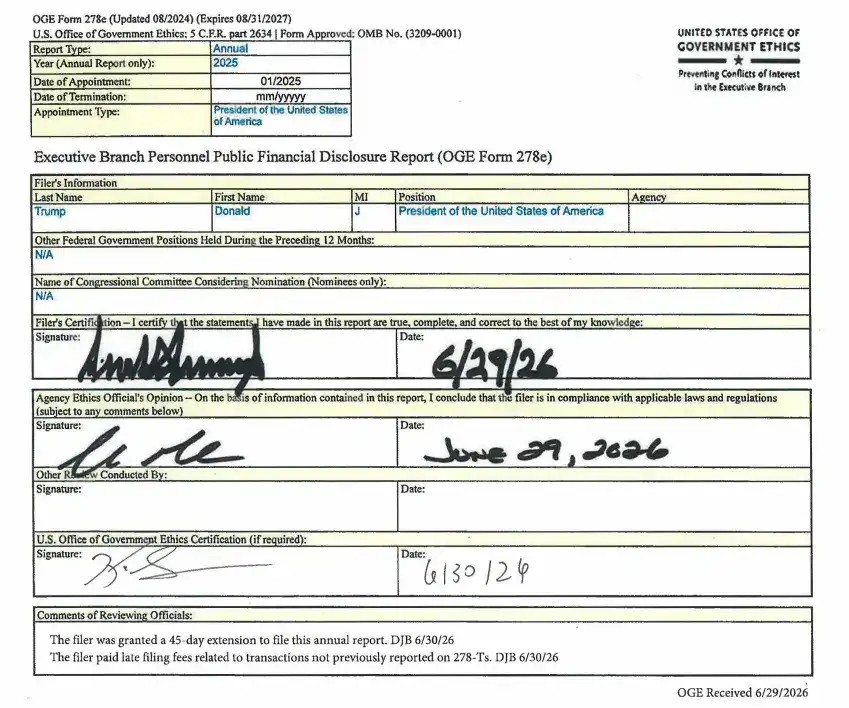
Recently, the U.S. Office of Government Ethics released a 927-page annual financial disclosure report showing Trump's personal income in 2025 exceeded $2.2 billion, setting a record for the highest annual income during a U.S. president's term.
To put this number in perspective: it exceeds McDonald's net profit in last year's fourth quarter. If he accepted the statutory presidential salary of $400,000, Trump would need to work 5,500 years without spending a penny.
In contrast, former President Obama, after leaving office, has been busy writing books, giving global speeches, and taking photos with entrepreneurs, with his net worth nearing $70 million by the end of 2025. Before stepping down, President Biden's net worth was around $10 million—a fraction of Trump's annual income.
But Trump wasn't always this successful. In 2024, Trump's annual income was only over $600 million, and before taking office, he owed New York State nearly $500 million due to a fraud conviction fine, and $88 million to Carroll for sexual assault and defamation charges.
The challenging financial situation was quickly resolved after Trump took office—his annual income increased 3.5-fold, and his personal net worth soared from $2.3 billion in 2024 to $6.5 billion in 2026.
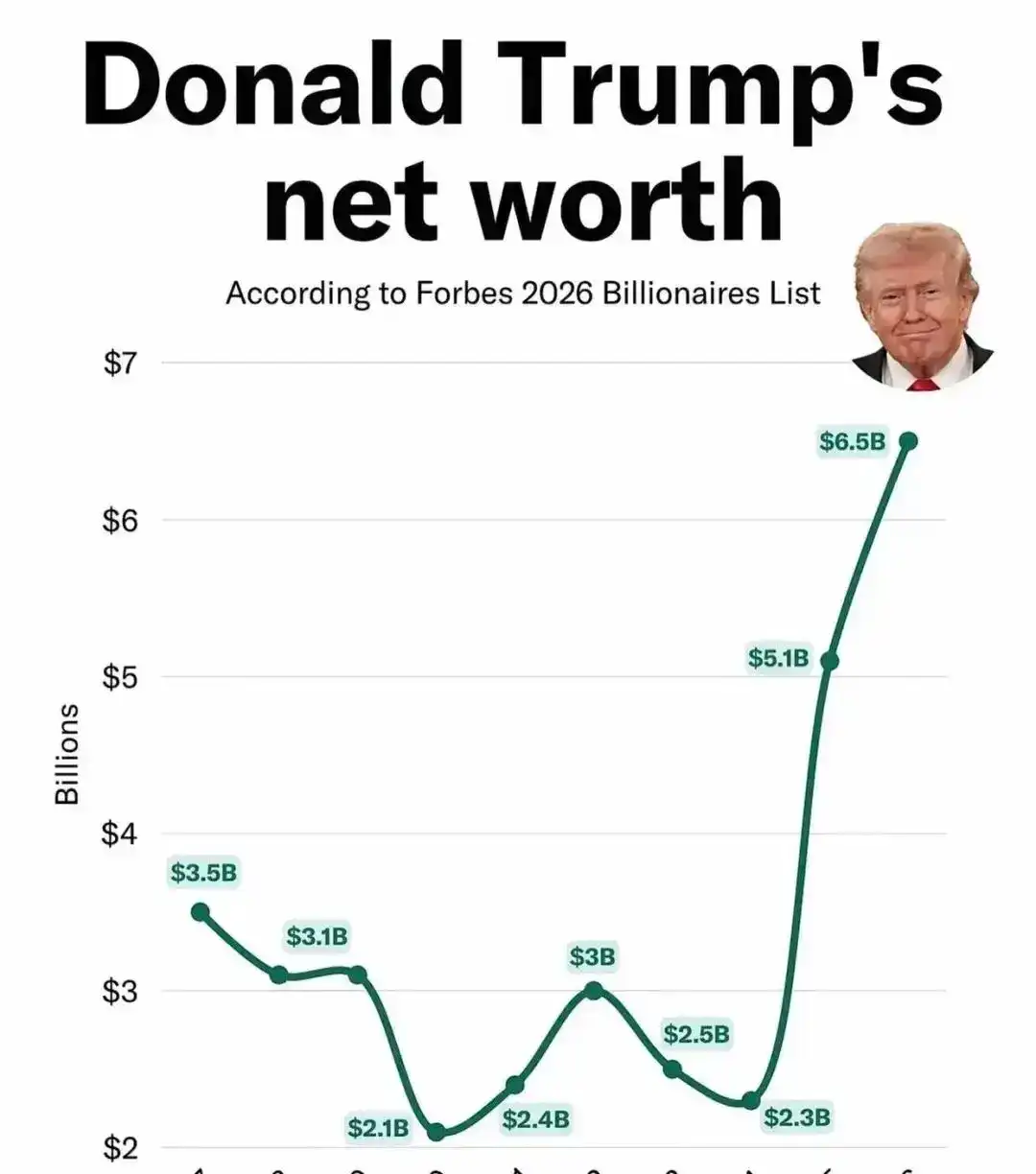
Image Source: Internet
In other words, during this year in the White House, Trump earned an average of $6.02 million per day and $250,000 per hour. This massive income is not simply from real estate rentals. From cryptocurrencies to resorts, brand licensing to stock investments, Trump has almost turned the identity of "President" into a business.
Next, let's break down this "report card" and interpret some of Trump's "investment codes."
1 Where Does the Money Come From?
According to the Wall Street Journal's analysis of the disclosure documents, of the $2.2 billion Trump earned last year, $1.4 billion came from cryptocurrencies, accounting for about 64%, and $575 million came from real estate, accounting for about 26%. Together, they make up nearly 90% of his income.
Additionally, there were $86.5 million from lawsuit settlements, $68.6 million from brand licensing fees, and $79.3 million from stock investments, among other income sources.
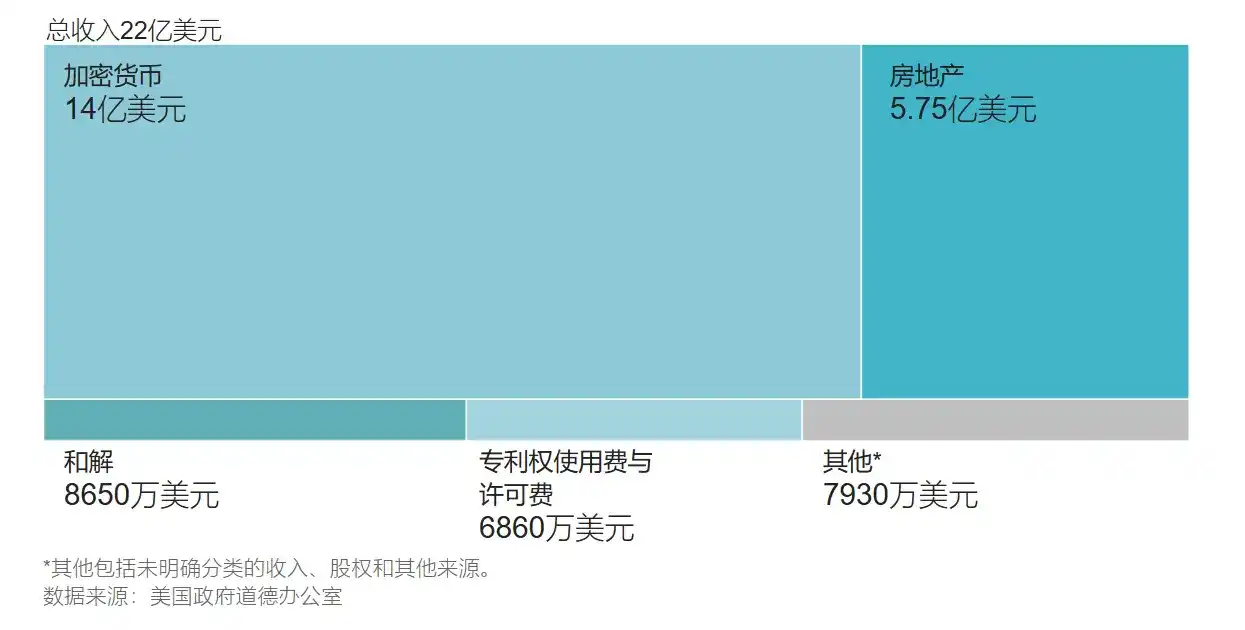
Image Source: Wall Street Journal
Cryptocurrencies are undoubtedly the most dazzling chapter in Trump's "money-making playbook."
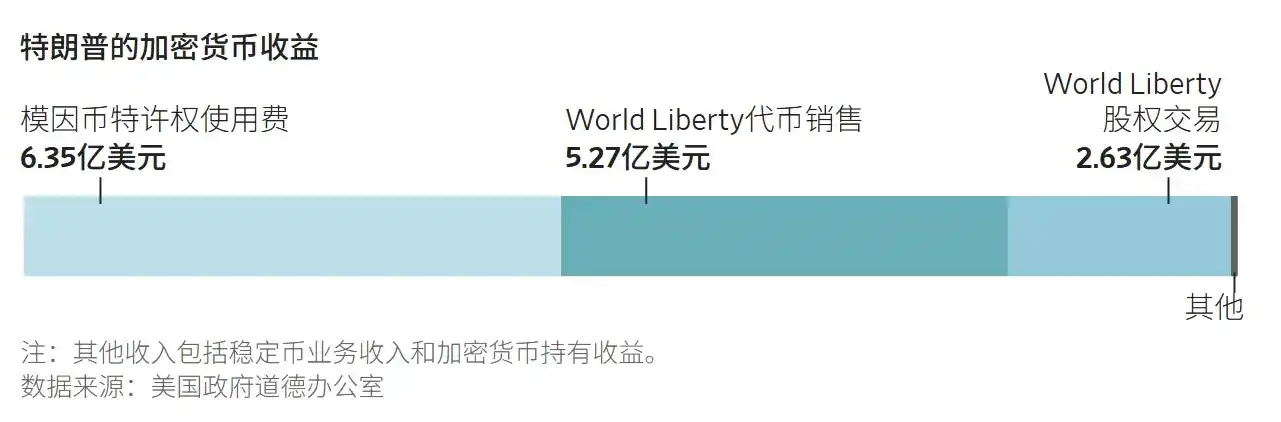
Of this $1.4 billion in cryptocurrency income, $635 million came from Trump's personal meme coin—$TRUMP. Unlike cryptocurrencies like Bitcoin and Ethereum, which have payment or technological functions, most meme coins have little practical use, and their value stems more from celebrity influence, online popularity, and investor speculation.
In January 2025, just two days before Trump's return to the White House and at the peak of his popularity, he signed an IP licensing agreement with an affiliated company to launch the $TRUMP token named after him. The token quickly gained popularity after its launch, and Trump earned over $600 million in licensing fees through this arrangement.
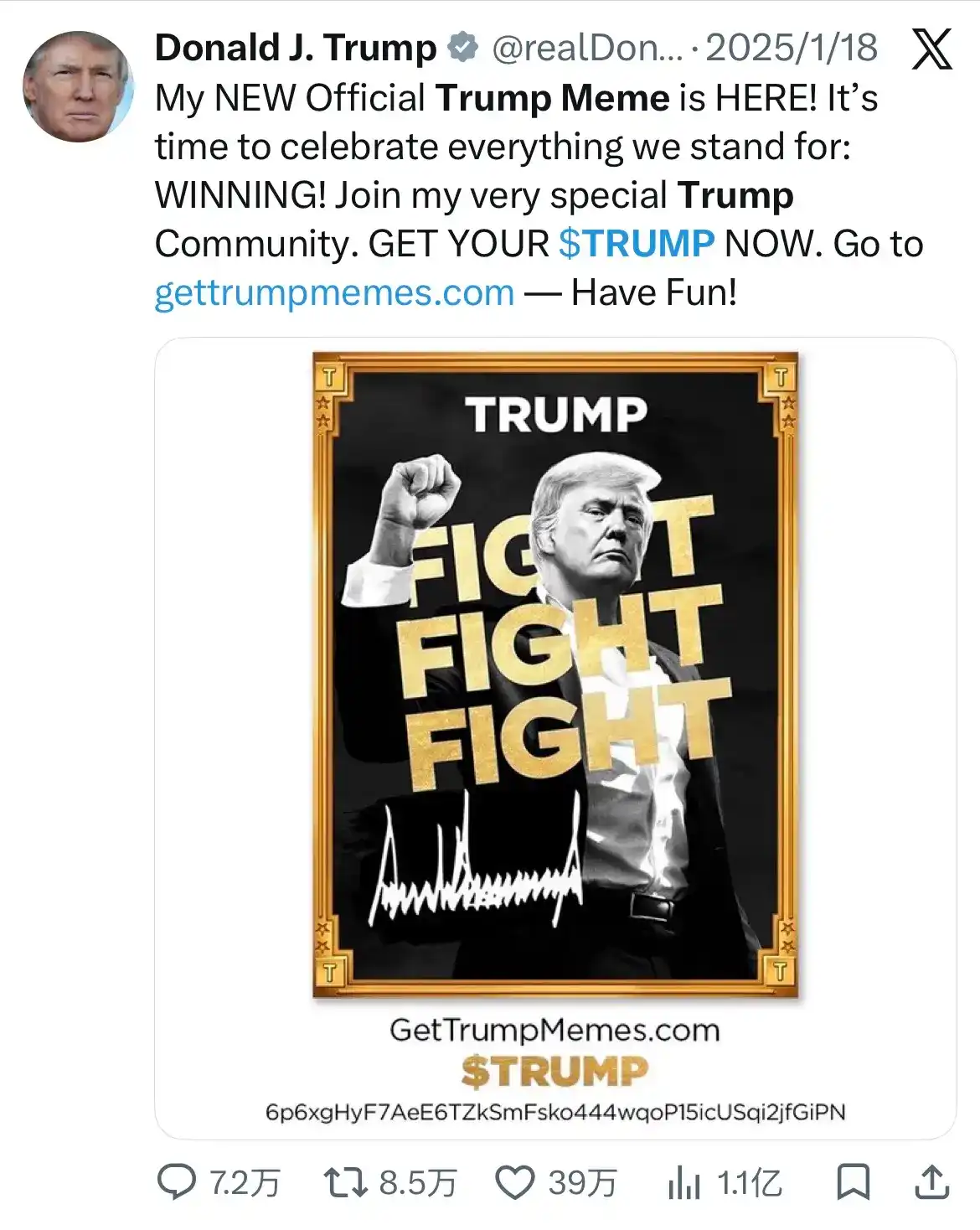
Trump posts to promote $TRUMP
Beyond $TRUMP, another major source of Trump's cryptocurrency income is the WLFI token.
Near the end of the 2024 presidential campaign, the Trump family founded the cryptocurrency company World Liberty Financial (WLFI) and issued the WLFI token. Investors purchasing WLFI tokens can participate in platform governance, enjoy ecosystem benefits, and also buy low and sell high on trading markets to profit from price differences. In 2025, Trump made a whopping $527 million from WLFI token sales, a ninefold increase from 2024.
Finally, Trump also sold a portion of his stake in World Liberty Financial last year, gaining $263 million.
If Trump has turned cryptocurrency into his most profitable new venture, then real estate is his original business and foundation.
In 2025, the U.S. real estate market was sluggish, with home sales hovering near 30-year lows. Amidst the downturn, most of Trump's real estate projects performed averagely, with annual income levels similar to or lower than what he declared a decade ago.
However, among these mediocre real estate projects, two types performed exceptionally well—resorts and golf courses, with annual income growing by 15%.
And the biggest increase naturally came from clubs that Trump frequently visited since taking office.
Mar-a-Lago is Trump's most famous resort, which he calls the "Winter White House," often hosting events there. In 2025, Mar-a-Lago's income exceeded $77 million, surging by 50%, while the nearby golf club also saw a 27% increase in revenue.
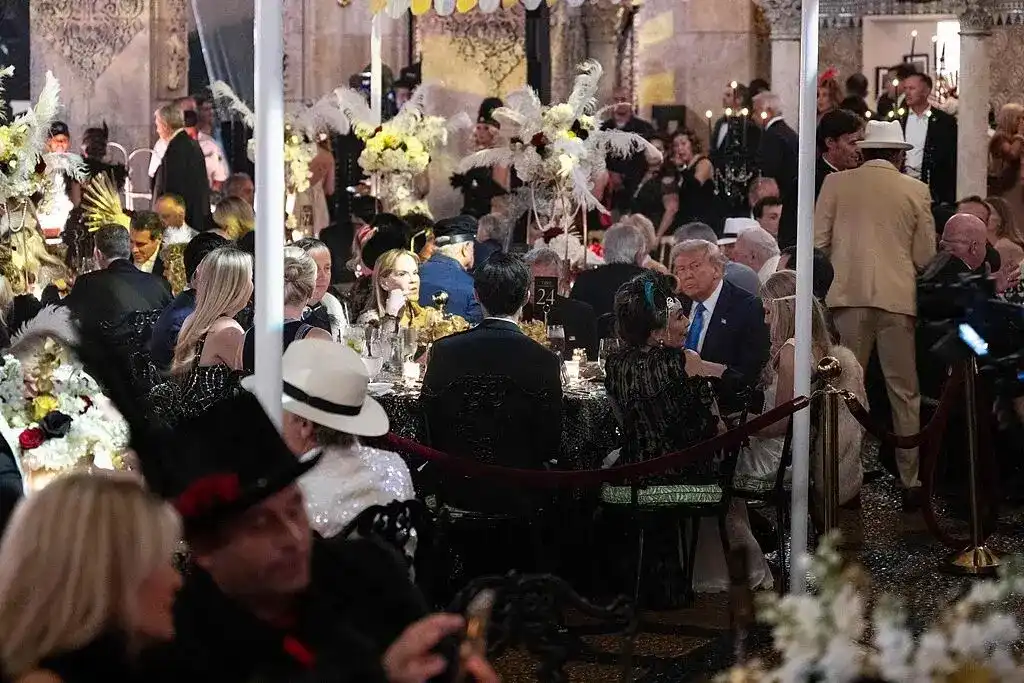
Trump attends a Halloween party at Mar-a-Lago
Ordinary real estate follows market trends up and down, but these resorts and golf courses rise and fall with Trump's schedule.
2 The Eye-Catching Stock Trading
Although cryptocurrencies and real estate made up the vast majority of Trump's income last year, his every move in the stock market has not escaped the scrutiny of the American media.
In 2025, Trump reported over 22,000 stock trades, averaging 87 transactions per trading day.
In comparison, Trump conducted only 517 trades during his entire first term, and Biden made only 13 trades throughout his presidency. Trump's investment account suddenly entered "ultra-high-frequency mode" upon his second entry into the White House.
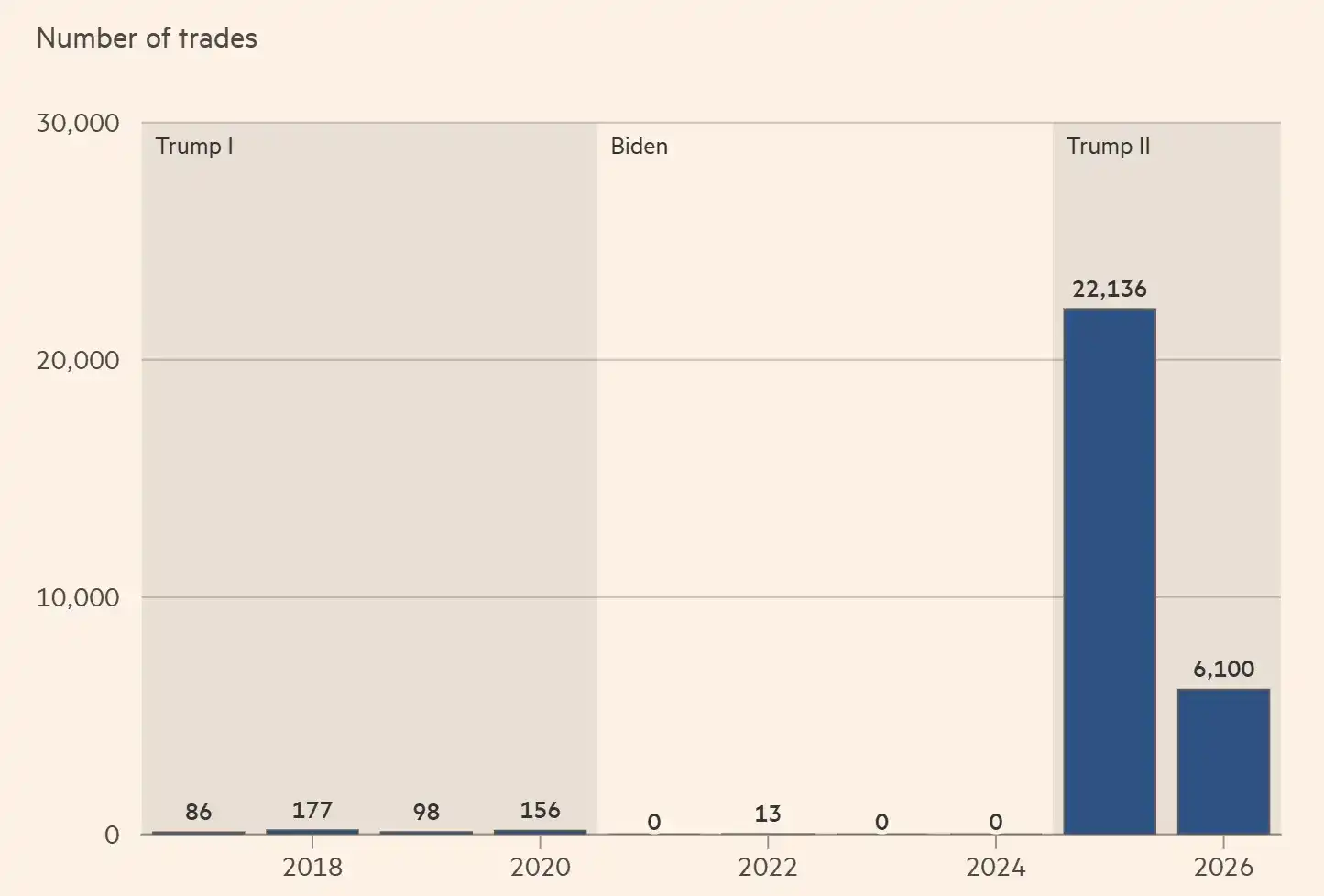
Trump's trading operations skyrocketed during his second term
But more striking than the number of trades is the timing of Trump's transactions. According to the Wall Street Journal's analysis, Trump's account repeatedly conducted intensive trades around the announcement of major policies.
For example, last April, Trump announced the "Liberation Day" tariffs on global trading partners, causing global stock market volatility. Subsequently, his investment account conducted hundreds of stock trades over several days. A few days later, Trump suddenly posted on social media, saying, "It's a good time to buy." Shortly after, he announced a suspension of tariffs on most countries, and the U.S. stock market rebounded sharply.
Another example: Trump's account purchased at least $82 million worth of corporate and municipal bonds from late August to early October last year, spanning multiple industries, many of which clearly benefited from U.S. policy adjustments.
In response to public scrutiny, the White House explained that these trades were executed by a professional investment team managing Trump's trust account and were not directly handled by Trump himself. The other day, Trump also told reporters that he never questions the actions of his money managers and attributed his success to the stock market hitting new highs: "Everyone is making money. I can make money because I have a large capital base and plenty of cash on hand."
But Trump obviously omitted one thing.
After the Watergate scandal, to minimize the connection between public power and personal wealth, successive U.S. presidents typically sold assets that could be affected by policies or placed them in blind trusts managed by independent third parties, where they could neither intervene nor know the specific holdings.
Although Trump also established a trust, it is not managed by an independent third party but by family members, thus always accompanied by controversy over conflicts of interest.
3 The Master of Monetizing "Presidential Influence"
After reviewing the 927-page financial disclosure report, the most discussed topic is not how much money Trump made, but how Trump has almost turned the presidential identity into a business, maximizing the conversion of presidential influence into commercial gains.
Some critics joke that while the White House is an office for other presidents, for Trump, it's a brand management center.
The most typical example is cryptocurrency.
During his first term, Trump criticized cryptocurrencies as "based on thin air" and a scam. However, during his second term, his attitude changed 180 degrees. He not only introduced a series of policies favorable to the crypto industry, publicly stating he wants "to make America the crypto capital," but also hosted at the White House some of the largest holders of $TRUMP tokens.
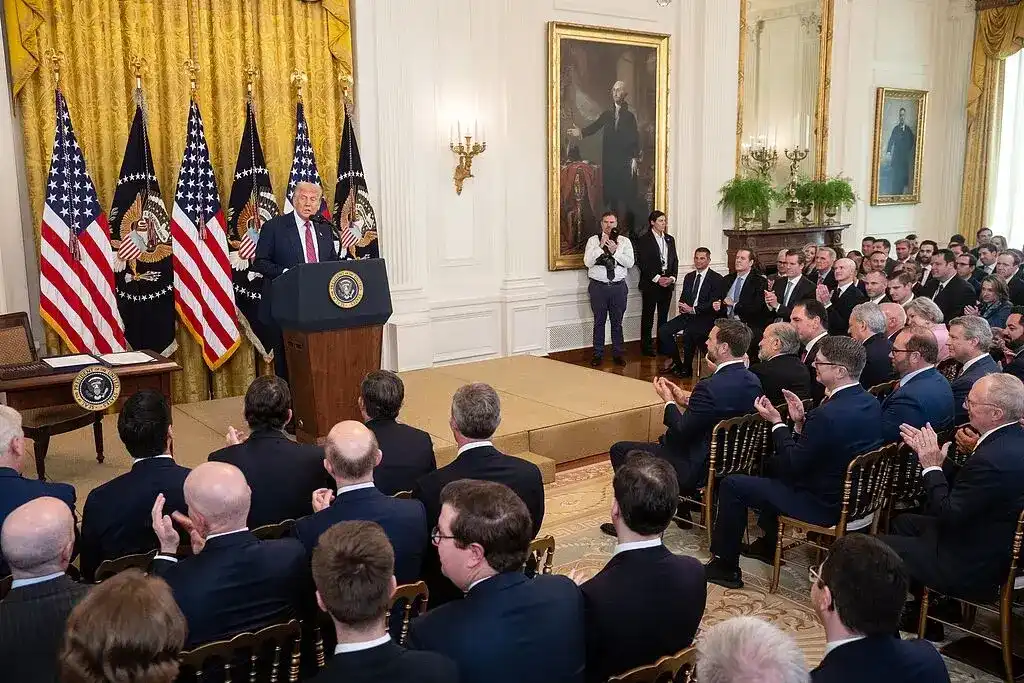
Trump attends a cryptocurrency legislation bill signing ceremony
Moreover, not only is Trump making money, but his entire family is eager to follow suit. After World Liberty Financial was established, Trump served as the "Chief Cryptocurrency Advocate," while his sons Donald Jr. and Eric became "Web3 Ambassadors," and his youngest son Barron was dubbed a "DeFi Visionary." Less than 48 hours after the launch of $TRUMP, First Lady Melania also launched her own meme coin, $MELANIA.
Reuters recently estimated that since Trump returned to the White House in 2025, the Trump family has profited at least $2.3 billion from cryptocurrency-related projects.
Real estate follows a similar logic.
It is reported that the initial membership fee for the Mar-a-Lago Club was around $20,000. However, after the 2016 election, membership fees skyrocketed from $100,000, $200,000 to today's $700,000, $1 million... These exorbitant memberships are widely promoted as offering "face-to-face interaction opportunities with Trump" and widely criticized as a backdoor to selling political connections.
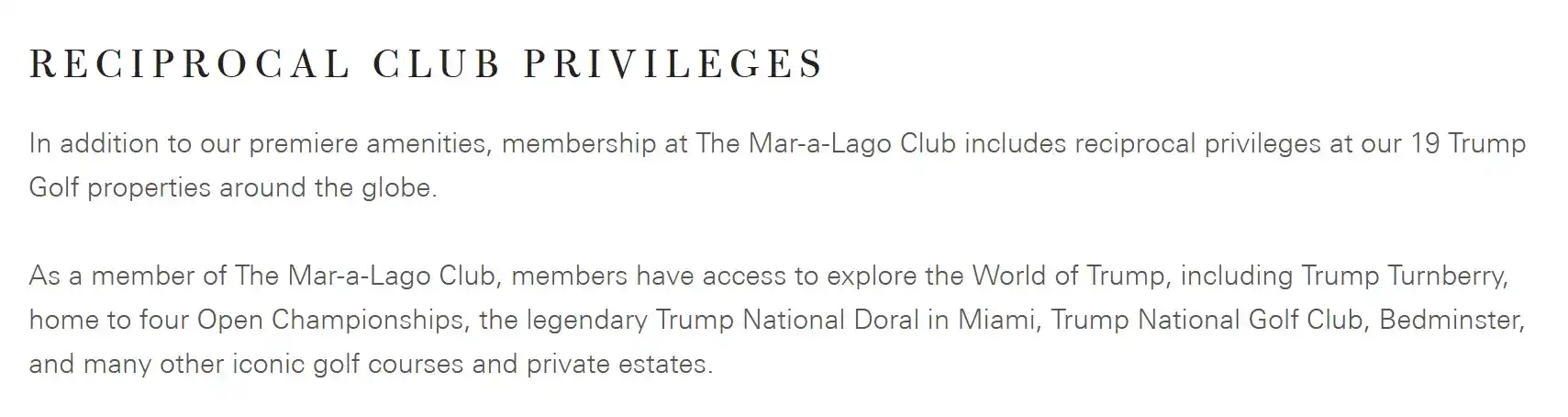
The Mar-a-Lago Club membership page states it offers access to the "Trump World" system
In 2025, during a visit to Scotland, Trump made a special trip to his newly opened golf course for a ribbon-cutting ceremony. Although criticized again for using a presidential trip to promote a private business, Trump likely doesn't care, as this project brought him over $40 million in revenue last year.
In stocks, Trump also spares no effort in endorsing the companies whose stocks he buys.
The Financial Times pointed out that while Trump's purchases may seem mechanically following market indices, he holds significant stakes in companies heavily influenced by public policy.
For example, Trump purchased Nvidia stock worth up to $67 million. Since taking office, Trump has mentioned Nvidia at least 31 times in public and 19 times on social media.
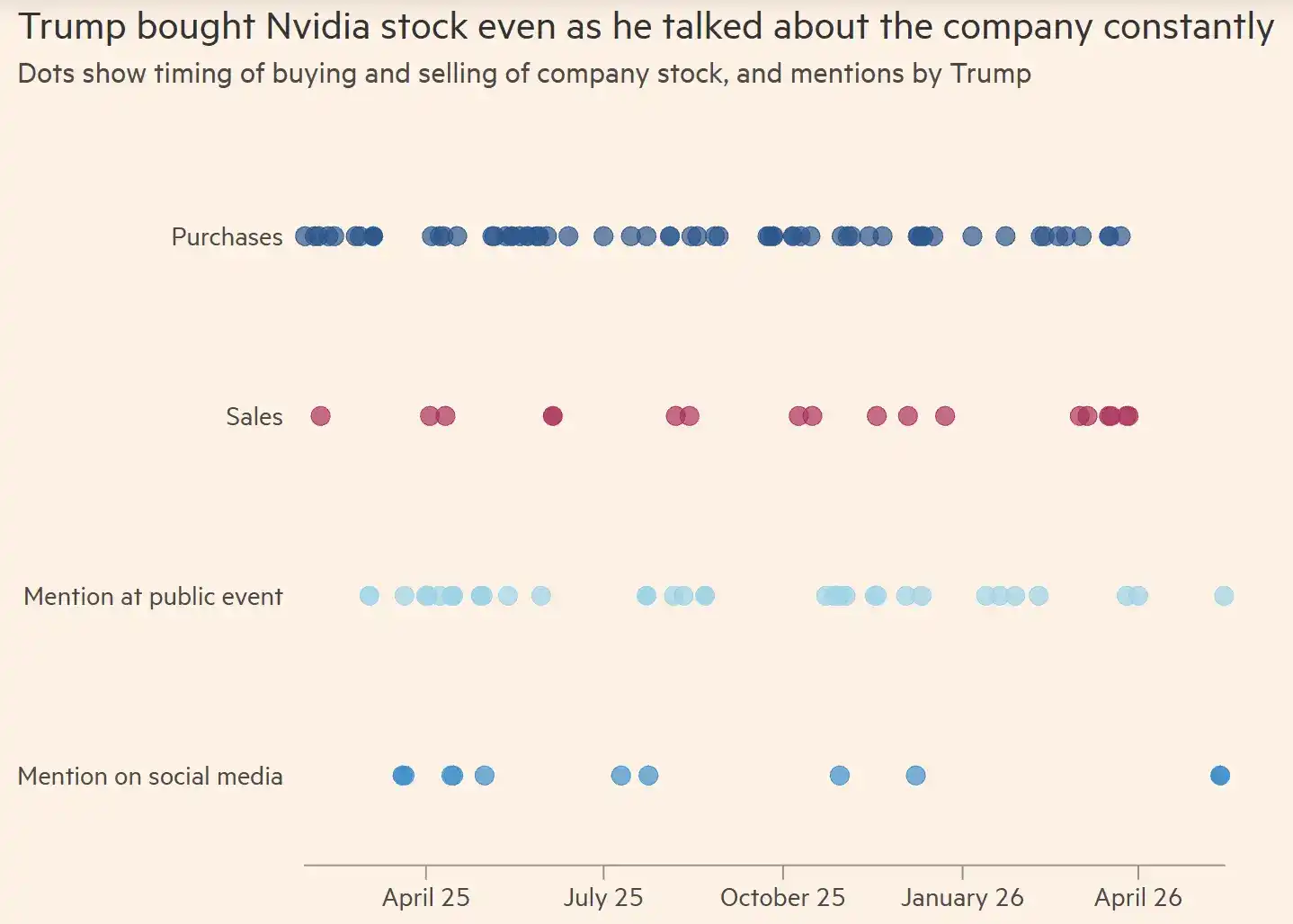
Timing of Trump's buying and selling of Nvidia stock
and the timing of his public and social media mentions of Nvidia
Trump's series of money-making moves seem like a public experiment on the boundaries of modern political commercialization. Whether it's business innovation or a conflict of interest, American public opinion is already fiercely divided.
For supporters, it's a legendary story of a successful businessman. For critics, it means the presidency is becoming a commercial asset that can be continuously monetized.
Fox, former acting director of the Office of Government Ethics, stated that every president since Watergate has managed their finances as if they were conflicts of interest, but Trump has completely ignored these norms. He, more than anyone, demonstrates that it's time for further ethics reforms.
The Trump Organization responded that this nearly thousand-page financial disclosure report precisely proves that the President has conducted the most comprehensive and transparent financial disclosure in history.
Ultimately, whether these $2.2 billion are legally earned may be up to U.S. law to decide. However, the debate sparked by this $2.2 billion—regarding how far public power and private business should be kept apart—is likely entering a new phase.