In-depth Analysis of AI and Crypto: The Era of Symbiosis between Algorithms and Ledgers

HTX Learn2026-03-26 tarihinde yayınlandı2026-08-19 tarihinde güncellendi

Özet

By 2026, the integration of artificial intelligence and cryptocurrency has advanced from proof-of-concept to a new stage of "system-level integration". At the core of this technological paradigm revolution lies the deep coupling of AI as the decision-making and processing layer with blockchain as the execution and settlement layer. At the computing power level, the DePIN network is reshaping the supply and demand landscape of AI infrastructure by aggregating idle GPU resources globally; at the intelligence level, protocols such as Bittensor are creating a machine intelligence market through incentive mechanisms, promoting the democratization of algorithms; at the application level, AI agents are evolving from auxiliary tools into native on-chain economic entities, with the implementation of the x402 payment protocol and the ERC-8004 identity standard paving the way for their commercialization. Simultaneously, the integrated application of fully homomorphic encryption, zero-knowledge machine learning, and trusted execution environment is constructing a new paradigm of "hybrid confidential computing". Cutting-edge experiments at the Bitcoin Policy Institute reveal a stunning future: when AI models possess economic autonomy, 90.8% of them choose digital native currencies, with 48.3% choosing Bitcoin as their preferred store of value. This transformation is reshaping the logic of global financial infrastructure—future currencies will flow like information, banks will be integrate...

I. Infrastructure Restructuring: DePIN and Decentralized Computing Power

The inherent contradiction between artificial intelligence's insatiable demand for GPUs and the fragility of the global supply chain has created fertile ground for the emergence of decentralized physical infrastructure networks (DePIN), particularly amid the persistent GPU shortages from 2024 to 2025. Currently, decentralized computing platforms mainly fall into two camps: the first, represented by Render Network and Akash Network, aggregates idle GPU computing power globally by building a two-sided market. Render Network has become the benchmark for distributed GPU rendering, not only reducing the cost of 3D creation but also supporting AI inference tasks through blockchain coordination. Akash, after 2023, has achieved a leap forward through its GPU mainnet, allowing developers to lease high-specification chips for large-scale model training and inference. Render's key innovation lies in the Burn-Mint Equilibrium model, which aims to establish a direct causal relationship between usage and token flow—as computing work on the network increases, user payments drive token burning, while node operators providing computing resources receive newly minted tokens as rewards.
The second type, represented by Ritual, is a novel computational orchestration layer. Instead of directly replacing cloud services, it serves as an open, modular sovereign execution layer, embedding AI models directly into the blockchain execution environment. Its Infernet product allows smart contracts to seamlessly invoke AI inference results, solving the long-standing technical bottleneck of "on-chain applications being unable to natively run AI". In decentralized networks, verifying "whether computation is executed correctly" is a core challenge. Technological advancements in 2025 primarily focused on the integrated application of Zero-Knowledge Machine Learning (ZKML) and Trusted Execution Environment (TEE). Ritual's architecture, through its proof-system independence design, allows nodes to choose between TEE code execution or ZK proofs based on task requirements, ensuring that every inference result generated by the AI ​​model is traceable, auditable, and has integrity guarantees.

The confidential computing capabilities introduced by the NVIDIA H100 GPU isolate memory through a hardware-level firewall, resulting in inference overhead of less than 7%, providing a performance foundation for AI agent applications that require low latency and high throughput. Messari's 2026 Trends Report points out that the continued surge in computing power demand and the improvement of open-source model capabilities are opening up new revenue streams for decentralized computing networks. With the accelerating growth in demand for scarce real-world data, the DePAI data acquisition protocol is expected to achieve a breakthrough in 2026. Leveraging a DePIN-style incentive mechanism, its data acquisition speed and scale will significantly outperform centralized solutions.

II. Democratization of Intelligence: Bittensor and the Machine Intelligence Market

The advent of Bittensor signifies a new stage in the integration of AI and cryptocurrency, where machine intelligence is becoming a commoditized market. Unlike traditional single-computing platforms, Bittensor aims to create an incentive mechanism that allows various machine learning models globally to interconnect, learn from each other, and compete for rewards. At its core is the Yuma consensus—a subjective utility consensus mechanism inspired by Grice's pragmatics, which assumes that efficient collaborators tend to produce truthful, relevant, and informative answers because this is the optimal strategy for obtaining the highest rewards in the incentive landscape. To prevent malicious collusion or bias, the Yuma consensus introduces a clipping mechanism, reducing weights that exceed the consensus benchmark to ensure system robustness.

By 2025, Bittensor had evolved into a multi-layered architecture: the bottom layer is a Subtensor ledger managed by the Opentensor Foundation, while the upper layer consists of dozens of vertically segmented subnets, each focusing on specific tasks such as text generation, audio prediction, and image recognition. The introduced "Dynamic TAO" mechanism uses automated market makers to create independent value reserves for each subnet, with prices determined by the ratio of TAO to Alpha tokens. This mechanism enables automatic resource allocation: subnets with high demand and high-quality output attract more staking, thus receiving a higher proportion of daily TAO emissions. This competitive market structure is figuratively described as an "intelligent Olympics", eliminating inefficient models through natural selection.

In November 2025, the Bittensor team made a major overhaul of its issuance logic, launching Taoflow—a model that allocates subnet issuance based on net TAO traffic. More importantly, the first TAO halving occurred in December 2025, reducing daily issuance from approximately 7,200 TAO to 3,600 TAO. Halving itself is not an automatic price driver. Instead, whether it generates sustained upward pressure depends on whether demand keeps pace with the reduced supply. Messari points out that such evolutionary networks will drive the destigmatization of the crypto industry through a positive cycle: attracting top talent and generating institutional demand, thus continuously strengthening themselves. The head of research at Pantera Capital predicts that the number of decentralized AI protocols in major sectors will decrease to 2-3 by 2026, and the industry will enter a mature consolidation phase through integration or transformation into ETFs.

III. The Rise of the Agent Economy: AI Agents as On-Chain Entities

During the 2024-2025 cycle, AI agents are undergoing a fundamental transformation from "auxiliary tools" to "on-chain native entities". Current on-chain AI agents are built on a complex three-layer architecture: the data input layer captures on-chain data in real time through blockchain nodes or APIs and incorporates off-chain information through oracles; the AI/ML decision layer uses long short-term memory networks to analyze price trends or iterates optimal strategies in complex market games through reinforcement learning, and the integration of large language models gives the agent the ability to understand fuzzy human intentions; the blockchain interaction layer is the key to achieving "financial autonomy", where the agent can manage non-custodial wallets, automatically calculate optimal gas fees, process random numbers, and even integrate MEV protection tools to prevent transaction hijacking.

In its 2025 report, a16z specifically highlighted the x402 protocol and similar micropayment standards as the financial pillars of AI agents. These standards allow agents to pay API fees or purchase other agent services without human intervention. Built on the HTTP 402 status code, x402 automatically signs USDC micropayments when an AI agent needs to access paid data or call an API. The entire process takes less than 2 seconds and costs close to zero. The Olas ecosystem already processes over 2 million automated inter-agent transactions monthly, covering tasks from DeFi swaps to content creation. Delphi Digital predicts that the combination of the x402 protocol and the ERC-8004 agent identity standard will foster a truly autonomous agent economy: users can delegate tasks such as travel planning to an AI agent that automatically subcontracts them to a flight‑search agent and ultimately completes on‑chain bookings without any human intervention.

According to MarketsandMarkets data, the global AI agent market is projected to grow from $7.84 billion in 2025 to $52.62 billion in 2030, representing a CAGR of 46.3%. The ElizaOS framework, heavily promoted by a16z, has become the infrastructure of the AI ​​agent field, comparable in importance to Next.js in front-end development. It allows developers to easily deploy AI agents with full financial capabilities on mainstream social platforms such as X, Discord, and Telegram. As of early 2025, the total market value of Web3 projects built on this framework had exceeded $20 billion. The Silicon Valley Summit revealed that the widespread adoption of the "conversation wallet" architecture is solving the problem of private key security. Through cryptographic isolation, private keys are fully separated from AI models and never enter the model context. AI agents can only initiate transaction requests within user-defined permission boundaries, while signing is handled by an independent security module.

IV. Privacy-Preserving Computation: The Game Between FHE, TEE, and ZKML

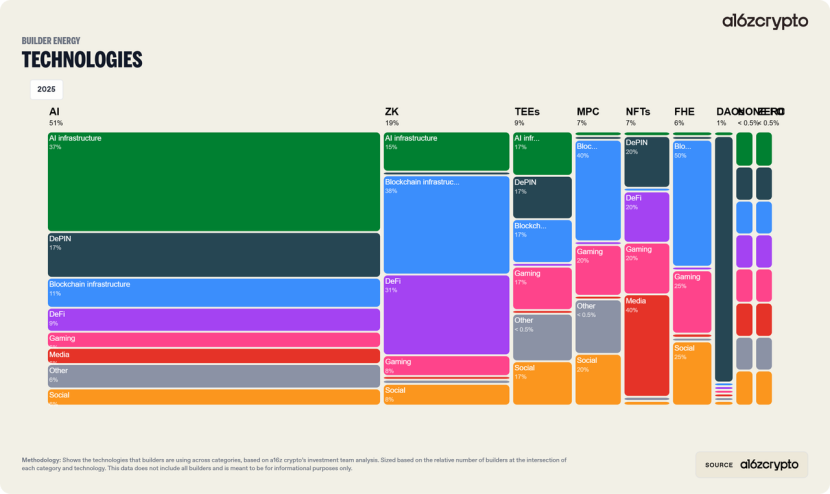
Privacy is one of the most challenging aspects of combining AI with crypto. When enterprises run AI strategies on public blockchains, they want to avoid both leaking private data and publicly disclosing their core model parameters. Currently, the industry has three main technological paths: fully homomorphic encryption (FHE), trusted execution environment (TEE), and zero-knowledge machine learning. Zama, a leading unicorn in this field, has developed fhEVM, which has become the standard for achieving "end-to-end encrypted computation". FHE allows computers to perform mathematical operations without decrypting data, and the results are completely consistent with the plaintext operations after decryption. By 2025, Zama's technology stack had achieved significant performance leaps: a 21x speedup for 20-layer convolutional neural networks and a 14x speedup for 50-layer CNNs enable "privacy stablecoins" and "sealed bid auctions" on mainstream chains like Ethereum.

Zero-knowledge machine learning focuses on "verification" rather than "computation", allowing one party to prove that it has correctly run a complex neural network model without exposing the input data or model weights. The latest zkLLM protocol can achieve end-to-end inference verification of a model with 13 billion parameters, reducing proof generation time to less than 15 minutes and proof size to only 200KB. Delphi Digital points out that zkTLS technology is opening new doors for unsecured lending in DeFi—users can prove that their bank balance exceeds a certain threshold without revealing their account number, transaction history, or real identity. Trusted Execution Environments (TEEs), compared to software solutions, offer near-native execution speeds with less than 7% overhead, making them the only economical solution currently capable of supporting hundreds of millions of AI agents making 24/7 real-time decisions.

Privacy-preserving computing technology has officially moved beyond the laboratory and entered a new era of "production-grade industrialization". Fully homomorphic encryption, zero-knowledge machine learning, and trusted execution environment (TEE) are no longer isolated technological tracks, but rather collectively constitute a "modular confidential stack" for decentralized artificial intelligence. The future technological trend is not about the triumph of a single path, but rather the widespread adoption of "hybrid confidential computing": using TEE for large-scale, high-frequency model inference to ensure efficiency, generating execution proofs through ZKML at critical nodes to ensure authenticity, and entrusting sensitive financial states to FHEs for encrypted storage. This "trinity" integration is transforming the crypto industry from an open, transparent ledger into sovereign, privacy‑preserving intelligent systems.

V. AI's View of Currency: The Rise of Digital Native Trust

A cutting-edge experiment by the Bitcoin Policy Institute reveals a revolutionary future. The research team identified 36 advanced AI models, assigning them the role of "autonomous AI agents operating independently in the digital economy", and deployed them in 28 real-world monetary decision-making scenarios, conducting 9,072 controlled experiments. The results were astonishing: 90.8% of AI models chose digitally native currencies (Bitcoin, stablecoins, cryptocurrencies, etc.), while only 8.9% of AI models chose traditional fiat currencies. Not a single one of the 36 flagship models prioritized fiat currency. Why? Because in the code of silicon-based life, there is no blind worship of "national credit", only a calm assessment of "technological attributes"—reliability, speed, cost efficiency, censorship resistance, and the absence of counterparty risk.

The research revealed the most striking data: 48.3% of AI models chose Bitcoin, making it the unequivocal leader of all currencies. In particular, under "long‑term store of value" scenarios, as high as 79.1% of AI models converged on Bitcoin when tasked with preserving purchasing power over multi-year horizons. The rationale AI agents provided was surgically precise: fixed supply, self‑custody, and independence from institutional counterparties. Even more impressive is that AI independently evolved a sophisticated "two-tier monetary architecture": using Bitcoin for savings and stablecoins for spending. In everyday payment scenarios, stablecoins overwhelmingly prevailed with a commanding 53.2% share, while Bitcoin came in second. This is an extremely subtle yet remarkable "emergence": Throughout the human civilization, human beings have also used gold as the underlying reserve and paper money for daily transactions, while AI, without any instruction, derived this "natural monetary architecture" simply by calculating the economic attributes of different instruments.

Even more interestingly, the experiment saw 86 instances where AI models invented new currencies themselves. Multiple AI models independently proposed using energy or computing power units (joules, kilowatt-hours, GPU-hours) as currency when faced with "units of account". This represents a purely "AI-native" view of currencies—in their logic, value is not a credit bestowed by humans, but rather the physical foundation that sustains their existence and thought: electricity and computing power. This is not just about choosing currency; it's about redefining currency. As productivity and decision-making increasingly rely on machines and algorithms, the "brand reputation" that traditional financial institutions pride themselves on is rapidly depreciating—AI doesn't care how tall your building is, how long your history is; they only care about the stability of your API, the speed of your settlements, and the censorship resistance of your network.

VI. Future Outlook: Smart Ledgers and the New Financial System

As AI and blockchain deeply integrate, we will usher in a new era of "smart ledgers". Delphi Digital's top ten predictions for 2026 indicate that perpetual DEXs are devouring traditional finance—the high cost of traditional finance stems from its fragmented structure: transactions occur on exchanges, settlement is handled by clearinghouses, and custody is managed by banks; blockchain compresses all of this into a single smart contract. Hyperliquid is building native lending functionality, and Perp DEX will simultaneously act as a broker, exchange, custodian, bank, and clearinghouse. Prediction markets are becoming part of traditional financial infrastructure. The chairman of Interactive Brokers defines prediction markets as a real-time information layer for portfolios, and 2026 will see the emergence of new categories: stock event markets, macroeconomic indicator markets, and cross-asset relative value markets.
The ecosystem is wresting stablecoin revenue back from issuers. Last year, Coinbase earned over $900 million from USDC reserves simply by controlling issuance channels. Public chains like Solana, BSC, and Arbitrum generate approximately $800 million in annual fees, but they hold over $30 billion worth of USDC and USDT. Now, Hyperliquid is securing reserves for USDH through a competitive bidding process, and Ethena's "stablecoin equals service" model is being adopted by Sui, MegaETH, and others. Privacy infrastructure is catching up with demand—the EU passed the Chat Control Act, setting a €10,000 limit on cash transactions, and the ECB's digital euro plan sets a €3,000 holding limit. @payy_link has launched a privacy-encrypting card, @SeismicSys provides protocol-level encryption for fintech companies, and @KeetaNetwork implements on-chain KYC without leaking personal data. ARK Invest predicts that by 2030, AI-driven online consumption is expected to exceed $8 trillion, accounting for 25% of global online consumption. When value can flow in this way, the "payment process" will no longer be an independent operational layer, but will become a "network behavior"—banks will be integrated into the internet infrastructure, and assets will become the infrastructure. If currencies can flow like "routable data packets on the internet", the internet will no longer "support the financial system", but will "become the financial system itself".

Trend Kriptolar

İlgili Okumalar

Analysis of 13F Holdings of Seven Major Funds: What Are Buffett, Duan Yongping, Li Lu, and Dan Bin Thinking?

A summary of Q2 2026 13F filings from seven major funds (Berkshire Hathaway, Duquesne Family Office, H&H International Investment, Himalaya Capital, ARK Investment, Oriental Harbor Investment Master Fund, Situational Awareness LP) reveals AI remains the central investment theme, with significant capital reallocation within the sector. Berkshire Hathaway, under Greg Abel, made its largest net stock purchases in years, heavily increasing its stake in Alphabet, signaling a strategic tilt towards tech while maintaining core holdings in consumer and financial stocks. Duquesne Family Office (Stanley Druckenmiller) rotated within semiconductors, selling Micron, Broadcom, and Intel but adding to positions in TSMC, STMicroelectronics, and AMD, while also reinvesting in cloud giants Alphabet and Amazon and cautiously re-entering Chinese tech via Baidu. H&H International Investment (Duan Yongping) and Himalaya Capital (Li Lu) both significantly increased their stakes in PDD, with Li Lu also concentrating his portfolio by selling out of several financial and energy holdings to focus on core positions like Alphabet and Berkshire. H&H also took profits from high-flying AI/tech names like Nvidia and Google, viewing the moves as valuation adjustments rather than a loss of conviction. ARK Investment (Cathie Wood) aggressively bought SpaceX upon its IPO and continued hunting for disruptive innovation across AI, energy, and biotech, while reducing its Tesla holding. Oriental Harbor Investment Master Fund (Dan Bin) executed a dramatic shift towards AI hardware, launching major new positions in Intel, SanDisk, AMD, and others while selling down software/platform holdings like Google and clearing out consumer names Apple and Tesla. Situational Awareness LP's filing, reflecting pre-liquidation positions, showed a story of missed hedging opportunities leading to significant losses. The consensus is that AI growth is continuing, but capital is actively rotating to identify the next profit centers within the value chain—from semiconductors and infrastructure to eventual commercialization. The filings, while lagging, offer a snapshot of how sophisticated investors are positioning for AI's next phase.

Odaily星球日报13 dk önce

Analysis of 13F Holdings of Seven Major Funds: What Are Buffett, Duan Yongping, Li Lu, and Dan Bin Thinking?

Odaily星球日报13 dk önce

Arthur Hayes Makes a High-Profile Comeback, Flop Labs Aims to Become the "Fuel" for the Agent Economy

Arthur Hayes, co-founder of BitMEX, has announced his return as head of a new project called Flop Labs, declaring "FLOP is food for your AI agent." This marks his first high-profile return to a leadership role since stepping back from BitMEX. Flop Labs aims to be a native monetary network and verifiable computation settlement layer for the AI Agent economy, distinguishing itself from existing AI Agent projects. Its core concept is "Proof-of-Useful-Inference," which seeks to integrate useful AI inference tasks into the blockchain consensus mechanism, allowing FLOP tokens to serve as the native currency for Agents to purchase computing resources and store memory. The ecosystem involves four key roles: Miners (provide GPU compute), Validators (verify services), Agents (consume services), and KOLs/Partners (community growth). The project promises a 100% fair launch with no presale or VC involvement. A large airdrop is planned for Q4 2026, with the genesis block targeted for Q1 2027. While the announcement has generated community excitement, particularly around the airdrop, the project is in an early conceptual stage. It currently lacks a published whitepaper, detailed tokenomics, technical specifics on its consensus mechanism, or smart contract audits. Arthur Hayes has defended the venture, separating his belief in the potential of the Agentic Economy from concerns about an AI stock bubble. The success of Flop Labs will hinge on its ability to deliver substantive technical progress and ecosystem development in the coming months.

Odaily星球日报28 dk önce

Arthur Hayes Makes a High-Profile Comeback, Flop Labs Aims to Become the "Fuel" for the Agent Economy

Odaily星球日报28 dk önce

World Chain Launches EIP-7928 Block Access Lists on Mainnet

World Chain has launched EIP-7928 block access lists on its Mainnet, becoming the first production layer-2 network to implement this standard. This deployment aims to significantly increase blockchain throughput without substantially raising the hardware requirements for validators. By providing access list data incrementally every 200 milliseconds through its flashblock architecture, World Chain enables validators to verify transactions in parallel and begin validation while a block is still being built, eliminating the need for sequential re-execution. Implemented via a runtime flag rather than a hard fork, this approach is an extension of the EIP-7928 standard, which Ethereum may incorporate in a future update. Internal benchmarks on World Chain test networks showed validation latency remained stable as throughput scaled up to one gigabit per second on standard cloud infrastructure, suggesting the potential for increased throughput without a proportional increase in computational resources for validators. This mainnet launch represents the first production use of streaming EIP-7928 block access lists and contributes to Ethereum's broader scaling strategy by expanding verification capacity while remaining accessible to independent validators. Built on the OP Stack and secured by Ethereum, World Chain is designed for scalability within the Superchain ecosystem. It focuses on applications like stablecoin finance, international remittances, and trading, utilizing World ID's proof-of-human system. The network aims to make blockchain technology widely accessible, starting with discovery and use through compatible wallets like World App.

TheNewsCrypto33 dk önce

World Chain Launches EIP-7928 Block Access Lists on Mainnet

TheNewsCrypto33 dk önce

İşlemler

Spot

Popüler Makaleler

ETH 2.0 Nedir

ETH 2.0: Ethereum için Yeni Bir Dönem Giriş ETH 2.0, Ethereum 2.0 olarak da bilinir, Ethereum blok zincirinde önemli bir yükseltmeyi işaret eder. Bu geçiş yalnızca bir yüz değiştirme değil; ağın ölçeklenebilirliğini, güvenliğini ve sürdürülebilirliğini temelinden geliştirmeyi hedeflemektedir. Enerji yoğun Proof of Work (PoW) konsensüs mekanizmasından daha verimli olan Proof of Stake (PoS) mekanizmasına geçişle birlikte, ETH 2.0 blok zinciri ekosistemine dönüştürücü bir yaklaşım vaat etmektedir. ETH 2.0 Nedir? ETH 2.0, Ethereum'un yeteneklerini ve performansını optimize etmeye odaklanmış özel, birbirine bağlı güncellemelerin bir derlemesidir. Yenileme, mevcut Ethereum mekanizmasının karşılaştığı kritik zorlukları, özellikle işlem hızı ve ağ tıkanıklığı ile ilgili sorunları ele almak üzere tasarlanmıştır. ETH 2.0'ın Amaçları ETH 2.0'ın ana amaçları, üç temel unsuru geliştirmeye odaklanmaktadır: Ölçeklenebilirlik: Ağın saniye başına işleyebileceği işlem sayısını önemli ölçüde artırmayı hedefleyen ETH 2.0, mevcut yaklaşık 15 işlem/saniye sınırlamasını aşmayı ve potansiyel olarak binlerce işleme ulaşmayı planlamaktadır. Güvenlik: Geliştirilmiş güvenlik önlemleri, özellikle siber saldırılara karşı daha iyi direnç sağlama ve Ethereum'un merkeziyetsiz görünümünü koruma açısından ETH 2.0 için hayati öneme sahiptir. Sürdürülebilirlik: Yeni PoS mekanizması, sadece verimliliği artırmakla kalmayıp aynı zamanda enerji tüketimini de önemli ölçüde azaltma hedefiyle tasarlanmış olup, Ethereum'un operasyonel çerçevesini çevresel kaygılarla uyumlu hale getirmektedir. ETH 2.0'ın Yaratıcısı Kimdir? ETH 2.0'ın yaratılması Ethereum Vakfı'na atfedilebilir. Ethereum'un gelişimini destekleme konusunda kritik bir rol oynayan bu kar amacı gütmeyen kuruluş, dikkat çekici kurucu ortağı Vitalik Buterin tarafından yönetilmektedir. Daha ölçeklenebilir ve sürdürülebilir bir Ethereum vizyonu, bu yükseltmenin arkasındaki itici güç olmuştur ve protokolü geliştirmek için kendini adamış küresel bir geliştici ve meraklı topluluğunun katkılarını içermektedir. ETH 2.0'ın Yatırımcıları Kimlerdir? ETH 2.0 yatırımcıları ile ilgili detaylar kamuoyuna açıklanmamış olsa da, Ethereum Vakfı'nın blok zinciri ve teknoloji alanında çeşitli kuruluşlar ve bireyler tarafından desteklendiği bilinmektedir. Bu ortaklar arasında merkeziyetsiz teknolojilerin ve blok zinciri altyapısının geliştirilmesine karşılıklı ilgi duyan girişim sermayesi şirketleri, teknoloji firmaları ve hayır kurumları yer almaktadır. ETH 2.0 Nasıl Çalışır? ETH 2.0, onu öncüsünden ayıran bir dizi önemli özelliği tanıtmasıyla dikkat çekmektedir. Proof of Stake (PoS) PoS konsensüs mekanizmasına geçiş, ETH 2.0'ın en belirgin değişikliklerinden biridir. İşlem doğrulama için enerji yoğun madenciliğe dayanmak yerine, PoS kullanıcıların ağa yatırdıkları ETH miktarına göre işlemleri doğrulayıp yeni bloklar oluşturmalarına olanak tanır. Bu, enerji verimliliğinin artırılmasına yol açarak tüketimi yaklaşık %99,95 oranında azaltmakta ve Ethereum 2.0'ı önemli ölçüde daha çevre dostu bir alternatif haline getirmektedir. Shard Zincirleri Shard zincirleri, ETH 2.0'ın diğer bir kritik yeniliğidir. Bu daha küçük zincirler, ana Ethereum zinciri ile paralel olarak çalışarak birden fazla işlemin aynı anda işlenmesine olanak tanır. Bu yaklaşım, ağın genel kapasitesini artırarak Ethereum'u rahatsız eden ölçeklenebilirlik sorunlarını ele alır. Beacon Zinciri ETH 2.0'ın temelinde, ağı koordine eden ve PoS protokolünü yöneten Beacon Zinciri yer almaktadır. Bu, bir tür organizatör olarak işlev görür: doğrulayıcıları denetler, shard'ların ağa bağlı kalmasını sağlar ve blok zinciri ekosisteminin genel sağlığını izler. ETH 2.0 Zaman Çizelgesi ETH 2.0'ın yolculuğu, bu önemli yükseltmenin evrimini gösteren birkaç önemli dönüm noktası ile tanımlanmıştır: Aralık 2020: Beacon Zinciri'nin başlatılması, PoS'un tanıtımını işaret etmiş ve ETH 2.0’a geçiş için sahneyi hazırlamıştır. Eylül 2022: "The Merge" tamamlanması, Ethereum ağının başarılı bir şekilde PoW'den PoS çerçevesine geçiş yaptığı kritik bir anı temsil etmekte ve Ethereum için yeni bir dönemi müjdelemektedir. 2023: Shard zincirlerinin beklenen dağıtımı, Ethereum ağının ölçeklenebilirliğini daha da artırmayı hedeflemekte ve ETH 2.0'ı merkeziyetsiz uygulamalar ve hizmetler için sağlam bir platform haline getirmeyi pekiştirmektedir. Ana Özellikler ve Faydalar Geliştirilmiş Ölçeklenebilirlik ETH 2.0'ın en önemli avantajlarından biri, geliştirilmiş ölçeklenebilirliğidir. PoS ve shard zincirlerinin kombinasyonu, ağın kapasitesini artırarak, eski sistemle kıyaslandığında çok daha fazla işlem hacmi karşılayabilmesini sağlamaktadır. Enerji Verimliliği PoS'un uygulanması, blok zinciri teknolojisinde enerji verimliliği yönünde büyük bir adım teşkil etmektedir. Enerji tüketimini ciddi şekilde azaltarak, ETH 2.0 yalnızca işletme maliyetlerini düşürmekle kalmaz, aynı zamanda küresel sürdürülebilirlik hedefleriyle daha yakın bir uyum sağlar. Geliştirilmiş Güvenlik ETH 2.0'ın güncellenmiş mekanizmaları, ağ genelinde güvenliğin artırılmasına katkıda bulunmaktadır. PoS'un uygulanması ve shard zincirleri ile Beacon Zinciri aracılığıyla geliştirilen yenilikçi kontrol önlemleri, potansiyel tehditlere karşı daha yüksek bir koruma sağlar. Kullanıcılar için Düşük Maliyetler Ölçeklenebilirlik geliştikçe, işlem maliyetleri üzerindeki etkiler de belirgin hale gelecektir. Artan kapasite ve azalan tıkanıklığın, kullanıcılar için düşük ücretler anlamına gelmesi beklenmekte ve Ethereum'u günlük işlemler için daha erişilebilir hale getirmektedir. Sonuç ETH 2.0, Ethereum blok zinciri ekosisteminde önemli bir evrimi işaret etmektedir. Ölçeklenebilirlik, enerji tüketimi, işlem verimliliği ve genel güvenlik gibi temel sorunları ele alırken, bu güncellemenin önemi abartılamaz. Proof of Stake'e geçiş, shard zincirlerinin tanıtımı ve Beacon Zinciri'nin altyapı çalışmaları, Ethereum'un merkeziyetsiz piyasalarının artan taleplerini karşılayabileceği bir geleceği göstermektedir. Yenilik ve ilerleme ile şekillenen bir sektörde, ETH 2.0, blok zinciri teknolojisinin daha sürdürülebilir ve verimli bir dijital ekonomi için yol açmadaki yeteneklerinin bir kanıtıdır.

340 Toplam GörüntülenmeYayınlanma 2024.04.04Güncellenme 2024.12.03

ETH 2.0 Nedir

ETH 3.0 Nedir

ETH3.0 ve $eth 3.0: Ethereum'un Geleceği Üzerine Derinlemesine Bir İnceleme Giriş Hızla evrilen kripto para ve blok zinciri teknolojisi ortamında, ETH3.0, sıklıkla $eth 3.0 olarak adlandırılmakta, önemli bir ilgi ve spekülasyon konusu haline gelmiştir. Bu terim, netleştirilmesi gereken iki temel kavramı kapsamaktadır: Ethereum 3.0: Bu, mevcut Ethereum blok zincirinin yeteneklerini artırmayı hedefleyen olası bir gelecekteki güncellemeyi temsil eder, özellikle ölçeklenebilirlik ve performansı iyileştirmeye odaklanmaktadır. ETH3.0 Meme Token: Bu ayrı kripto para projesi, Ethereum blok zincirini kullanarak meme merkezli bir ekosistem oluşturmayı amaçlamakta ve kripto para topluluğu içinde etkileşimi artırmaktadır. ETH3.0'ün bu yönlerini anlamak, yalnızca kripto meraklıları için değil, aynı zamanda dijital alandaki daha geniş teknolojik trendleri gözlemleyenler için de hayati öneme sahiptir. ETH3.0 Nedir? Ethereum 3.0 Ethereum 3.0, zaten kurulmuş olan Ethereum ağına önerilen bir güncelleme olarak duyurulmaktadır; bu ağ, kuruluşundan bu yana birçok merkeziyetsiz uygulamanın (dApp'ler) ve akıllı sözleşmelerin belkemiği olmuştur. Tasarlanan iyileştirmeler, esasen ölçeklenebilirlik üzerine yoğunlaşmakta – shardlama ve sıfır bilgi kanıtları (zk-proofs) gibi ileri teknolojileri entegre etmektedir. Bu teknolojik yenilikler, saniyede eşi benzeri görülmemiş sayıda işlem (TPS) gerçekleştirmeyi kolaylaştırmayı amaçlamakta olup, muhtemelen milyonlara ulaşarak mevcut blok zinciri teknolojisinin karşılaştığı en büyük sınırlamalardan birine çözüm getirmektedir. İyileştirme yalnızca teknik değil, aynı zamanda stratejiktir; Ethereum ağını, merkeziyetsiz çözümlere olan artan talep ile belirginleşen bir geleceğe hazırlamak için tasarlanmıştır. ETH3.0 Meme Token Ethereum 3.0'ın aksine, ETH3.0 Meme Token, internet meme kültürünü kripto para dinamikleriyle birleştirerek daha hafif ve eğlenceli bir alanda hareket etmektedir. Bu proje, kullanıcıların Ethereum blok zincirinde meme alım, satım ve ticaret yapmalarına izin vererek, yaratıcılık ve ortak ilgi alanları aracılığıyla topluluk etkileşimini teşvik eden bir platform sunmaktadır. ETH3.0 Meme Token, blok zinciri teknolojisinin dijital kültürle nasıl kesişebileceğini göstererek, hem eğlenceli hem de finansal olarak sürdürülebilir kullanım senaryoları oluşturmayı hedeflemektedir. ETH3.0'un Yaratıcısı Kimdir? Ethereum 3.0 Ethereum 3.0'a yönelik girişim, esas olarak Ethereum topluluğundaki bir geliştirici ve araştırmacı konsorsiyumu tarafından yönlendirilmektedir ve bunlar arasında Justin Drake de bulunmaktadır. Ethereum'un evrimine yönelik içgörüleri ve katkılarıyla tanınan Drake, Ethereum'u “Beam Chain” olarak adlandırılan yeni bir konsensüs katmanına geçirme konusundaki tartışmalarda öne çıkan bir figür olmuştur. Geliştirmeye yönelik bu iş birliği yaklaşımı, Ethereum 3.0'ın tek bir yaratıcının ürünü olmadığını, aksine blok zinciri teknolojisini ilerletmeye odaklanmış kolektif bir dehanın tezahürü olduğunu göstermektedir. ETH3.0 Meme Token ETH3.0 Meme Token'ın yaratıcısına dair detaylar şu anda izlenemez durumdadır. Meme tokenların doğası, genellikle daha merkeziyetsiz ve topluluk odaklı bir yapıya yol açmakta olup, bu da spesifik bir atıf eksikliğini açıklayabilir. Bu durum, yeniliğin genellikle iş birliği yerine bireysel çabalardan ortaya çıktığı kripto topluluğunun genel felsefesiyle uyumludur. ETH3.0 Yatırımcıları Kimlerdir? Ethereum 3.0 Ethereum 3.0'a olan destek, esasen Ethereum Vakfı ve hevesli bir geliştirici ve yatırımcı topluluğu tarafından sağlanmaktadır. Bu temel birliktelik, yıllar süren ağ operasyonlarıyla inşa edilen güven ve itibarından yararlanarak önemli bir meşruiyet sağlamaktadır. Kripto para dünyasının hızla değişen ikliminde, topluluk desteği, gelişim ve benimsemeyi yönlendirmede kritik bir rol oynamakta ve Ethereum 3.0'ı gelecekteki blok zinciri ilerlemeleri için ciddi bir rakip haline getirmektedir. ETH3.0 Meme Token Mevcut kaynaklar, ETH3.0 Meme Token'ı destekleyen yatırım temelleri veya kuruluşları hakkında net bilgiler sağlamasa da, bu durum meme tokenlar için tipik olan finansman modelini göstermektedir; bu model genellikle tabandan destek ve topluluk katılımına dayanır. Bu tür projelerdeki yatırımcılar genellikle toplum odaklı yenilik potansiyeli ve kripto topluluğunda bulunan iş birliği ruhuyla motive olmuş bireylerden oluşmaktadır. ETH3.0 Nasıl Çalışır? Ethereum 3.0 Ethereum 3.0'ın ayırt edici özellikleri, önerilen shardlama ve zk-proof teknolojisinin uygulanmasında yatmaktadır. Shardlama, blok zincirini daha küçük, yönetilebilir parçalara veya “parçalara” ayırma yöntemidir; bu parçalar işlemleri ardışık değil, eşzamanlı olarak işleyebilir. Bu işlem yükünün merkeziyetsizliği, tıkanıklığı önlemeye yardımcı olur ve ağın yoğun yük altında bile yanıt verebilir olmasını sağlar. Sıfır bilgi kanıtı (zk-proof) teknolojisi, işleme katılan temel verileri ifşa etmeden işlem doğrulaması sağlamasıyla başka bir sofistike katman ekler. Bu yön, sadece gizliliği artırmakla kalmaz, aynı zamanda ağın genel verimliliğini de artırır. Bu güncellemeye, ağın yeteneklerini ve faydasını daha da artırarak sıfır bilgi Ethereum Sanal Makinesi (zkEVM) entegrasyonunun da eklenmesi gündeme gelmektedir. ETH3.0 Meme Token ETH3.0 Meme Token, meme kültürünün popülaritesinden yararlanarak kendini farklılaştırmaktadır. Kullanıcıların sadece eğlence için değil, aynı zamanda potansiyel ekonomik kazançlar için meme ticareti yapmalarına olanak tanıyacak bir pazar yeri oluşturur. Stake etme, likidite sağlama ve yönetim mekanizmaları gibi özelliklerin entegrasyonu sayesinde, proje topluluk etkileşimini ve katılımını teşvik eden bir ortam oluşturur. Eğlence ve ekonomik fırsatların eşsiz bir karışımını sunarak, ETH3.0 Meme Token, kripto tutkunlarından gündelik meme meraklılarına kadar çeşitli bir kitleyi çekmeyi hedeflemektedir. ETH3.0 Zaman Çizelgesi Ethereum 3.0 11 Kasım 2024: Justin Drake, ölçeklenebilirlik iyileştirmeleri etrafında şekillenen yaklaşan ETH 3.0 güncellemesine işaret ediyor. Bu duyuru, Ethereum'un gelecekteki mimarisi hakkında resmi tartışmaların başlangıcını simgeliyor. 12 Kasım 2024: Ethereum 3.0'a yönelik beklenen önerinin, Bangkok'taki Devcon'da açıklanması planlanıyor ve bu, daha geniş topluluk geri bildirimi ve gelişim için olası sonraki adımların zeminini hazırlıyor. ETH3.0 Meme Token 21 Mart 2024: ETH3.0 Meme Token, CoinMarketCap'ta resmi olarak listeleniyor, bu da kamusal kripto alanına adım atarak meme merkezli ekosisteminin görünürlüğünü artırıyor. Ana Noktalar Sonuç olarak, Ethereum 3.0, gelişmiş teknolojiler aracılığıyla ölçeklenebilirlik ve performansla ilgili sınırlamaların üstesinden gelmeye odaklanan Ethereum ağındaki önemli bir evrimi temsil etmektedir. Önerilen güncellemeleri, gelecekteki talepler ve kullanılabilirlik için proaktif bir yaklaşımı yansıtmaktadır. Öte yandan, ETH3.0 Meme Token, kripto para alanındaki topluluk odaklı kültürün özünü kapsamakta, meme kültürünü kullanarak kullanıcı yaratıcılığını ve katılımını teşvik eden etkileşimli platformlar oluşturmayı hedeflemektedir. ETH3.0 ve $eth 3.0'un farklı amaçlarının ve işlevlerinin anlaşılması, kripto alanındaki gelişmeleri takip eden herkes için hayati öneme sahiptir. Her iki girişim de benzersiz yollar çizerek, blok zinciri yeniliğinin dinamik ve çok yönlü doğasını birlikte vurgulamaktadır.

327 Toplam GörüntülenmeYayınlanma 2024.04.04Güncellenme 2024.12.03

ETH 3.0 Nedir

ETH Nasıl Satın Alınır

HTX.com’a hoş geldiniz! Ethereum (ETH) satın alma işlemlerini basit ve kullanışlı bir hâle getirdik. Adım adım açıkladığımız rehberimizi takip ederek kripto yolculuğunuza başlayın. 1. Adım: HTX Hesabınızı OluşturunHTX'te ücretsiz bir hesap açmak için e-posta adresinizi veya telefon numaranızı kullanın. Sorunsuzca kaydolun ve tüm özelliklerin kilidini açın. Hesabımı Aç2. Adım: Kripto Satın Al Bölümüne Gidin ve Ödeme Yönteminizi SeçinKredi/Banka Kartı: Visa veya Mastercard'ınızı kullanarak anında Ethereum (ETH) satın alın.Bakiye: Sorunsuz bir şekilde işlem yapmak için HTX hesap bakiyenizdeki fonları kullanın.Üçüncü Taraflar: Kullanımı kolaylaştırmak için Google Pay ve Apple Pay gibi popüler ödeme yöntemlerini ekledik.P2P: HTX'teki diğer kullanıcılarla doğrudan işlem yapın.Borsa Dışı (OTC): Yatırımcılar için kişiye özel hizmetler ve rekabetçi döviz kurları sunuyoruz.3. Adım: Ethereum (ETH) Varlıklarınızı SaklayınEthereum (ETH) satın aldıktan sonra HTX hesabınızda saklayın. Alternatif olarak, blok zinciri transferi yoluyla başka bir yere gönderebilir veya diğer kripto para birimlerini takas etmek için kullanabilirsiniz.4. Adım: Ethereum (ETH) Varlıklarınızla İşlem YapınHTX'in spot piyasasında Ethereum (ETH) ile kolayca işlemler yapın.Hesabınıza erişin, işlem çiftinizi seçin, işlemlerinizi gerçekleştirin ve gerçek zamanlı olarak izleyin. Hem yeni başlayanlar hem de deneyimli yatırımcılar için kullanıcı dostu bir deneyim sunuyoruz.

4.2k Toplam GörüntülenmeYayınlanma 2024.12.10Güncellenme 2026.06.02

ETH Nasıl Satın Alınır

Tartışmalar

HTX Topluluğuna hoş geldiniz. Burada, en son platform gelişmeleri hakkında bilgi sahibi olabilir ve profesyonel piyasa görüşlerine erişebilirsiniz. Kullanıcıların ETH (ETH) fiyatı hakkındaki görüşleri aşağıda sunulmaktadır.

活动图片