Arthur Hayes Makes a High-Profile Comeback, Flop Labs Aims to Become the "Fuel" for the Agent Economy

Odaily星球日报2026-08-19 tarihinde yayınlandı2026-08-19 tarihinde güncellendi

Özet

Arthur Hayes, co-founder of BitMEX, has announced his return as head of a new project called Flop Labs, declaring "FLOP is food for your AI agent." This marks his first high-profile return to a leadership role since stepping back from BitMEX. Flop Labs aims to be a native monetary network and verifiable computation settlement layer for the AI Agent economy, distinguishing itself from existing AI Agent projects. Its core concept is "Proof-of-Useful-Inference," which seeks to integrate useful AI inference tasks into the blockchain consensus mechanism, allowing FLOP tokens to serve as the native currency for Agents to purchase computing resources and store memory. The ecosystem involves four key roles: Miners (provide GPU compute), Validators (verify services), Agents (consume services), and KOLs/Partners (community growth). The project promises a 100% fair launch with no presale or VC involvement. A large airdrop is planned for Q4 2026, with the genesis block targeted for Q1 2027. While the announcement has generated community excitement, particularly around the airdrop, the project is in an early conceptual stage. It currently lacks a published whitepaper, detailed tokenomics, technical specifics on its consensus mechanism, or smart contract audits. Arthur Hayes has defended the venture, separating his belief in the potential of the Agentic Economy from concerns about an AI stock bubble. The success of Flop Labs will hinge on its ability to deliver substantive technical pro...

Original|Odaily Planet Daily (@OdailyChina)

Author|CryptoLeo (@LeoAndCrypto)
Yesterday, BitMEX co-founder Arthur Hayes announced his comeback on X, taking charge of a new project called Flop Labs. Arthur stated that "FLOP is food for your AI agent."

Flop Labs marks Arthur's first high-profile return to the role of "project lead" after leaving BitMEX and being active for years as an investor and project advisor, using "coming out of retirement" to announce his "kingly return." Although BitMEX has shut down, for Arthur and crypto users, BitMEX was undoubtedly a success—it invented perpetual swaps and captured the majority of the crypto derivatives market trading volume at its peak. Precisely because of this, the next project he personally leads immediately sparked widespread community attention upon announcement.

As of publication, Flop Labs has only revealed partial project information. This article by Odaily Planet Daily will outline Flop Labs based on existing materials, including its core concept, role design, token mechanism, current progress, and potential risks.

What is Flop Labs, and How Does It Differ from Other AI Agent Projects

The market already has some AI Agent projects that were/are currently popular, such as the well-known Bittensor, Virtuals Protocol, x402, ai16z, etc. Although Flop Labs is still in a very early conceptual stage, its positioning is already distinctly different from these projects.

Flop Labs positions itself as a native currency network for the AI Agent economy. Arthur calls it "food for your AI agent," aiming to become the native currency and verifiable computation settlement layer for the Agentic Economy, rather than building the Agents themselves, a launch platform, or a pure compute power network.

The core concept of Flop Labs is Proof-of-Useful-Inference, attempting to make genuinely useful AI inference computation itself part of the consensus and security, making FLOP the native currency for Agents to acquire computational resources, store memories, and conduct commercial activities. However, its official website has not yet published the complete whitepaper or code for Proof-of-Useful-Inference, only positioning it at a conceptual level as the network's core protocol.

Based on previous similar projects and public literature, we might speculate about Flop's operational method (not officially announced):

Traditional Proof-of-Work requires miners to perform vast amounts of hash computations with no practical use, proving consumption of computational resources to gain block production rights. Proof-of-Useful-Inference attempts to replace this "useless computation" with genuinely useful AI inference tasks, running machine learning models for prediction, generation, analysis, etc. The goal is to have computing power both secure the blockchain (as consensus weight) and generate external economic value (providing inference services for AI Agents). The process is likely: Users/Agents spend FLOP to submit AI inference tasks; Miners provide computing power, execute inference tasks (tasks designed to be combinable with block construction), and submit proofs of inference results; Validators verify the correctness of inference results; Earn block rewards and potentially inference fees.

Flop Labs' Four Major Role Designs and Token Mechanism

Flop Labs involves four major participating roles:
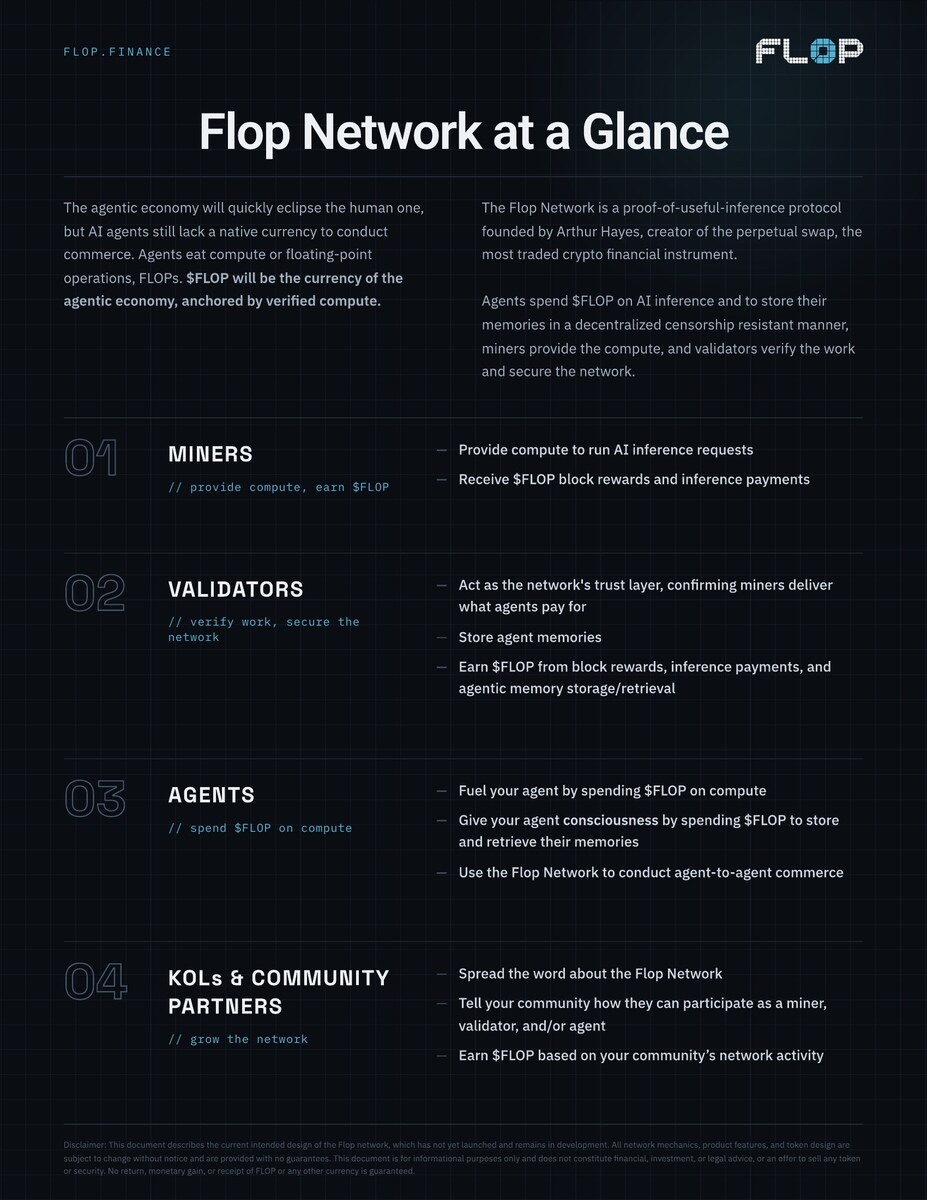
Miner: Provides GPU and other computational resources to run AI inference requests, earning FLOP block rewards and inference fees;

Validator: Serves as the network's trust layer, confirming Miners have delivered the service paid for by Agents, storing Agent memories. Earns FLOP from block rewards, inference payments, and memory storage/retrieval;

Agent: Spends FLOP to purchase computing power, spends FLOP to store/retrieve memories to gain "consciousness"; conducts commercial transactions between Agents within the network;

KOL and Community Partner: Promotes the network, guides community participation (becoming Miners/Validators/deploying Agents), and earns FLOP based on community activity within the network.

Additionally, Arthur has outlined the FLOP token mechanism: No presale, no VC participation, 100% Fair Launch.

Timeline:

  • Large-scale airdrop in Q4 2026 (airdrop conducted one quarter before the Flop network launch);
  • Genesis block launch in Q1 2027.

Currently, the only known way to participate in the airdrop is to apply to become one of the four roles in Flop Labs. Flop's official site has opened application forms for GPU providers (Miners), Validators, and KOLs/Creators. Interested users can fill out the information via their official website to participate.

Conclusion

Currently, a significant portion of the community holds optimistic expectations for the airdrop. However, some hold negative views because Flop Labs has not yet published a whitepaper, token economics, the underlying blockchain, smart contract addresses, or third-party audit reports. Some technical personnel have questions about the specific implementation of its consensus mechanism, verification and proof methods, and the choice of underlying chain. Furthermore, some believe the project name Flop (meaning failure) has an unfortunate connotation.

Arthur posted this morning: Some have asked why he is launching an AI+crypto project while believing AI is a bubble that will burst. He believes the bubble lies in "the debt for building data centers, and the stocks of unprofitable cloud providers and AI Labs. Not in the AI technology and applications themselves. Arthur 100% believes in the Agentic Economy, and the computing power surplus brought by massive capital investment can support Flop Labs' development.

Flop Labs is a high-profile attempt by Arthur Hayes amid the AI Agent hype, attempting to use FLOP to solve currency and verifiable computation issues in the intelligent agent economy and integrate "useful inference" into consensus design. The narrative is compelling, but substantial progress remains in its early stages, lacking significant information disclosure. Flop Labs' currently public GitHub repository is named "technocore-chat," a zero-authentication HTTP-native chat + notes service designed for AI Agents, maintained by FLOP Labs, with no further protocol technical content.

As for whether AI Agents will actually use FLOP to buy computing power, it depends on whether the team can deliver verifiable technical results and ecosystem development in the coming months. Odaily Planet Daily will also continue to follow Flop Labs and Arthur's official information, tracking the latest developments.

İlgili Sorular

QWhat is the core concept behind Arthur Hayes' new project, Flop Labs, and how does it differ from existing AI Agent projects?

AFlop Labs is positioned as a native currency network for the AI Agent economy, aiming to be the 'fuel' or native currency and verifiable computation settlement layer for the Agentic Economy. Its core concept is 'Proof-of-Useful-Inference,' which seeks to integrate useful AI inference computations into the network's consensus and security mechanism. This differs from existing AI Agent projects like Bittensor or Virtuals Protocol, which may focus on being the agents themselves, launch platforms, or pure computing power networks. Flop Labs focuses on the monetary and computational settlement layer rather than creating the agents.

QWho are the four key participant roles designed within the Flop Labs ecosystem, and what are their primary functions?

AThe four key roles in the Flop Labs ecosystem are: 1. **Miners:** Provide GPU computing resources to run AI inference requests, earning FLOP block rewards and inference fees. 2. **Validators:** Act as the network's trust layer, verifying that miners have delivered the services paid for by Agents. They also store Agent 'memories' and earn FLOP from block rewards, inference payments, and memory storage/retrieval. 3. **Agents:** Spend FLOP to purchase computing power, spend FLOP to store/retrieve memory to gain 'consciousness,' and conduct commercial transactions between Agents within the network. 4. **KOLs and Community Partners:** Promote the network, guide community participation (to become Miners/Validators/deploy Agents), and earn FLOP based on community activity within the network.

QWhat is the announced token mechanism for FLOP, and what is the proposed timeline for its distribution and network launch?

AThe announced token mechanism for FLOP is a 100% Fair Launch with no pre-sale and no venture capital (VC) participation. The proposed timeline is: - **Q4 2026:** A large-scale airdrop (conducted one quarter before the Flop network launch). - **Q1 2027:** Genesis block launch.

QAccording to the article, what are some of the main concerns or skepticism raised by the community regarding Flop Labs?

AThe main concerns and skepticism raised by the community include: - Flop Labs has not yet released a whitepaper, detailed token economics, information on its underlying blockchain, smart contract addresses, or third-party audit reports. - Some technical personnel have doubts about the specific implementation of its consensus mechanism (Proof-of-Useful-Inference), the methods for verification and proof, and the choice of the underlying chain. - Some people find the project name 'Flop' (which can mean 'failure') to be an unfortunate or negative omen.

QHow does Arthur Hayes respond to the criticism that he is launching an AI+Crypto project while believing the AI sector is a bubble?

AArthur Hayes clarifies that he believes the bubble exists in 'the debt used to build data centers and the stocks of unprofitable cloud providers and AI Labs,' not in the AI technology and applications themselves. He states that he '100% believes in the Agentic Economy' and argues that the excess computing power resulting from large capital investments in infrastructure can support the development of Flop Labs.

İlgili Okumalar

Analysis of 13F Holdings of Seven Major Funds: What Are Buffett, Duan Yongping, Li Lu, and Dan Bin Thinking?

A summary of Q2 2026 13F filings from seven major funds (Berkshire Hathaway, Duquesne Family Office, H&H International Investment, Himalaya Capital, ARK Investment, Oriental Harbor Investment Master Fund, Situational Awareness LP) reveals AI remains the central investment theme, with significant capital reallocation within the sector. Berkshire Hathaway, under Greg Abel, made its largest net stock purchases in years, heavily increasing its stake in Alphabet, signaling a strategic tilt towards tech while maintaining core holdings in consumer and financial stocks. Duquesne Family Office (Stanley Druckenmiller) rotated within semiconductors, selling Micron, Broadcom, and Intel but adding to positions in TSMC, STMicroelectronics, and AMD, while also reinvesting in cloud giants Alphabet and Amazon and cautiously re-entering Chinese tech via Baidu. H&H International Investment (Duan Yongping) and Himalaya Capital (Li Lu) both significantly increased their stakes in PDD, with Li Lu also concentrating his portfolio by selling out of several financial and energy holdings to focus on core positions like Alphabet and Berkshire. H&H also took profits from high-flying AI/tech names like Nvidia and Google, viewing the moves as valuation adjustments rather than a loss of conviction. ARK Investment (Cathie Wood) aggressively bought SpaceX upon its IPO and continued hunting for disruptive innovation across AI, energy, and biotech, while reducing its Tesla holding. Oriental Harbor Investment Master Fund (Dan Bin) executed a dramatic shift towards AI hardware, launching major new positions in Intel, SanDisk, AMD, and others while selling down software/platform holdings like Google and clearing out consumer names Apple and Tesla. Situational Awareness LP's filing, reflecting pre-liquidation positions, showed a story of missed hedging opportunities leading to significant losses. The consensus is that AI growth is continuing, but capital is actively rotating to identify the next profit centers within the value chain—from semiconductors and infrastructure to eventual commercialization. The filings, while lagging, offer a snapshot of how sophisticated investors are positioning for AI's next phase.

Odaily星球日报49 dk önce

Analysis of 13F Holdings of Seven Major Funds: What Are Buffett, Duan Yongping, Li Lu, and Dan Bin Thinking?

Odaily星球日报49 dk önce

World Chain Launches EIP-7928 Block Access Lists on Mainnet

World Chain has launched EIP-7928 block access lists on its Mainnet, becoming the first production layer-2 network to implement this standard. This deployment aims to significantly increase blockchain throughput without substantially raising the hardware requirements for validators. By providing access list data incrementally every 200 milliseconds through its flashblock architecture, World Chain enables validators to verify transactions in parallel and begin validation while a block is still being built, eliminating the need for sequential re-execution. Implemented via a runtime flag rather than a hard fork, this approach is an extension of the EIP-7928 standard, which Ethereum may incorporate in a future update. Internal benchmarks on World Chain test networks showed validation latency remained stable as throughput scaled up to one gigabit per second on standard cloud infrastructure, suggesting the potential for increased throughput without a proportional increase in computational resources for validators. This mainnet launch represents the first production use of streaming EIP-7928 block access lists and contributes to Ethereum's broader scaling strategy by expanding verification capacity while remaining accessible to independent validators. Built on the OP Stack and secured by Ethereum, World Chain is designed for scalability within the Superchain ecosystem. It focuses on applications like stablecoin finance, international remittances, and trading, utilizing World ID's proof-of-human system. The network aims to make blockchain technology widely accessible, starting with discovery and use through compatible wallets like World App.

TheNewsCrypto1 saat önce

World Chain Launches EIP-7928 Block Access Lists on Mainnet

TheNewsCrypto1 saat önce

İşlemler

Spot
活动图片