Understanding Vitalik's Reflection on L2: Farewell to Fragmentation, Rectifying the Course Towards Native Rollup in the New Phase

marsbit2026-02-21 tarihinde yayınlandı2026-02-21 tarihinde güncellendi

Özet

Vitalik Buterin's recent reflections on Ethereum's scaling roadmap signal a significant shift: the original plan prioritizing L2s as the primary scaling solution is now considered outdated. Rather than abandoning L2s entirely, the new strategy refocuses on Ethereum L1 as the most secure settlement layer, while L2s are expected to pursue specialization and differentiation—offering unique features like privacy-focused virtual machines or AI-agent environments—instead of mere scalability. A key issue is the fragmentation caused by numerous L2s, many of which remain centralized (e.g., stuck at "Stage 1" with limited decentralization). This undermines Ethereum’s core values and splits liquidity. The community is now moving toward "Native Rollup" concepts, particularly Based Rollup, which integrates rollup logic directly into L1, using Ethereum validators for sequencing instead of independent, often centralized, sequencers. This enhances security, reduces fragmentation, and enables synchronous composability. To improve user experience, preconfirmations and fast L1 confirmation rules are proposed to reduce finality wait times from ~13 minutes to 15-30 seconds. Looking ahead, Ethereum’s evolution will emphasize account abstraction (simplifying user onboarding), privacy with ZK-EVM, and infrastructure for AI agents operating trustlessly on-chain. Ultimately, Vitalik’s critique is not a rejection of L2s but a correction—away from fragmentation and toward deeper integration with L1, ...

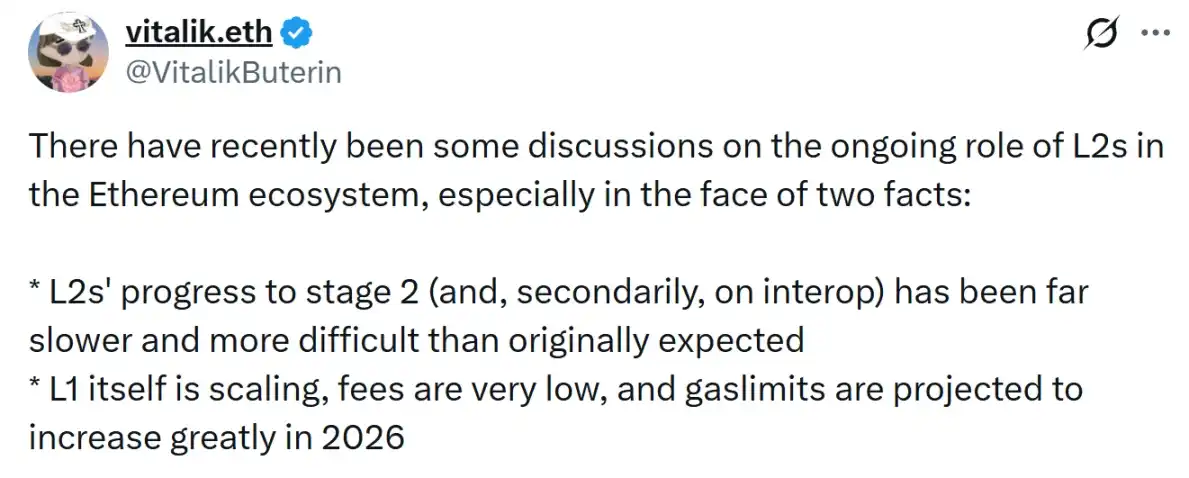
Recently, the most discussed topic in the Ethereum community has undoubtedly been Vitalik Buterin's public reflection on the scaling roadmap.

It can be said that Vitalik's attitude was quite "sharp,"直言随着以太坊主网(L1)自身扩容能力的提升,那个在五年前制定的、将 L2 视为主要扩容手段的路线图,已经失效了。

These remarks were once interpreted negatively by the market as "pessimism" or even "denial" towards L2. However, if one carefully examines Vitalik's core points and considers Ethereum's series of mainnet scaling progress, the decentralization progress evaluation framework, and recent technical discussions around Native/Based Rollup, it becomes clear that Vitalik is not completely negating the value of L2, but rather engaging in a kind of "course correction":

Ethereum is not abandoning L2, but is redefining the division of labor—L1 returns to its role as the most secure settlement layer, while L2 pursues differentiation and specialization, thereby refocusing the strategic emphasis on the mainnet itself.
一、Has L2 Fulfilled Its Historical Mission?

Objectively speaking, in the previous cycle, L2 was indeed once seen as Ethereum's lifeline.

In the initial Rollup-Centric roadmap, the division of labor was also very clear: L1 was responsible for security and data availability, L2 was responsible for extreme scaling and low Gas fees. In an era where Gas fees often reached tens of dollars, this was almost the only feasible answer.

But reality developed in a more complex way than expected.

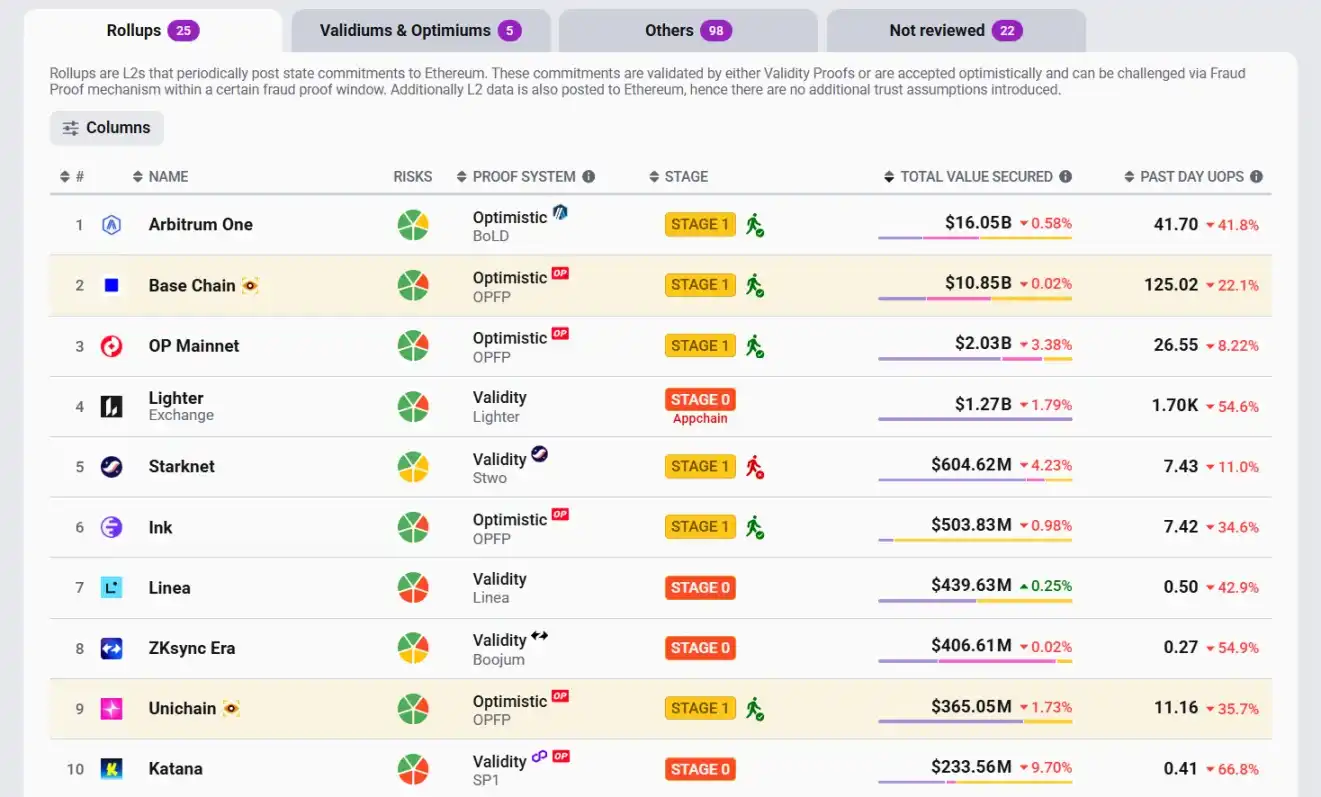
The latest statistics from L2BEAT show that there are now over a hundred L2s in the broad sense, but quantitative膨胀 does not equal structural maturity, with the vast majority making slow progress in decentralization.

Here, some basic knowledge needs to be added. As early as 2022, Vitalik criticized the "Training Wheels" architecture of most Rollups in a blog post,直言其依赖中心化运维、人工干预保障安全. Frequent users of L2Beat should be very familiar with this, as its homepage displays a key related indicator—Stage:

This is an evaluation framework that categorizes Rollups into three stages of decentralization: "Stage 0" which fully depends on centralized control, "Stage 1" with limited dependence, and the fully decentralized "Stage 2". This also reflects the degree of reliance on the artificial intervention of training wheels.

In his recent reflection, Vitalik pointed out that some L2s, possibly due to regulatory or commercial needs, might forever remain at "Stage 1", relying on security councils to control upgradability. This means that such L2s are essentially still a "secondary L1" with cross-chain bridging properties, rather than the "branded shards" initially envisioned.

Or, to put it more bluntly, if the sequencing power, upgrade rights, and final arbitration are concentrated in the hands of a few entities, it not only runs counter to Ethereum's decentralized初衷, but the L2 itself is nothing more than a parasite leaching off the Ethereum mainnet.
At the same time, the proliferation of L2s has brought another structural problem that everyone has felt deeply over the past few years: liquidity fragmentation.

This has caused the流量 originally gathered on Ethereum to be gradually divided, forming一个个被割裂的价值孤岛. As the number of public chains and L2s increases, the degree of liquidity fragmentation will intensify further, which was not the original intention of scaling.

From this perspective, one can understand why Vitalik emphasizes that the next step for L2 is not more chains, but deeper integration. Ultimately, this is actually a timely course correction—through institutionalized scaling and protocol-inherent security mechanisms, strengthening L1's positioning as the world's most trusted settlement layer.

Against this background, scaling is no longer the sole goal; security, neutrality, and predictability have重新成为以太坊的核心资产. The future of L2 lies not in quantity, but in deeper integration with the mainnet and more specialized innovation in细分场景.

For example, providing unique additional functions, such as privacy-specific virtual machines, extreme scaling, or specialized environments designed for non-financial applications like AI agents.

The views of Ethereum Foundation Executive Director Hsiao-Wei Wang at Consensus 2026 coincide with this: L1 should serve as the most secure settlement layer, carrying the most critical activities; while L2 should pursue differentiation and specialization, carrying activities that追求极致用户体验.

二、Native Rollup: Based Rollup + The Future of Preconfirmations?

It is in this wave of reflection on the L2 narrative that the concept of Based Rollup is expected to have its moment of glory in 2026.

Because if the keyword of the past five years was "Rollup-Centric," then the core of the current discussion is shifting to a more specific question: Can Rollups be "grown inside Ethereum" rather than "attached outside Ethereum"?

Therefore, the "Native Rollup" currently hotly debated in the Ethereum community can, to some extent, be understood as an extension of the Based Rollup concept—if Native Rollup is the ultimate ideal, then Based Rollup is currently the most practical path towards that ideal.

As is well known, the biggest difference between Based Rollup and traditional L2s like Arbitrum and Optimism is that it completely抛弃了独立的、甚至是中心化的序列器(Sequencer)层, and instead is directly sequenced by Ethereum L1 nodes. In other words, the Ethereum protocol itself integrates Rollup-like verification logic at the L1 level, thus unifying the extreme performance optimization and protocol-level security that originally belonged to L2 and the Ethereum mainnet separately.

The most intuitive feeling this design gives users is that the Rollup seems to be embedded within Ethereum, inheriting not only L1's censorship resistance and liveness but, more importantly, solving the most headache-inducing problem for L2s—synchronous composability. In a Based Rollup block, you can directly call L1's liquidity, achieving atomic cross-layer transactions.

However, Based Rollup faces a practical challenge: if it completely follows L1's rhythm (one Slot every 12 seconds), the user experience would be cumbersome. After all, under the current Ethereum architecture, even after a transaction is packed into a block, the system still needs to wait about 13 minutes (2 Epochs) to reach finality. This is too slow for financial scenarios.

Interestingly, in the same tweet where Vitalik reflected on L2, he recommended a community proposal from January titled "Combining preconfirmations with based rollups for synchronous composability". The core of this proposal is not simply pushing Based Rollup, but rather proposing a hybrid structure:

Retain low latency sequenced blocks, generate a based block at the end of the slot, submit the based block to L1, and finally combine it with a preconfirmation mechanism to achieve synchronous composability.
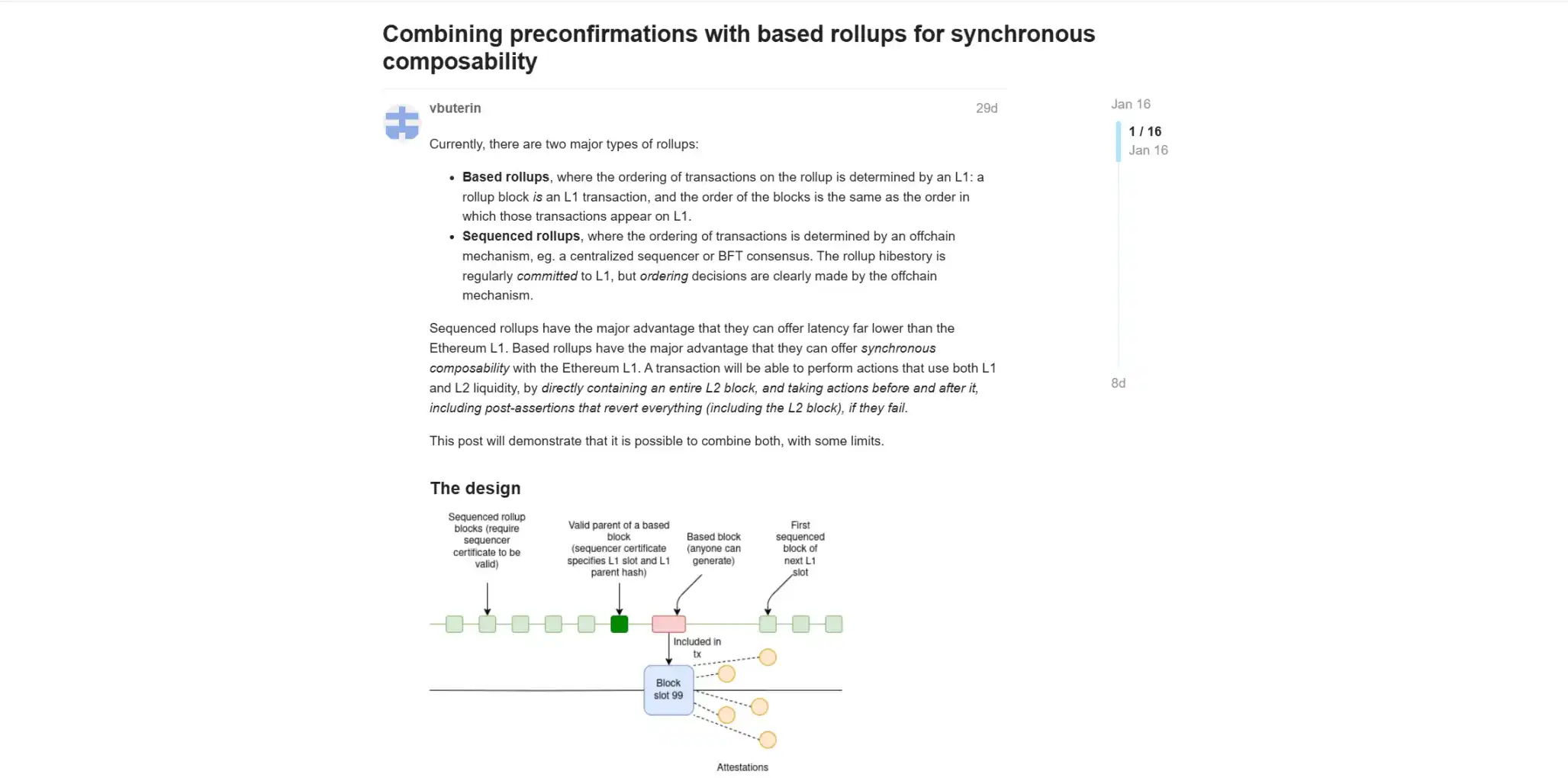
In Based Rollup, a preconfirmation is a commitment made by a specific角色 (like an L1 proposer) that a transaction will be included before it is formally submitted to L1. This is also what Project #4: Fast L1 Confirmation Rule in Ethereum's Interop roadmap explicitly proposes to do.

Its core goal is very direct: to allow applications and cross-chain systems to obtain a "strong and verifiable" L1 confirmation signal within 15–30 seconds, without having to wait the full 13 minutes required for finality.

Mechanically, the fast confirmation rule does not introduce a new consensus process, but rather reutilizes the attester voting that occurs in every slot of Ethereum's PoS system. When a block has accumulated enough, and sufficiently dispersed, validator votes in early slots, even if it has not entered the finalization phase, it can be considered "extremely unlikely to be reverted under a reasonable attack model".

Simply put, this confirmation level does not replace Finality, but provides a strong confirmation explicitly acknowledged by the protocol *before* Finality. For Interop, this is particularly critical: cross-chain systems, Intent Solvers, and wallets no longer need to blindly wait for finality; instead, they can safely advance the next logic within 15–30 seconds based on a protocol-level confirmation signal.

Through this layered confirmation logic, Ethereum finely segments different levels of trust between "security" and "perceived speed,"有望构建出极致丝滑的互操作体验 (extended reading: "Ethereum's 'Second-Level' Evolution: From Fast Confirmations to Settlement Compression, How Interop Eliminates Waiting Time?").

三、What is Ethereum's Future?

Looking back from the vantage point of 2026, Ethereum's main theme is quietly shifting, gradually moving from pursuing extreme "scaling" to pursuing "unification, layering, and inherent security."

Last month, executives from several Ethereum L2 solutions have successively expressed their willingness to explore and embrace the Native Rollup path to enhance the consistency and synergy of the entire network. This attitude itself is an important signal: the Ethereum ecosystem is undergoing a painful but necessary deflation of泡沫, shifting from pursuing "the number of chains" back to pursuing "the unification of the protocol."

However, as Ethereum's underlying roadmap is recalibrated and advanced, especially as L1 continues to strengthen and Based Rollup with preconfirmations are gradually implemented, and底层性能不再是唯一瓶颈时, a more practical problem begins to emerge—the biggest bottleneck is no longer the chain, but the wallet and the entry barrier.

This confirms the insight that imToken repeatedly emphasized in 2025: when infrastructure becomes趋于隐形, what truly determines the limit of scale will be the entry-level interaction experience.

Overall, besides底层扩容, the future breakthrough and规模化发展 of the Ethereum ecosystem will not focus solely on TPS or Blob count, but will revolve around three more structurally significant directions:

  • Account Abstraction and the Erosion of Entry Barriers: Ethereum is promoting native account abstraction (Native AA). Future smart contract wallets will become the default choice, completely replacing obscure seed phrases and EOA addresses. For users of wallets like imToken, this means the barrier to entering the crypto world will become as simple as registering a social media account (extended reading: "From EOA to Account Abstraction: Will Web3's Next Leap Happen in the 'Account System'?");
  • Privacy and ZK-EVM: Privacy features are no longer边缘需求. As ZK-EVM technology matures, Ethereum will provide necessary on-chain privacy protection for commercial applications while maintaining transparency. This will be its core competitive advantage in the public chain competition (extended reading: "The 'Dawn Moment' of the ZK Route: Is Ethereum's Endgame Roadmap Accelerating Comprehensively?");
  • On-Chain Sovereignty of AI Agents: In 2026, the initiator of transactions might not be humans, but AI agents. The future challenge lies in establishing trustless interaction standards: how to ensure that AI agents are executing the user's will, rather than being manipulated by third parties? Ethereum's decentralized settlement layer will become the most reliable rule arbiter for the AI economy (extended reading: "The New Ticket in the Age of AI Agents: What is Ethereum Betting on by Promoting ERC-8004?");

Returning to the initial question, did Vitalik really "deny" L2?

A more accurate understanding is that he denied an overly膨胀、脱离主网、各自为政的碎片化叙事. This is not an endpoint, but a brand new starting point. From the grand illusion of "branded shards" back to the meticulous crafting of Based Rollup and preconfirmations, this本质上反而有助于强化以太坊 L1 作为全球信任底座的绝对地位.

However, this also means that in this return to technological pragmatism, only those innovations that are truly rooted in the underlying principles of Ethereum's new phase and share the same breath and fate as the mainnet will survive and thrive in the next great navigation era.


İlgili Sorular

QWhat is the core argument of Vitalik Buterin's recent reflection on Ethereum's scaling roadmap?

AVitalik Buterin argues that the original five-year-old roadmap, which positioned L2 as the primary scaling solution, is now obsolete. The focus is shifting towards a 'dialectical correction': L1 should return to its role as the most secure settlement layer, while L2s should pursue differentiation and specialization, recentering the strategic focus on the mainnet itself.

QAccording to the article, what is a major structural problem caused by the proliferation of L2s?

AA major structural problem caused by the proliferation of L2s is liquidity fragmentation. The expansion has splintered the traffic originally concentrated on Ethereum, creating isolated value islands and exacerbating the fragmentation of liquidity, which was not the original intention of scaling.

QWhat is the key difference between a Based Rollup and a traditional L2 like Arbitrum?

AThe key difference is that Based Rollups completely abandon an independent, often centralized, sequencer layer. Instead, they are ordered directly by Ethereum L1 nodes. This integrates Rollup-like validation logic at the L1 protocol level, unifying extreme performance optimization with protocol-level security.

QHow does the proposed 'Fast L1 Confirmation Rule' aim to improve user experience on Based Rollups?

AThe 'Fast L1 Confirmation Rule' aims to provide applications and cross-chain systems with a 'strong and verifiable' L1 confirmation signal within 15-30 seconds, without waiting for the full 13-minute Finality. It leverages the existing attester votes in Ethereum's PoS system to create a protocol-level, strong confirmation level before finality is reached.

QWhat are the three key directions identified for Ethereum's future scaling and mass adoption, beyond just底层 (underlying) TPS?

AThe three key directions are: 1) Account Abstraction and lowering the entry barrier, making entering crypto as simple as registering a social account. 2) Privacy and ZK-EVM, providing necessary on-chain privacy for commercial applications. 3) AI Agent on-chain sovereignty, establishing the decentralized settlement layer as the most reliable rule adjudicator for the AI economy.

İlgili Okumalar

Core 'Key Contributors' Depart One After Another, Has Aave's DAO Dream Shattered?

Recent weeks have seen major internal turbulence within Aave, one of DeFi’s most successful DAOs. The Aave Chan Initiative (ACI), a core governance team, announced it would cease operations and exit the ecosystem on March 3, following the departure of BGD Labs, the development team behind Aave V3, just two weeks earlier. The crisis stems from governance disputes that began in December, when Aave Labs unilaterally switched the protocol’s front-end aggregator from ParaSwap to CoW Swap, redirecting fee revenue from the DAO treasury to Aave Labs. In response, Aave Labs proposed the bundled “Aave Will Win” proposal in February, requesting $51M in funding for V4 development in exchange for routing all future product revenue to the DAO and phasing out V3. ACI strongly criticized the proposal, alleging that a significant portion of supporting votes came from addresses linked to Aave Labs, raising concerns about self-dealing and lack of transparency. Despite ACI’s attempts to introduce stricter accountability measures, their proposals were not adopted. The departures of both BGD Labs and ACI—key contributors responsible for technical development and governance—raise serious questions about Aave’s future, including technical risks associated with transitioning to V4 and the centralization of decision-making power. The situation highlights broader challenges in DAO governance, where power often remains concentrated among founders, developers despite the ideal of decentralized token-holder control. Moving forward, the resolution of the “Aave Will Win” proposal and the possibility of a protocol fork remain critical points to watch. How Aave addresses its governance flaws and rebalances power among stakeholders may determine its ability to sustain long-term growth.

比推51 dk önce

Core 'Key Contributors' Depart One After Another, Has Aave's DAO Dream Shattered?

比推51 dk önce

İşlemler

Spot
Futures

Popüler Makaleler

ETH 2.0 Nedir

ETH 2.0: Ethereum için Yeni Bir Dönem Giriş ETH 2.0, Ethereum 2.0 olarak da bilinir, Ethereum blok zincirinde önemli bir yükseltmeyi işaret eder. Bu geçiş yalnızca bir yüz değiştirme değil; ağın ölçeklenebilirliğini, güvenliğini ve sürdürülebilirliğini temelinden geliştirmeyi hedeflemektedir. Enerji yoğun Proof of Work (PoW) konsensüs mekanizmasından daha verimli olan Proof of Stake (PoS) mekanizmasına geçişle birlikte, ETH 2.0 blok zinciri ekosistemine dönüştürücü bir yaklaşım vaat etmektedir. ETH 2.0 Nedir? ETH 2.0, Ethereum'un yeteneklerini ve performansını optimize etmeye odaklanmış özel, birbirine bağlı güncellemelerin bir derlemesidir. Yenileme, mevcut Ethereum mekanizmasının karşılaştığı kritik zorlukları, özellikle işlem hızı ve ağ tıkanıklığı ile ilgili sorunları ele almak üzere tasarlanmıştır. ETH 2.0'ın Amaçları ETH 2.0'ın ana amaçları, üç temel unsuru geliştirmeye odaklanmaktadır: Ölçeklenebilirlik: Ağın saniye başına işleyebileceği işlem sayısını önemli ölçüde artırmayı hedefleyen ETH 2.0, mevcut yaklaşık 15 işlem/saniye sınırlamasını aşmayı ve potansiyel olarak binlerce işleme ulaşmayı planlamaktadır. Güvenlik: Geliştirilmiş güvenlik önlemleri, özellikle siber saldırılara karşı daha iyi direnç sağlama ve Ethereum'un merkeziyetsiz görünümünü koruma açısından ETH 2.0 için hayati öneme sahiptir. Sürdürülebilirlik: Yeni PoS mekanizması, sadece verimliliği artırmakla kalmayıp aynı zamanda enerji tüketimini de önemli ölçüde azaltma hedefiyle tasarlanmış olup, Ethereum'un operasyonel çerçevesini çevresel kaygılarla uyumlu hale getirmektedir. ETH 2.0'ın Yaratıcısı Kimdir? ETH 2.0'ın yaratılması Ethereum Vakfı'na atfedilebilir. Ethereum'un gelişimini destekleme konusunda kritik bir rol oynayan bu kar amacı gütmeyen kuruluş, dikkat çekici kurucu ortağı Vitalik Buterin tarafından yönetilmektedir. Daha ölçeklenebilir ve sürdürülebilir bir Ethereum vizyonu, bu yükseltmenin arkasındaki itici güç olmuştur ve protokolü geliştirmek için kendini adamış küresel bir geliştici ve meraklı topluluğunun katkılarını içermektedir. ETH 2.0'ın Yatırımcıları Kimlerdir? ETH 2.0 yatırımcıları ile ilgili detaylar kamuoyuna açıklanmamış olsa da, Ethereum Vakfı'nın blok zinciri ve teknoloji alanında çeşitli kuruluşlar ve bireyler tarafından desteklendiği bilinmektedir. Bu ortaklar arasında merkeziyetsiz teknolojilerin ve blok zinciri altyapısının geliştirilmesine karşılıklı ilgi duyan girişim sermayesi şirketleri, teknoloji firmaları ve hayır kurumları yer almaktadır. ETH 2.0 Nasıl Çalışır? ETH 2.0, onu öncüsünden ayıran bir dizi önemli özelliği tanıtmasıyla dikkat çekmektedir. Proof of Stake (PoS) PoS konsensüs mekanizmasına geçiş, ETH 2.0'ın en belirgin değişikliklerinden biridir. İşlem doğrulama için enerji yoğun madenciliğe dayanmak yerine, PoS kullanıcıların ağa yatırdıkları ETH miktarına göre işlemleri doğrulayıp yeni bloklar oluşturmalarına olanak tanır. Bu, enerji verimliliğinin artırılmasına yol açarak tüketimi yaklaşık %99,95 oranında azaltmakta ve Ethereum 2.0'ı önemli ölçüde daha çevre dostu bir alternatif haline getirmektedir. Shard Zincirleri Shard zincirleri, ETH 2.0'ın diğer bir kritik yeniliğidir. Bu daha küçük zincirler, ana Ethereum zinciri ile paralel olarak çalışarak birden fazla işlemin aynı anda işlenmesine olanak tanır. Bu yaklaşım, ağın genel kapasitesini artırarak Ethereum'u rahatsız eden ölçeklenebilirlik sorunlarını ele alır. Beacon Zinciri ETH 2.0'ın temelinde, ağı koordine eden ve PoS protokolünü yöneten Beacon Zinciri yer almaktadır. Bu, bir tür organizatör olarak işlev görür: doğrulayıcıları denetler, shard'ların ağa bağlı kalmasını sağlar ve blok zinciri ekosisteminin genel sağlığını izler. ETH 2.0 Zaman Çizelgesi ETH 2.0'ın yolculuğu, bu önemli yükseltmenin evrimini gösteren birkaç önemli dönüm noktası ile tanımlanmıştır: Aralık 2020: Beacon Zinciri'nin başlatılması, PoS'un tanıtımını işaret etmiş ve ETH 2.0’a geçiş için sahneyi hazırlamıştır. Eylül 2022: "The Merge" tamamlanması, Ethereum ağının başarılı bir şekilde PoW'den PoS çerçevesine geçiş yaptığı kritik bir anı temsil etmekte ve Ethereum için yeni bir dönemi müjdelemektedir. 2023: Shard zincirlerinin beklenen dağıtımı, Ethereum ağının ölçeklenebilirliğini daha da artırmayı hedeflemekte ve ETH 2.0'ı merkeziyetsiz uygulamalar ve hizmetler için sağlam bir platform haline getirmeyi pekiştirmektedir. Ana Özellikler ve Faydalar Geliştirilmiş Ölçeklenebilirlik ETH 2.0'ın en önemli avantajlarından biri, geliştirilmiş ölçeklenebilirliğidir. PoS ve shard zincirlerinin kombinasyonu, ağın kapasitesini artırarak, eski sistemle kıyaslandığında çok daha fazla işlem hacmi karşılayabilmesini sağlamaktadır. Enerji Verimliliği PoS'un uygulanması, blok zinciri teknolojisinde enerji verimliliği yönünde büyük bir adım teşkil etmektedir. Enerji tüketimini ciddi şekilde azaltarak, ETH 2.0 yalnızca işletme maliyetlerini düşürmekle kalmaz, aynı zamanda küresel sürdürülebilirlik hedefleriyle daha yakın bir uyum sağlar. Geliştirilmiş Güvenlik ETH 2.0'ın güncellenmiş mekanizmaları, ağ genelinde güvenliğin artırılmasına katkıda bulunmaktadır. PoS'un uygulanması ve shard zincirleri ile Beacon Zinciri aracılığıyla geliştirilen yenilikçi kontrol önlemleri, potansiyel tehditlere karşı daha yüksek bir koruma sağlar. Kullanıcılar için Düşük Maliyetler Ölçeklenebilirlik geliştikçe, işlem maliyetleri üzerindeki etkiler de belirgin hale gelecektir. Artan kapasite ve azalan tıkanıklığın, kullanıcılar için düşük ücretler anlamına gelmesi beklenmekte ve Ethereum'u günlük işlemler için daha erişilebilir hale getirmektedir. Sonuç ETH 2.0, Ethereum blok zinciri ekosisteminde önemli bir evrimi işaret etmektedir. Ölçeklenebilirlik, enerji tüketimi, işlem verimliliği ve genel güvenlik gibi temel sorunları ele alırken, bu güncellemenin önemi abartılamaz. Proof of Stake'e geçiş, shard zincirlerinin tanıtımı ve Beacon Zinciri'nin altyapı çalışmaları, Ethereum'un merkeziyetsiz piyasalarının artan taleplerini karşılayabileceği bir geleceği göstermektedir. Yenilik ve ilerleme ile şekillenen bir sektörde, ETH 2.0, blok zinciri teknolojisinin daha sürdürülebilir ve verimli bir dijital ekonomi için yol açmadaki yeteneklerinin bir kanıtıdır.

170 Toplam GörüntülenmeYayınlanma 2024.04.04Güncellenme 2024.12.03

ETH 2.0 Nedir

ETH 3.0 Nedir

ETH3.0 ve $eth 3.0: Ethereum'un Geleceği Üzerine Derinlemesine Bir İnceleme Giriş Hızla evrilen kripto para ve blok zinciri teknolojisi ortamında, ETH3.0, sıklıkla $eth 3.0 olarak adlandırılmakta, önemli bir ilgi ve spekülasyon konusu haline gelmiştir. Bu terim, netleştirilmesi gereken iki temel kavramı kapsamaktadır: Ethereum 3.0: Bu, mevcut Ethereum blok zincirinin yeteneklerini artırmayı hedefleyen olası bir gelecekteki güncellemeyi temsil eder, özellikle ölçeklenebilirlik ve performansı iyileştirmeye odaklanmaktadır. ETH3.0 Meme Token: Bu ayrı kripto para projesi, Ethereum blok zincirini kullanarak meme merkezli bir ekosistem oluşturmayı amaçlamakta ve kripto para topluluğu içinde etkileşimi artırmaktadır. ETH3.0'ün bu yönlerini anlamak, yalnızca kripto meraklıları için değil, aynı zamanda dijital alandaki daha geniş teknolojik trendleri gözlemleyenler için de hayati öneme sahiptir. ETH3.0 Nedir? Ethereum 3.0 Ethereum 3.0, zaten kurulmuş olan Ethereum ağına önerilen bir güncelleme olarak duyurulmaktadır; bu ağ, kuruluşundan bu yana birçok merkeziyetsiz uygulamanın (dApp'ler) ve akıllı sözleşmelerin belkemiği olmuştur. Tasarlanan iyileştirmeler, esasen ölçeklenebilirlik üzerine yoğunlaşmakta – shardlama ve sıfır bilgi kanıtları (zk-proofs) gibi ileri teknolojileri entegre etmektedir. Bu teknolojik yenilikler, saniyede eşi benzeri görülmemiş sayıda işlem (TPS) gerçekleştirmeyi kolaylaştırmayı amaçlamakta olup, muhtemelen milyonlara ulaşarak mevcut blok zinciri teknolojisinin karşılaştığı en büyük sınırlamalardan birine çözüm getirmektedir. İyileştirme yalnızca teknik değil, aynı zamanda stratejiktir; Ethereum ağını, merkeziyetsiz çözümlere olan artan talep ile belirginleşen bir geleceğe hazırlamak için tasarlanmıştır. ETH3.0 Meme Token Ethereum 3.0'ın aksine, ETH3.0 Meme Token, internet meme kültürünü kripto para dinamikleriyle birleştirerek daha hafif ve eğlenceli bir alanda hareket etmektedir. Bu proje, kullanıcıların Ethereum blok zincirinde meme alım, satım ve ticaret yapmalarına izin vererek, yaratıcılık ve ortak ilgi alanları aracılığıyla topluluk etkileşimini teşvik eden bir platform sunmaktadır. ETH3.0 Meme Token, blok zinciri teknolojisinin dijital kültürle nasıl kesişebileceğini göstererek, hem eğlenceli hem de finansal olarak sürdürülebilir kullanım senaryoları oluşturmayı hedeflemektedir. ETH3.0'un Yaratıcısı Kimdir? Ethereum 3.0 Ethereum 3.0'a yönelik girişim, esas olarak Ethereum topluluğundaki bir geliştirici ve araştırmacı konsorsiyumu tarafından yönlendirilmektedir ve bunlar arasında Justin Drake de bulunmaktadır. Ethereum'un evrimine yönelik içgörüleri ve katkılarıyla tanınan Drake, Ethereum'u “Beam Chain” olarak adlandırılan yeni bir konsensüs katmanına geçirme konusundaki tartışmalarda öne çıkan bir figür olmuştur. Geliştirmeye yönelik bu iş birliği yaklaşımı, Ethereum 3.0'ın tek bir yaratıcının ürünü olmadığını, aksine blok zinciri teknolojisini ilerletmeye odaklanmış kolektif bir dehanın tezahürü olduğunu göstermektedir. ETH3.0 Meme Token ETH3.0 Meme Token'ın yaratıcısına dair detaylar şu anda izlenemez durumdadır. Meme tokenların doğası, genellikle daha merkeziyetsiz ve topluluk odaklı bir yapıya yol açmakta olup, bu da spesifik bir atıf eksikliğini açıklayabilir. Bu durum, yeniliğin genellikle iş birliği yerine bireysel çabalardan ortaya çıktığı kripto topluluğunun genel felsefesiyle uyumludur. ETH3.0 Yatırımcıları Kimlerdir? Ethereum 3.0 Ethereum 3.0'a olan destek, esasen Ethereum Vakfı ve hevesli bir geliştirici ve yatırımcı topluluğu tarafından sağlanmaktadır. Bu temel birliktelik, yıllar süren ağ operasyonlarıyla inşa edilen güven ve itibarından yararlanarak önemli bir meşruiyet sağlamaktadır. Kripto para dünyasının hızla değişen ikliminde, topluluk desteği, gelişim ve benimsemeyi yönlendirmede kritik bir rol oynamakta ve Ethereum 3.0'ı gelecekteki blok zinciri ilerlemeleri için ciddi bir rakip haline getirmektedir. ETH3.0 Meme Token Mevcut kaynaklar, ETH3.0 Meme Token'ı destekleyen yatırım temelleri veya kuruluşları hakkında net bilgiler sağlamasa da, bu durum meme tokenlar için tipik olan finansman modelini göstermektedir; bu model genellikle tabandan destek ve topluluk katılımına dayanır. Bu tür projelerdeki yatırımcılar genellikle toplum odaklı yenilik potansiyeli ve kripto topluluğunda bulunan iş birliği ruhuyla motive olmuş bireylerden oluşmaktadır. ETH3.0 Nasıl Çalışır? Ethereum 3.0 Ethereum 3.0'ın ayırt edici özellikleri, önerilen shardlama ve zk-proof teknolojisinin uygulanmasında yatmaktadır. Shardlama, blok zincirini daha küçük, yönetilebilir parçalara veya “parçalara” ayırma yöntemidir; bu parçalar işlemleri ardışık değil, eşzamanlı olarak işleyebilir. Bu işlem yükünün merkeziyetsizliği, tıkanıklığı önlemeye yardımcı olur ve ağın yoğun yük altında bile yanıt verebilir olmasını sağlar. Sıfır bilgi kanıtı (zk-proof) teknolojisi, işleme katılan temel verileri ifşa etmeden işlem doğrulaması sağlamasıyla başka bir sofistike katman ekler. Bu yön, sadece gizliliği artırmakla kalmaz, aynı zamanda ağın genel verimliliğini de artırır. Bu güncellemeye, ağın yeteneklerini ve faydasını daha da artırarak sıfır bilgi Ethereum Sanal Makinesi (zkEVM) entegrasyonunun da eklenmesi gündeme gelmektedir. ETH3.0 Meme Token ETH3.0 Meme Token, meme kültürünün popülaritesinden yararlanarak kendini farklılaştırmaktadır. Kullanıcıların sadece eğlence için değil, aynı zamanda potansiyel ekonomik kazançlar için meme ticareti yapmalarına olanak tanıyacak bir pazar yeri oluşturur. Stake etme, likidite sağlama ve yönetim mekanizmaları gibi özelliklerin entegrasyonu sayesinde, proje topluluk etkileşimini ve katılımını teşvik eden bir ortam oluşturur. Eğlence ve ekonomik fırsatların eşsiz bir karışımını sunarak, ETH3.0 Meme Token, kripto tutkunlarından gündelik meme meraklılarına kadar çeşitli bir kitleyi çekmeyi hedeflemektedir. ETH3.0 Zaman Çizelgesi Ethereum 3.0 11 Kasım 2024: Justin Drake, ölçeklenebilirlik iyileştirmeleri etrafında şekillenen yaklaşan ETH 3.0 güncellemesine işaret ediyor. Bu duyuru, Ethereum'un gelecekteki mimarisi hakkında resmi tartışmaların başlangıcını simgeliyor. 12 Kasım 2024: Ethereum 3.0'a yönelik beklenen önerinin, Bangkok'taki Devcon'da açıklanması planlanıyor ve bu, daha geniş topluluk geri bildirimi ve gelişim için olası sonraki adımların zeminini hazırlıyor. ETH3.0 Meme Token 21 Mart 2024: ETH3.0 Meme Token, CoinMarketCap'ta resmi olarak listeleniyor, bu da kamusal kripto alanına adım atarak meme merkezli ekosisteminin görünürlüğünü artırıyor. Ana Noktalar Sonuç olarak, Ethereum 3.0, gelişmiş teknolojiler aracılığıyla ölçeklenebilirlik ve performansla ilgili sınırlamaların üstesinden gelmeye odaklanan Ethereum ağındaki önemli bir evrimi temsil etmektedir. Önerilen güncellemeleri, gelecekteki talepler ve kullanılabilirlik için proaktif bir yaklaşımı yansıtmaktadır. Öte yandan, ETH3.0 Meme Token, kripto para alanındaki topluluk odaklı kültürün özünü kapsamakta, meme kültürünü kullanarak kullanıcı yaratıcılığını ve katılımını teşvik eden etkileşimli platformlar oluşturmayı hedeflemektedir. ETH3.0 ve $eth 3.0'un farklı amaçlarının ve işlevlerinin anlaşılması, kripto alanındaki gelişmeleri takip eden herkes için hayati öneme sahiptir. Her iki girişim de benzersiz yollar çizerek, blok zinciri yeniliğinin dinamik ve çok yönlü doğasını birlikte vurgulamaktadır.

171 Toplam GörüntülenmeYayınlanma 2024.04.04Güncellenme 2024.12.03

ETH 3.0 Nedir

ETH Nasıl Satın Alınır

HTX.com’a hoş geldiniz! Ethereum (ETH) satın alma işlemlerini basit ve kullanışlı bir hâle getirdik. Adım adım açıkladığımız rehberimizi takip ederek kripto yolculuğunuza başlayın. 1. Adım: HTX Hesabınızı OluşturunHTX'te ücretsiz bir hesap açmak için e-posta adresinizi veya telefon numaranızı kullanın. Sorunsuzca kaydolun ve tüm özelliklerin kilidini açın. Hesabımı Aç2. Adım: Kripto Satın Al Bölümüne Gidin ve Ödeme Yönteminizi SeçinKredi/Banka Kartı: Visa veya Mastercard'ınızı kullanarak anında Ethereum (ETH) satın alın.Bakiye: Sorunsuz bir şekilde işlem yapmak için HTX hesap bakiyenizdeki fonları kullanın.Üçüncü Taraflar: Kullanımı kolaylaştırmak için Google Pay ve Apple Pay gibi popüler ödeme yöntemlerini ekledik.P2P: HTX'teki diğer kullanıcılarla doğrudan işlem yapın.Borsa Dışı (OTC): Yatırımcılar için kişiye özel hizmetler ve rekabetçi döviz kurları sunuyoruz.3. Adım: Ethereum (ETH) Varlıklarınızı SaklayınEthereum (ETH) satın aldıktan sonra HTX hesabınızda saklayın. Alternatif olarak, blok zinciri transferi yoluyla başka bir yere gönderebilir veya diğer kripto para birimlerini takas etmek için kullanabilirsiniz.4. Adım: Ethereum (ETH) Varlıklarınızla İşlem YapınHTX'in spot piyasasında Ethereum (ETH) ile kolayca işlemler yapın.Hesabınıza erişin, işlem çiftinizi seçin, işlemlerinizi gerçekleştirin ve gerçek zamanlı olarak izleyin. Hem yeni başlayanlar hem de deneyimli yatırımcılar için kullanıcı dostu bir deneyim sunuyoruz.

2.9k Toplam GörüntülenmeYayınlanma 2024.12.10Güncellenme 2025.03.21

ETH Nasıl Satın Alınır

Tartışmalar

HTX Topluluğuna hoş geldiniz. Burada, en son platform gelişmeleri hakkında bilgi sahibi olabilir ve profesyonel piyasa görüşlerine erişebilirsiniz. Kullanıcıların ETH (ETH) fiyatı hakkındaki görüşleri aşağıda sunulmaktadır.

活动图片