Core 'Key Contributors' Depart One After Another, Has Aave's DAO Dream Shattered?

比推2026-03-03 tarihinde yayınlandı2026-03-03 tarihinde güncellendi

Özet

Recent weeks have seen major internal turbulence within Aave, one of DeFi’s most successful DAOs. The Aave Chan Initiative (ACI), a core governance team, announced it would cease operations and exit the ecosystem on March 3, following the departure of BGD Labs, the development team behind Aave V3, just two weeks earlier. The crisis stems from governance disputes that began in December, when Aave Labs unilaterally switched the protocol’s front-end aggregator from ParaSwap to CoW Swap, redirecting fee revenue from the DAO treasury to Aave Labs. In response, Aave Labs proposed the bundled “Aave Will Win” proposal in February, requesting $51M in funding for V4 development in exchange for routing all future product revenue to the DAO and phasing out V3. ACI strongly criticized the proposal, alleging that a significant portion of supporting votes came from addresses linked to Aave Labs, raising concerns about self-dealing and lack of transparency. Despite ACI’s attempts to introduce stricter accountability measures, their proposals were not adopted. The departures of both BGD Labs and ACI—key contributors responsible for technical development and governance—raise serious questions about Aave’s future, including technical risks associated with transitioning to V4 and the centralization of decision-making power. The situation highlights broader challenges in DAO governance, where power often remains concentrated among founders, developers despite the ideal of decentralized token-h...

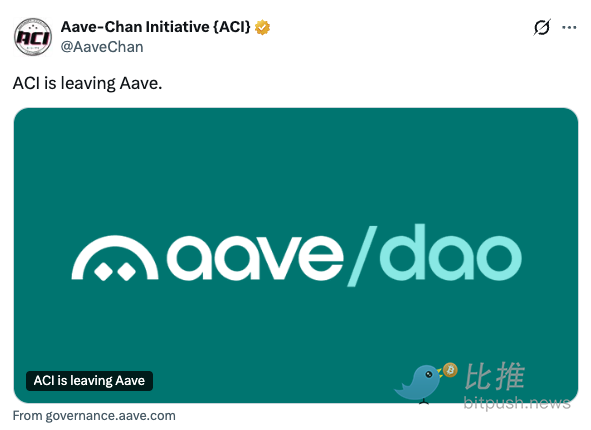
On March 3rd, the Aave protocol's core governance team, Aave Chan Initiative (ACI), announced it would cease operations and exit AAVE.

This is the second major contributor to leave within two weeks—previously, on February 20th, the development team behind the Aave V3 codebase, BGD Labs, announced its departure.
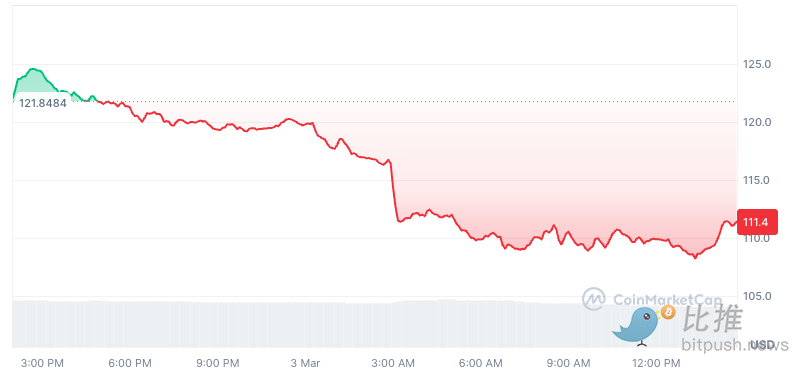
Following the announcement, the price of the AAVE token fell by more than 11%.

As one of the most successful DAOs (Decentralized Autonomous Organizations) in DeFi history, this DeFi leader with nearly $27 billion in TVL (Total Value Locked) is undergoing profound internal turmoil.
From Revenue Attribution Dispute to Bundled Voting

The seeds of this crisis were sown as early as last December.

At that time, Aave Labs replaced the front-end transaction aggregator from ParaSwap to CoW Swap without prior governance discussion. The fees that originally flowed to the DAO treasury instead went into Aave Labs' accounts.

Facing质疑 (query/doubt), Aave founder Stani Kulechov responded: the front-end interface was built by Labs, so the revenue naturally belongs to Labs; the smart contracts and liquidity pools belong to the DAO. This explanation was legally sound but caused discontent within the community.

To quell the controversy, Aave Labs proposed a plan called "Aave Will Win" in February. The proposal主要内容 (main content) included: requesting DAO approval for approximately $51 million in funding for V4 development; in exchange, all future revenue from Aave-branded products would be assigned to the DAO, and Aave V4 would be established as the sole technical foundation, gradually phasing out V3.

The problem was that these three matters were bundled together. Support revenue going to the DAO but think the funding amount is too large? No choice. Believe V3 still has value and shouldn't be sidelined?同样没得选 (Similarly, no choice). Either accept the entire package or reject it entirely.

ACI's Grievance: Opaque Voting

In its exit statement, ACI's core accusation was: a significant portion of the votes supporting the proposal came from addresses associated with Aave Labs. A temperature check vote passed by a narrow margin of 52.58%, and ACI believes the result might have been different without these "self-votes".
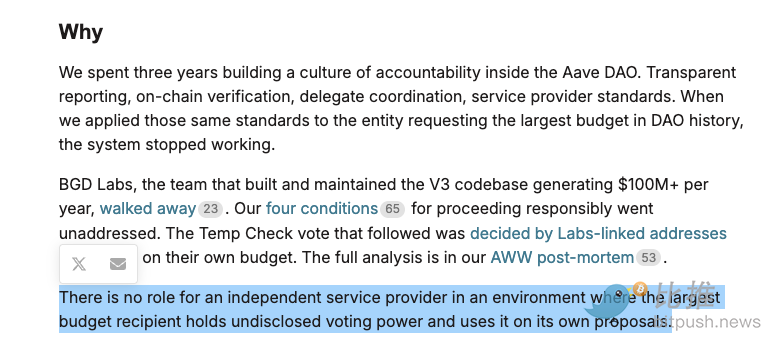
ACI founder Marc Zeller wrote: "If a major budget recipient can use its undisclosed voting power to force through its own proposals, then independent service providers lose their raison d'être within the DAO."

ACI did try to resolve the issue. Before the vote, it proposed four conditions, including stricter on-chain milestone tracking and restrictions on self-voting by budget recipients, but none were adopted.

This conflict reflects structural problems in DAO governance.

Aave Labs controls the codebase, brand domains, social media, and development discourse. BGD Labs maintains the main version V3—it contributes over 75% of the protocol's revenue and 97% of the total deposits. ACI is responsible for governance coordination and business development, claiming to have driven 61% of governance actions over the past three years, helping Aave's DeFi market share rise from less than 50% to over 65%.

These three teams were supposed to check and balance each other. But with BGD and ACI leaving one after another, the remaining power center, no matter how it表态 (states its position), is difficult to be fully trusted.

Stani Kulechov responded after ACI announced its exit: "Thank you Marc for years of contribution, the protocol will continue to operate normally."
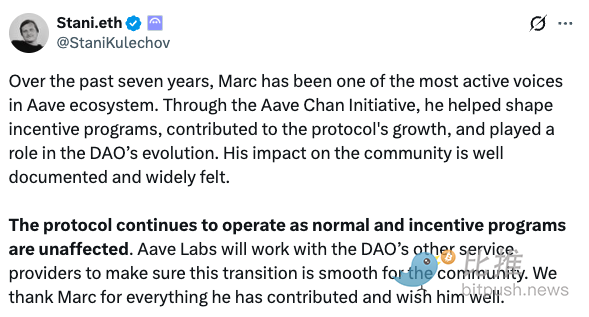
But this response did not address the core issue: when the people most capable of assessing the technical risks of V3 have left, how can the DAO feel confident betting its future on the untested V4?

Another noteworthy detail is that institutional investor Blockchain Capital stated afterwards that they were unable to participate in the snapshot vote with their held AAVE because their custody platform did not support it. This reveals another reality of DAO governance: nominally based on collective decision-making by token holders, voting power is often concentrated in the hands of a few.

DAO's Governance Dilemma

ACI stated that during the four-month transition period, it will transfer or open-source tools and responsibilities such as the governance dashboard, incentive framework, and committee roles. But some things are difficult to transfer: three years of accumulated governance experience, familiarity with protocol details, and the interpersonal network for coordinating different stakeholders.

Data shows that ACI spent $4.6 million from the DAO over the past three years, helping the GHO stablecoin grow from $35 million to $527 million. Who will take over these tasks in the future remains unknown.

This turmoil at Aave is essentially a microcosm of the DAO governance dilemma.

In theory, a DAO is a community of token holders. But in practice, governance is often dominated by the founding team, early investors, and core developers. These roles are both rule-makers, rule-enforcers, and sometimes budget recipients. When conflicts of interest arise, whether "procedural justice" is sufficient becomes the焦点 (focus) of controversy.

A DeFi practitioner commented: "This is not a question of who is right or wrong, but rather that the existing governance mechanisms do not provide an effective way to resolve conflicts when interests and positions diverge."

What Happens Next?

The ARFC (Request for Comments) stage revisions to the "Aave Will Win" proposal will be the first window to observe the direction of events. If the "structural improvements" promised by Kulechov can be implemented, such as unbundling the proposal and clarifying the boundaries of voting behavior, it might draw a line under this turmoil.

If consensus cannot be reached, the most extreme possibility is that BGD and ACI start anew, forking a new protocol. Although liquidity barriers are high, it's not impossible—the simultaneous departure of core developers and the governance team provides both the technical foundation and community basis for a fork.

For Aave, the immediate problem is how to fill the void left by the departure of the two core teams. The longer-term problem is how to find a more sustainable balance between the founder's vision, the interests of core developers, and the will of the community. If the paradox of "power concentration" cannot be resolved, even the strongest protocol may lose its first-mover advantage in endless internal friction.

Author: Bootly


Twitter:https://twitter.com/BitpushNewsCN

Bitpush TG Discussion Group:https://t.me/BitPushCommunity

Bitpush TG Subscription: https://t.me/bitpush

Original link:https://www.bitpush.news/articles/7616451

Trend Kriptolar

İlgili Sorular

QWhat was the immediate market reaction to the announcement of Aave Chan Initiative (ACI) shutting down operations?

AThe AAVE token price dropped by over 11%.

QWhat was the core accusation made by ACI in their exit statement regarding the 'Aave Will Win' proposal vote?

AACI alleged that a significant portion of the votes supporting the proposal came from addresses associated with Aave Labs, and that the vote might have failed without this 'self-voting'.

QWhat three main things were bundled together in the controversial 'Aave Will Win' proposal from Aave Labs?

AThe proposal bundled a request for ~$51M in funding for V4 development, the future redirection of all Aave brand product revenue to the DAO, and the establishment of Aave V4 as the sole technical base while phasing out V3.

QAccording to the article, what fundamental problem does Aave's crisis expose about DAO governance?

AIt exposes the structural problem where governance is often dominated by the founding team, early investors, and core developers, who are rule-makers, executors, and budget recipients, creating conflicts of interest that existing mechanisms struggle to resolve.

QWhat is one potential extreme outcome mentioned if a consensus cannot be reached after the departure of BGD Labs and ACI?

AThe most extreme possibility is that BGD and ACI could fork the protocol to create a new one, as their departure provides both the technical foundation and community basis for a fork.

İlgili Okumalar

Only 153 Venture Capital Firms Invested in July: Is the Crypto VC Industry Experiencing a 'Mass Extinction'?

In July 2026, only 153 unique venture capital firms participated in disclosed crypto funding rounds, marking the lowest monthly count since November 2020. This figure represents an 87% decline from the peak of 1,177 firms in 2022. Overall, the first seven months of 2026 saw crypto projects raise approximately $11.78 billion across 481 rounds. This crypto VC contraction contrasts sharply with the broader venture capital landscape, where global VC investment reached a record $560.4 billion in H1 2026, heavily fueled by major AI company financings. This shift in capital allocation has drawn funds away from the crypto sector. Within crypto, funding is highly concentrated. Trading platforms, prediction markets, and payment sectors absorbed 53% of the total capital. While early-stage deals remain frequent, the largest sums flow to a few late-stage rounds and mergers & acquisitions, which surged to $7.23 billion in Q2 2026. The market is consolidating around top funds like a16z crypto and Dragonfly, which successfully raised new multi-billion dollar funds, while many smaller firms have retreated. Analysts describe this as a "great extinction" for crypto VCs, where capital is becoming more selective, favoring proven business models and assets over early-stage speculation. This raises the bar for project quality, funding efficiency, and viable exit paths.

marsbit17 dk önce

Only 153 Venture Capital Firms Invested in July: Is the Crypto VC Industry Experiencing a 'Mass Extinction'?

marsbit17 dk önce

Strategy's Loss in the Second Quarter Reaches $8.22 Billion Amid Bitcoin Decline

Strategy, the largest corporate holder of Bitcoin, reported a net loss of $8.22 billion for the second quarter. This loss was primarily driven by an $8.32 billion unrealized loss on its Bitcoin holdings due to a decline in the asset's price during the period. Despite these paper losses, the company increased its Bitcoin holdings to 843,775 BTC, a 25% growth since the start of the year. As part of a new monetization strategy, Strategy sold approximately $218.4 million worth of Bitcoin, mainly to fund dividends for preferred shareholders, with $216 million of that sold after Q2 ended. The company also built a $3.75 billion cash reserve, which it claims is sufficient to cover over two years of dividend and interest payments, aiming to insulate itself from Bitcoin's volatility while meeting obligations. Following the earnings release, Strategy's stock (MSTR) rose 4.7% in regular trading but corrected slightly after-hours. This pattern reflects how the company's accounting results are heavily tied to Bitcoin's price swings, even as its long-term strategy remains unchanged. The report indicates that Strategy is maintaining its core strategy of accumulating Bitcoin while building a financial buffer. This quarterly loss follows a recognizable pattern, with the company posting significant unrealized losses in previous quarters (e.g., $12.4 billion in Q4 2025 and ~$12.5 billion in Q1 2026) due to fair-value accounting. A key technical shift is its new monetization program, which introduces periodic selling pressure on the market, transitioning Strategy from a pure accumulator to a participant that occasionally adds supply. A critical question remains: how long can the cash reserve cover dividend obligations if a Bitcoin price downturn persists beyond two years?

cryptonews.ru37 dk önce

Strategy's Loss in the Second Quarter Reaches $8.22 Billion Amid Bitcoin Decline

cryptonews.ru37 dk önce

Will Terrorist Durov Ban Russian Officials?

Telegram founder Pavel Durov publicly reacted to being labeled a "terrorist" by Russian authorities, stating the designation came after he refused demands for mass surveillance and censorship on the platform. In a Telegram post, he highlighted that this status formally bans him from "publishing information online." Durov concluded with a statement widely circulated: Russian officials "clearly don't understand who can ban whom on the internet." This remark suggests Durov could potentially restrict official Russian government and officials' channels on Telegram, which continue to operate on the platform despite its formal blocking in Russia. The situation parallels previous, slow-moving state directives, like switching officials to domestic cars, contrasted with the current push to migrate all government communication to the Russian-made messenger MAX by 2030. However, reports indicate many officials still use Telegram via workarounds, fearing surveillance on MAX, while alternatives like BiP and KakaoTalk recently became inaccessible in Russia without a VPN. Durov has not specified any immediate actions against state channels. His statement is an initial response, with further developments depending on the authorities' reaction. The dynamic differs from 2020 when Russian regulators lifted a block on Telegram; now, Durov implies control from within the platform itself over the official accounts that persisted through that earlier blockade.

cryptonews.ru37 dk önce

Will Terrorist Durov Ban Russian Officials?

cryptonews.ru37 dk önce

DeepSeek V4 Official Version Arrives, New Capabilities Emerge, Value-for-Money King Enters the Fray

On July 31st, DeepSeek officially launched the public API beta for its DeepSeek-V4-Flash model. A key highlight is its performance on multiple Agent benchmark tests, reportedly nearing or even surpassing the level of the V4-Pro preview version from three months ago. Notably, the Flash model achieves this with significantly smaller scale (130B active parameters vs. Pro's 490B), suggesting that post-training optimization and data quality may be as crucial as raw model size. DeepSeek emphasized that the V4-Flash-0731 uses the same model architecture and size as its preview version, with improvements attributed solely to "re-trained post-training." The update also marks the official debut of DeepSeek's self-developed Agent framework, "Harness." The move signals DeepSeek's strategic push to position its cost-effective Flash model as a competitive base for Agent applications—scenarios requiring autonomous planning, tool usage, and complex task execution—where inference speed and cost are critical. By natively supporting OpenAI's Responses API format and adapting for code-generation scenarios, DeepSeek aims not just to be a cheaper alternative but to establish its own ecosystem in the Agent era. This release follows DeepSeek's record-breaking ~$50 billion fundraising round roughly two months prior, underscoring market confidence in its technology and commercialization prospects. The company is reportedly preparing for another funding round at a valuation of approximately $71 billion. The Flash model's advancement represents a step in fulfilling the high expectations that come with this valuation, setting the stage for the impending release of the V4-Pro official version and intensifying competition in the global Agent landscape.

marsbit41 dk önce

DeepSeek V4 Official Version Arrives, New Capabilities Emerge, Value-for-Money King Enters the Fray

marsbit41 dk önce

İşlemler

Spot

Popüler Makaleler

ONE Nasıl Satın Alınır

HTX.com’a hoş geldiniz! Harmony (ONE) satın alma işlemlerini basit ve kullanışlı bir hâle getirdik. Adım adım açıkladığımız rehberimizi takip ederek kripto yolculuğunuza başlayın. 1. Adım: HTX Hesabınızı OluşturunHTX'te ücretsiz bir hesap açmak için e-posta adresinizi veya telefon numaranızı kullanın. Sorunsuzca kaydolun ve tüm özelliklerin kilidini açın. Hesabımı Aç2. Adım: Kripto Satın Al Bölümüne Gidin ve Ödeme Yönteminizi SeçinKredi/Banka Kartı: Visa veya Mastercard'ınızı kullanarak anında Harmony (ONE) satın alın.Bakiye: Sorunsuz bir şekilde işlem yapmak için HTX hesap bakiyenizdeki fonları kullanın.Üçüncü Taraflar: Kullanımı kolaylaştırmak için Google Pay ve Apple Pay gibi popüler ödeme yöntemlerini ekledik.P2P: HTX'teki diğer kullanıcılarla doğrudan işlem yapın.Borsa Dışı (OTC): Yatırımcılar için kişiye özel hizmetler ve rekabetçi döviz kurları sunuyoruz.3. Adım: Harmony (ONE) Varlıklarınızı SaklayınHarmony (ONE) satın aldıktan sonra HTX hesabınızda saklayın. Alternatif olarak, blok zinciri transferi yoluyla başka bir yere gönderebilir veya diğer kripto para birimlerini takas etmek için kullanabilirsiniz.4. Adım: Harmony (ONE) Varlıklarınızla İşlem YapınHTX'in spot piyasasında Harmony (ONE) ile kolayca işlemler yapın.Hesabınıza erişin, işlem çiftinizi seçin, işlemlerinizi gerçekleştirin ve gerçek zamanlı olarak izleyin. Hem yeni başlayanlar hem de deneyimli yatırımcılar için kullanıcı dostu bir deneyim sunuyoruz.

569 Toplam GörüntülenmeYayınlanma 2024.12.12Güncellenme 2026.06.02

ONE Nasıl Satın Alınır

Tartışmalar

HTX Topluluğuna hoş geldiniz. Burada, en son platform gelişmeleri hakkında bilgi sahibi olabilir ve profesyonel piyasa görüşlerine erişebilirsiniz. Kullanıcıların ONE (ONE) fiyatı hakkındaki görüşleri aşağıda sunulmaktadır.

活动图片