News of Europeans scrambling to buy Chinese air conditioners has been quite hot recently, but consider this possibility:
The ones who really need air conditioning might be AI supercomputers (doge).
Far away in the UK, something like this just happened:
Dawn, one of the UK's most powerful AI supercomputers, crashed for a whole week under temperatures just over 30 degrees Celsius.

This supercomputer, located at Cambridge University, has quite the pedigree:
A core component of the UK government's £300 million National AI Compute Plan, featuring 1024 Intel GPUs, 256 liquid-cooled servers, and already supporting over 350 research projects.
In January of this year, it received a £36 million upgrade and expansion, expected to boost performance sixfold.
Then at the end of June, a heatwave arrived, and it shut down.
Even more absurdly, the research running on this supercomputer included climate change simulations.
Wait, what? The machine used to predict global warming was defeated by global warming.
37.7°C: The 'Darkest Hour' for a National Supercomputer
Here's what happened.
This June, the UK experienced its most severe June heatwave on record.
On June 26th, Lingwood in Norfolk reached 37.7°C, smashing the previous June record of 35.6°C set in 1957 and 1976.
The UK Met Office issued a rare three-day red extreme heat warning.
Over 1000 schools closed, railway signals failed due to the heat, and road surfaces began to melt.
Then, on June 27th, as the peak of the day's heatwave arrived, the cooling system at the Cambridge West data centre housing the Dawn supercomputer failed.
(P.S. Lingwood and Cambridge are both in eastern England, about 103 km apart)
Dawn ground to a halt.

△
After the incident, a Cambridge University spokesperson stated:
Dawn experienced a technical issue during the hot weather. Cooling capacity has been fully restored, and access is expected to reopen on July 6th.
The specific cause wasn't disclosed, but the situation was this:
From June 27th to July 6th, Dawn was 'cooling down' for over a week.
For a supercomputer that costs money by the hour and advances scientific research every second, a week-long shutdown is terrifying.
And indeed, the deepest casualties have already emerged.

Professor Vendruscolo's team at Cambridge University was using Dawn for molecular screening of new Parkinson's drugs.
Dawn's machine learning capabilities could screen billions of molecules in days, searching for compounds that bind to protein aggregates linked to Parkinson's.
Traditional methods? Six months minimum, costing millions of pounds, and only covering a fraction of what Dawn could scan in a few hours.
A week-long shutdown meant this life-saving pipeline stopped dead.

Oxford University's Lennard Lee, lead of the UK's Cancer Vaccine AI & Supercomputing Project, whose team secured a 10,000 GPU-hour allocation on Dawn to use AI to accelerate the discovery of targets for personalized cancer vaccines.
Lee had previously said:
Discoveries that used to take years can now be made in weeks.
Although Lee later stated there was no data loss and no need to redo work, the relief in his words itself speaks to the severity of the issue.
Furthermore, the British Antarctic Survey's IceNet sea ice prediction model training on Dawn paused, Cambridge PhD student Bill McGough's AI kidney cancer screening project on Dawn halted... virtually none of the over 350 projects running on Dawn were spared.
And the cause of it all? A mere 37.7°C.
Okay, the 'culprit' has been identified. So, who is ultimately responsible?
Going round in circles, it seems no one wants to take the blame.
Dawn's cooling system was supplied by USystems, part of the French Legrand group. Afterwards, USystems issued a statement:
Our equipment performed normally, operating fully within design specifications throughout the incident.
Translation: The cooling failed, but it's not our fault; our equipment simply wasn't designed for this temperature.

So, were the design standards too conservative, or is climate change happening too fast?
The answer is likely: Both.
The historical extreme June temperature in the UK was only 35.6°C, and Dawn's cooling system was most likely designed for that magnitude.
37.7°C exceeded the spec.
And this 'exceedance' came with little warning, as the last time a record this high was set was nearly 50 years ago.
Furthermore, Dawn wasn't the only victim.
The same week, cooling unit failures at Queen Alexandra Hospital in Portsmouth, UK, led to a declared major incident.
Operating theatres stopped, cardiac catheter labs stopped, imaging departments stopped. The hospital told patients:
Please bring plenty of drinking water, as the hospital is very hot.

Norfolk and Norwich University Hospital (NNUH) fared even worse:
Cooling systems for all MRI scanners failed due to high heat and humidity, leading to the cancellation of at least 254 outpatient appointments.
So, in a sense:
It's not that the supercomputer is fragile; it's that the UK's entire temperature-control infrastructure wasn't prepared for this weather.
How Can the 30s (°C) Paralyze a Supercomputer?
Looking at a longer timeline, Dawn being crippled by heat is hardly surprising.
In July 2022, the UK experienced what was then its hottest day on record (40.3°C).
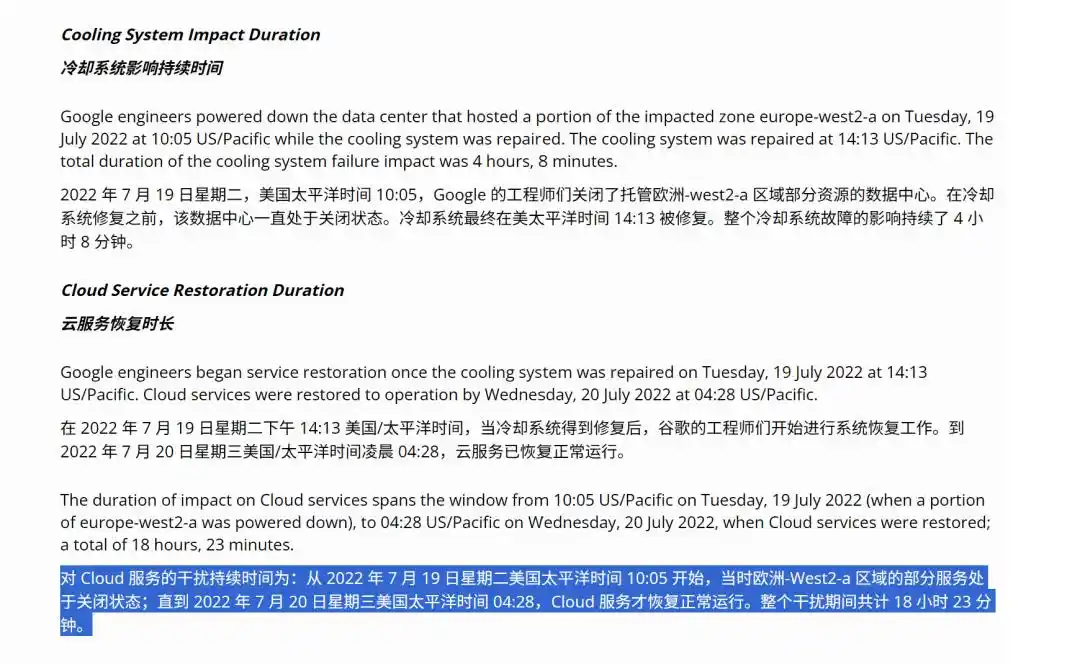
The cooling system at a Google London data centre suffered "multiple redundant system failures," forcing a shutdown to protect hardware. Google Cloud's London region services were disrupted for over 18 hours before full recovery.
△
An Oracle data centre in South London failed the same day. Oracle's statement used an interesting phrase: "unseasonably high temperatures."
From 2022 to 2026, four years later, a similar event plays out again.
One has to ask, is this problem so difficult that it can't be prevented in advance?
Actually, the 30s (°C) crippling a supercomputer does have its reasons, with the hardest bottleneck being heat dissipation.
Especially in Europe, facilities commonly use natural cooling, which is inherently limited by the outdoor ambient temperature.
How to understand this?
All cooling systems, no matter how advanced, must ultimately dump their heat into the outdoor air. Outdoor air temperature is the ultimate bottleneck for the entire chain.
The chain, when expanded, looks like this:
The chip transfers heat to the heatsink, the heatsink to coolant or air, the coolant to a cooling tower, and the cooling tower to the atmosphere.
The atmosphere is the final receiver.
So when the atmosphere itself is 37°C, it starts struggling to accept more.

Specifically, when outdoor temperature rises from 20°C to 37°C, the heat dissipation efficiency of cooling towers and dry coolers can plummet by 40% to 50%.
Why not just turn on the air conditioning? Because compressor efficiency drops in high heat, current draw increases, and they are prone to overheating and tripping.
Oracle's 2022 incident report stated verbatim: Two cooling units failed while being asked to operate beyond their design limits.

Dawn's situation this time is likely similar, one can reasonably speculate.
It uses Dell PowerEdge XE9640 servers equipped with direct liquid cooling, a far more advanced cooling solution than traditional air cooling.
Coolant flows directly over the chip surface, carrying away heat much more efficiently than blowing air.
But again, liquid cooling solves the efficiency inside the rack. After the heat is carried away by the coolant, it still must pass through the Coolant Distribution Unit, facility chilled water loop, cooling tower, and ultimately to the outdoor atmosphere. The final link is still constrained by outdoor temperature.
And once the cooling system fails, it triggers a chain reaction.
Research data shows that once cooling stops, server inlet temperatures can soar from 22°C to over 35°C within 5 minutes.
Faced with this, chips activate self-protection:
First, thermal throttling – actively reducing operating speed to decrease heat generation, causing performance to nosedive. If the temperature continues to rise beyond safe thresholds, forced shutdown kicks in.
At this point, operators have only two choices:
Let the equipment power down on its own, risking data corruption; Or proactively shut down in an orderly fashion, protecting hardware but halting operations.
Google, Oracle, and Cambridge's Dawn all chose the latter.
The Stronger AI Gets, the More It Fears Heat
There's more to worry about.
As AI data centres continue to 'inflate,' the impact of temperature on AI is likely to become increasingly significant.
A few days ago, watching Xiaolin's on-site visit to a Huawei data centre on Bilibili, one comparison was striking:
Traditional data centre racks have a power density of about 5 to 10 kilowatts, but AI training racks have reached 30 to 50 kW, with Nvidia's latest GB200 NVL72 rack hitting 120 to 132 kW (and the next-generation Rubin possibly reaching 600 kW).
What does that mean? A 100 kW AI rack's heat output is equivalent to turning on 50 electric heaters simultaneously in a space the size of a phone booth.
Imagine the little space heaters used in winter, then cramming all of them into a single server cabinet. That's the cooling pressure facing today's AI compute infrastructure.

△
Making matters worse, GPUs themselves are becoming 'hotter.'
Nvidia's V100 from 2017 was about 300 watts, the H100 in 2023 jumped to 700 watts, the B200 in 2024 reached 1000 watts, and the B300 and AMD MI355X in 2025-2026 directly hit 1400 watts.
In seven years, single-chip heat output has increased 3 to 5 times.
So, whether from quantity or individual chips, as AI grows stronger, it becomes more afraid of heat and more in need of cooling.
Thus, we can see two colliding curves:
Chips are getting exponentially hotter, and the Earth is also warming at an accelerating pace.
The situation is becoming more棘手.
Google went to Finland to build a data centre as early as 2011, Meta went to northern Sweden, all to use cold climates as natural heat sinks.
Musk even thought of building AI data centres in space.
But the UK government just poured £36 million into expanding Dawn this January and is planning a new national supercomputer in Edinburgh.
Were the cooling designs for these facilities calculated based on British summers of the past era, or the new normal that is arriving? It's hard to say for sure.

But one thing is certain:
The supercomputer used to predict climate change was shut down by climate change-induced heat.
This is no longer a joke; it's a real challenge facing infrastructure in the AI era.
Reference Links:
[1]https://www.thetimes.com/uk/science/article/cambridge-ai-supercomputer-heatwave-shutdown-ns7rcmkgs
[2]https://www.datacenterdynamics.com/en/news/data-center-housing-uks-dawn-supercomputer-suffers-heatwave-related-outage-report/
[3]https://x.com/cashandcarrots/status/2074016783812505762
This article is from the WeChat public account "Quantum Bit," author: Yi Shui