Ставки хедж-фондов против доллара достигли максимума за 20 лет

cryptonews.ru2025-04-25 tarihinde yayınlandı2025-11-26 tarihinde güncellendi

Крупный капитал агрессивно наращивает ставки на снижение американской валюты. Текущий объем позиций достиг уровней, которые не наблюдались в течение последних двух десятилетий. Индекс позиционирования показывает, что фонды находятся в зоне экстремальных продаж.

Историческая статистика свидетельствует, что подобная ситуация часто предшествует восстановлению курса, а не его дальнейшему падению.

Рекордные ставки против доллара США как угроза для рынка криптовалют

Аналитик Гильерме Таварес отметил риски данной рыночной конфигурации. По его мнению, такая согласованность действий трейдеров создает опасность резкого разворота.

“Хедж-фонды удерживают значительные короткие позиции по DXY, а исторически подобные уровни часто предшествуют хорошим возможностям для покупки – по крайней мере, для краткосрочного отскока. Когда торговля становится слишком переполненной, обычно стоит рассмотреть противоположную сторону”, – написал он.

За минувшие 20 лет каждый случай масштабных продаж американской валюты завершался одинаково. Происходил рост котировок, который вынуждал спекулянтов экстренно закрывать убыточные сделки.
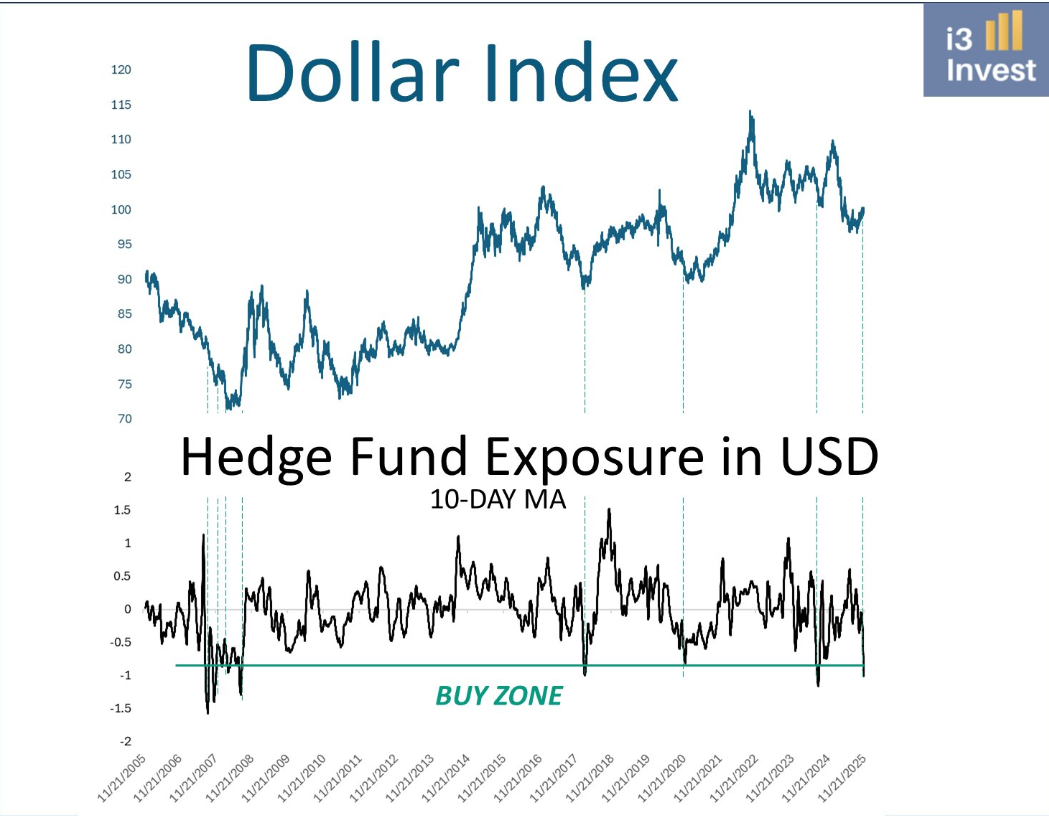
Экспозиция хедж-фондов по DXY
Экспозиция хедж-фондов по DXY. Источник: Tavares on X

Макроэкономические факторы и ликвидность

Аналитическая группа EndGame Macro также выпустила предупреждение для участников рынка. Эксперты подчеркивают, что экстремальное позиционирование редко формируется в спокойных условиях. Фонды играют на понижение уже ослабевшего актива. Следовательно, финансовая система становится уязвимой к любым изменениям настроений или ликвидности.

Фундаментальная среда сейчас не поддерживает продолжение девальвации нацвалюты США. Долговой рынок уже учел в ценах будущие действия ФРС. Глобальный экономический рост замедляется. Условия финансирования в долларах ужесточаются. Эти факторы повышают вероятность смены тренда.

“Такая ситуация не гарантирует бычьего роста доллара, но говорит о том, что возможности снижения, скорее всего, ограничены”, – считает аналитик EndGame Macro.

Влияние динамики DXY на биткоин

Отраслевые эксперты продолжают указывать на обратную корреляцию между индексом доллара и цифровыми активами. Рост курса американской валюты традиционно оказывает давление на котировки биткоина.

“Доллар растет = плохо для криптовалют. Доллар вниз = хорошо для криптовалют. Если доллар продолжит расти до 2026 года… возможно, вам придется поцеловать этот любимый бычий рынок на прощание”, – предупреждает аналитик Milk Road.

Существует риск резкого восстановления котировок на фоне принудительного закрытия коротких позиций. Это создаст длительное давление на индустрию в период ожидаемого цикла роста.

Технические сигналы к смене тренда

Специалисты по техническому анализу фиксируют сигналы пробоя на графике индекса DXY. По данным трейдера Daan Crypto, котировки впервые за девять месяцев закрылись выше 200-дневной скользящей средней. Это может означать завершение нисходящего тренда, который длился около восьми месяцев.

“Это не идеально для рисковых активов и оказывает давление на них… Нужно следить”, – сказал он.

Слабость иены и снижение аппетита к риску после недавней волатильности усиливают технический импульс. Если фонды начнут массово ликвидировать короткие позиции, доллар продемонстрирует уверенный рост. Это негативно скажется на стоимости биткоина и фондовых индексов. Ближайшие недели станут определяющими для среднесрочных перспектив крипторынка.


İlgili Okumalar

Financing Weekly Report | 11 Public Financing Events, Stablecoin Payment Infrastructure Company Trace Finance Completes $32 Million Series A Round Led by CoinFund

Financing Weekly Report | 11 public funding events recorded, with a total scale exceeding $264 million. The stablecoin payment infrastructure sector remains a hot spot. Key Deals: - Trace Finance, a stablecoin payment infrastructure firm, raised $32 million in a Series A round led by CoinFund to expand in Latin America and Asia-Pacific. - Galaxy Ventures co-led a $140 million Series A round for Karta, a US credit card provider for global travelers without requiring an SSN. - Instant payment platform Interchecks completed a $50 million Series C round. - Paradigm led a $9 million Series A for Latin American cross-border payment app El Dorado. - Range, a stablecoin compliance startup, raised $8.3 million in an oversubscribed Series A. - RWA infrastructure project Renaiss raised $1.5 million to expand its on-chain collectibles platform. Sector Breakdown: - Infrastructure & Tools: 6 deals, including the above-mentioned Trace Finance, Range, and Renaiss. - Centralized Finance (CeFi): 3 deals, led by Karta's $140 million round. - DeFi: 1 deal – reinsurance protocol Re secured strategic investment from Coinbase Ventures. - Prediction Markets: 1 deal – K25.ai completed a $10 million Pre-A round from NewGen. Other notable transactions include digital asset depository RDC raising $7 million, ad-tech startup EarnOS securing $6 million, and a $1 million strategic investment in LitVM, a ZK Layer 2 for Litecoin. The report highlights sustained investor interest in stablecoin payment infrastructure, compliant on-chain finance, and real-world asset (RWA) tokenization.

marsbit31 dk önce

Financing Weekly Report | 11 Public Financing Events, Stablecoin Payment Infrastructure Company Trace Finance Completes $32 Million Series A Round Led by CoinFund

marsbit31 dk önce

When Transfers Become Truly Frictionless: How Sui Uses 'Zero Gas' to Become the Underlying Infrastructure for Stablecoin Payments

Title: Sui Launches Zero-Gas Stablecoin Transfers to Become the Foundation for Stablecoin Payments Sui has introduced a zero-gas fee feature for peer-to-peer stablecoin transfers, eliminating the need for users or businesses to hold separate SUI tokens to pay transaction costs. This innovation, built on a new underlying account architecture called Address Balances, significantly reduces validator processing costs for eligible transactions. Currently, the feature applies to a whitelist of stablecoins for transfers meeting a minimum amount, effectively preventing spam. This development aims to unlock mainstream payment use cases for stablecoins—such as everyday purchases, remittances, and subscriptions—by removing cost and complexity barriers. It is also positioned to benefit high-frequency micro-payments for AI agents and institutional B2B payments, reducing operational friction. Major custody provider Fireblocks has already announced support. The move follows Sui processing over $1 trillion in stablecoin transfer volume since August 2025. Looking ahead, Sui plans to enhance this infrastructure with protocol-level confidential transactions later in 2026, aiming to provide scalable, free, and privacy-preserving payments. Together, these advancements strengthen Sui's goal of becoming the default settlement layer for stablecoin payments.

marsbit33 dk önce

When Transfers Become Truly Frictionless: How Sui Uses 'Zero Gas' to Become the Underlying Infrastructure for Stablecoin Payments

marsbit33 dk önce

Ethereum Is Retracing the Path of the Internet and Linux: No One Yields, and the Neutral Party Ultimately Prevails

This article argues that Ethereum is following the historical path of open, neutral systems like the Internet and Linux, which eventually triumphed over proprietary, centrally-controlled alternatives. Major financial institutions like JPMorgan, Stripe, and Circle are building their own proprietary blockchains or networks (e.g., Tempo, Arc), but will never agree to build on a competitor's controlled infrastructure. This creates the perfect opportunity for Ethereum as the only neutral, credibly neutral settlement layer that no single entity controls. The piece draws parallels to the 1990s, when experts like Bill Gates predicted proprietary networks (from Microsoft, Oracle) would win over the open Internet, and when Sun Microsystems' Unix lost to the open-source "bazaar" development model of Linux. This model, described in Eric Raymond's "The Cathedral and the Bazaar," thrives on permissionless innovation where countless contributors improve the system, outpacing any centralized competitor. Ethereum embodies this through its decentralized development, broad validator distribution, and credible neutrality—rules that are transparent, equally applied, hard to change, and open to all. This has attracted over a million developers and major institutions like Coinbase, BlackRock, and JPMorgan, who choose Ethereum for its security, ecosystem, and sovereignty (the inability of any single party to change the rules). While proprietary chains offer initial speed and control, they inherit the downsides of both centralization and decentralization without the long-term innovation benefits. The article concludes that, just as open systems historically win, Ethereum is poised to become the foundational, neutral settlement layer for global finance.

marsbit42 dk önce

Ethereum Is Retracing the Path of the Internet and Linux: No One Yields, and the Neutral Party Ultimately Prevails

marsbit42 dk önce

Kalshi's Biggest Rival is Not Polymarket

Kalshi's CEO Tarek Mansour has identified the company's primary competitors not as the crypto-based prediction market Polymarket, but as established financial and gaming giants: CME Group, Robinhood, and DraftKings. This reflects a shift in the prediction market landscape, where the 2026 FIFA World Cup is expected to bring massive new trading volume. Traditional platforms are increasingly integrating prediction markets as a feature within their existing ecosystems. Robinhood has seen rapid growth with its prediction markets, contributing significantly to its "other transaction revenue." Similarly, Interactive Brokers (IBKR) integrates contracts from Kalshi and CME Group, while DraftKings and FanDuel (via CME) have launched their own prediction products. This allows these firms to leverage their vast user bases and infrastructure at low marginal cost, turning prediction markets from standalone apps into embedded functionalities. In response, prediction market platforms are evolving along two paths. First, they are expanding into new event categories like sports (e.g., the World Cup) and financial data to reduce reliance on election cycles. Second, they are moving towards becoming infrastructure and liquidity providers for distribution platforms. Kalshi's lead over Polymarket in trading volume is partly attributed to this channel strategy, integrating with brokers like Robinhood, Coinbase, and Webull. However, this strategy faces a challenge as distributors like Robinhood begin building their own in-house prediction market capabilities (e.g., Rothera), potentially threatening the value of pure infrastructure providers. The situation parallels historical tech battles, such as Zoom competing with Microsoft Teams and Google Meet, where embedded features in larger platforms reshape market dynamics. The future of standalone prediction market leaders like Kalshi and Polymarket will depend on their ability to navigate this new competitive landscape dominated by integrated financial and gaming titans.

链捕手49 dk önce

Kalshi's Biggest Rival is Not Polymarket

链捕手49 dk önce

İşlemler

Spot
Futures
活动图片