Over 65 Crypto Firms Unite In Letter To Trump: Lead Or Fall Behind

bitcoinist2025-11-22 tarihinde yayınlandı2025-11-22 tarihinde güncellendi

Özet

According to reports, more than 65 crypto firms and advocacy groups have sent a joint letter to US President Donald...

Trusted Editorial content, reviewed by leading industry experts and seasoned editors. Ad Disclosure

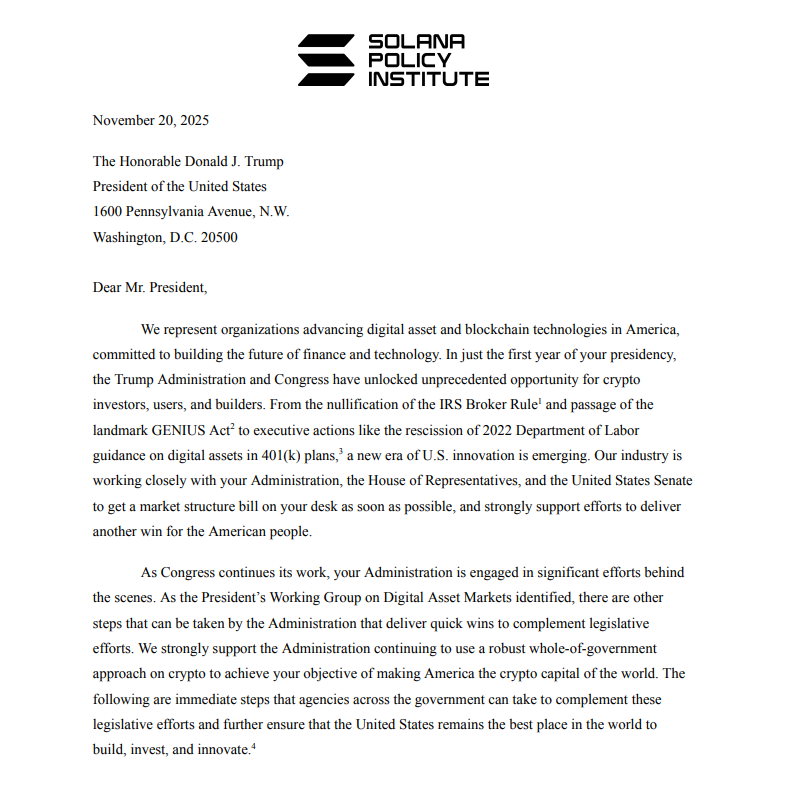
According to reports, more than 65 crypto firms and advocacy groups have sent a joint letter to US President Donald Trump urging immediate action to clarify tax and regulatory rules for digital assets.

The groups said agencies can move now to protect US innovation without waiting for Congress, and they laid out a set of specific fixes they want applied quickly.

The letter was signed by some of the biggest names in the blockchain and crypto industry, including Coinbase, Uniswap Labs, Exodus, Pantera, the Blockchain Association, the Solana Foundation, and the Solana Policy Institute, which helped lead the effort.

Reports also say other groups such as Block, Paradigm, Multicoin Capital, and the Crypto Council for Innovation joined the call for immediate action.

Tax Rules And Developer Protections

The letter asks for clearer tax treatment for everyday crypto activity, including a call to treat staking and mining rewards as self-created property that would be taxed only when sold or converted, not when received.

The groups also proposed a “de minimis” carve-out — an example figure mentioned in coverage was $600 — to avoid taxing tiny transfers that users don’t think of as taxable events.

The signers want rules that say routine operations like bridges, forks, airdrops, collateral moves, and liquidations should not automatically trigger tax events.
Regulators Urged To Move First

Industry leaders told the White House that agencies such as the SEC, CFTC, Treasury and DOJ can grant interim guidance, “no-action” letters, or exemptive relief to give builders room to work.

Reports say the groups pressed for targeted safe harbors and regulatory sandboxes to protect developers who publish open source code and to support self-custody options for everyday users. The push is framed as a short-term administrative fix while longer rulemaking proceeds.

BTCUSD trading at $85,298 on the 24-hour chart: TradingView

A Call Over A High-Profile Case

The coalition also asked the administration to urge the Department of Justice to drop or reconsider charges against Roman Storm, the developer tied to Tornado Cash, arguing that his work should be treated as publishing software rather than a criminal act.

That request reflects broader industry concern about cases that, they say, blur the line between building code and committing a crime.

Where This Fits In The White House Agenda

The letter lands in the context of an executive push on crypto that began with an order signed on January 23, 2025, which set up a Presidential Working Group on Digital Asset Markets to coordinate a whole-of-government approach.

The industry frames the new letter as a practical follow-up: these are steps agencies could take now to make the rules clearer while the working group’s longer reports and proposals move forward.

Featured image from CP Image/Policy Options, chart from TradingView

Editorial Process for bitcoinist is centered on delivering thoroughly researched, accurate, and unbiased content. We uphold strict sourcing standards, and each page undergoes diligent review by our team of top technology experts and seasoned editors. This process ensures the integrity, relevance, and value of our content for our readers.

Christian, a journalist and editor with leadership roles in Philippine and Canadian media, is fueled by his love for writing and cryptocurrency. Off-screen, he's a cook and cinephile who's constantly intrigued by the size of the universe.

İlgili Okumalar

Media: Anthropic Aims for Revenue Up to $200 Billion by 2028 Ahead of IPO

Anthropic, the AI company behind Claude, is reportedly projecting its revenue could reach between $190 billion and $200 billion by 2028, according to sources cited by Reuters. This forecast, significantly higher than its reported $47 billion annual run-rate in May 2026, is being used by investors and bankers to value the company ahead of a potential IPO. Anthropic has confidentially filed with the SEC, with listing details dependent on market conditions and regulatory approval. The valuation reportedly applies a revenue multiple (EV/Revenue) to these future 2028 figures, an approach common for high-growth tech firms but unusual for a forecast two years ahead of an IPO. This reflects confidence in Anthropic's rapid scaling; its annual run-rate grew tenfold yearly for three years leading into 2026, jumping from ~$9B in late 2025 to over $47B by May 2026. Investors are betting the company's massive spending on GPUs, model training, and infrastructure will eventually outpace costs, leading to expanding margins. Public companies like Palantir, Cloudflare, and SpaceX, valued at high multiples of their forward revenue, serve as benchmarks. While this forward-looking method has precedents, some analysts question the sustainability of such valuations and the actual productivity gains from AI. Despite these concerns, earlier reports suggested Anthropic could be valued at over $1 trillion for its IPO.

cryptonews.ru11 dk önce

Media: Anthropic Aims for Revenue Up to $200 Billion by 2028 Ahead of IPO

cryptonews.ru11 dk önce

Open Blockchain Business: Who Gets the Fees and Why a Foundation is Needed

Business of Open Blockchain: Who Gets the Fees and Why a Foundation is Needed In public blockchains, user transaction fees do not simply become "revenue" for a single entity. The flow of money is complex and protocol-dependent. In Ethereum, fees consist of a base fee (burned, permanently removing ETH from circulation) and a priority tip (paid to the validator). In Solana, half the base fee is burned and half goes to the validator, while priority fees go entirely to validators. Thus, "fees" are not synonymous with "project revenue"; they may go to network operators or be destroyed. Foundations like the Ethereum Foundation do not take a cut of user fees. They are funded by their own treasuries, which can generate income (e.g., from staking rewards) and finance ecosystem development, research, and security. Their role is to fund public goods that are hard to monetize directly. Developers of open-source blockchain code can monetize through services, not the code itself. For example, Optimism provides its technology freely but sells enterprise support and managed services (OP Enterprise). Additionally, networks built on Optimism's tech, like Coinbase's Base, share a portion of their revenue with the Optimism ecosystem via agreements, creating an economic link. Token holders do not automatically receive fees as dividends. In Optimism, a portion of protocol revenue is now used to buy back and treasury-lock OP tokens, creating an indirect link between network usage and token economics. In Ethereum, fee burning reduces ETH supply but doesn't distribute funds to all holders; stakers and validators receive direct rewards. For evaluation, analysts should look beyond total fee figures. Key questions are: Who paid and for what? Where did the money go (to validators, operators, treasury, or burning)? What were the recipient's costs? Is there a mechanism linking this income to the token? The same fee amount impacts different blockchain economies in vastly different ways depending on these factors.

cryptonews.ru13 dk önce

Open Blockchain Business: Who Gets the Fees and Why a Foundation is Needed

cryptonews.ru13 dk önce

İşlemler

Spot
活动图片