How This Cardano Holder Lost $6.09 Million In Minutes Due To On-Chain Liquidity Issues

bitcoinist2025-11-19 tarihinde yayınlandı2025-11-19 tarihinde güncellendi

Özet

A Cardano holder has experienced a staggering financial blow this week, losing over $6 million worth of ADA in just...

Trusted Editorial content, reviewed by leading industry experts and seasoned editors. Ad Disclosure

A Cardano holder has experienced a staggering financial blow this week, losing over $6 million worth of ADA in just minutes due to on-chain liquidity issues. The funds, which had been sitting dormant for nearly five years, vanished almost instantly during the massive swap. The incident raises alarm regarding the risks involved in using Decentralized Exchanges (DEXs) and the importance of understanding liquidity and slippage before executing large trades. 

Cardano Holder Loses Over $6 Million ADA In Minutes

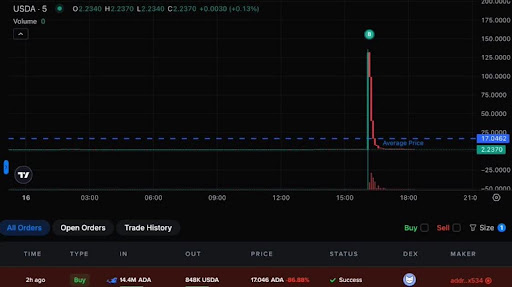
A new report from a famous on-chain sleuth, ZachXBT, revealed a jaw-dropping loss for a Cardano investor. The user had swapped 14.4 million ADA, valued at approximately $6.9 million, for 847,000 USDA, a stablecoin pegged to ADA.  The transaction occurred just two hours before the report became public, revealing that the investor had lost approximately $6.05 million, wiping out more than 80% of his initial investment. 

ZachXBT has said that the dramatic loss was likely due to extremely thin liquidity in the trading pool, which caused the price of ADA to spike temporarily during the swap. Vladimir S., a threat researcher who shared ZachXBT’s findings on X from his Telegram group, speculated that the Decentralized Exchange interface where the transaction occurred probably did not provide clear, low-liquidity warnings for a swap of that magnitude. 
Cardano
Source: Chart from ZachXBT on X

Vladimir suggested that an Over-The-Counter (OTC) deal would have been a much safer alternative for a $6.9 million ADA swap. Notably, this case highlights how even long-term crypto holders can suffer major losses when they do not fully understand how DEXs work.

Community Weighs In On Liquidity Issues And Slippage Warnings

ZachXBT’s report sparked extensive discussions among crypto traders and analysts, who pointed out that the $6.9 million ADA swap carried a staggering high price impact of 87.433%. Many in the community noted that the transaction was executed on the Minswap DEX, where users are required to actively acknowledge and consent to high slippage warnings to confirm trades.

Some members argued that the $6.05 million loss could have been avoided if the user paid attention to the interface and the obvious warnings displayed for transactions exceeding typical slippage thresholds. Responding to Vladimir’s speculation about a lack of clear liquidity warnings, other community members confirmed that Minswap always provides visible alerts for low liquidity swaps. Large slippage percentages, typically above 3-5%, are displayed in bright red texts, making it almost impossible for traders to miss. 

Some observers suggested that the Cardano holder may have misunderstood the interface, possibly due to language barriers or a lack of familiarity with decentralized finance mechanisms. Regardless of the reasons, this incident serves as a clear reminder for crypto users to pay attention to liquidity and slippage alerts when executing high-value swaps.

Cardano
ADA trading at $0.46 on the 1D chart | Source: ADAUSDT on Tradingview.com
Featured image from Adobe Stock, chart from Tradingview.com
Editorial Process for bitcoinist is centered on delivering thoroughly researched, accurate, and unbiased content. We uphold strict sourcing standards, and each page undergoes diligent review by our team of top technology experts and seasoned editors. This process ensures the integrity, relevance, and value of our content for our readers.

Scott Matherson is a leading crypto writer at Bitcoinist, who possesses a sharp analytical mind and a deep understanding of the digital currency landscape. Scott has earned a reputation for delivering thought-provoking and well-researched articles that resonate with both newcomers and seasoned crypto enthusiasts. Outside of his writing, Scott is passionate about promoting crypto literacy and often works to educate the public on the potential of blockchain.

İlgili Okumalar

Wall Street's 'Compliance Hunt': The Great Stablecoin Reserve Migration

In a concentrated move over the past week, several Wall Street giants have advanced their tokenized money market fund initiatives, signaling a strategic shift driven by impending U.S. stablecoin regulations. JPMorgan Chase launched its second such fund, JLTXX, on Ethereum, explicitly targeting future stablecoin issuer reserve needs. Concurrently, Franklin Templeton partnered with Kraken to integrate its BENJI tokenized funds onto the exchange platform for use as collateral and cash management tools. BlackRock further solidified its position by filing for two new tokenized funds with the SEC, aiming to convert its massive traditional stablecoin custody business into a tokenized model. These parallel developments represent a multi-pronged institutional "compliance hunt" to capture future crypto liquidity. BlackRock and JPMorgan are focusing on the backend, preparing to serve as the core reserve and settlement infrastructure for compliant stablecoins as outlined by the GENIUS Act. This act defines strict "qualified reserve asset" requirements for stablecoin backing while prohibiting interest payments to holders. Franklin Templeton and Kraken, however, are exploiting a potential regulatory gap. By offering a tokenized fund (BENJI) that is not a stablecoin, they aim to provide yield-bearing, collateralizable digital cash instruments, circumventing GENIUS Act's ban on stablecoin yield. The impending CLARITY Act, which will delineate digital asset market structure, is seen as a complementary piece to GENIUS. Its treatment of passive income could solidify the niche for instruments like BENJI. With conservative market size estimates for tokenized money market funds reaching hundreds of billions by 2030, Wall Street institutions are positioning themselves early, using on-chain settlement as a key competitive differentiator to offer superior liquidity and composability for the next generation of dollar reserves.

marsbit40 dk önce

Wall Street's 'Compliance Hunt': The Great Stablecoin Reserve Migration

marsbit40 dk önce

Altman Drops Bombshell While Musk is Away: He Once Wanted His Children to Inherit OpenAI

In a California court, Sam Altman testified for the first time in the ongoing legal battle between Elon Musk and OpenAI. Altman made a striking claim: Musk once suggested that control of OpenAI could one day be passed down to his children. This statement reframes the long-standing conflict not as a simple governance dispute but as a foundational power struggle. Altman sought to counter the narrative that OpenAI betrayed its original non-profit, idealistic mission. He argued that from the beginning, it was Musk who sought increasing control over the organization, including a larger equity stake and ultimate decision-making authority. Altman opposed this, citing OpenAI's core principle that AGI should not be controlled by any single individual. He also addressed the key point of contention about OpenAI's shift to a for-profit structure, claiming Musk was aware of and initially supportive of exploring such a model to secure the massive funding needed for advanced AI research. Altman framed the change as a practical necessity, not a betrayal. Further testimony revealed internal concerns after Musk left OpenAI's board, with worries he might take retaliatory action. Altman critiqued Musk's management style as unsuitable for a research lab, damaging morale and culture. Throughout his testimony, Altman's focus appeared to shift from technological idealism to the realities of organizational governance and resource requirements. Regarding his brief ouster in 2023, Altman stated he seriously considered joining Microsoft but ultimately returned because OpenAI was too important to abandon.

marsbit1 saat önce

Altman Drops Bombshell While Musk is Away: He Once Wanted His Children to Inherit OpenAI

marsbit1 saat önce

İşlemler

Spot
Futures

Popüler Makaleler

ADA Nasıl Satın Alınır

HTX.com’a hoş geldiniz! Cardano (ADA) satın alma işlemlerini basit ve kullanışlı bir hâle getirdik. Adım adım açıkladığımız rehberimizi takip ederek kripto yolculuğunuza başlayın. 1. Adım: HTX Hesabınızı OluşturunHTX'te ücretsiz bir hesap açmak için e-posta adresinizi veya telefon numaranızı kullanın. Sorunsuzca kaydolun ve tüm özelliklerin kilidini açın. Hesabımı Aç2. Adım: Kripto Satın Al Bölümüne Gidin ve Ödeme Yönteminizi SeçinKredi/Banka Kartı: Visa veya Mastercard'ınızı kullanarak anında Cardano (ADA) satın alın.Bakiye: Sorunsuz bir şekilde işlem yapmak için HTX hesap bakiyenizdeki fonları kullanın.Üçüncü Taraflar: Kullanımı kolaylaştırmak için Google Pay ve Apple Pay gibi popüler ödeme yöntemlerini ekledik.P2P: HTX'teki diğer kullanıcılarla doğrudan işlem yapın.Borsa Dışı (OTC): Yatırımcılar için kişiye özel hizmetler ve rekabetçi döviz kurları sunuyoruz.3. Adım: Cardano (ADA) Varlıklarınızı SaklayınCardano (ADA) satın aldıktan sonra HTX hesabınızda saklayın. Alternatif olarak, blok zinciri transferi yoluyla başka bir yere gönderebilir veya diğer kripto para birimlerini takas etmek için kullanabilirsiniz.4. Adım: Cardano (ADA) Varlıklarınızla İşlem YapınHTX'in spot piyasasında Cardano (ADA) ile kolayca işlemler yapın.Hesabınıza erişin, işlem çiftinizi seçin, işlemlerinizi gerçekleştirin ve gerçek zamanlı olarak izleyin. Hem yeni başlayanlar hem de deneyimli yatırımcılar için kullanıcı dostu bir deneyim sunuyoruz.

1.3k Toplam GörüntülenmeYayınlanma 2024.12.10Güncellenme 2025.03.21

ADA Nasıl Satın Alınır

Tartışmalar

HTX Topluluğuna hoş geldiniz. Burada, en son platform gelişmeleri hakkında bilgi sahibi olabilir ve profesyonel piyasa görüşlerine erişebilirsiniz. Kullanıcıların ADA (ADA) fiyatı hakkındaki görüşleri aşağıda sunulmaktadır.

活动图片