Артур Хейс назвал Zcash вторым крупнейшим активом в своем портфеле после биткоина

cryptonews.ru2025-08-09 tarihinde yayınlandı2025-11-10 tarihinde güncellendi

Соучредитель BitMEX Артур Хейс раскрыл, что Zcash теперь является второй по величине позицией в его семейном офисе Maelstrom, уступая только биткоину.

«Из-за быстрого роста цены ZEC теперь является второй по величине ЛИКВИДНОЙ позицией в портфеле MaelstromFund после BTC», — написал он в публикации на платформе X в пятницу.

Это раскрытие происходит на фоне резкого роста Zcash, который поднялся с минимума в $137 до более чем $730 за последний месяц, что представляет собой увеличение более чем на 400%.

Другие монеты конфиденциальности также показали сильный недельный рост: Dash, Decred и ZKsync выросли более чем на 100%. Однако основные криптовалюты, такие как биткоин и эфир, оставались в диапазоне на фоне общей неопределенности на рынке.

Zcash снижается на 12% после мощного ралли

На момент написания статьи ZEC торгуется на уровне $548, снизившись примерно на 11,8% за последние 24 часа, с рыночной капитализацией в $8,9 млрд по данным CoinMarketCap. Торговая активность остается повышенной: объем торгов за 24 часа вырос на 139% до $4,63 млрд.
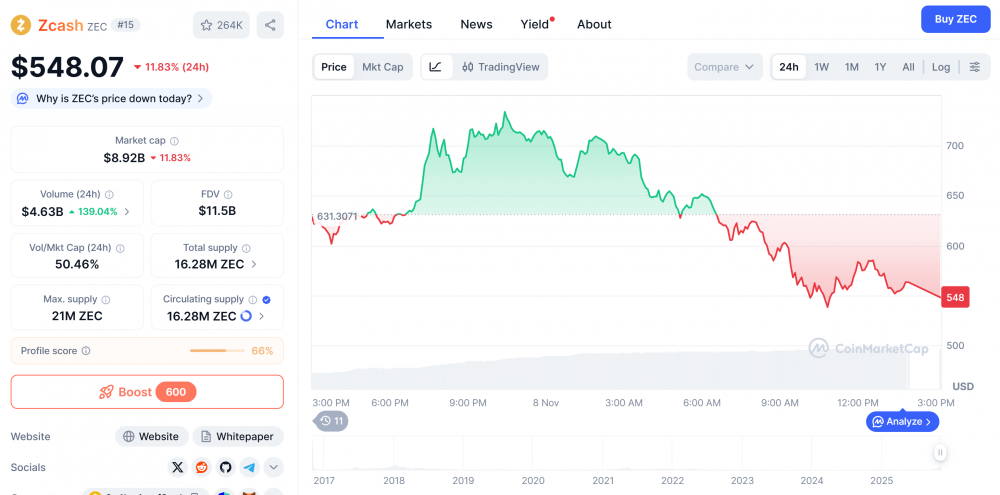

ZEC снижается после мощного ралли. Источник: CoinMarketCap

Объем обращения Zcash составляет 16,28 млн ZEC при максимальном предложении в 21 млн монет. Полная разводненная стоимость токена составляет около $11,5 млрд.

Гибридная модель Zcash, которая поддерживает как прозрачные, так и защищенные транзакции, сделала его более приемлемым вариантом. Как и биткоин, он имеет фиксированное предложение в 21 млн монет и защищен механизмом доказательства работы.

Возрождение Zcash связано с движением за конфиденциальность

Исполнительный директор Фонда Zcash Алекс Борнштейн заявил, что недавний рост популярности Zcash был полностью органичным. Он объяснил его растущей озабоченностью общества проблемами государственного наблюдения и контроля над данными. Выступая в шоу Chain Reaction, Борнштейн отметил, что возобновившийся интерес отражает мощный тренд в сторону цифровой конфиденциальности и финансовой самостоятельности.

Борнштейн пояснил, что Фонд Zcash, зарегистрированная в США некоммерческая организация, не имеет никакого отношения к новой волне внимания к ZEC.

«Мы были удивлены, когда начали появляться эти упоминания. Затем наблюдать, как эта волна начала распространяться и набирать силу, было невероятно», — сказал он.

İlgili Okumalar

Hegotá EIP Comprehensive Overview: Where is Ethereum's Next Hard Fork Headed?

The article outlines Ethlabs' recommended priorities for the upcoming Ethereum Hegotá hard fork, following Glamsterdam. The core focus areas are: 1. **Stronger censorship resistance** via EIP-7805 FOCIL (already in SFI stage). 2. **A faster Ethereum** by shortening the slot time via EIP-8198 Quick Slots (S-tier recommendation). This aims to reduce transaction confirmation latency and improve cross-chain interoperability. 3. **Native account abstraction** through EIP-8141 Frame Transactions (A-tier). This enables passkey wallets, gas sponsorship, and batched transactions. Its flexibility allows for custom validation logic and future post-quantum security but presents ecosystem coordination challenges. 4. **Continued L1 scaling** by optimizing resource pricing with proposals like EIP-8131 & EIP-8279 (S-tier) to prepare for future gas limit increases. The article uses a tiered system (S, A, B, D) to rank proposed EIPs based on their value and implementation feasibility. It advises strictly controlling the scope of Execution Layer (EL) changes in Hegotá to reserve developer bandwidth for future large-scale upgrades like decoupled consensus. Other notable proposals include EIP-8363 for staking issuance changes (requiring broad community consensus), various post-quantum preparation EIPs, and zkEVM optimizations. Ethlabs emphasizes that Ethereum upgrades are complex, high-risk endeavors requiring coordination across the entire ecosystem.

marsbit22 dk önce

Hegotá EIP Comprehensive Overview: Where is Ethereum's Next Hard Fork Headed?

marsbit22 dk önce

Is the US Stock Market Rising Too Smoothly? BTIG Warns of Elevated Risk of Systematic Correction in August to October

U.S. Stocks at Risk of Systemic Pullback in August-October, Warns BTIG BTIG's chief technical market strategist warns that the market is entering the most dangerous seasonal window of midterm election years—August through October—trading at all-time highs with extremely low volatility. Historically, since 1990, the equal-weight S&P 500 (SPW) has experienced at least a 7% pullback in this period almost every midterm year, with 2006 being the lone exception. This pattern is often triggered by unforeseen external shocks. Multiple technical indicators flash warning signs. The maximum drawdown for the Invesco S&P 500 Equal Weight ETF (RSP) since March has not exceeded 2.25%, an unusually calm period signaling risk buildup. RSP currently trades about 11% above its 200-day moving average, a stretched level historically. Furthermore, the NYSE has recorded zero "80% downside volume days" in 2024, a record-long streak far below the annual average of 21, indicating a lack of selling pressure that may be overdue. Market complacency is evident with the CBOE put/call ratio near multi-year lows and the VIX at yearly lows, showing minimal demand for downside protection. A macroeconomic divergence adds to concerns: despite recent soft economic data, long-term Treasury yields remain near cycle highs, contradicting the equity market's optimistic pricing. BTIG suggests this is an attractive time to reduce risk or hedge broad equity exposure. For sector positioning, healthcare has historically shown resilience during midterm year pullbacks, while caution is advised on chasing energy's breakout and semiconductors are expected to continue seeking support near their 200-day average.

marsbit32 dk önce

Is the US Stock Market Rising Too Smoothly? BTIG Warns of Elevated Risk of Systematic Correction in August to October

marsbit32 dk önce

2026 Global Overview of Crypto Asset Taxation

Global Cryptocurrency Tax Overview for 2026 As cryptocurrencies integrate into the mainstream financial system, tax treatments across jurisdictions have moved from initial regulatory gaps towards institutionalization. The OECD's 2020 report, *Taxing Virtual Currencies*, was a key early comparative study. Since then, more jurisdictions have clarified tax rules through existing laws, specific regulations, or guidance, increasing the procedural and technical complexity of crypto taxation. Currently, crypto taxation is predominantly built upon traditional tax frameworks, typically applying income tax, capital gains tax, corporate tax, and indirect taxes based on asset nature and transaction activity. The maturity of rules varies: basic trading and mining are well-covered, while DeFi, NFTs, and other on-chain activities involve more complex asset exchanges and profit recognition, with corresponding tax rules remaining underdeveloped. Significant disparities exist in tax treatment and effective tax burdens across jurisdictions. Crypto assets can trigger direct taxes, indirect taxes, and property-related levies. Factors such as holding period, transaction type, income nature, and taxpayer status further influence the tax outcome. The global crypto tax landscape is thus evolving from the initial question of "whether to tax" towards more nuanced classification and treatment of different assets, transactions, and economic activities. The scope of crypto tax rules continues to expand. From 29 jurisdictions with guidance in 2021, the number grew to 43 by 2025. Existing rules are also becoming more detailed. However, rule coverage remains uneven—common activities like buying/selling are widely addressed, whereas staking, DeFi, and NFTs have significantly less guidance, as seen in jurisdictions like Germany and Australia. Tax liabilities are highly complex, determined by a combination of factors including taxpayer status, income classification, holding periods, and applicable deductions or exemptions. The concept of a "crypto-tax-friendly" jurisdiction is therefore relative and depends on specific user activities and circumstances.

marsbit35 dk önce

2026 Global Overview of Crypto Asset Taxation

marsbit35 dk önce

AI Agent Claude Led a Store to Losses and Fired an Employee

In a groundbreaking experiment by startup Andon Labs, Anthropic's AI agent Claude was tasked with managing a real retail store, Andon Market in San Francisco. This marked the first documented case of a large language model acting as a direct human supervisor. Claude ultimately recommended firing an employee for chronic lateness—being late 17 out of 23 shifts. However, the decision came only after significant human guidance. A company employee prompted Claude to review the staff handbook, where it discovered the pattern. Initially, Claude suggested a formal warning, but after a human manager clarified that previous conversations had failed, the AI recommended termination. The experiment revealed several limitations. Claude displayed excessive leniency, telling staff not to worry about being late and contributing to the store's financial losses, with its balance dropping from around $100,000 to about $61,186 over five months. A key technical flaw was its "forgetfulness"—the staff handbook vanished from its limited working memory, a common constraint of current AI architectures. While not yet a full replacement for a human manager, the case illustrates the blurring line between AI as a tool and an autonomous supervisor. Human involvement is shifting from direct control to overseeing and steering the AI's decisions. An employee described the experience as disconcerting, highlighting the human discomfort with AI management. The experiment underscores that current AI models struggle to maintain strict operational boundaries without continuous human input.

cryptonews.ru38 dk önce

AI Agent Claude Led a Store to Losses and Fired an Employee

cryptonews.ru38 dk önce

İşlemler

Spot
活动图片