Банк России: Запуск цифрового рубля не приведет к изменению количества денег в экономике

cryptonews.ru2025-09-02 tarihinde yayınlandı2025-11-03 tarihinde güncellendi

В Банке России заявили, что перевод средств в государственные стейблкоины не приведет к изменению количества денег в экономике — для владельцев безналичных рублей изменятся только запись в онлайн-банке.

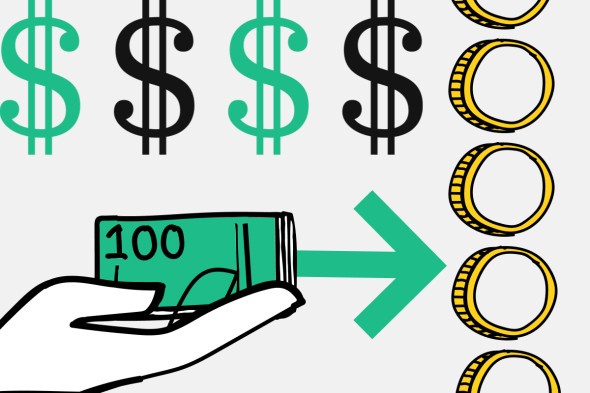
Регулятор подчеркнул, что для перевода наличных рублей в цифровые клиентам необходимо положить их на счет в своем банке. В этот момент они превратятся в безналичные, а купюры и монеты окажутся в банкомате или кассе банка. Далее в онлайн-приложении банка следует перевести их в свой цифровой кошелек на платформе Банка России.

«Рублей в экономике не станет больше или меньше, если вы переведете их в цифровые. Для владельца безналичных рублей поменяются только записи в онлайн-банке: деньги спишутся с банковского счета и зачислятся в кошелек с цифровыми рублями», — указал регулятор.

У клиентов будет возможность самим распределять средства между наличными, безналичными и цифровыми рублями, исходя из их потребностей. Переводы будут осуществляться мгновенно и безопасно, отметили в ЦБ.

Массовый запуск цифрового рубля для населения запланирован на 1 сентября 2026 года. С 1 января 2026 года государственный стейблкоин планируют задействовать во всех доходных и расходных операциях федерального бюджета, а с июля 2027 года он будет использоваться местными властями.

Ранее председатель Банка России Эльвира Набиуллина сообщила, что ключевое преимущество государственного стейблкоина состоит в возможности отследить все бюджетные расходы.
İlgili Okumalar

Media: Anthropic Aims for Revenue Up to $200 Billion by 2028 Ahead of IPO

Anthropic, the AI company behind Claude, is reportedly projecting its revenue could reach between $190 billion and $200 billion by 2028, according to sources cited by Reuters. This forecast, significantly higher than its reported $47 billion annual run-rate in May 2026, is being used by investors and bankers to value the company ahead of a potential IPO. Anthropic has confidentially filed with the SEC, with listing details dependent on market conditions and regulatory approval. The valuation reportedly applies a revenue multiple (EV/Revenue) to these future 2028 figures, an approach common for high-growth tech firms but unusual for a forecast two years ahead of an IPO. This reflects confidence in Anthropic's rapid scaling; its annual run-rate grew tenfold yearly for three years leading into 2026, jumping from ~$9B in late 2025 to over $47B by May 2026. Investors are betting the company's massive spending on GPUs, model training, and infrastructure will eventually outpace costs, leading to expanding margins. Public companies like Palantir, Cloudflare, and SpaceX, valued at high multiples of their forward revenue, serve as benchmarks. While this forward-looking method has precedents, some analysts question the sustainability of such valuations and the actual productivity gains from AI. Despite these concerns, earlier reports suggested Anthropic could be valued at over $1 trillion for its IPO.

cryptonews.ru13 dk önce

Media: Anthropic Aims for Revenue Up to $200 Billion by 2028 Ahead of IPO

cryptonews.ru13 dk önce

Open Blockchain Business: Who Gets the Fees and Why a Foundation is Needed

Business of Open Blockchain: Who Gets the Fees and Why a Foundation is Needed In public blockchains, user transaction fees do not simply become "revenue" for a single entity. The flow of money is complex and protocol-dependent. In Ethereum, fees consist of a base fee (burned, permanently removing ETH from circulation) and a priority tip (paid to the validator). In Solana, half the base fee is burned and half goes to the validator, while priority fees go entirely to validators. Thus, "fees" are not synonymous with "project revenue"; they may go to network operators or be destroyed. Foundations like the Ethereum Foundation do not take a cut of user fees. They are funded by their own treasuries, which can generate income (e.g., from staking rewards) and finance ecosystem development, research, and security. Their role is to fund public goods that are hard to monetize directly. Developers of open-source blockchain code can monetize through services, not the code itself. For example, Optimism provides its technology freely but sells enterprise support and managed services (OP Enterprise). Additionally, networks built on Optimism's tech, like Coinbase's Base, share a portion of their revenue with the Optimism ecosystem via agreements, creating an economic link. Token holders do not automatically receive fees as dividends. In Optimism, a portion of protocol revenue is now used to buy back and treasury-lock OP tokens, creating an indirect link between network usage and token economics. In Ethereum, fee burning reduces ETH supply but doesn't distribute funds to all holders; stakers and validators receive direct rewards. For evaluation, analysts should look beyond total fee figures. Key questions are: Who paid and for what? Where did the money go (to validators, operators, treasury, or burning)? What were the recipient's costs? Is there a mechanism linking this income to the token? The same fee amount impacts different blockchain economies in vastly different ways depending on these factors.

cryptonews.ru15 dk önce

Open Blockchain Business: Who Gets the Fees and Why a Foundation is Needed

cryptonews.ru15 dk önce

İşlemler

Spot
活动图片