Solana 官方 Perp 协议曝光,打响 DEX 反击战

Foresight News2025-10-22 tarihinde yayınlandı2025-10-22 tarihinde güncellendi

Özet

Solana 有机会给 Perp DEX 基础设施一个真正能承接传统金融资产交易需求的应用场景,而不止是停留于加密原生资产交易层面。

撰文:Haotian

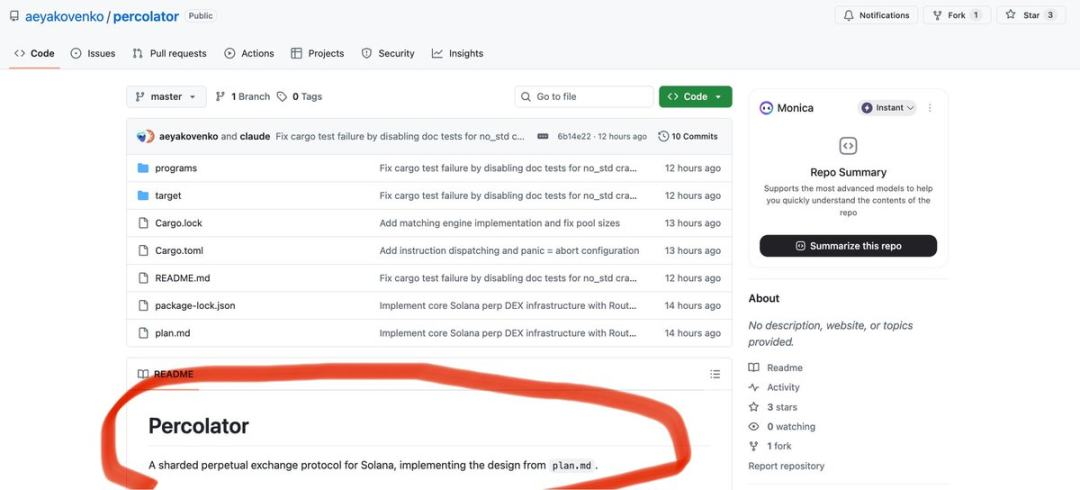
之前就撰文分析过,Perp Dex 一定会在 Solana 生态内爆发。这不,@aeyakovenko 意外曝光的 Github 仓库,一个名为 Percolator 的分片式永续合约协议框架成了关注焦点:

1)它的架构创新大致是把订单簿拆成多个分片并行处理,包含,Router 全局调度和保证金管理 +Slab 独立撮合引擎。此外还采用了高频交易优化和风控设计,比如,采用 reserve-commit 两阶段执行机制防止 MEV 攻击。

有意思的事,Toly 和别人在评论区互动时还提到,可能引入 prop AMM 竞争实验机制,允许 LP 自主定制撮合引擎和风险参数。

2)意外的是,原以为 Solana 切入 Perp Dex 竞争的方式会是扶持本生态诸如 @DriftProtocol、@pacifica_fi、@bulktrade 等新锐 Perp Dex,但其却提升到了 Solana 官方实验室操刀的战略级别。可见,Solana 对延续 Perp Dex 热潮表现的多么饥渴。

3)这背后的逻辑很清楚,在我看来,Perp Dex 是为一个能把高频、高杠杆、大体量三个特性同时吃下的赛道。Solana 打磨了一年多的 Alpenglow 共识、Firedancer 客户端等性能优化,且能顶住 Meme Season 等大体量的峰值交易,现在正是把这套基础设施能力接入 Perp Dex 场景引爆的最佳时机。

况且验证者层优化的想象空间,以及 @doublezero 在网络带宽上的进一步优化等等,都在提升 Solana 的性能上限。 @jito_sol 也已经证明了在验证者层做专业优化能够跑通。就技术基础而言,Solana 生态内长出一个 @HyperliquidX 级别的 Perp Dex 完全不在话下。

4)可能提及此,Toly、 @calilyliu 等核心高管一定忿忿不平,冲着 Solana 优良的 infra 底子,怎能让 @Aster_DEX、@Lighter_xyz 等是骡子是马还搞不清楚的项目过分显摆?

关键是,现在被交易所阵营幕后驱动的 Perp Dex 存在空投刺激下的虚假刷量,交易即挖矿的不可持续性,以及没有真实高频的交易需求等等诸多问题,给了 Solana 跳出来截胡的理由。

5)而凭借美股代币化方面的基本布局,以及 ICM 互联网资本市场上的长期布局,Solana 有机会给 Perp DEX 基础设施一个真正能承接传统金融资产交易需求的应用场景,而不止是停留于加密原生资产交易层面。

想象一下:美股代币化后,用户可以直接在 Solana 上开特斯拉、英伟达的杠杆多空,结算用 $SOL 或稳定币,交易费回流生态。这种「链上纳斯达克」的叙事,是不是比单纯炒 BTC、SOL、ETH 资产永续合约的天花板要高太多?
以上

接下来,且看,Solana 上的 Perp Dex 反击战该如何表演!
İlgili Okumalar

Media: Anthropic Aims for Revenue Up to $200 Billion by 2028 Ahead of IPO

Anthropic, the AI company behind Claude, is reportedly projecting its revenue could reach between $190 billion and $200 billion by 2028, according to sources cited by Reuters. This forecast, significantly higher than its reported $47 billion annual run-rate in May 2026, is being used by investors and bankers to value the company ahead of a potential IPO. Anthropic has confidentially filed with the SEC, with listing details dependent on market conditions and regulatory approval. The valuation reportedly applies a revenue multiple (EV/Revenue) to these future 2028 figures, an approach common for high-growth tech firms but unusual for a forecast two years ahead of an IPO. This reflects confidence in Anthropic's rapid scaling; its annual run-rate grew tenfold yearly for three years leading into 2026, jumping from ~$9B in late 2025 to over $47B by May 2026. Investors are betting the company's massive spending on GPUs, model training, and infrastructure will eventually outpace costs, leading to expanding margins. Public companies like Palantir, Cloudflare, and SpaceX, valued at high multiples of their forward revenue, serve as benchmarks. While this forward-looking method has precedents, some analysts question the sustainability of such valuations and the actual productivity gains from AI. Despite these concerns, earlier reports suggested Anthropic could be valued at over $1 trillion for its IPO.

cryptonews.ru14 dk önce

Media: Anthropic Aims for Revenue Up to $200 Billion by 2028 Ahead of IPO

cryptonews.ru14 dk önce

Open Blockchain Business: Who Gets the Fees and Why a Foundation is Needed

Business of Open Blockchain: Who Gets the Fees and Why a Foundation is Needed In public blockchains, user transaction fees do not simply become "revenue" for a single entity. The flow of money is complex and protocol-dependent. In Ethereum, fees consist of a base fee (burned, permanently removing ETH from circulation) and a priority tip (paid to the validator). In Solana, half the base fee is burned and half goes to the validator, while priority fees go entirely to validators. Thus, "fees" are not synonymous with "project revenue"; they may go to network operators or be destroyed. Foundations like the Ethereum Foundation do not take a cut of user fees. They are funded by their own treasuries, which can generate income (e.g., from staking rewards) and finance ecosystem development, research, and security. Their role is to fund public goods that are hard to monetize directly. Developers of open-source blockchain code can monetize through services, not the code itself. For example, Optimism provides its technology freely but sells enterprise support and managed services (OP Enterprise). Additionally, networks built on Optimism's tech, like Coinbase's Base, share a portion of their revenue with the Optimism ecosystem via agreements, creating an economic link. Token holders do not automatically receive fees as dividends. In Optimism, a portion of protocol revenue is now used to buy back and treasury-lock OP tokens, creating an indirect link between network usage and token economics. In Ethereum, fee burning reduces ETH supply but doesn't distribute funds to all holders; stakers and validators receive direct rewards. For evaluation, analysts should look beyond total fee figures. Key questions are: Who paid and for what? Where did the money go (to validators, operators, treasury, or burning)? What were the recipient's costs? Is there a mechanism linking this income to the token? The same fee amount impacts different blockchain economies in vastly different ways depending on these factors.

cryptonews.ru16 dk önce

Open Blockchain Business: Who Gets the Fees and Why a Foundation is Needed

cryptonews.ru16 dk önce

İşlemler

Spot
活动图片