Платежная компания Wise ищет руководителя по продукту для стейблкоинов

cryptonews.ru2025-04-20 tarihinde yayınlandı2025-10-21 tarihinde güncellendi

Wise, глобальная платформа обмена валют и платежей, нанимает руководителя по продукту для цифровых активов со специализацией на стейблкоинах. Этот шаг может свидетельствовать о расширении деятельности компании в криптовалютной сфере на фоне изменений в глобальном регулировании.

Директор по продуктам Wise Мэтью Солсбери опубликовал вакансию в LinkedIn на прошлой неделе. Вакансия открыта в лондонском офисе, где расположена международная штаб-квартира Wise.

«Если вы разрабатывали кошельки или платежные решения на основе стейблкоинов и теперь хотите работать в Wise, подайте заявку через объявление или напишите мне в личные сообщения», — написал Солсбери.
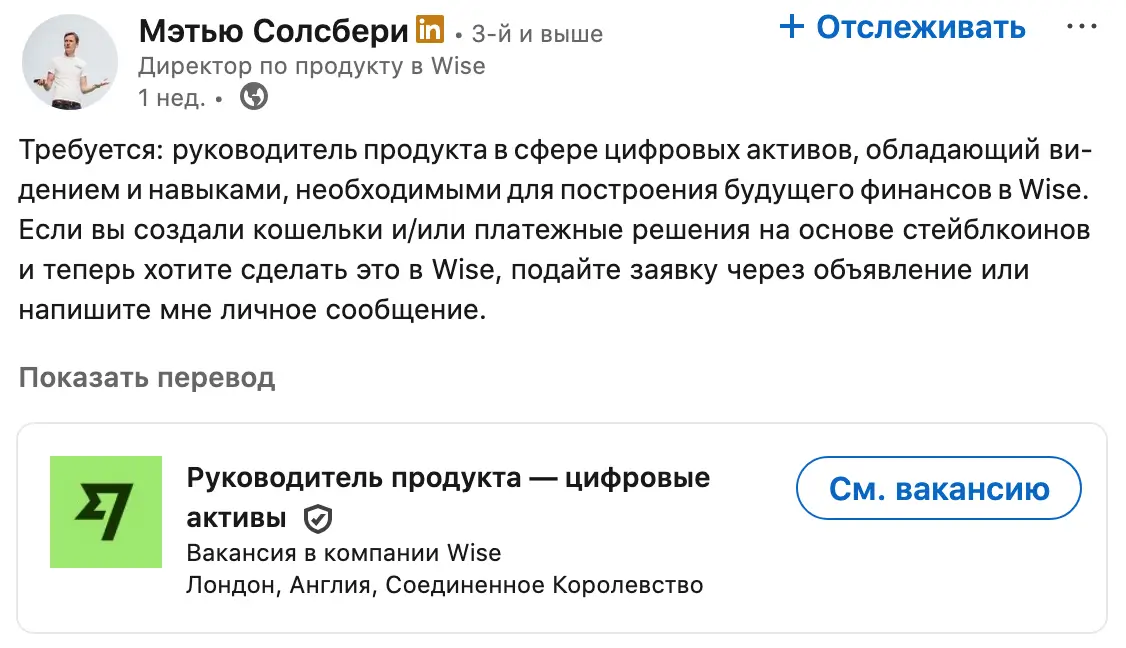

Источник: Мэтью Солсбери.

Согласно объявлению на LinkedIn, которое уже привлекло внимание более 100 соискателей, успешный кандидат присоединится к команде Wise Accounts. Он поможет расширить линейку продуктов и изучить возможности хранения цифровых активов клиентами в их аккаунтах Wise.

Компания ищет кандидатов с не менее чем пятилетним опытом управления продуктами и подтвержденным опытом запуска продуктов B2C в сфере цифровых активов или блокчейна.

Wise, ранее известная как TransferWise, наиболее известна как компания, предоставляющая услуги международных денежных переводов с низкой комиссией в более чем 160 странах и 40 валютах. В 2024 году выручка компании составила 979,9 млн фунтов стерлингов ($1,23 млрд), а прибыль — 345,6 млн фунтов стерлингов ($443 млн).

Wise и платежи в стейблкоинах: оценка потенциала

Пока неясно, будет ли Wise использовать платежные системы в стейблкоинах и как именно это будет реализовано. Технология стейблкоинов обычно рассматривается как способ ускорить и повысить эффективность международных денежных переводов. Она позволяет цифровым долларам перемещаться без участия традиционных банковских посредников.

В прошлом месяце Visa запустила пилотную программу с использованием стейблкоинов USDC и EURC, чтобы помочь финансовым учреждениям упростить трансграничные платежи. Wise, напротив, обслуживает в первую очередь розничных пользователей, которые уже обращаются к стейблкоинам для аналогичных целей.

По данным Chainalysis, Латинская Америка и Африка являются одними из самых быстрорастущих регионов по внедрению стейблкоинов. Это обусловлено более низкой стоимостью денежных переводов и волатильностью местных валют.

«В этих регионах внедрение стейблкоинов в рознице во многом обусловлено их практичностью для недорогих денежных переводов, безопасными сбережениями в регионах с волатильными валютами и доступностью DeFi-услуг, таких как кредитование и размещение в стекинге», — отметила компания в декабрьском отчете.
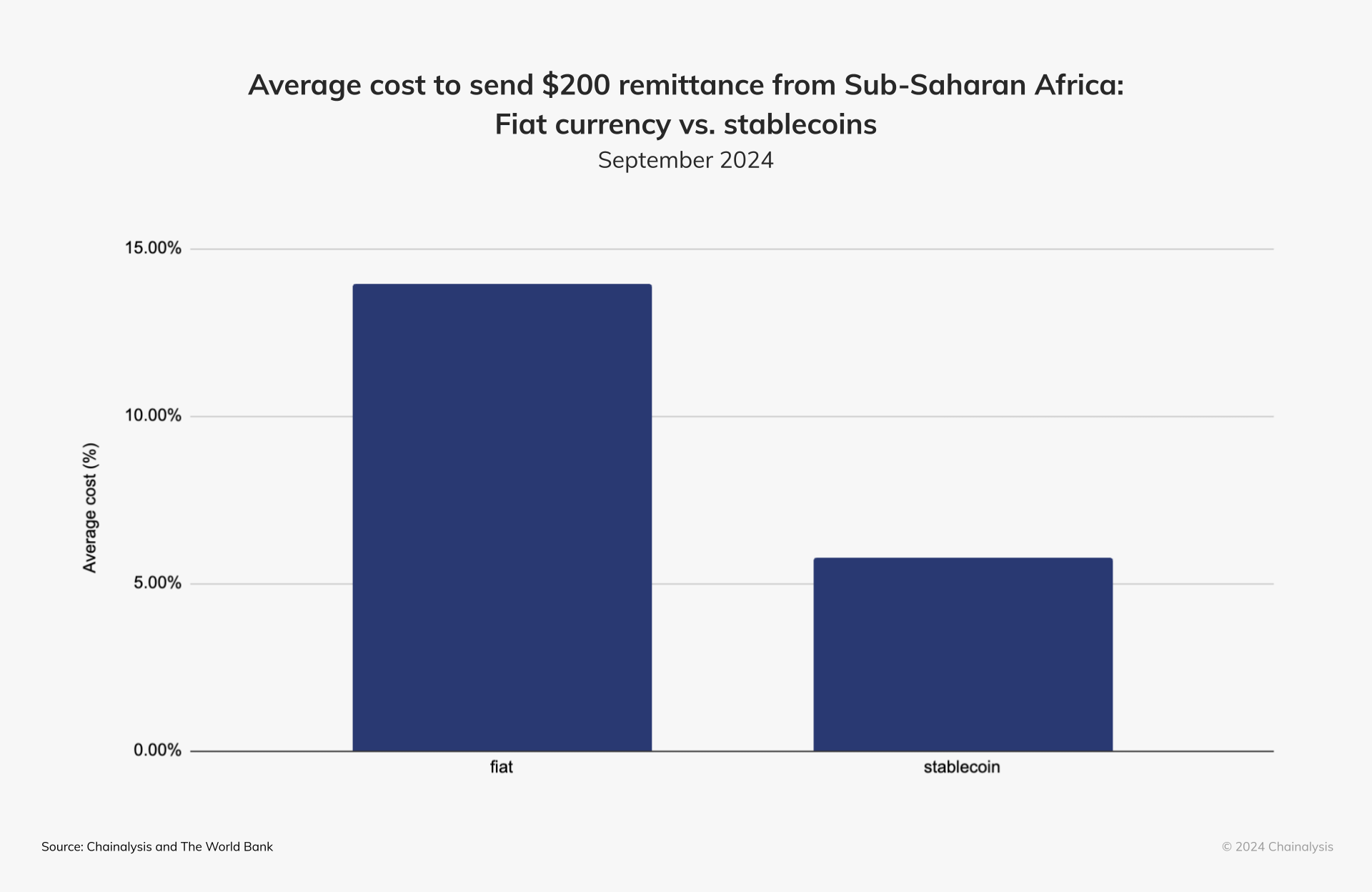

Денежные переводы в стейблкоинах предлагают значительно большую экономию средств по сравнению с традиционными способами в странах Африки к югу от Сахары. Источник: Chainalysis

Этот шаг был предпринят на фоне более благоприятной нормативной среды для принятия стейблкоинов в США после недавнего принятия закона GENIUS. В отличие от этого, на родном рынке Wise в Британии процесс принятия стейблкоинов идет медленнее, поскольку регуляторы работают над внедрением новых правил для стейблкоинов к концу 2026 года.

В результате стейблкоины, привязанные к доллару США, продолжают доминировать на рынке, в то время как альтернативные валюты, номинированные в британских фунтах, составляют лишь небольшую долю от общего числа фиатных стейблкоинов в обращении.

İlgili Okumalar

Rented Faith: How Much of the Bitcoin ETF Inflows Is Real Money?

"Rented Conviction: How Much of Bitcoin ETF Flows Is Real Money" The weekly inflows into Bitcoin ETFs are often interpreted as a gauge of institutional belief. However, a significant portion of this activity is driven by a hidden arbitrage trade, not directional conviction. The core mechanism is a cash-and-carry arbitrage: traders buy spot Bitcoin (often via ETFs) while simultaneously shorting CME futures to lock in the price difference, or "basis." This delta-neutral trade is essentially an interest rate play. In weekly data, about half the fluctuation in ETF flows can be explained by new short positions added by leveraged funds (hedge funds), with a correlation of 0.70. Bitcoin's price movement in a given week shows no statistical power in predicting these flows. While this arbitrage trade drives weekly *volatility*, it is not the main component of the cumulative *stock*. Of the total ~$55 billion in net ETF inflows, the current net arbitrage position is only about $1 billion. The remainder is steady, directional buying averaging ~$400 million per week, which constitutes the vast majority of the accumulated "mountain" over two years. Thus, ETF flow data overstates the *volatility* of conviction, not its *level*. This arbitrage trade has been unwinding for nearly two years. Leveraged fund short positions peaked at ~$14 billion in late 2024 and have since declined to ~$4.5 billion. When the basis compresses to unprofitable levels, ETF inflows and short positions retreat together. Recent outflows should not be mistaken for a loss of faith but rather the routine unwinding of this rate trade. For Ethereum ETFs, the pattern is weaker. Accounting for staking yield makes the basis often negative, so neither strong conviction buying nor robust arbitrage supports its flows. To interpret ETF flows correctly, monitor the CME basis versus T-bill rates and leveraged fund net shorts. They reveal how much of the next "demand" headline is real. The real, patient buy-and-hold demand is what constitutes the enduring bulk of ETF assets.

marsbit47 dk önce

Rented Faith: How Much of the Bitcoin ETF Inflows Is Real Money?

marsbit47 dk önce

Soaring Over Tenfold Within the Year: The Frenzy Over SK Hynix Leveraged Products

South China Morning Post The leveraged ETF tracking SK Hynix has surged over tenfold year-to-date, fueled by intense market speculation on the memory chip sector. By June 22, the value of the 'South Korea 2x Long SK Hynix ETF' listed in Hong Kong had skyrocketed by more than 1,061% since the start of the year, while its asset size exploded over twenty times from the end of last year. The rally is driven by AI-driven demand for high-bandwidth memory (HBM), with SK Hynix recently sampling its next-generation HBM4E product. However, industry professionals warn of significant risks. Leveraged ETFs magnify both gains and losses. During a recent market correction, while the underlying SK Hynix stock fell 19.1%, its double-leveraged ETF dropped nearly 38%. Korean regulators noted that such products could theoretically lose 60% in a single day. Additionally, these ETFs face risks like time decay in volatile markets, liquidity spirals during mass redemptions, and extreme price dislocations from market-making failures, as seen in early June when an ETF moved opposite to its underlying stock. The trading is predominantly driven by retail investors, with institutional capital largely absent due to the products' high volatility. Analysts caution that with the semiconductor sector at elevated valuations and facing geopolitical and supply chain uncertainties, leveraged ETFs pose a substantial threat of amplified losses for uninformed investors.

marsbit1 saat önce

Soaring Over Tenfold Within the Year: The Frenzy Over SK Hynix Leveraged Products

marsbit1 saat önce

18 Months, Over 50x Surge: KIOXIA's Epic Comeback

KIOXIA, a NAND flash memory giant, staged a dramatic comeback driven by AI demand. After a period of significant losses, a failed merger, and missed HBM opportunities, its 2024 IPO began modestly. However, fueled by explosive demand for AI data storage, its stock price skyrocketed over 50 times within 18 months, making it Japan's most valuable company, surpassing Toyota. Its Q1 FY2026 profit guidance soared 30-fold year-over-year, with 2026 NAND capacity already sold out. Key to its success is its 3D NAND technology, BiCS FLASH. As the inventor of NAND, KIOXIA advanced its technology through generations, reaching over 200 layers by 2023. Key innovations include CBA (CMOS directly Bonded to Array), which separately manufactures control circuits and memory arrays for better performance, and OPS (On Pitch Select Gate) to increase density. The company is now developing high-capacity packages like an 8TB solution stacking 32 dies. Looking beyond NAND, KIOXIA is exploring 3D DRAM with its OCTRAM technology, using oxide semiconductor transistors for ultra-low leakage to reduce power consumption. This fundamental research differs from HBM and represents a long-term bet to extend its 3D expertise from NAND into future DRAM architectures. KIOXIA's story highlights how technological assets and shifting market cycles can rapidly transform a company's fortunes. While questions remain about sustaining growth beyond the current AI boom, its resurgence demonstrates that in semiconductors, being down does not necessarily mean being out.

marsbit1 saat önce

18 Months, Over 50x Surge: KIOXIA's Epic Comeback

marsbit1 saat önce

İşlemler

Spot
Futures
活动图片