Soaring Over Tenfold Within the Year: The Frenzy Over SK Hynix Leveraged Products

marsbit2026-06-23 tarihinde yayınlandı2026-06-23 tarihinde güncellendi

Özet

South China Morning Post The leveraged ETF tracking SK Hynix has surged over tenfold year-to-date, fueled by intense market speculation on the memory chip sector. By June 22, the value of the 'South Korea 2x Long SK Hynix ETF' listed in Hong Kong had skyrocketed by more than 1,061% since the start of the year, while its asset size exploded over twenty times from the end of last year. The rally is driven by AI-driven demand for high-bandwidth memory (HBM), with SK Hynix recently sampling its next-generation HBM4E product. However, industry professionals warn of significant risks. Leveraged ETFs magnify both gains and losses. During a recent market correction, while the underlying SK Hynix stock fell 19.1%, its double-leveraged ETF dropped nearly 38%. Korean regulators noted that such products could theoretically lose 60% in a single day. Additionally, these ETFs face risks like time decay in volatile markets, liquidity spirals during mass redemptions, and extreme price dislocations from market-making failures, as seen in early June when an ETF moved opposite to its underlying stock. The trading is predominantly driven by retail investors, with institutional capital largely absent due to the products' high volatility. Analysts caution that with the semiconductor sector at elevated valuations and facing geopolitical and supply chain uncertainties, leveraged ETFs pose a substantial threat of amplified losses for uninformed investors.

Source:Shanghai Securities News

Fueled by intense market capital interest in memory chips, as of June 22, the South China Double Long SK Hynix ETF has seen its year-to-date gains break through tenfold. Concurrently, the ETF's asset scale has skyrocketed by over twenty times compared to the end of last year.

However, industry insiders caution that against the backdrop of semiconductor sector valuations being at historical highs and growing divergence between bullish and bearish sentiments, the risks of leveraged products magnifying losses in both directions are accelerating. Retail investors need to maintain a sufficiently prudent attitude towards such instruments.

South China Double Long SK Hynix ETF Surges Over Tenfold Year-to-Date

Since 2026, the global semiconductor rally has continued its furious pace. In the A-share market, core storage stocks like GigaDevice, Deming Li, and Jiangbolong have persistently climbed; overseas market fervor remains unabated, with South Korean memory giant SK Hynix's stock price continuing its ascent. On June 22, SK Hynix briefly surpassed Samsung Electronics in market capitalization during trading hours, touching the top spot in the South Korean stock market. Its closing price rose 5.61% on the day.

Previously, SK Hynix announced it had delivered samples of its 12-layer HBM4E to key customers. This product is a new-generation high-performance DRAM designed for AI scenarios.

According to industry observers, compared to HBM4, HBM4E achieves dual upgrades in performance and energy efficiency, with a maximum pin speed reaching 16 Gbps and energy efficiency improving by over 20%. Leveraging a new interface and architecture design, it can reduce transmission latency and maintain stable operation under high-bandwidth conditions, thereby enhancing both the data processing capabilities for AI training and inference and the overall computational efficiency of next-generation AI data centers and large-scale computing systems.

Zhou Jingxiang, Fund Manager of Noah Research Select Fund, told the Shanghai Securities News reporter that the core driver of this memory upcycle stems from the explosive demand for SSD storage driven by AI inference computing power, and industry prosperity may trend upward throughout the year.

Leveraged ETFs linked to core chip leaders like SK Hynix and Samsung Electronics have also experienced epic-level market performance.

As of the close on June 22, the South China Double Long SK Hynix ETF listed in the Hong Kong market surged 16.55% in a single day, with year-to-date cumulative gains reaching a staggering 1061.92%. The product officially debuted on the Hong Kong Stock Exchange on October 16, 2025, with an initial size of approximately HK$24 million. However, as the storage rally intensified, the product's scale experienced explosive growth – reaching $14.418 billion as of June 18, a meteoric rise of 21.7 times from $636 million at the end of last year.
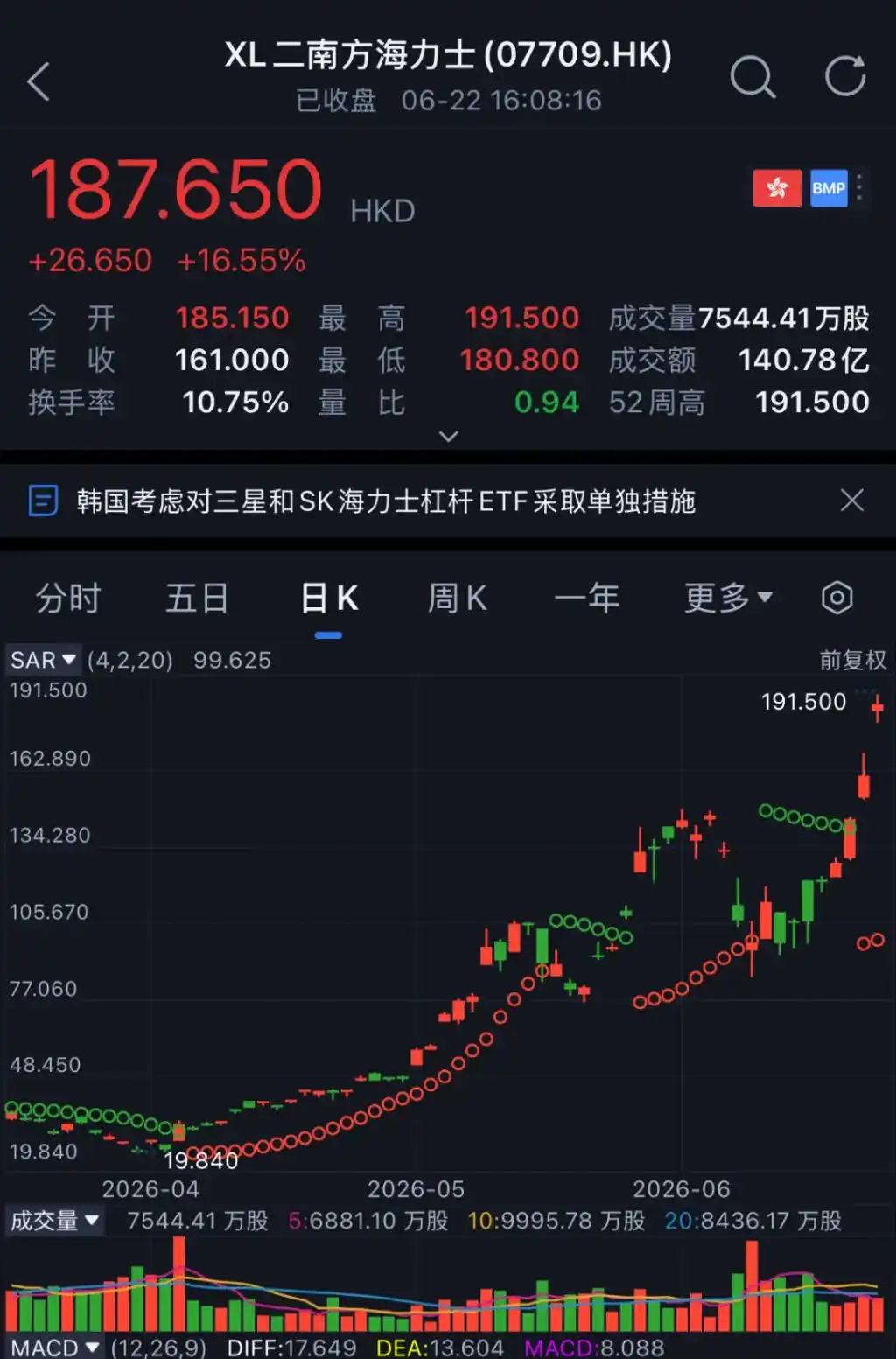
The South China Double Long Samsung Electronics ETF has also seen substantial capital inflows. Data shows that as of June 18, its size reached $4.4 billion. Following a 215.96% surge in scale in May, its size has grown by over 50% again since June.

However, dissecting the capital structure reveals that the leveraged ETF trading market currently exhibits a highly distinct feature of retail investor dominance, with institutional capital largely absent.

"The vast majority of institutions do not allocate to leveraged ETFs; only a small number of hedge funds use them as tools for short-term swing trading," a senior foreign fund manager candidly told this newspaper. Long-term allocation funds like pensions seek stable, long-term returns, which are completely mismatched with the high-volatility, high-risk return profile of leveraged products. Individual investors constitute the core purchasing group for such products.

Beware of Potential Volatility Risks

From an industry perspective, leveraged ETFs are typical "double-edged swords" that amplify both returns and risks. They can multiply investment returns during upward market phases; however, when the market turns downward, the magnitude of losses is similarly magnified. With growing divergence in global semiconductor sector outlooks and multiple uncertainties intertwining across geopolitics, industry dynamics, and valuations, the hidden risks within leveraged ETFs are continuously being exposed. Investors need to remain highly vigilant.

Recent severe market volatility has vividly demonstrated the destructive power of leveraged product losses. The South Korean Financial Supervisory Service's monitoring report released on June 18 showed that during the period from May 27 to June 12, while the underlying Samsung Electronics stock experienced a maximum drawdown of 18.0%, the corresponding two-times leveraged long ETF suffered a maximum drawdown of 35.9%, with losses nearly doubling. The SK Hynix stock drawdown was 19.1%, but its two-times leveraged ETF drawdown expanded further to 38%. Regulatory authorities have repeatedly warned that with South Korean individual stocks having a daily price limit of ±30%, two-times leveraged products theoretically face maximum single-day losses of up to 60%. Under extreme market conditions, principal capital can be severely depleted.

Beyond the routine amplification of volatility risk, leveraged ETFs have also experienced extreme abnormal scenarios where their price action completely diverges from the underlying stock, inflicting massive losses on retail investors chasing highs in the short term. In early June this year, a two-times leveraged ETF tracking SK Hynix exhibited divergent performance for two consecutive trading days: On June 8, while the underlying SK Hynix stock fell nearly 8%, the ETF surged nearly 50% against the trend; the next day, when the underlying stock rose sharply over 13%, the ETF plummeted by 40% intraday.

Addressing this abnormal volatility, the product issuer, Korea Investment Management, explained that the root cause was insufficient market maker liquidity. During the closing auction period, market makers are not obligated to provide mandatory quotes. A large volume of market buy orders pushed the fund price higher, creating a significant premium. When market liquidity recovered the following day, prices rapidly converged to fair value, causing substantial drawdowns for investors who entered at the previous day's elevated prices.

A fund analyst in Shanghai systematically dissected multiple potential risks of leveraged ETFs, both long-term and short-term: Firstly, due to the derivative structure employing daily leverage resetting, high market volatility environments can lead to time decay. Even if the underlying stock price returns to its previous high, the fund's net asset value may still suffer permanent losses. Secondly, leverage amplifies both gains and losses. With the overall semiconductor sector valuation currently at historical highs, any collective pullback would trigger drawdown impacts far exceeding those of the underlying stocks. If concentrated redemptions occur after sustained product scale inflation, it could also trigger a liquidity spiral, further exacerbating price declines. Thirdly, the trading volume of leveraged products in the South Korean market is nearing that of leading chip stocks themselves. Massive retail capital concentrated in one-sided bets creates a positive feedback loop, continuously boosting buying pressure during rallies, while batch stop-loss selling accelerates declines during downturns, significantly elevating market fragility.

Uncertainties at the industry chain fundamental level can also amplify the volatility risks of leveraged products. Sheng Jin, Portfolio Director at Value Partners, told this newspaper reporter that the semiconductor industry chain is long and deeply intertwined with globalized specialization. The variables affecting valuations are complex and intertwined. Any single variable, such as a company's quarterly earnings falling short of expectations or adjustments in global industrial policies, can quickly disrupt existing valuation logic, triggering violent sector fluctuations, which high-leverage products will synchronously magnify in impact.

İlgili Sorular

QWhat is the year-to-date return of the Leverage Product linked to SK Hynix mentioned in the article as of June 22nd?

AThe article states that the year-to-date return of the Southern Leverage Product (ETF) that provides two times the daily return of SK Hynix has exceeded 1000%, specifically reaching 1061.92%.

QWhat are the main risks associated with leveraged ETFs like the one tracking SK Hynix, as highlighted in the article?

AThe article highlights several key risks: 1) Magnified losses during market downturns, as losses are amplified just like gains. 2) The potential for permanent value erosion due to 'volatility decay' inherent in the daily resetting leverage structure. 3) Liquidity risks, where a lack of market makers can lead to extreme price dislocations from the underlying asset, causing severe losses for investors. 4) Increased market fragility due to a high concentration of retail investors engaging in one-sided bets, which can amplify price swings.

QAccording to the article, what is the core driver of the current upcycle in the memory chip sector?

AAccording to Zhou Jingxiang, a fund manager cited in the article, the core driver of the current memory upcycle is the explosive demand for SSD storage brought about by AI inference computing power.

QWhat specific product advancement from SK Hynix is mentioned as contributing to its market performance?

AThe article mentions that SK Hynix announced it had sent samples of its next-generation high-performance DRAM, the 12-layer HBM4E, to key customers. This product is designed for AI scenarios and offers upgrades in both performance and energy efficiency compared to HBM4.

QWhat unusual price behavior did a leveraged ETF tracking SK Hynix exhibit in early June, and what was the cited reason?

AIn early June, a two-times leveraged ETF tracking SK Hynix exhibited a price dislocation from the underlying stock. On June 8th, the stock fell nearly 8%, but the ETF surged nearly 50%. The next day, the stock rose over 13%, but the ETF plunged 40% intraday. The product manager, Korea Investment Management Company, attributed this abnormal volatility to insufficient market maker liquidity during the closing auction period, which led to a large premium. When liquidity normalized, the price sharply corrected to its fair value.

İlgili Okumalar

A Chip Company Releases AIDC Energy Storage Certification Standards. Why NVIDIA? Computing Power Reshapes Power Supply Logic. Who's in the Lead and Who's Left Out?

NVIDIA has released a "Battery Energy Storage System Self-Certification Guide," setting strict technical standards for energy storage systems specifically for AI data centers (AIDC). The guide focuses solely on certifying the Power Conversion System (PCS), not the batteries, with 10 mandatory performance metrics and 12 validation tests requiring real-world and simulation comparisons. Key requirements include rapid dynamic response to AI workloads, high-frequency system telemetry, and detailed electromagnetic transient models. The move is driven by the extreme and fluctuating power demands of next-generation AI hardware. Modern AIDCs require energy storage systems to act as intelligent, controllable grid assets, not just passive backup, to manage instantaneous, massive power load shifts that traditional UPS systems cannot handle. This redefines the competitive landscape for energy storage providers, shifting focus from capacity and cost to advanced control capabilities and system integration. While the market potential is significant—with forecasts of hundreds of GWh in new demand by 2030—the certification creates a high barrier to entry. It requires proven PCS delivery volumes and credible plans for rapid capacity scaling, favoring established, well-resourced players. Early movers like Fluence (partnering with Siemens) and several Chinese companies have secured projects ahead of the standard, but new entrants must now navigate this rigorous, costly, and time-intensive certification process to compete in the AIDC energy storage market.

marsbit45 dk önce

A Chip Company Releases AIDC Energy Storage Certification Standards. Why NVIDIA? Computing Power Reshapes Power Supply Logic. Who's in the Lead and Who's Left Out?

marsbit45 dk önce

After Missing the 20x, I've Found a 'Dumb' Method for AI Investing

**Missing the 20x Opportunity: A Simple 'Dumb' Approach to AI Investing** The AI boom, driving NVIDIA's revenue from $60B to $216B in two years, creates immense investment pressure. However, like the internet bubble of 2000, the largest AI opportunities likely lie ahead, perhaps after a correction. Instead of rushing in now or waiting paralyzed for a crash, the author proposes a third way: building a "knowledge warehouse" by systematically mapping the AI industry to be ready when opportunities arise. The core of the strategy is understanding AI's four-layer value chain: 1. **Compute Infrastructure (The "Engine"):** This foundational layer, where all money eventually flows, includes: a) **Chip Design:** NVIDIA's dominance via its CUDA ecosystem, b) **Chip Manufacturing/Packaging/Memory:** TSMC's near-monopoly in advanced manufacturing and SK Hynix's lead in High Bandwidth Memory (HBM), c) **Optical Interconnects:** Essential for large-scale AI clusters (e.g., Lumentum, Coherent), d) **Cooling & Power:** Critical for high-density AI data centers (e.g., Vertiv), e) **Servers/Data Centers & Cloud Platforms:** The physical and virtual wholesale providers. 2. **Models & Tools (The "OS"):** The competitive layer of foundation models (OpenAI, Anthropic, Google, Meta, xAI), now generating real revenue. A key shift is the center of gravity moving from **Training** models to **Inference** (running models), which demands different chip characteristics and could challenge NVIDIA's monopoly. 3. **Middleware & Platform ("The Glue"):** Connects models and applications (e.g., Scale AI, Hugging Face). This layer could explode if applications take off. 4. **Vertical Applications ("The Cash Register"):** Where AI meets end-users (e.g., enterprise AI, coding tools, medical AI, robotics). A critical cross-cutting constraint is **Energy**, as AI's massive power consumption drives investment in nuclear and other energy infrastructure. The author identifies four key questions for further research: 1) How will the shift from Training to Inference reshape the competitive landscape? 2) With tech giants spending over $600B on capex, where is the ROI from AI applications? 3) What are the under-the-radar opportunities in the "second" and "third" circles of the value chain (e.g., cooling, specialty foundries)? 4) How will geopolitics (e.g., U.S.-China chip restrictions) bifurcate the supply chain? The conclusion is that missed opportunities stem from insufficient research, not slow timing. By methodically studying each layer—its business models, competition, and valuations—investors can build the "killer intuition" needed to act decisively when the market presents its chance.

marsbit1 saat önce

After Missing the 20x, I've Found a 'Dumb' Method for AI Investing

marsbit1 saat önce

İşlemler

Spot
Futures
活动图片