Новая функция Boost на CoinMarketCap вызвала споры в криптосообществе

cryptonews.ru2025-09-05 tarihinde yayınlandı2025-09-05 tarihinde güncellendi

CoinMarketCap (CMC) запустила Boost — новый сервис, который позволяет пользователям поднимать рейтинг токена в трендах. Любой, будь то разработчик или трейдер, может приобрести бусты

Функция вызвала споры: сторонники считают, что Boost поддержит органический интерес, а противники опасаются искажения данных и манипуляций на рынке. Некоторые из 10 самых трендовых токенов CMC уже имеют буст.

Бусты токенов CoinMarketCap

CoinMarketCap — одна из ведущих мировых платформ по сбору ончейн-данных и анализу криптовалют. Малые токены могут получить большую известность благодаря трендам CMC. Поскольку внимание к токенам так ценно, CoinMarketCap решила монетизировать его с помощью нового сервиса Boost:

🔎 CMC Feature Release | CMC Boost

The Boost feature gives projects the option to amplify their presence on by climbing trending lists across CoinMarketCap.

🔗 https://t.co/k1poFf75qL pic.twitter.com/HN0bOt33DE

— CoinMarketCap (@CoinMarketCap) September 2, 2025

Согласно пресс-релизу, Boost позволяет пользователям платить за повышение рейтинга токена. Это не гарантирует, что он станет трендовым, но увеличивает шансы актива на 12 или 24 часа. Повышенные токены четко обозначены, и два из 10 самых трендовых активов на CMC сейчас имеют буст:
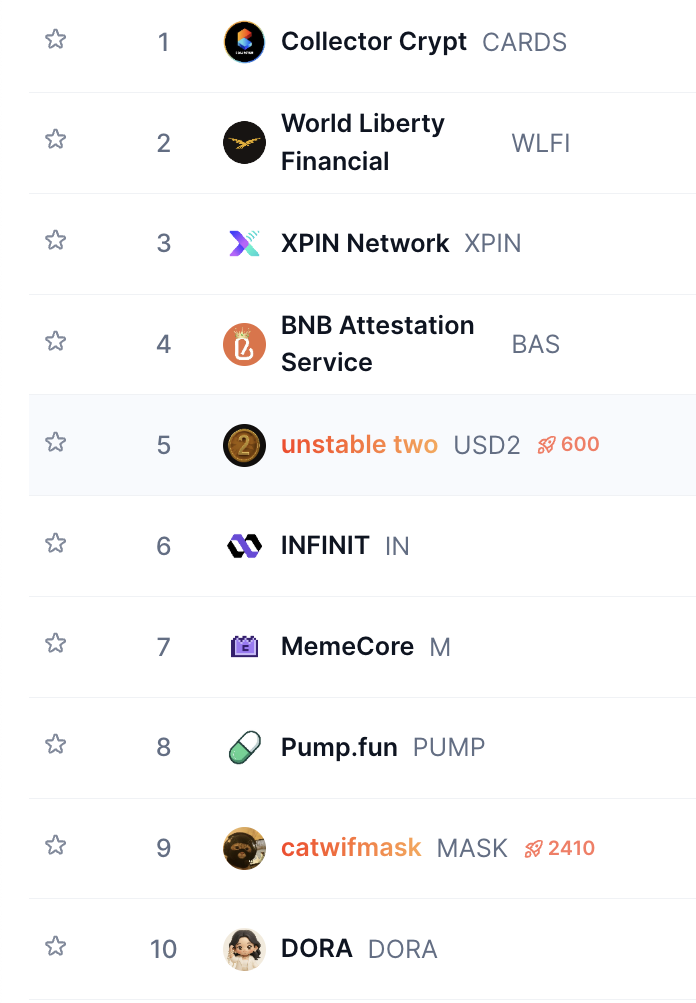
CoinMarketCap Boosts в действии. Источник: CoinMarketCap

Любой желающий может добавить токен на CoinMarketCap, а не только разработчики проектов. Это может вызвать ажиотаж в сообществе и способствовать росту мемных монет. Многие трейдеры с энтузиазмом восприняли это обновление.

Среди пользователей разгораются споры

Один пользователь может купить сколько угодно бустов, и CoinMarketCap будет учитывать их суммарно. Некоторые небольшие проекты обеспокоены, что это создаст новые несправедливые условия. Тем временем ритейлеры считают, что Boost может испортить репутацию платформы, предоставляющей объективные данные. Кроме того, пользователи, вероятно, не будут знать, насколько сильно алгоритм учитывает оценки Boost.

a little confused. What is the algo to rank listings under trending? The project that pays the most fees?

I think you may have scared away 80% of crypto traders who are non-trenchers.

— tomo.apt | Mereo (@apt_tomo) September 3, 2025

CoinMarketCap уже сталкивалась с подобными противоречиями. Ее обвиняли в требовании «платы за заложников» для повышения видимости новых проектов, что вызвало призывы покинуть платформу. В начале этого года обвинения в бот-трейдинге поставили под сомнение метрики сайта.

Boost может повредить репутации CoinMarketCap. Самый высокий уровень Boost стоит $4 000 на 24 часа, что позволяет манипуляторам рынка дешево накачивать стоимость актива. С другой стороны, небольшие команды разработчиков могут видеть в Boost еще одно препятствие на пути к успеху.

Ясно одно: данные о трендах CoinMarketCap больше не объективны. Будущим трейдерам, возможно, стоит подумать, станет ли Boost преградой для сделки или новой возможностью.

İlgili Okumalar

IPO Imminent, OpenAI Faces Major Personnel Upheaval

OpenAI, preparing for a potential IPO, is experiencing significant leadership turmoil. In mid-August 2026, longtime "GPU geek" Scott Gray quietly left, and within three days, Chief Operating Officer Brad Lightcap (8-year veteran) and Chief Revenue Officer Denise Dresser (8-month tenure) departed. This follows a broader exodus of at least 10 senior executives in 2026, including heads of product, safety, and ethics. Analysts view this as a strategic "surgery" to transform from a research lab into a sales-driven enterprise company before going public. Revenue now tilts toward enterprise clients, surpassing consumer income sooner than expected, with annualized revenue reaching $40 billion. The new CRO, Dali Rajic, is a veteran enterprise sales leader. Concurrently, OpenAI has disbanded independent safety teams like "Preparedness," which assessed catastrophic risks, integrating their functions into core research. Critics warn this removes dedicated "brakes" on AI development. The leadership vacuum raises questions about who is the clear second-in-command after former apps CEO Fidji Simo moved to an advisory role. Co-founder Greg Brockman appears to be consolidating power. As OpenAI races against rival Anthropic ($47B annualized revenue), it faces the dual challenge of commercial execution while managing the departure of foundational technical talent and ensuring responsible AI development remains a priority.

marsbit1 saat önce

IPO Imminent, OpenAI Faces Major Personnel Upheaval

marsbit1 saat önce

AI Can 'Have Moods Too'! New Research from USTC: Confusion and Anxiety Make AI Work Better

The article discusses research from the University of Science and Technology of China and Oxford, revealing that allowing AI to recognize and act upon simulated "internal emotions" can significantly improve its performance. The study demonstrates a coherent pairing between specific emotional states in AI agents and their subsequent skill choices. For instance, an agent feeling curious and desirous will search for products, while one feeling confused and tense will rephrase queries. This mirrors human decision-making influenced by emotions. Statistical validation showed a 76.5% semantic consistency in these pairings. Crucially, the research challenges the traditional view of AI errors as flaws to be eliminated. It found that "bad" emotions like confusion, tension, or frustration serve as useful metacognitive signals, indicating a mismatch between the current strategy and the environment. By responding to these signals, AI can proactively adjust before a failure occurs. This is particularly effective in complex tasks prone to failure. For example, in tasks like "heating an item" and "picking up two items," success rates surged from 9.6% to 56.9% and 4.4% to 31.3%, respectively, when using the emotion-driven skill selection method (EMOTION2SKILL). The AI's "nervous" state about a closed microwave, for instance, prompted it to check and open it first, preventing failure. The article also mentions related work from Tianjin University, which embeds emotional prediction into world models (Large Emotional World Model, LEWM), significantly improving prediction accuracy in human-centric environments. Removing emotional data was found to degrade performance even in unrelated logical reasoning tasks. These studies build on earlier findings, like those from Anthropic, that identifiable emotional representations exist within large language models (LLMs). The focus is shifting from philosophical debate about AI emotion to practically harnessing these internal states as functional signals to enhance AI robustness and capability.

marsbit1 saat önce

AI Can 'Have Moods Too'! New Research from USTC: Confusion and Anxiety Make AI Work Better

marsbit1 saat önce

İşlemler

Spot
活动图片