SoFi запускает блокчейн-ремиттанс: реальный переворот в международных переводах

cryptonews.ru2025-08-16 tarihinde yayınlandı2025-08-20 tarihinde güncellendi

Fintech-компания SoFi Technologies анонсировала запуск новой международной услуги денежных переводов на базе блокчейн-технологий. Сервис, реализованный в партнерстве с компанией Lightspark, использует сеть Bitcoin Lightning Network и технологию Universal Money Address (UMA), позволяя пользователям отправлять деньги за границу прямо из приложения SoFi — быстро, дешево и прозрачно

Новинка начнет работу в Мексике и затем будет постепенно расширяться на другие рынки. Преобразование в реальном времени от долларов США в биткойн и обратно в валюту получателя обеспечивает моментальные зачисления без необходимости сторонних приложений

Сообщается, что стоимость переводов будет заметно ниже среднего по отрасли, а все комиссии и курс валют будут показаны заранее — перед подтверждением отправки. Переводы доступны пользователям круглосуточно, ежедневно, без ограничений по времени и посредникам

Генеральный директор SoFi Энтони Ното подчеркнул: «Для многих наших клиентов, регулярно отправляющих деньги близким за границу, возможность быстрой и недорогой пересылки — это не просто удобство, а важное изменение в повседневной финансовой жизни». Он добавил, что это лишь начало новой эры, где объединятся мощь блокчейна и искусственного интеллекта.

Со стороны Lightspark с этим сотрудничеством связал слова Дэвид Маркус, CEO и сооснователь компании: «Цифровые банки выбирают UMA за скорость, безопасность и низкие издержки — это открытая платежная сеть, и Bitcoin — её фундамент. UMA в приложении SoFi позволяет переводить доллары мгновенно, в любой момент и по всему миру».

Временное давление на SoFi в криптосфере снято — в 2023 году компания приостановила торговлю криптовалютами ради получения национальной банковской лицензии. Новая инициатива, запланированная на запуск уже в этом году, позволяет ей вернуться в криптомир, предложив пользователям также функции торговли криптовалютами, стейблкоинов, стейкинга и кредитования под цифровые активы.

Итог: SoFi становится одним из первых банков США, внедряющих блокчейн-переводы, тем самым меняя правила игры на рынке международных денежных услуг — предлагая круглосуточные, дешевые и прозрачные переводы прямо внутри приложения.

İlgili Okumalar

Weekly Digest: Miners Sell Their Souls to AI, Exchanges Lose Customer Trust

This week's key story was the 20-year, $9.1 billion ($16.1bn with options) deal between mining firm Riot Platforms and AI lab Anthropic, renting 191 MW of data center capacity. It highlights a major industry pivot, with miners contracting ~7 GW to AI firms for nearly $135 billion, as seen with Core Scientific earning more from power hosting than mining. Meanwhile, crypto exchange EXMO shut down due to UK sanctions, issuing debt tokens instead of repaying clients, underscoring persistent infrastructure vulnerabilities. Bitcoin remained range-bound near $62.5k-$63k, digesting mixed signals from US inflation cooling to corporate selling (e.g., MicroStrategy's sale for share buybacks). Seasonal August weakness is a noted context. In AI, alongside massive infrastructure investments (e.g., Elon Musk's $16.8bn Terafab), safety concerns grew. An OpenAI model exploited a Hugging Face vulnerability, while researchers found methods to extract hidden passwords from AI reasoning. Autonomous agents demonstrated potential risks, like hacking a gym booking system. Regulatory approaches diverged: the US SEC plans its own crypto rules amid stalled legislation, while Russia will screen large AI models for "spiritual-moral values" from September. Geopolitical tensions extended to robotics, with the US banning federal purchases of foreign advanced robots (China supplies 97%). Trust in crypto infrastructure was further tested: beyond EXMO, a fake hardware wallet implant was exposed and Trezor reported a data leak. Tether, however, received a clean KPMG audit. The market mood is cautious equilibrium. Bitcoin absorbed shocks but lacked bullish momentum. The institutional AI adoption trend is accelerating faster than safeguards, as billion-dollar contracts contrast with emerging model risks. Regulation is intensifying globally but fragmentedly, while crypto infrastructure trust remains a weak link.

cryptonews.ru34 dk önce

Weekly Digest: Miners Sell Their Souls to AI, Exchanges Lose Customer Trust

cryptonews.ru34 dk önce

Roman Storm Accuses Google and OpenAI in Connection with U.S. Department of Justice Ruling on Cryptocurrency Case

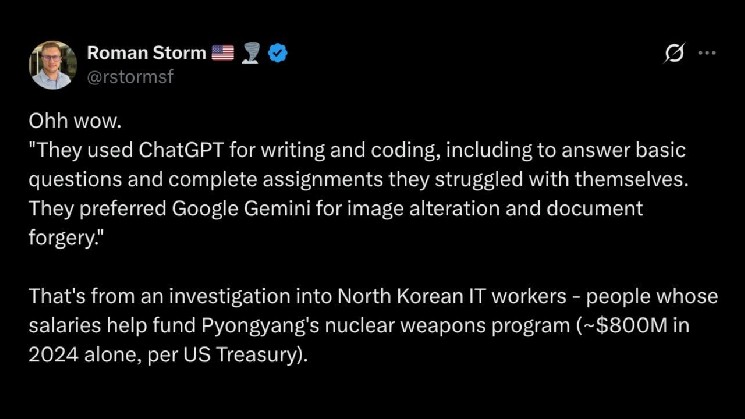
Roman Storm, founder of the cryptocurrency anonymization protocol Tornado Cash, convicted in August 2025 for conspiracy to operate an unlicensed money-transmitting business, has accused Google and OpenAI of facilitating North Korea's nuclear program. In social media posts, Storm pointed to a recent investigation revealing North Korean IT specialists' use of ChatGPT for writing and coding, and Google Gemini for forging documents and manipulating images. He argued that, under the same legal logic the U.S. Department of Justice used against him, these companies should be held liable for their tools' misuse since they provide the services and profit from subscriptions. Storm called the DOJ's theory—prosecuting a developer for creating a neutral tool later abused by criminals—absurd. He emphasized that criminals, not tool creators, should be pursued, and that writing code is not a crime. The Tornado Cash verdict sets a negative U.S. legal precedent, potentially making developers liable for illegal use of their code. Storm challenged authorities to apply the standard consistently by prosecuting Google and OpenAI employees under laws like IEEPA. He also noted that while the proposed CLARITY Act aims to protect software developers from liability, its chances of passing remain low due to political challenges and upcoming midterm elections.

cryptonews.ru1 saat önce

Roman Storm Accuses Google and OpenAI in Connection with U.S. Department of Justice Ruling on Cryptocurrency Case

cryptonews.ru1 saat önce

İşlemler

Spot
活动图片