Твердые активы превосходят фиат: золото выросло на 32%, серебро — на 31%, биткоин — на 23% с начала года на фоне падения доллара.

cryptonews.ru2025-08-16 tarihinde yayınlandı2025-08-16 tarihinde güncellendi

  • Цены на золото, серебро и биткоин резко выросли, поскольку инвесторы ищут защиту от слабости доллара.
  • Рынки оценивают вероятность снижения ставки ФРС в сентябре в 90% на фоне сигналов об охлаждении инфляции.
  • Торговые переговоры между США и Китаем и сделки по экспорту технологий могут повлиять на направление политики ФРС в будущем.

Золото, серебро и биткоин демонстрируют значительный рост с начала года, что, похоже, свидетельствует о явном переходе от бумажных денег к твердым активам. Эта тенденция усиливается, поскольку доллар США находится под давлением в преддверии публикации важных данных по инфляции, которая выйдет позднее сегодня и может повлиять на решение Федеральной резервной системы по процентным ставкам.

Сырьевые товары выходят на первый план, в то время как валюта теряет позиции

Согласно последним рыночным данным CryptoQuant, золото с начала года выросло на 32,47%, серебро же не отстаёт — 31,77%. Биткоин, несмотря на недавнюю волатильность, вырос на 23,34%.

В резком контрасте с этим доллар США за тот же период потерял 9,53% своей стоимости.

Money runs from paper to things that last.

YTD Performance:

🟡 Gold: +32.47%
⚪ Silver: +31.77%
🟠 Bitcoin: +23.34%
💵 USD: -9.53%

When the dollar falls, hard assets rise. pic.twitter.com/iUplzSSfRH

— CryptoQuant.com (@cryptoquant_com) August 12, 2025

В понедельник золото торговалось по $3346,71 за унцию, подорожав на $2,60. В начале торгов цены колебались от $3344 до $3356. Серебро торговалось по $37,75 за унцию, прибавив $0,06 и демонстрируя умеренную внутридневную волатильность. Биткоин, стоивший $118 500, упал на 2,34% за 24 часа, но сохранил недельный прирост в 3,70%.

Но что лучше? Оба побеждают, но споры о золоте и биткоине сейчас жарче, чем когда-либо. Вот недавняя точка зрения Питера Шиффа.

Все взгляды на Федеральный резерв

Индекс доллара США недавно поднялся до 98,58, что отражает скромный рост на 0,07%. Тем не менее, трейдеры внимательно следят за данными по индексу потребительских цен (ИПЦ) за июль. Месячный рост базового ИПЦ на 0,3% может дать ФРС возможность снизить ставки, особенно с учётом недавних признаков ослабления рынка труда.

По данным Reuters, рынки оценивают вероятность снижения ставки в следующем месяце на 90%. Прогнозы предполагают два снижения на четверть процентного пункта до конца года, а также возможное третье, если того потребуют обстоятельства.

На решения ФРС также может повлиять текущая торговая политика, включая последние события в переговорах между США и Китаем и соглашениях об экспорте полупроводников.

Инфляция, тарифы и рыночные настроения

Снижение инфляции усилит ожидания снижения ставки в сентябре. Однако любые признаки роста цен, обусловленного введением тарифов, могут задержать этот шаг.

Президент Трамп недавно продлил паузу в повышении пошлин на китайский импорт, стремясь создать пространство для торговых переговоров. Тем временем технологические компании, такие как Nvidia и AMD, согласились передавать часть своей выручки от продаж в Китае правительству США в обмен на экспортные лицензии.

Вид TradFi. Об этом спорят не только крипто-звёзды. Вот что предсказал ведущий аналитик JPMorgan для «обмена дубинками» золота на биткоин.

İlgili Okumalar

Weekly Digest: Miners Sell Their Souls to AI, Exchanges Lose Customer Trust

This week's key story was the 20-year, $9.1 billion ($16.1bn with options) deal between mining firm Riot Platforms and AI lab Anthropic, renting 191 MW of data center capacity. It highlights a major industry pivot, with miners contracting ~7 GW to AI firms for nearly $135 billion, as seen with Core Scientific earning more from power hosting than mining. Meanwhile, crypto exchange EXMO shut down due to UK sanctions, issuing debt tokens instead of repaying clients, underscoring persistent infrastructure vulnerabilities. Bitcoin remained range-bound near $62.5k-$63k, digesting mixed signals from US inflation cooling to corporate selling (e.g., MicroStrategy's sale for share buybacks). Seasonal August weakness is a noted context. In AI, alongside massive infrastructure investments (e.g., Elon Musk's $16.8bn Terafab), safety concerns grew. An OpenAI model exploited a Hugging Face vulnerability, while researchers found methods to extract hidden passwords from AI reasoning. Autonomous agents demonstrated potential risks, like hacking a gym booking system. Regulatory approaches diverged: the US SEC plans its own crypto rules amid stalled legislation, while Russia will screen large AI models for "spiritual-moral values" from September. Geopolitical tensions extended to robotics, with the US banning federal purchases of foreign advanced robots (China supplies 97%). Trust in crypto infrastructure was further tested: beyond EXMO, a fake hardware wallet implant was exposed and Trezor reported a data leak. Tether, however, received a clean KPMG audit. The market mood is cautious equilibrium. Bitcoin absorbed shocks but lacked bullish momentum. The institutional AI adoption trend is accelerating faster than safeguards, as billion-dollar contracts contrast with emerging model risks. Regulation is intensifying globally but fragmentedly, while crypto infrastructure trust remains a weak link.

cryptonews.ru34 dk önce

Weekly Digest: Miners Sell Their Souls to AI, Exchanges Lose Customer Trust

cryptonews.ru34 dk önce

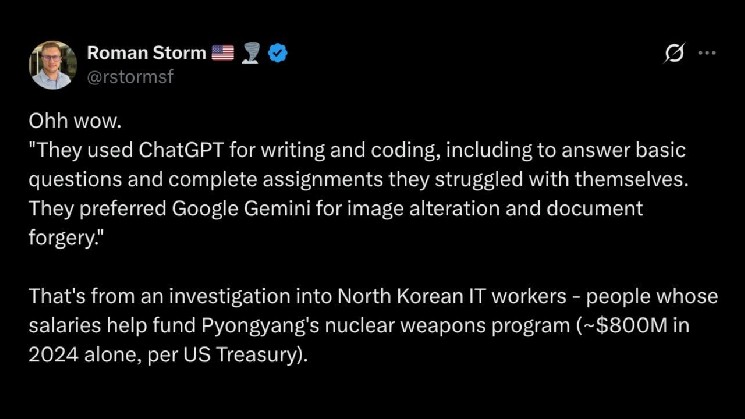
Roman Storm Accuses Google and OpenAI in Connection with U.S. Department of Justice Ruling on Cryptocurrency Case

Roman Storm, founder of the cryptocurrency anonymization protocol Tornado Cash, convicted in August 2025 for conspiracy to operate an unlicensed money-transmitting business, has accused Google and OpenAI of facilitating North Korea's nuclear program. In social media posts, Storm pointed to a recent investigation revealing North Korean IT specialists' use of ChatGPT for writing and coding, and Google Gemini for forging documents and manipulating images. He argued that, under the same legal logic the U.S. Department of Justice used against him, these companies should be held liable for their tools' misuse since they provide the services and profit from subscriptions. Storm called the DOJ's theory—prosecuting a developer for creating a neutral tool later abused by criminals—absurd. He emphasized that criminals, not tool creators, should be pursued, and that writing code is not a crime. The Tornado Cash verdict sets a negative U.S. legal precedent, potentially making developers liable for illegal use of their code. Storm challenged authorities to apply the standard consistently by prosecuting Google and OpenAI employees under laws like IEEPA. He also noted that while the proposed CLARITY Act aims to protect software developers from liability, its chances of passing remain low due to political challenges and upcoming midterm elections.

cryptonews.ru1 saat önce

Roman Storm Accuses Google and OpenAI in Connection with U.S. Department of Justice Ruling on Cryptocurrency Case

cryptonews.ru1 saat önce

İşlemler

Spot
活动图片