3 Major Cardano Announcements Just Landed: The Breakdown

bitcoinist2026-02-12 tarihinde yayınlandı2026-02-12 tarihinde güncellendi

Özet

Three major announcements for the Cardano ecosystem were made at Consensus Hong Kong. First, the integration with LayerZero was approved, marking Cardano's largest interoperability expansion. This will connect Cardano to over 160 blockchains, providing access to $80 billion in omnichain assets and new liquidity. Second, founder Charles Hoskinson announced that USDCx, a new stablecoin with claimed privacy and immutability features, is scheduled to launch at the end of February. Finally, the privacy-focused network Midnight confirmed its mainnet will go live before the end of March, establishing a foundation for applications built on selective disclosure.

Three Cardano ecosystem announcements landed onstage at Consensus Hong Kong yesterday, spanning cross-chain rails, a new stablecoin rollout timeline, and a privacy-focused network’s march to mainnet.

#1 Cardano Taps LayerZero

Intersect said via X its Critical Cardano Integrations workstream has approved bringing LayerZero into the Cardano ecosystem, positioning the move as the network’s largest interoperability expansion to date. In its post, Intersect framed the integration as a step-change in access to cross-chain assets and infrastructure:

“LayerZero is one of the most widely adopted omnichain messaging protocols in Web3, connecting 150+ blockchains and enabling access to 400+ tokens and $80B+ in omnichain assets. This integration unlocks the largest cross-chain connectivity expansion in Cardano’s history, opening pathways to stablecoin liquidity, Bitcoin-backed assets, tokenized real-world assets, and shared DeFi infrastructure across the broader crypto ecosystem.”

A companion write-up describes the effort in similar terms, saying the protocol “connects over 160 blockchains” and “has facilitated over $200 billion in cross-chain volume,” with Cardano gaining technical access to “over 400 tokens” and “$80 billion in omnichain assets” once the LayerZero endpoint is deployed.

The post argues that LayerZero’s messaging-layer approach is chain-agnostic “regardless of the underlying execution model,” explicitly flagging Cardano’s extended UTXO design as a historical friction point for tooling built around account-based chains.

Intersect said delivery work now moves into deployment, with “further milestones and timelines to be shared as progress continues.”

#2 USDCx Gets A Launch Date

Cardano founder Charles Hoskinson used the event to put a calendar marker on USDCx, saying the product now has a target launch window at the end of February. “We’ve announced not long ago that we will have USDCx. Now we have a launch date for USDCx, end of February. We’ve done some amazing engineering to have a beautiful UX. You can go straight from any wallet to Coinbase, or Binance, and back, and there’s instant convertibility to USDC,” Hoskinson said.

He also claimed feature advantages versus standard USDC in circulation, saying USDCx has “privacy, and it’s also immutable and irreversible, so it’s actually better [than USDC].”

#3 Midnight Targets Mainnet Before End Of March

Midnight, the privacy-oriented network tied to the broader Cardano ecosystem, said its mainnet is now imminent. “On the ConsensusHK stage, we shared that Midnight mainnet will officially go live before the end of March,” the team posted via X, calling it “a major milestone and the beginning of a live, production network designed to support early applications built around selective disclosure and real-world privacy.”

Midnight added that mainnet is “foundational,” describing it as the stable base for teams to “launch, test, and iterate,” while setting expectations for “rapid protocol and tooling expansion ahead.”

At press time, Cardano traded at $0.261.
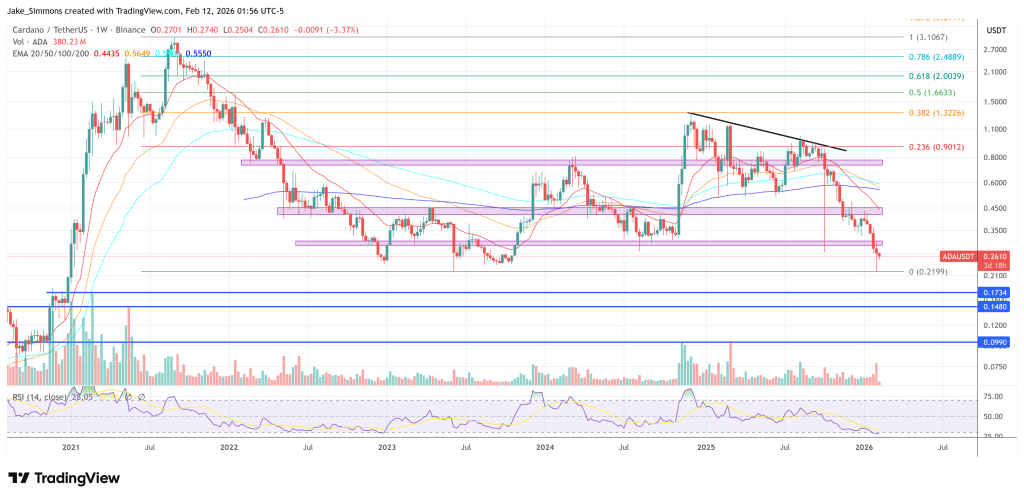
ADA hovers above key support, 1-week chart | Source: ADAUSDT on TradingView.com

İlgili Sorular

QWhat are the three major Cardano announcements made at Consensus Hong Kong?

AThe three major announcements are: 1) The integration of LayerZero for cross-chain interoperability, 2) A launch date for USDCx set for the end of February, and 3) The imminent mainnet launch of the Midnight privacy network before the end of March.

QWhat benefits does the LayerZero integration bring to the Cardano ecosystem according to Intersect?

AIntersect states that LayerZero unlocks the largest cross-chain connectivity expansion in Cardano's history, providing access to over 400 tokens, $80 billion in omnichain assets, stablecoin liquidity, Bitcoin-backed assets, tokenized real-world assets, and shared DeFi infrastructure.

QWhat specific advantages did Charles Hoskinson claim USDCx has over standard USDC?

ACharles Hoskinson claimed that USDCx has privacy features, is immutable, and is irreversible, making it 'actually better' than the standard USDC in circulation.

QWhen is the Midnight network's mainnet expected to go live, and what is its primary purpose?

AThe Midnight network's mainnet is expected to go live before the end of March. Its primary purpose is to serve as a production network designed to support applications built around selective disclosure and real-world privacy.

QHow did the article describe the significance of LayerZero's technology for Cardano's unique eUTXO design?

AThe article described LayerZero's chain-agnostic, messaging-layer approach as a solution to the historical friction point posed by Cardano's extended UTXO (eUTXO) design, which had been a challenge for tooling built around account-based chains.

İlgili Okumalar

The Compounding Crisis in an Era of High Valuations: Is the US Stock Market Facing a New 'Lost Decade'?

This article analyzes the long-term structural risks in US equity markets, challenging the assumption that "time in the market" always ensures positive returns. Drawing on 155 years of historical data, it identifies three prolonged periods—1929-1954, 1966-1982, and 2000-2013—where real buy-and-hold returns were near zero or negative. Collectively, these "lost decades" represent roughly 35% of market history since 1871 and cause not just delayed wealth accumulation but permanent damage to compound growth paths due to the mathematics of recovering from significant drawdowns. Crucially, the authors argue that current conditions mirror historical precursors to such phases. Multiple valuation indicators, including the CAPE ratio (near its 99th percentile), the Buffett Indicator, and Tobin's Q, signal extreme overvaluation, historically associated with lower future 10-year real returns (averaging 3.6%). The paper debunks the common objection to tactical management—fear of missing the "best days" in the market—by showing that the vast majority of these top-performing days occur during bear markets and crises, often adjacent to the worst days. Therefore, avoiding major drawdowns inherently means missing these volatile surges. A key framework proposed involves monitoring market breadth (advance/decline data), which tends to deteriorate before major indices peak, providing an early warning signal. Combined with high valuations, breadth analysis offers a more robust risk-assessment tool. The conclusion for investors and advisors is not a forecast of an inevitable downturn, but a call to move from complacency to preparedness. The empirical evidence suggests that the conditions preceding lost decades are identifiable. A disciplined, adaptive strategy focused on valuation and breadth signals, rather than precise timing, can help protect long-term compounding from permanent impairment.

marsbit4 dk önce

The Compounding Crisis in an Era of High Valuations: Is the US Stock Market Facing a New 'Lost Decade'?

marsbit4 dk önce

Farewell to Traditional Bull and Bear Markets, Deciphering the Logic of Today's Bubble Rotation

"Farewell to Traditional Bulls and Bears: Understanding Today's Market Logic of Bubble Rotation" The article draws a parallel between modern financial markets and a meteorological chain of thunderstorms, contrasting it with the past's slower-moving, more predictable 'layered cloud' systems of long bull/bear cycles and gradual sector rotations. The author argues that today's market has undergone a permanent structural shift, creating an environment where discrete, intense thematic bubbles (e.g., AI, GLP-1 drugs, crypto, robotics, quantum tech) sequentially form, swell, and burst. These 'storm cells' are triggered when capital fleeing a dying bubble acts like a meteorological 'cold air wedge,' forcing the warm, moist capital of latent interest in a new sector to rapidly rise and condense into the next speculative frenzy. This new 'convective' market regime is driven by eight fundamental changes: 1. Democratization of speculation via zero-commission trading, gamified apps, and heavy retail participation in instruments like 0DTE options. 2. Permanent, price-insensitive buying pressure from defined-contribution retirement plans (e.g., 401(k)s). 3. Passive investing creating inelastic market participants that amplify momentum, especially into mega-cap stocks. 4. The dominance of multi-strategy funds and high-frequency trading (HFT), weakening price discovery and creating fragile microstructure prone to synchronized sell-offs. 5. Artificially suppressed volatility that eventually erupts in violent spikes. 6. A transformed market index heavily weighted toward long-duration, narrative-driven tech companies instead of stable, cyclical industrials. 7. The total elimination of information delay, accelerating fear-of-missing-out (FOMO) and herd behavior. 8. A persistently loose fiscal and monetary policy environment. These structural shifts are deemed irreversible. The article outlines the common lifecycle of these thematic bubbles: latency, catalyzing event, narrative formation, peak divergence, and rupture—with outflowing capital seeding the next bubble. In this environment, two investor archetypes can thrive: deep domain experts who understand underlying technologies and business models, and disciplined trend-followers. The author concludes that while emotionally challenging, recognizing this new "climate" is crucial. The key is to elevate one's perspective above the immediate storm to see the cyclical chain of bubbles, avoiding being swept away by the emotions of any single thematic frenzy.

Foresight News23 dk önce

Farewell to Traditional Bull and Bear Markets, Deciphering the Logic of Today's Bubble Rotation

Foresight News23 dk önce

Michael Saylor's Latest Article: Bitcoin Must Find Balance Between Uniqueness and Universal Value

Michael Saylor outlines four key Bitcoin ideologies shaping its future: * **Bitcoin Maximalists** see Bitcoin as the dominant digital monetary network and a breakthrough in economic empowerment, emphasizing its superior property rights and role as a sound money solution. * **Bitcoin Capitalists** focus on integration, believing Bitcoin must embed into the global economy—through institutions, capital markets, and financial products—to reach its full potential as digital capital. * **Bitcoin Technologists** advocate for continuous protocol improvements in scalability, privacy, and security to adapt to evolving needs and threats, while acknowledging the high bar for change. * **Bitcoin Fundamentalists** guard Bitcoin's core principles of self-custody, decentralization, and censorship resistance, warning against dilution from institutions or risky modifications. Saylor argues that a healthy Bitcoin ecosystem requires a balance of these perspectives. Bitcoin's path forward involves disciplined expansion: preserving its immutable core (Fundamentalist insight), recognizing its dominant status (Maximalist view), integrating with the global economy (Capitalist drive), and enabling careful innovation, primarily in higher layers (Technologist role). The challenge is to maintain Bitcoin's unique properties while making it useful for the world, ensuring it remains Bitcoin as it grows.

Foresight News55 dk önce

Michael Saylor's Latest Article: Bitcoin Must Find Balance Between Uniqueness and Universal Value

Foresight News55 dk önce

İşlemler

Spot
Futures

Popüler Makaleler

ADA Nasıl Satın Alınır

HTX.com’a hoş geldiniz! Cardano (ADA) satın alma işlemlerini basit ve kullanışlı bir hâle getirdik. Adım adım açıkladığımız rehberimizi takip ederek kripto yolculuğunuza başlayın. 1. Adım: HTX Hesabınızı OluşturunHTX'te ücretsiz bir hesap açmak için e-posta adresinizi veya telefon numaranızı kullanın. Sorunsuzca kaydolun ve tüm özelliklerin kilidini açın. Hesabımı Aç2. Adım: Kripto Satın Al Bölümüne Gidin ve Ödeme Yönteminizi SeçinKredi/Banka Kartı: Visa veya Mastercard'ınızı kullanarak anında Cardano (ADA) satın alın.Bakiye: Sorunsuz bir şekilde işlem yapmak için HTX hesap bakiyenizdeki fonları kullanın.Üçüncü Taraflar: Kullanımı kolaylaştırmak için Google Pay ve Apple Pay gibi popüler ödeme yöntemlerini ekledik.P2P: HTX'teki diğer kullanıcılarla doğrudan işlem yapın.Borsa Dışı (OTC): Yatırımcılar için kişiye özel hizmetler ve rekabetçi döviz kurları sunuyoruz.3. Adım: Cardano (ADA) Varlıklarınızı SaklayınCardano (ADA) satın aldıktan sonra HTX hesabınızda saklayın. Alternatif olarak, blok zinciri transferi yoluyla başka bir yere gönderebilir veya diğer kripto para birimlerini takas etmek için kullanabilirsiniz.4. Adım: Cardano (ADA) Varlıklarınızla İşlem YapınHTX'in spot piyasasında Cardano (ADA) ile kolayca işlemler yapın.Hesabınıza erişin, işlem çiftinizi seçin, işlemlerinizi gerçekleştirin ve gerçek zamanlı olarak izleyin. Hem yeni başlayanlar hem de deneyimli yatırımcılar için kullanıcı dostu bir deneyim sunuyoruz.

1.4k Toplam GörüntülenmeYayınlanma 2024.12.10Güncellenme 2026.06.02

ADA Nasıl Satın Alınır

Tartışmalar

HTX Topluluğuna hoş geldiniz. Burada, en son platform gelişmeleri hakkında bilgi sahibi olabilir ve profesyonel piyasa görüşlerine erişebilirsiniz. Kullanıcıların ADA (ADA) fiyatı hakkındaki görüşleri aşağıda sunulmaktadır.

活动图片













