Crypto Gaming Interest Up Despite Dip in Web3 Markets

ccn.com2025-08-07 tarihinde yayınlandı2025-08-09 tarihinde güncellendi

Key Takeaways
  • “Crypto gaming” searches far outpace “Web3 gaming” on Google.
  • Gaming cryptos currently comprise a market cap of roughly $20 billion.
  • Play-to-earn gaming is running out of steam, according to industry experts.

Crypto gaming is on the rise as Google Trends analytics reveals interest levels not seen since 2021, despite a brief bearish moment for Web3 gaming cryptocurrencies.

Crypto Gaming Up

As the Google Trends graph shows (blue for “crypto gaming”, red for “Web3 gaming”), there’s a huge gap between the two, which has widened significantly over the past month.

Interestingly, searches for “Web3 gaming” have more or less flatlined, which suggests the ‘Web3’ label has failed to gain traction with mainstream audiences.
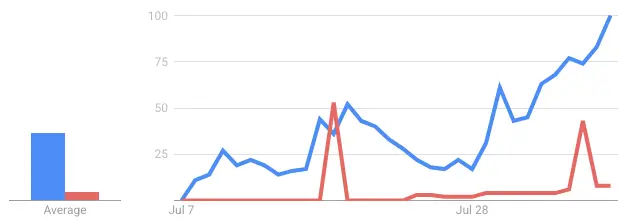
Crypto Gaming searches soar above Web3 gaming. | Source: Google Trends.

Immutable’s Robbie Ferguson also noticed the uptick, which includes a notably solid performance from the gaming crypto market, stating that the sector hasn’t seen this level of interest since 2021.

Speaking with CCN, he posited that this momentum is coming from positive regulatory shifts in the U.S. thanks to the CLARITY Act and initiatives such as Project Crypto.

From my conversations with multi-billion dollar gaming companies, there’s a clear shift in sentiment towards web3 gaming, and how effective it is in building sustainable ecosystems within games and lowering UA costs.

The impact is already showing at Immutable; in the last month alone, we’ve seen a 32% increase in MAU on Immutable Play as well as more than double developer inbounds.”

Per CoinMarketCap data, gaming tokens have had a bumpy month. After climbing to a $22.9 billion market cap, tokens took a nosedive amid bearish conditions, which saw this figure decline to a 30-day low of $17 billion.
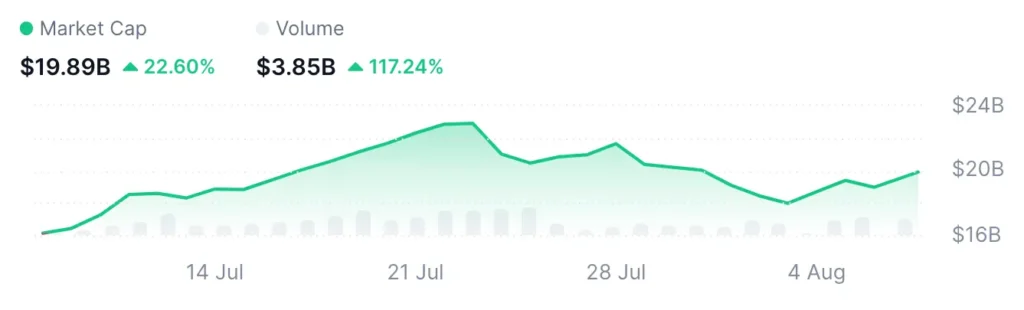
Gaming tokens market cap. | Source: CoinMarketCap.

However, this has begun recovering with market cap and trading volumes surging in the first week of August.

Ferguson also believes that stablecoins are also playing a big role in the market’s overall growth, noting that people are beginning to notice the “parallels of what stablecoin adoption, driven by Stripe, did for Payments, and what institutional momentum behind digital assets will do for gaming.”

“The entire category of gaming will be the next big thing to explode in crypto,” he adds.

The Quality Era

The Web3 industry has a habit of labelling everything it needs to define to the point it becomes a bit of a buzzword.

And the discussion around building ‘quality games’ first has – oddly – become a marketing necessity in this era.

It’s odd as the idea of games being of ‘good quality’ should be front and center.

However, it’s a very fragmented sector rife with an increasing number of failed titles, disappointing play-to-earn airdrop flops, and low-effort cash-grab games that are more investment opportunity/gamble than they are fun to play.

As a result, it almost became necessary to signal that upcoming/current titles like Star Citizen, Illuvium, EVE Frontier, and MapleStory N represent something entirely within the crypto sector.

And so, Web3 gaming, or as Google users appear to prefer, crypto gaming, continues to rise once again. Though perhaps this time around, it’ll be legitimized by the mainstream once and for all.

Was this Article helpful? Yes No

İlgili Okumalar

Solana Expands Validator Power With Launch of On-Chain Governance

Solana has formally launched its on-chain governance system, empowering token holders and validators with a more open and decentralized way to influence major protocol decisions. Governance debates and voting are now conducted entirely on-chain using the new Solana Governance Proposals (SGP) framework, supported by stake-weighted voting and cryptographic verification. Validators with at least 100,000 SOL in delegated stake can submit an SGP. To proceed to a formal vote, a proposal must first gain support from at least 15% of the network's total staked SOL, ensuring only ideas with significant backing move forward. SGPs serve a distinct purpose from the technical Solana Improvement Documents (SIMDs). While SIMDs focus on *how* to implement protocol upgrades, SGPs determine *whether* the broader ecosystem believes a proposal should proceed, via an on-chain, stake-weighted vote. This separation allows core developers to continue building effectively while reserving community-wide votes for impactful decisions. A key feature grants delegators greater control: they can now override their validator's governance vote. If a validator votes against a delegator's preference or abstains, the delegator can cast a vote directly using their own stake weight through Solana's governance portal. The voting process is secured using Merkle proofs to verify participant stakes against an on-chain consensus snapshot. With this implementation, Solana aims to broaden community participation in governance without hindering development, combining decentralized decision-making with efficient protocol evolution.

TheNewsCrypto20 dk önce

Solana Expands Validator Power With Launch of On-Chain Governance

TheNewsCrypto20 dk önce

Trillion-Won Bet on Semiconductors: Is South Korea Really Panicking This Time?

**Summary:** South Korea, traditionally adept at "counter-cyclical" investments during industry downturns, has launched an unprecedented trillion-dollar (approximately 6.4 trillion RMB) semiconductor investment plan during a current AI-driven boom. This shift signals deep strategic anxiety, driven by the rapid rise of China's memory chip challengers. The article traces this dynamic through the history of East Asian semiconductor competition. In the 1980s, Japan used a "national system + industrial capital" model to surpass the US in DRAM, only to be overtaken in the 1990s by South Korea employing the same aggressive, efficiency-focused tactics—most notably massive, loss-tolerant investments during downturns to crush competitors like Japan's Elpida. Now, China's memory giants, Yangtze Memory (YMTC) and ChangXin Memory Technologies (CXMT), are employing a strikingly similar playbook. Starting from near-zero a decade ago, they've used a combination of government-backed capital, strategic technology acquisition (e.g., CXMT leveraging Qimonda's legacy), and innovative architectural leaps (e.g., YMTC's Xtacking) to achieve rapid technological catch-up. Crucially, during the severe industry downturn of 2023, while Korean and US giants cut production, the Chinese firms expanded capacity and competed on price, rapidly gaining global market share (reaching ~11% in NAND and ~7.67% in DRAM by 2025). South Korea's current massive investment, therefore, is a defensive move born of fear. The historical pattern suggests that once a technological gap closes, scale and integrated supply chain advantages—areas where China holds significant potential—can determine the leader. Having used counter-cyclical strategies to become the incumbent, South Korea now faces the prospect of a formidable challenger using those very same tactics. This investment marks not just a bet on the AI cycle, but the opening chapter in a new battle for dominance in the memory industry.

marsbit29 dk önce

Trillion-Won Bet on Semiconductors: Is South Korea Really Panicking This Time?

marsbit29 dk önce

İşlemler

Spot
活动图片