Сезон альткоинов приближается на фоне роста ликвидности и регуляторной ясности

cryptonews.ru2025-12-30 tarihinde yayınlandı2025-12-30 tarihinde güncellendi

Ранее геополитическая нестабильность и фискальная неопределённость в США спровоцировали распродажи в сегменте альткоинов. Однако, как отмечается в отчёте, текущие рыночные тенденции способны запустить «долгожданный сезон альткоинов».

«По мере распространения регуляторной ясности на альткоины капитал начинает перераспределяться в пользу проектов с реальной экономической полезностью и устойчивыми токеномиками. Некоторые секторы уже демонстрируют признаки этого перехода», — пишет Sygnum.

Отчёт также фиксирует снижение доминирования биткоина, которое достигло максимума с 2021 года под влиянием геополитических и торговых факторов, но затем упало более чем на 6% из-за оттока капитала в альткоины.
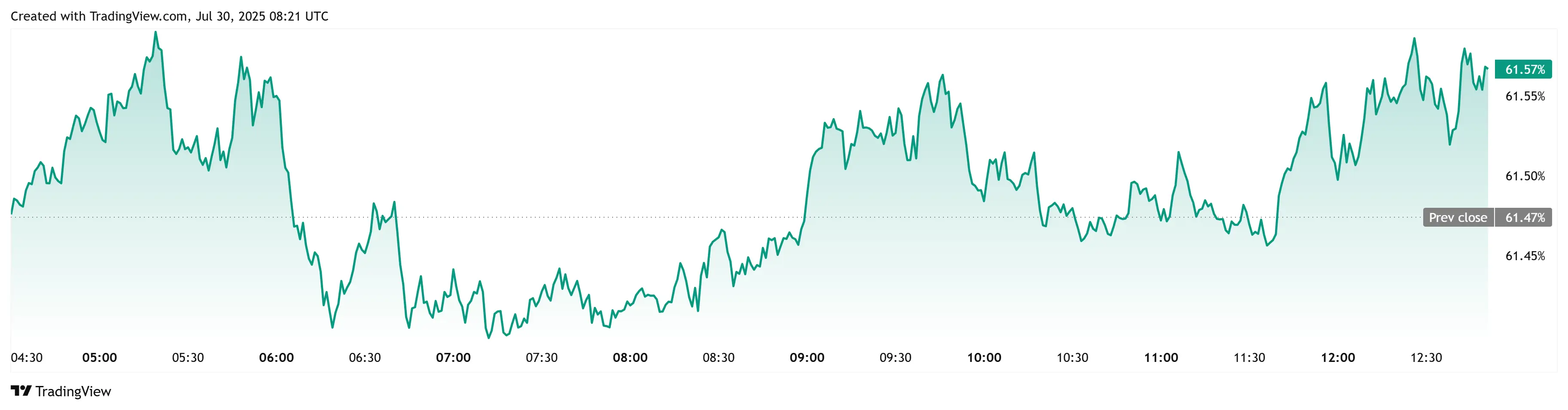

График доминирования биткоина. Источник: TradingView

Биткоин обновляет исторические максимумы на фоне дефицита предложения

Тренды ликвидности биткоина остаются «крайне благоприятными»: дисбаланс спроса и предложения привёл к тому, что крупнейшая по рыночной капитализации криптовалюта установила новые рекорды. 14 июля BTC достиг отметки выше $123 000.

«Активы под управлением спотовых биткоин-ETF превысили $160 млрд, при этом только за последний квартал было накоплено более 110 тыс BTC», — отмечает Sygnum. Ethereum (ETH) следует за биткоином, демонстрируя сокращение биржевых балансов, приток средств в ETF и около 30% ликвидного предложения в стекинге.
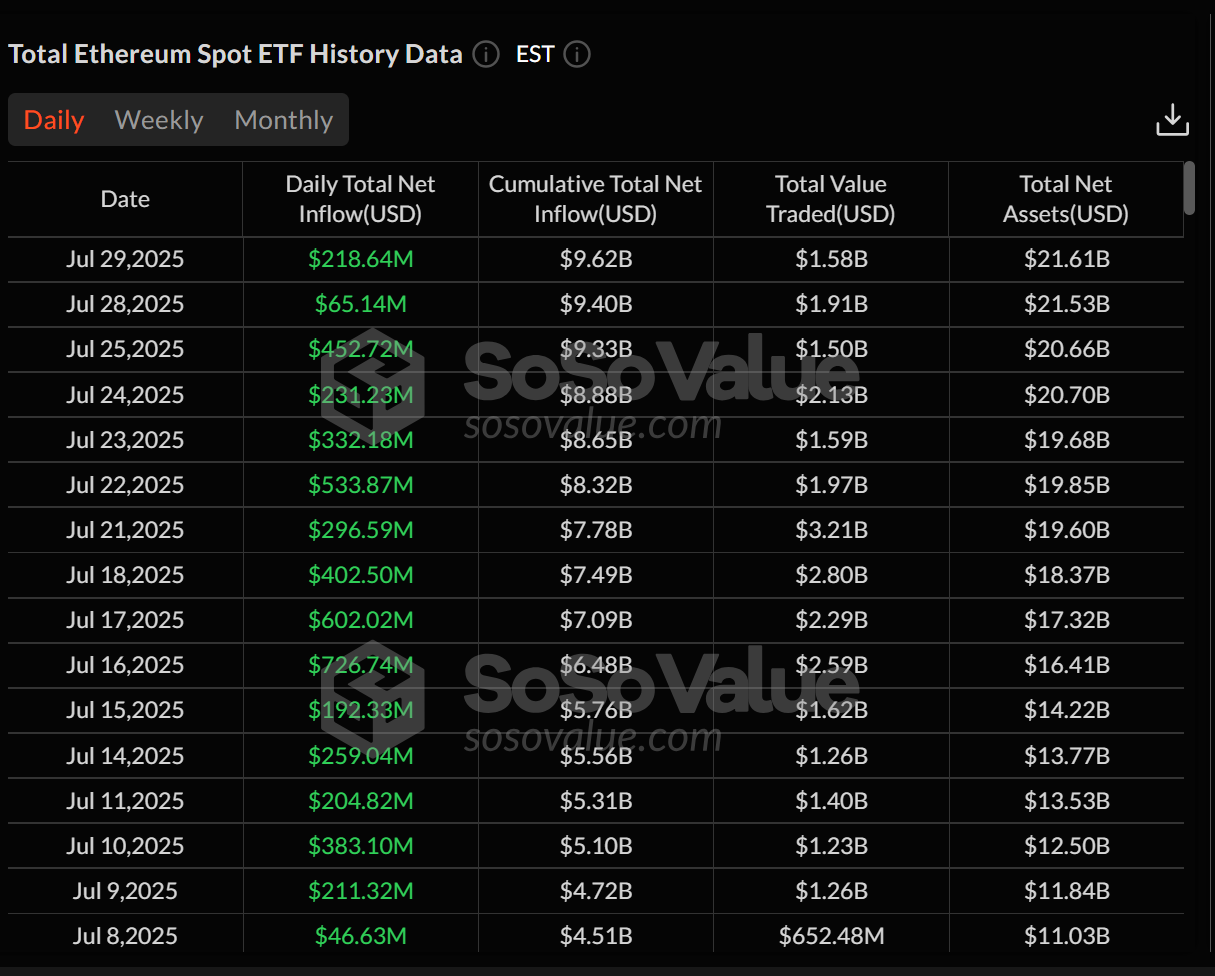

Приток средств в ETF Ethereum продолжается. Источник: SoSoValue

Позиции Ethereum укрепились после успешного обновления Pectra, которое «расширило лимиты стекинга и внесло ряд улучшений в протокол». Дополнительным стимулом стала регуляторная ясность: SEC подтвердила, что стейкинг Ethereum не подпадает под законодательство о ценных бумагах.

Sygnum заявляет, что ETH «окончательно преодолел долгосрочный нисходящий тренд», чему способствовал рост институционального спроса. Sharplink планирует инвестировать $1 млрд в Ethereum, а Wall Street-гиганты, включая BNY Mellon и Société Générale, запускают новые инициативы по токенизации и выпуску стейблкоинов на его базе. Отдельно отмечается стейблкоин с номиналом $1, поддерживаемый Дональдом Трампом.

Децентрализованные биржи захватили 30% рынка

В прошлом квартале децентрализованные биржи (DEX) достигли рекордной доли в 30% от общего объёма спотовых криптовалютных торгов. Росту способствовал ажиотаж вокруг мемкоинов, поднявший обороты DEX до $530 млрд. Лидером стал PancakeSwap на BNB Chain, а Solana-протокол PumpSwap быстро обошёл Raydium.

Объёмы DeFi-кредитования также достигли исторического максимума — $70 млрд, а доля ликвидного стейкинга превысила 30% от предложения ETH.

«Рыночный ралли особенно выгоден сегменту DeFi-кредитования: объёмы активных займов на Ethereum обновили рекорды, так как инвесторы наращивают аппетиты к риску и используют кредитное плечо», — пишет Sygnum.

Вместе с тем банк предупреждает, что текущий импульс альткоинов может спровоцировать новый пузырь мемкоинов, который в прошлом нередко заканчивался резкой коррекцией.

İlgili Okumalar

Can Generative Models Finally Be Trained End-to-End? The Core Is a For Loop

This article introduces a novel training paradigm for generative models called Explorative Modeling (XM), which enables true end-to-end training. Traditionally, powerful generative models like autoregressive and diffusion models are not trained end-to-end. They are trained to predict a single small step but require iterative multi-step sampling for inference. This "exposure bias" leads to error accumulation and limits performance. The core challenge XM addresses is "mode blurring." In generative tasks, a single input (e.g., "generate a dog") corresponds to many valid outputs (multiple modes). Standard training objectives like reconstruction loss force the model to average these modes, producing unrealistic, blurry outputs. To avoid this, existing models break generation into many small, almost deterministic steps, sacrificing end-to-end training. XM tackles this by restructuring the training loop itself. Its key insight is to amplify "generative expressivity." For each training input, instead of generating one sample, the model generates K candidate outputs. Only the candidate closest to the real data is used for computing the loss and updating the model via backpropagation. This simple "best-of-K" mechanism is implemented as a short for-loop. By exploring multiple possibilities, the model learns to distribute its guesses across different modes rather than collapsing to their uninformative average. The paper demonstrates that "exploration" acts as a new, powerful scaling axis. Gains from XM increase with model size, data scale, and compute. Experiments show improvements in FID scores for image generation and significant efficiency gains, sometimes outperforming larger models without exploration. When pushed to the limit, XM enables fully single-step, end-to-end generative models. In robotics tasks, an "Explorative Policy" matched the performance of a 100-step Diffusion Policy with a single forward pass, drastically improving inference speed. While the best-of-K concept is not entirely new, the authors' contribution lies in formally understanding it as a direct method to boost generative expressivity without fragmenting the generation process. This work suggests that as models scale, enhancing exploration during training may become crucial for overcoming fundamental performance bottlenecks.

marsbit5 dk önce

Can Generative Models Finally Be Trained End-to-End? The Core Is a For Loop

marsbit5 dk önce

Annual Salary of Millions Competing for Electricians, Meta Rushes to Open Its Own Technical School

The AI boom is facing an unexpected bottleneck: a severe shortage of skilled construction workers and electricians. As tech giants like Meta, OpenAI, and Alphabet race to build massive data centers—such as OpenAI's $16 billion "Stargate" project—they are hitting a critical labor wall. The U.S. needs an estimated 130,000 more electricians, 240,000 construction workers, and 150,000 supervisors by 2030 for AI infrastructure alone, but tens of thousands of electrician jobs go unfilled each year. While AI companies offer high premiums, with electricians earning up to $280,000 annually, worker scarcity still causes massive losses—delays on a single project can cost $14.2 million per month. The complexity of building AI data centers, which require immense power (equivalent to powering hundreds of thousands of homes), sophisticated electrical systems, and advanced liquid cooling solutions, demands highly skilled technicians who are in short supply. To combat this, companies are investing heavily in training. Meta has committed $115 million to a free training school offering tuition, housing, and stipends, targeting 5,000 new workers. OpenAI is partnering with unions to secure skilled labor. These efforts are paying off, with a significant rise in Gen Z interest in trade schools over college. However, the power demands are staggering. AI data centers are driving a rapid surge in electricity consumption, projected to account for up to 12% of U.S. power use by 2028 and raising costs for consumers. Furthermore, the construction boom is project-based, leading to a potential future glut of trained workers once building peaks, which could depress wages industry-wide. The race for AI supremacy now depends as much on skilled hands as on advanced chips.

marsbit1 saat önce

Annual Salary of Millions Competing for Electricians, Meta Rushes to Open Its Own Technical School

marsbit1 saat önce

İşlemler

Spot
活动图片