Американские законодатели требуют от SEC информации о криптофирме, поддерживаемой семьей Трампа

cryptonews.ru2022-02-03 tarihinde yayınlandı2025-04-03 tarihinde güncellendi

Два законодателя-демократа в Сенате и Палате представителей США призвали исполняющего обязанности председателя Комиссии по ценным бумагам и биржам (SEC) Марка Уйеду предоставить информацию о World Liberty Financial, криптофирме, поддерживаемой семьей президента Дональда Трампа.

В письме от 2 апреля сенатор Элизабет Уоррен и представитель Максин Уотерс — высокопоставленные члены банковского комитета Сената и комитета по финансовым услугам Палаты представителей соответственно — попросили Уйеду предоставить Конгрессу информацию, основанную на связях Трампа с World Liberty Financial (WLFI).

Два законодателя предположили, что SEC может находиться под влиянием фирмы, и «этот конфликт интересов может помешать ее миссии по защите инвесторов и поддержанию справедливых и упорядоченных рынков».

«Финансовая доля семьи Трампа в World Liberty Financial представляет собой беспрецедентный конфликт интересов, который может повлиять на контроль администрации Трампа — или его отсутствие — над криптовалютной индустрией, создавая очевидный стимул для администрации Трампа дать указание федеральным агентствам, включая SEC, занять позицию, благоприятную интересам криптовалюты, которые напрямую выгодны семье президента», — говорится в письме.
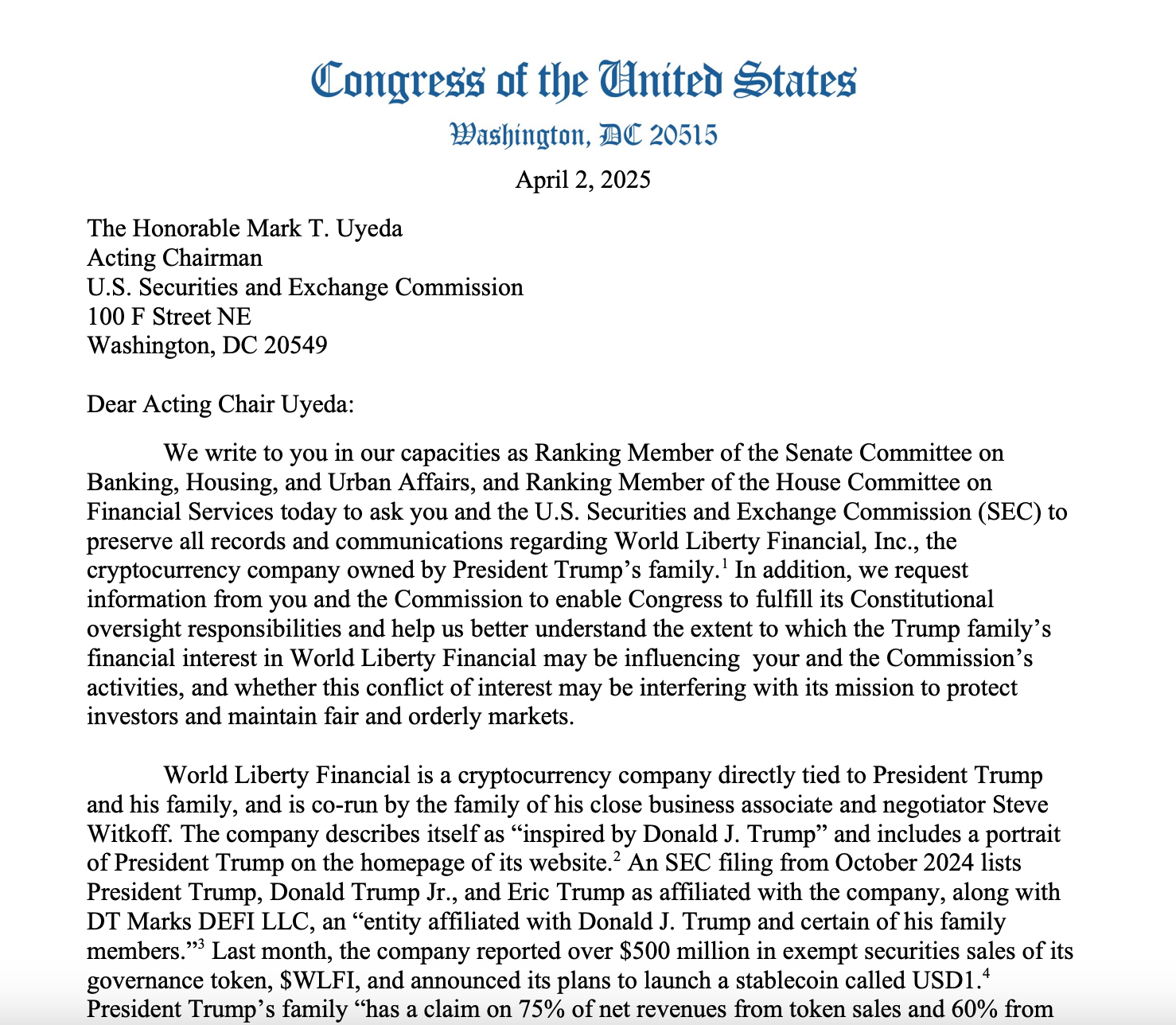

Письмо от 2 апреля исполняющему обязанности председателя SEC Марку Уйеде. Источник: Комитет по финансовым услугам Палаты представителей

Письмо пришло примерно через неделю после того, как WLFI объявила о запуске стейблкоина USD1 на блокчейне BNB Chain и Ethereum. Однако с января Трамп реализовал несколько криптовалютных политик и проектов с потенциальными конфликтами интересов, включая планы по созданию национального запаса криптовалюты и запуск мемокоина TRUMP.

По словам Уоррен и Уотерс, американцы заслуживают прозрачности относительно криптовалютных предприятий Трампа и того, как они могут потенциально повлиять на политику SEC, финансового регулирующего агентства, которое в значительной степени призвано быть независимым от администрации. Они призвали Уйеду предоставить записи и сообщения, связанные с WLFI, от Трампа и его семьи, а также переписку с SEC.

«Американский народ заслуживает знать, регулируются ли их финансовые рынки беспристрастно или же решения по регулированию принимаются в пользу финансовых интересов семьи президента», — написали законодатели-демократы.

В письме были повторены аргументы Уотерс, высказанные на слушаниях в Комитете по финансовым услугам Палаты представителей 2 апреля. Законодатель из Калифорнии заявил, что без надзора и подотчетности Трамп мог бы установить стейблкоин WLFI для государственных платежей и получать прибыль напрямую от своей должности президента.

Многие другие законодатели и финансовые эксперты по всему политическому спектру выразили обеспокоенность по поводу потенциальных конфликтов интересов Трампа с криптоиндустрией.

Руководство SEC при Трампе

С тех пор как Трамп назначил Уйеду исполняющим обязанности председателя, SEC прекратила расследования и принудительные меры в отношении нескольких криптофирм, включая те, руководители которых внесли непосредственный вклад в президентскую кампанию 2024 года.

Ожидается, что Пол Аткинс, номинированный Трампом на пост председателя SEC после Уйеды, предстанет перед голосованием в Банковском комитете Сената 3 апреля. Если кандидатура Аткинса будет отклонена комитетом, вся палата решит, утверждать ли его.


İlgili Okumalar

He Kaiming's Team's New Work: After Deleting VAE and Private Data, Text-to-Image Generation Becomes Even Stronger

KaiMing He's team introduces **MiniT2I**, a minimalist text-to-image (T2I) model that challenges the complexity of mainstream approaches. It eliminates components commonly considered essential: the VAE encoder-decoder, AdaLN conditioning mechanisms, auxiliary losses, private training data, and post-training alignment stages like RL/DPO. Instead, it uses a pure flow-matching objective trained directly on RGB pixels. The model employs a simplified **MM-JiT** Transformer architecture. It removes AdaLN blocks for conditioning and instead prepends two lightweight text adapter blocks to a standard pre-norm Transformer, allowing frozen T5 text features to adapt to the denoiser. Training follows a two-stage, LLM-like paradigm using only public datasets: pre-training on LLaVA-recaptioned CC12M for coverage, followed by fine-tuning on ~120k high-quality image-text pairs. With just 258M parameters (B/16), MiniT2I achieves competitive scores (0.87 on GenEval, 84.2 on DPG-Bench), outperforming larger pixel-space models. Scaling to 912M parameters (L/16) yields results comparable to SD3-Medium (~2B parameters) in style, composition, and imagination, though it lags in text rendering and named entities due to public data limitations. Key advantages include lower computational cost (~570 GFLOPs vs. ~1379 for latent models) and architectural simplicity. Acknowledged limitations include patch boundary artifacts in pixel space, side effects of high CFG scales, resolution ceilings for sequences longer than 1024 tokens, and the aforementioned data bottlenecks. The work demonstrates that high-performance T2I generation is possible with a radically simplified, publicly reproducible baseline.

marsbit2 dk önce

He Kaiming's Team's New Work: After Deleting VAE and Private Data, Text-to-Image Generation Becomes Even Stronger

marsbit2 dk önce

The Insurance Industry Faces Its Biggest Competitor: Are Prediction Markets the "Barbarians at the Gate"?

The insurance industry, long a stable "ballast" in the economy, may face a significant challenge from the rise of prediction markets, which are beginning to function as a new form of risk hedging and insurance. Platforms like Kalshi and Polymarket are demonstrating their utility in areas traditionally dominated by insurers. Examples include Kalshi's partnership with sports insurance broker Game Point Capital to offer more cost-effective hedging for NBA team performance bonuses, and Polymarket's collaboration with real estate platform Parcl, allowing users to hedge against housing price fluctuations in major US cities. A New York bar also used Kalshi to hedge a marketing promotion tied to an NBA game outcome, highlighting prediction markets' potential for small business risk management. These markets offer advantages over traditional insurance and sports betting in transparency, liquidity, and flexibility. They allow information monetization across a wider range of events, act as neutral platforms rather than direct counterparties, and provide clearer pricing. A historical precedent is the "Mattress Mack" marketing campaigns, which used sports betting for large-scale customer refunds, but prediction markets offer a more systematic and accessible model. Experts like SIG CEO Jeff Yass see their potential for efficient, parameter-based risk sharing, such as for weather-related property damage. However, challenges remain, including liquidity issues, unclear regulatory boundaries, and potential manipulation of event outcomes. Despite these hurdles, prediction markets represent a growing competitive force for both traditional gambling platforms and segments of the insurance industry.

marsbit3 dk önce

The Insurance Industry Faces Its Biggest Competitor: Are Prediction Markets the "Barbarians at the Gate"?

marsbit3 dk önce

Insurance Industry Faces Its Biggest Competitor: Are Prediction Markets the 'Barbarians at the Gate'?

"Insurance Industry Faces New Rival: Are Prediction Markets the 'Barbarians at the Gate'?" Prediction markets, exemplified by platforms like Kalshi and Polymarket, are emerging as potential disruptors to the traditional insurance industry by offering alternative risk-hedging mechanisms. These markets allow users to bet on specific event outcomes, effectively creating a form of customizable, on-demand insurance. Key examples highlight this shift. In sports, Kalshi partnered with insurance broker Game Point Capital to provide NBA teams with more affordable options to hedge performance bonuses compared to traditional insurers. In real estate, Polymarket's collaboration with Parcl lets users speculate on city-specific housing price indices, allowing homeowners to hedge against price drops or buyers against price increases. Furthermore, businesses like a New York bar have used Kalshi to hedge marketing promotions (e.g., offering free drinks if a team wins), framing the transaction explicitly as placing a "hedge." The article argues prediction markets offer advantages over traditional insurance and even sports betting in transparency, liquidity, and flexibility. They provide a wider range of event coverage, act as neutral platforms rather than counterparties, and offer clearer pricing. The piece cites historical precedents like large "refund promotion" hedges by businesses using sportsbooks but notes prediction markets modernize the concept. However, challenges remain for widespread adoption as an insurance alternative, including limited liquidity in some markets, unclear regulatory status, and potential vulnerabilities in event resolution mechanisms. Despite these hurdles, prediction markets are positioning themselves as new tools for risk management, directly challenging certain segments of the conventional insurance landscape.

Odaily星球日报9 dk önce

Insurance Industry Faces Its Biggest Competitor: Are Prediction Markets the 'Barbarians at the Gate'?

Odaily星球日报9 dk önce

Which Crypto Sectors Have Been 'Eaten' by AI Agents?

The article examines the transformative impact of AI Agents on the cryptocurrency landscape, highlighting how specific sectors are becoming increasingly dominated by automated systems. Key "agent-eaten" sectors include derivatives trading (perpetuals), where AI agents demonstrate significantly higher survival and performance rates than human traders; MEV and arbitrage trading, which are almost entirely automated; yield optimization, with over two-thirds of new DeFi protocols incorporating AI agents; and spot trading/portfolio management, where agents drive a growing share of DEX volume. "Battleground" sectors like prediction markets and DeFi lending show a mix, with agents excelling in short-term/arbitrage activities but humans retaining an edge in longer-term, nuanced decisions. Sectors still primarily "human-led" include stablecoin payments/remittances (driven by real-world economic activity) and wallets, where human oversight for approvals and security remains critical. As AI agent activity grows, the article emphasizes the rising importance of human-agent verification layers (e.g., World/AgentKit, t54, Self Protocol) to ensure trust, accountability, and control in an increasingly agentic economy. The conclusion is that while AI agents dominate in speed and optimization-focused areas, human judgment, trust, and real-world context remain essential in value-creating layers like payments and identity.

marsbit10 dk önce

Which Crypto Sectors Have Been 'Eaten' by AI Agents?

marsbit10 dk önce

AC Exits Sonic Board, 'DeFi Godfather' Pulls Off Another Strategic Retreat

Andre Cronje, known as the "DeFi Godfather," and two other founding directors have stepped down from the Sonic Labs board. The S token, once valued at $1.03, has plummeted 97% to $0.028, and the chain's TVL has evaporated 98% from its peak. In his exit statement, Cronje clarified he was a technical architect, not a founder, and distanced himself from token economics and migration decisions behind the token's crash. Cronje revealed his focus for the past 18 months has been his new project, Flying Tulip. This project raised $200 million privately last year at a $10 billion valuation. Its token design includes a perpetual put option (ftPUT NFT) for early investors, allowing them to redeem their initial investment at any time—a protection not extended to public market buyers. This pattern mirrors Cronje's past exits from projects like Yearn Finance and Fantom, where he departed near peak hype, leaving later holders to bear significant losses. Sonic itself has seen a complete management overhaul in recent months. The article frames this as a microcosm of the broader crypto bear market, where Layer-1 chains are bleeding value. It highlights a harsh reality: a project's valuation is often tied to a founder's reputation rather than fundamentals. Ironically, Flying Tulip is set to launch first on the Sonic chain Cronje just left, underscoring a disconnect between the person and the platform.

marsbit31 dk önce

AC Exits Sonic Board, 'DeFi Godfather' Pulls Off Another Strategic Retreat

marsbit31 dk önce

İşlemler

Spot
Futures
活动图片