He Kaiming's Team's New Work: After Deleting VAE and Private Data, Text-to-Image Generation Becomes Even Stronger

marsbit2026-06-22 tarihinde yayınlandı2026-06-22 tarihinde güncellendi

Özet

KaiMing He's team introduces **MiniT2I**, a minimalist text-to-image (T2I) model that challenges the complexity of mainstream approaches. It eliminates components commonly considered essential: the VAE encoder-decoder, AdaLN conditioning mechanisms, auxiliary losses, private training data, and post-training alignment stages like RL/DPO. Instead, it uses a pure flow-matching objective trained directly on RGB pixels. The model employs a simplified **MM-JiT** Transformer architecture. It removes AdaLN blocks for conditioning and instead prepends two lightweight text adapter blocks to a standard pre-norm Transformer, allowing frozen T5 text features to adapt to the denoiser. Training follows a two-stage, LLM-like paradigm using only public datasets: pre-training on LLaVA-recaptioned CC12M for coverage, followed by fine-tuning on ~120k high-quality image-text pairs. With just 258M parameters (B/16), MiniT2I achieves competitive scores (0.87 on GenEval, 84.2 on DPG-Bench), outperforming larger pixel-space models. Scaling to 912M parameters (L/16) yields results comparable to SD3-Medium (~2B parameters) in style, composition, and imagination, though it lags in text rendering and named entities due to public data limitations. Key advantages include lower computational cost (~570 GFLOPs vs. ~1379 for latent models) and architectural simplicity. Acknowledged limitations include patch boundary artifacts in pixel space, side effects of high CFG scales, resolution ceilings for sequence...

The field of text-to-image generation has long been a fiercely competitive red ocean, seemingly with no room left to innovate.

What do you need to train a powerful text-to-image model today?

Following the current mainstream approach, you would need: a pre-trained VAE encoder-decoder, concatenated text encoders, meticulously designed conditional injection mechanisms, massive datasets, RL or DPO alignment phases...

Overall, there seems to be a consensus: text-to-image generation must be this complex.

He Kaiming's team, however, takes a contrarian approach, offering a new perspective in the field of text-to-image models. They have released MiniT2I — a minimalist, pixel-space text-to-image model that deliberately pursues simplicity.

No VAE encoder-decoder, no AdaLN conditional injection, no auxiliary loss functions, no private data, no RL/DPO alignment, just pure flow matching trained directly on pixels. The 258M-parameter B/16 version achieves 0.87 on GenEval and 84.2 on DPG-Bench, surpassing pixel-space models several times its size.
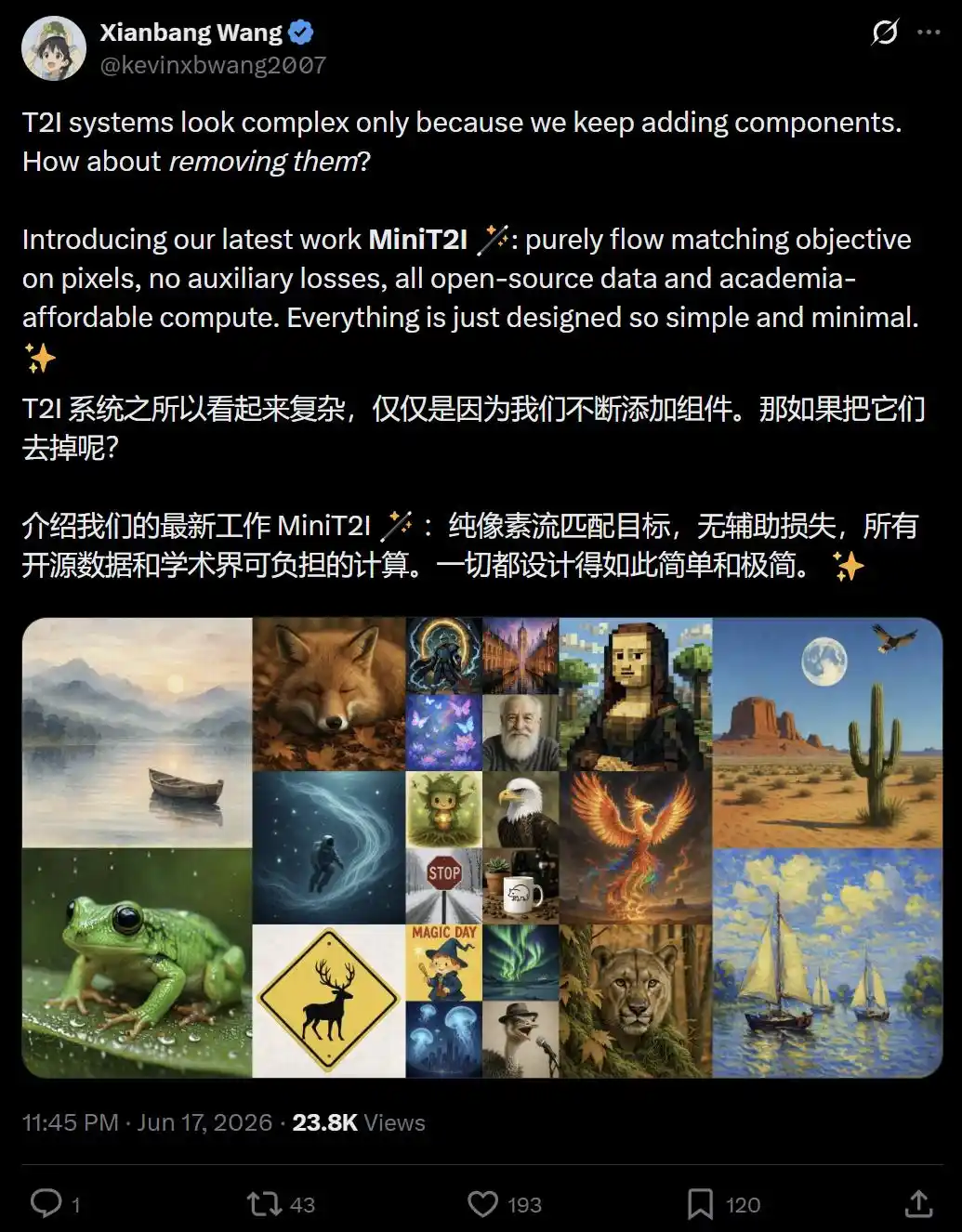
The core proposition of MiniT2I is: If text conditioning is treated as 'context tokens with semantic information' and injected into the model, text-to-image generation and class-conditional ImageNet generation are not fundamentally that different — the architecture can be similar, computational requirements comparable, and even the scale of data can be aligned.
  • Paper Title: A Minimalist Baseline for Text-to-Image Generation
  • Technical Blog: https://peppaking8.github.io/#/post/minit2i
  • Open Source Repo: https://github.com/PeppaKing8/minit2i-jax

Technical Approach: Subtraction at Every Step

Direct Pixel-Space Output, No VAE

MiniT2I's first design choice is radical: discard the VAE, perform denoising directly on RGB pixels.

Latent Diffusion Models are the current mainstream paradigm, first compressing images into a low-dimensional latent space using an autoencoder before diffusion. This makes high-resolution generation feasible, but at the cost of introducing reconstruction error, an extra training phase, and misalignment between the encoder and denoiser objectives.

MiniT2I's choice of pixel space is pragmatic: For 512×512 resolution, using 16×16 patches to divide the image into 1024 tokens keeps the sequence length well within the Transformer's comfort zone. Removing the VAE reduces single-step forward computation from ~1379 GFLOPs to ~570 GFLOPs (B/16 setting), and eliminates the ceiling on reconstruction accuracy — the output quality is only limited by the denoiser's capability.

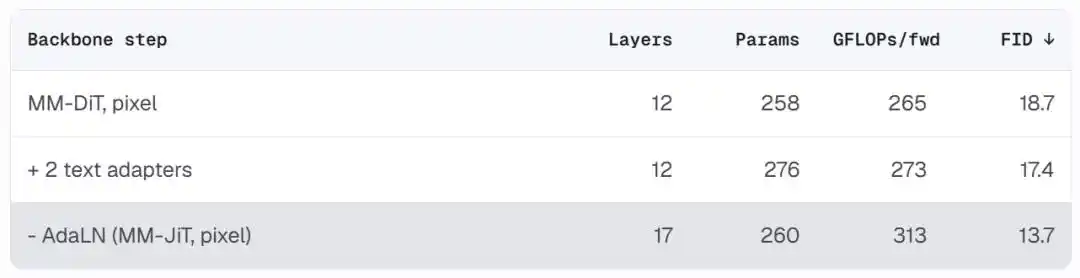
Experiments confirm this: Under the same parameter budget, pixel models achieve FID on par with latent space models (18.7 vs 19.0), but with a 5x lower per-step cost.

MM-JiT Architecture: Returning to a Simple Transformer

SD3's MM-DiT uses AdaLN (Adaptive Layer Normalization) within each block to inject timestep and pooled text embeddings into the network — each sub-block needs to compute scale, shift, and gate parameters generated by an extra MLP from the conditioning vectors. This is an elaborate modulation mechanism, but MiniT2I finds it non-essential.
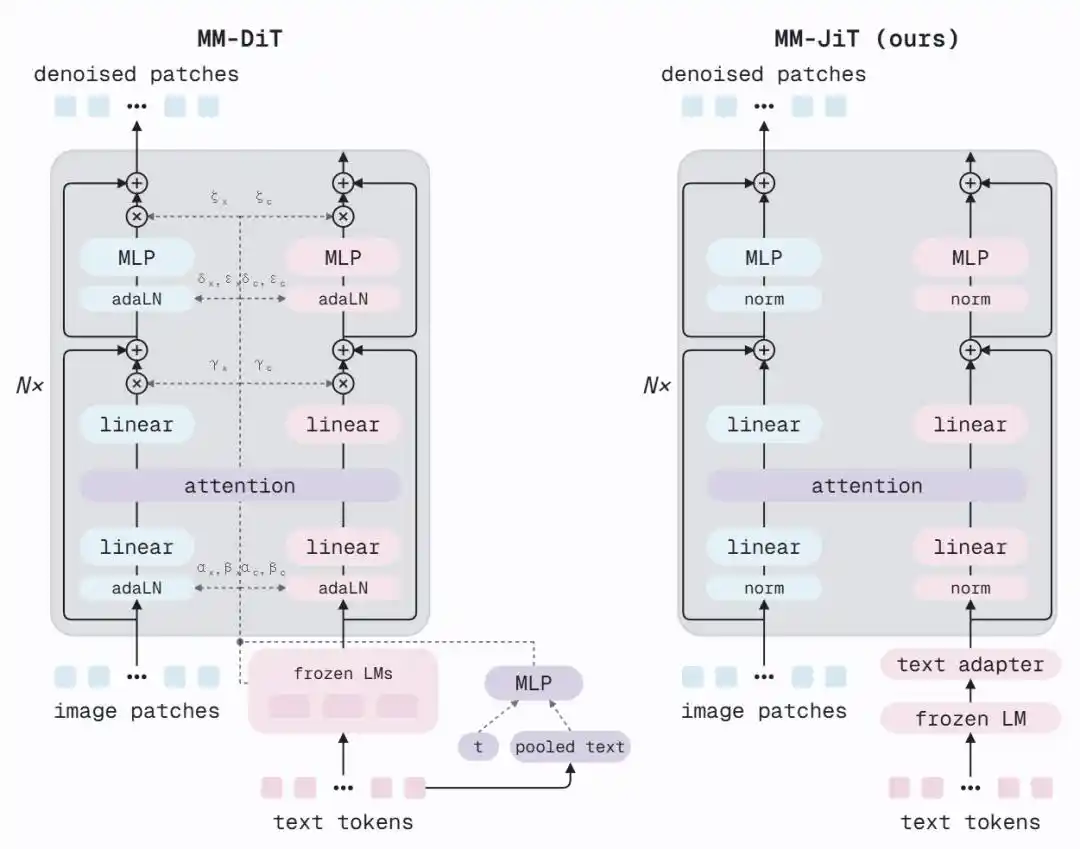
The proposed MM-JiT architecture does two things:

1. Add Two Text Adapter Layers: Insert two lightweight Transformer blocks before joint attention, allowing the frozen T5 features to first 'adapt' to the denoiser's needs.

2. Remove the AdaLN Branch: No longer inject timestep and global text information through an additional path. The model can still perceive noise levels — because the noise-corrupted image itself carries timestep information.

The result is a clean architecture nearly identical to a standard pre-normalization Transformer. Removing AdaLN reduces parameters, allowing for more layers within the same compute budget (12 layers → 17 layers). FID drops from 18.7 to 13.7, and the architecture itself is easier to understand and modify.
Training Data: Fully Public, Two-Phase

MiniT2I's training data also pursues minimalism:

  • Pre-training: LLaVA-recaptioned CC12M (publicly available VLM re-captioned dataset), 250K steps
  • Fine-tuning: ~120K high-quality image-text pairs (BLIP3o-60K + LAION DALL・E 3 Discord set + ShareGPT-4o-Image), 40K steps

This 'pre-train then fine-tune' two-stage pattern directly mirrors LLM training paradigms: pre-training buys coverage, fine-tuning teaches the model what a good answer is. Ablations show both are indispensable — pre-training alone yields acceptable image quality but poor prompt following; fine-tuning alone makes the model's world too narrow, causing generative diversity to collapse.

Results: Small Model, Big Performance

In comparisons among pixel-space text-to-image models, MiniT2I offers exceptional value:
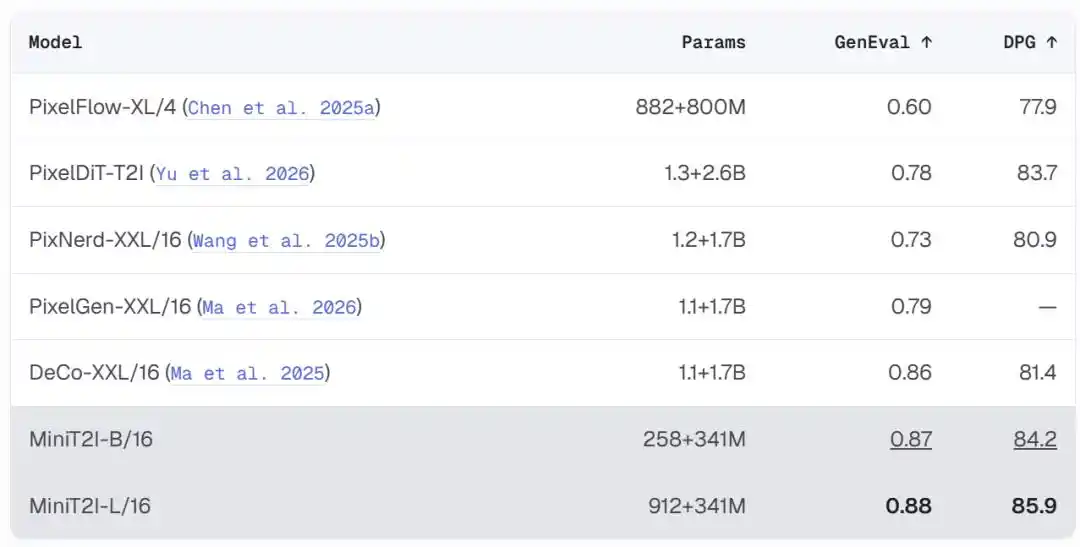
MiniT2I-B/16, with only ~600M total parameters (including text encoder), surpasses models 3-4 times its size on GenEval and DPG-Bench. Moreover, training cost is extremely low: the B/32 ablation model required only about 3 days on 8 H100s, with total training FLOPs comparable to a standard 200-epoch ImageNet experiment.
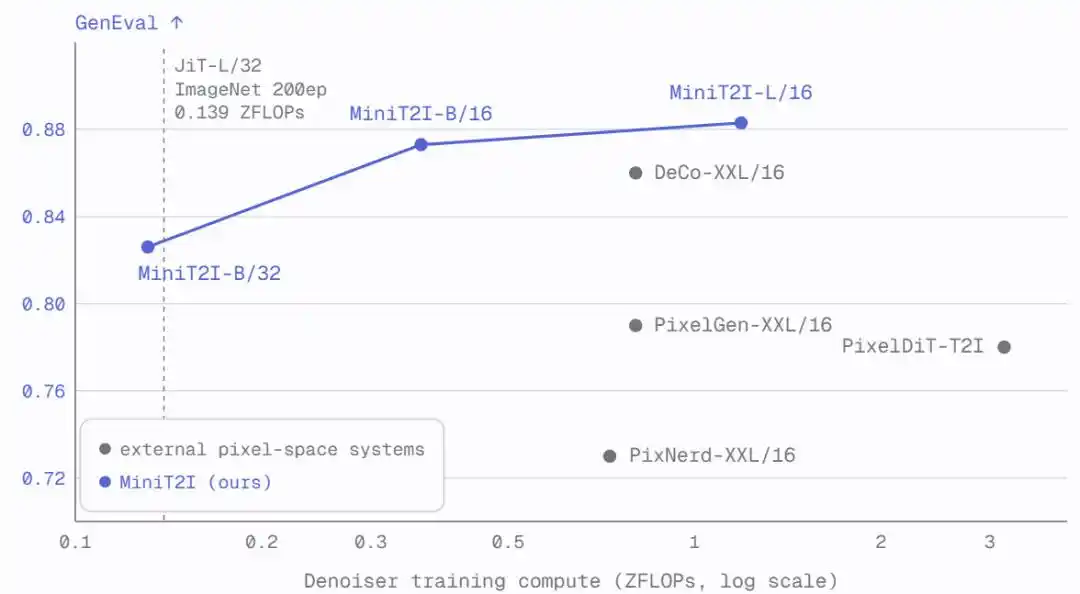
Scaling to L/16 (912M parameters) yields noticeable improvements in style diversity, spatial relationships, and text rendering, achieving quality on imaginative scenes comparable to or even better than SD3-Medium (~2B parameters).

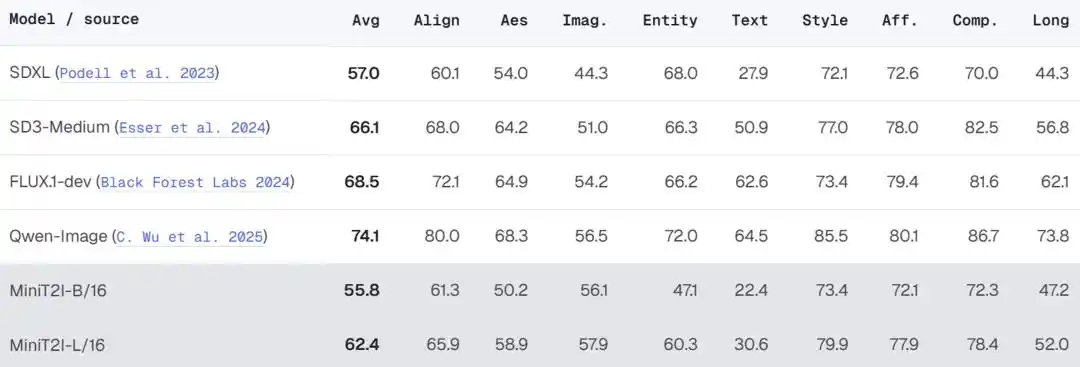
In the more comprehensive PRISM-Bench evaluation, MiniT2I-L/16 performs well in style, composition, and imagination dimensions (79.9, 78.4, 57.9), approaching SD3-Medium levels. However, gaps remain in text rendering (30.6 vs SD3's 50.9) and named entities (60.3 vs 66.3) — the team acknowledges these are inherent limitations of the public data recipe, requiring targeted data to bridge.
Limitations and Outlook

MiniT2I is a proof of concept for a technical path, not a final product. The team honestly points out several unresolved issues:

  • Patch artifacts in pixel space: Measurable discontinuities exist at patch boundaries (gradients 17-22% higher at boundaries than elsewhere), a problem latent-space models do not have.
  • Side effects of CFG in pixel space: High guidance scales (~6) push local tokens away from the data manifold, directly exposing visual artifacts without a decoder's 'smoothing' effect.
  • Resolution ceiling: Works well at 512×512 currently; pushing to 4K+ requires longer sequences or more efficient attention mechanisms.
  • Data bottleneck: Text rendering and named entities remain weaker than industrial systems, requiring specialized data augmentation.

MiniT2I demonstrates that state-of-the-art text-to-image generation is no longer a game only for top industrial labs.

When a 258M-parameter model, trained on purely public data with academic-level compute for just 3 days, can defeat opponents orders of magnitude larger, perhaps text-to-image is undergoing a paradigm shift from 'brute force' to 'distillation'.

"T2I is no longer an insurmountable wall. Welcome to use and improve it, to build a simpler baseline."

This article is from the WeChat public account "机器之心" (Almost Human)

Trend Kriptolar

İlgili Sorular

QWhat is the main contribution or innovation of the MiniT2I model proposed by He Kaiming's team?

AThe main contribution is proposing MiniT2I, a minimalist text-to-image baseline model. It removes numerous complex components standard in current models—such as the VAE encoder-decoder, the AdaLN conditional injection mechanism, auxiliary loss functions, and private training data—and relies solely on flow matching objectives trained directly on pixel space. It demonstrates that with a simpler architecture and public data, it can achieve competitive performance against much larger models.

QHow does the architectural design of MiniT2I's MM-JiT differ from the commonly used MM-DiT in models like SD3?

AThe MM-JiT architecture in MiniT2I differs from MM-DiT by performing simplification in two key ways. First, it adds two lightweight text adapter Transformer blocks before joint attention to help frozen T5 features adapt to the denoiser. Second, and more importantly, it deletes the complex AdaLN (Adaptive Layer Normalization) branches used to inject timestep and text conditioning. This results in a cleaner, near-standard pre-norm Transformer architecture, reducing parameters and allowing for more layers within the same compute budget.

QWhat is the core argument for MiniT2I's choice to operate directly in pixel space instead of a latent space like most models?

AThe core argument is simplicity and alignment. Removing the VAE eliminates several issues: reconstruction error, extra training stages, and misalignment between encoder and denoiser objectives. For 512x512 images, patchifying into 1024 16x16 tokens keeps the sequence length manageable for Transformers. This direct approach reduces computational cost per forward pass significantly (~570 vs ~1379 GFLOPs for the B/16 configuration) and removes the upper bound of reconstruction accuracy, meaning the output quality depends directly on the denoiser's capability.

QWhat were the two stages of data used to train MiniT2I, and why was this two-stage approach necessary?

AMiniT2I was trained in two stages using only public data: 1) Pre-training on LLaVA-recaptioned CC12M (a VLM-recaptioned dataset) for 250K steps. 2) Fine-tuning on a combined set of ~120K high-quality image-text pairs from sources like BLIP3o-60K, LAION DALL・E 3 Discord set, and ShareGPT-4o-Image for 40K steps. This 'pre-train then fine-tune' paradigm mirrors LLM training. Ablation studies showed both stages are essential: pre-training alone gives good image quality but poor prompt following, while fine-tuning alone causes a collapse in generation diversity due to a limited worldview.

QAccording to the article, what are some of the key limitations or unsolved problems with the MiniT2I approach?

AThe key limitations highlighted include: 1) Patch boundary artifacts in pixel space, leading to measurable discontinuities not present in latent models. 2) Negative side effects of high CFG (Classifier-Free Guidance) scales in pixel space, which push local tokens off the data manifold and manifest as visual flaws. 3) A resolution ceiling, as scaling to 4K+ would require longer sequences or more efficient attention. 4) Data bottlenecks, particularly in text rendering and named entity accuracy, which lag behind industrial systems and would require specialized data to improve.

İlgili Okumalar

A Company Once on the Brink of Bankruptcy Just Surpassed Bitcoin in Market Cap

On June 22nd, driven by rising stock prices, SK Hynix’s market capitalization reached $1.35 trillion, surpassing Bitcoin's total market cap of approximately $1.29 trillion. This temporarily made it South Korea's highest-valued company. The core driver of this surge is HBM (High Bandwidth Memory), for which SK Hynix is the primary supplier to NVIDIA, holding over 60% market share. AI's demand for high memory bandwidth has translated into immense profitability, with SK Hynix reporting a 72% operating profit margin in Q1. The company's success follows a 13-year bet on HBM technology, beginning in 2009. It nearly failed after the 2001 dot-com bubble, was acquired by SK Group in 2012, and was subsequently recapitalized to continue its long-term HBM development. The article contrasts this with the Crypto AI narrative. Capital currently favors AI infrastructure players like SK Hynix due to "real orders, physical barriers, and quantifiable profit margins." In comparison, Crypto AI projects, promising decentralized compute and data markets, remain largely conceptual with limited tangible progress. Examples include Bittensor, whose core mechanisms are still under development, and Bitcoin miners transitioning to AI, who face significant funding gaps and execution challenges. The piece cites analysis suggesting the AI sector has absorbed nearly all new market liquidity since 2022, leaving little for crypto. It concludes that the current AI infrastructure红利 is captured by entities with proven technical barriers and supply capabilities, while crypto networks still need to define their concrete role in the value chain.

链捕手23 dk önce

A Company Once on the Brink of Bankruptcy Just Surpassed Bitcoin in Market Cap

链捕手23 dk önce

Bittensor Moves Towards Ultimate Decentralization: The Critical 18 Months for the TAO Ecosystem is Here?

Bittensor, a decentralized AI protocol, is accelerating its transition to full decentralization over the next 18 months, as outlined in a recent post by co-founder Const. The project currently operates in a "semi-decentralized" state: ownership and network participation are open and permissionless, with TAO distribution based on competitive contribution. However, protocol upgrades and governance have remained under core team control to enable rapid iteration in the fast-evolving AI sector. This strategic shift comes as the ecosystem matures, boasting 128 subnets and a large community. Const argues that continued centralization now poses risks, including single points of failure and regulatory scrutiny. The upcoming decentralization roadmap includes optimizing validator competition, opening liquidity pools, introducing governance rights for Alpha holders, and refining economic models. The move could fundamentally reshape TAO's value proposition, adding governance premiums to its existing valuation based on AI narrative and scarcity. It also signals a potential maturation of the AI crypto sector, where competition may shift from hype to sustainable protocol design and real economic activity. Bittensor positions itself not just as another AI token, but as foundational infrastructure aiming to decentralize intelligence production—analogous to Bitcoin's role in decentralizing money—with the goal of creating a resilient "Millennium Intelligence Federation."

marsbit35 dk önce

Bittensor Moves Towards Ultimate Decentralization: The Critical 18 Months for the TAO Ecosystem is Here?

marsbit35 dk önce

Japan's AI Dark Horse Emerges: How a 7B Small Model Challenges Fable and Mythos?

In June 2026, Sakana AI's new model Fugu caused a stir in the AI community. Its Fugu Ultra variant achieved scores of 73.7 on SWE-Bench Pro and 82.1 on TerminalBench 2.1, surpassing GPT-5.5 and Claude Opus 4.8, and was claimed to be comparable to export-restricted models like Fable 5 and Mythos Preview. Remarkably, the core of this high-performance system is not a massive model, but a small 7B-parameter RL Conductor model. Fugu operates as a multi-agent orchestrator: the 7B model acts as a "foreman," dynamically analyzing user tasks and delegating subtasks to a pool of top-tier global models (e.g., GPT-5, Gemini 3.1 Pro). It then synthesizes and verifies their outputs. This architecture represents a paradigm shift from monolithic models to an expert-team approach. It enhances performance in complex, multi-step engineering tasks like code review and security testing by enabling cross-validation from specialized models, improving long-session stability and token efficiency. However, Fugu's strengths come with trade-offs: it faces inherent latency due to multiple API calls, relies heavily on underlying US model APIs (creating dependency risks), and its benchmark comparisons with Fable/Mythos are based on reported scores, not head-to-head testing. For Japan's AI ecosystem, which lacks the massive compute and data resources of the US or China, Fugu exemplifies an "asymmetric breakthrough" strategy. Instead of competing directly in parameter scale, it focuses on intelligent orchestration of existing global models, offering a degree of AI sovereignty and resilience. While a significant system-level innovation, its ultimate capability is still bounded by the underlying models it coordinates.

marsbit35 dk önce

Japan's AI Dark Horse Emerges: How a 7B Small Model Challenges Fable and Mythos?

marsbit35 dk önce

İşlemler

Spot
Futures

Popüler Makaleler

₿O₿ Nedir

Bitcoin Bob ($₿o₿): Hibrid Katman-2 İnovasyonu ile Bitcoin Merkezli DeFi'yi Öncü Hale Getiriyor Dijital ekonominin hızla evrildiği bir dönemde, Bitcoin Bob ($₿o₿), merkeziyetsiz finans (DeFi) sektöründe Bitcoin'in faydasını artırmayı amaçlayan devrim niteliğinde bir proje olarak ortaya çıkıyor. Mayıs 2024'te resmi olarak başlatılan Bitcoin Bob, aynı zamanda Build on Bitcoin (BOB) olarak da bilinir, Bitcoin’in tanınmış güvenliği ve değişmezliğini Ethereum'un programlanabilirliği ile birleştiren hibrid bir Katman-2 blok zinciri çözümünü temsil ediyor. Bu girişim, akıllı sözleşmelerin ve merkeziyetsiz uygulamaların entegrasyonunu kolaylaştırarak Bitcoin ekosisteminde önemli bir boşluğu doldurmayı hedefliyor ve Bitcoin'in özünde bulunan güven ve güvenlik ilkelerini koruyor. Önde gelen girişim sermayedarlarından önemli destek alarak, Bitcoin Bob, DeFi alanında Bitcoin'in rolünü yeniden tanımlamak için konumlanmış durumda ve onu küresel merkeziyetsiz finansal operasyonların temel taşı haline getiriyor. Bitcoin Bob, $₿o₿ Nedir? Bitcoin Bob'un özü, Bitcoin'in işlevselliğini artırmak için tasarlanmış bir hibrid blok zinciri çözümüdür. Projenin ana hedefi, Bitcoin üzerinde merkeziyetsiz finansı mümkün kılmak, hızlı ve sorunsuz işlemler sağlarken yüksek güvenlik seviyelerini garanti etmektir. Bitcoin Bob, Bitcoin'in güvenlik özelliklerini Ethereum Sanal Makinesi (EVM) ile birleştiren hibrid bir katman-2 mimarisi gibi ileri teknoloji kullanmaktadır. Bu pragmatik yaklaşım, projenin Bitcoin'in temel değerlerini tehlikeye atmadan etkili bir şekilde çalışmasını sağlar ve geleneksel Bitcoin sahipleri ile yeni ortaya çıkan DeFi ekosistemi arasında köprü kurmak için önemli bir adım oluşturur. Bitcoin Bob'un öne çıkan özelliklerinden biri, yenilikçi mekanizmalar aracılığıyla güveni minimize edilmiş bir ortam sağlama rolüdür; bu mekanizmalar arasında başlangıçta Ethereum'a dayanan iyimser rolluplar yer almakta ve nihayetinde tam Bitcoin entegrasyonuna geçiş yapılmaktadır. Bu hibrid sistem, Bitcoin'deki geniş likiditenin yalnızca korunmasını değil, aynı zamanda çeşitli DeFi protokollerinde etkili bir şekilde kullanılmasını sağlamayı amaçlamaktadır. Bitcoin Bob'un Yaratıcısı Kimdir, $₿o₿? Bitcoin Bob'un yaratıcı gücü, geniş kripto para alanındaki deneyim ve bilgisiyle Alexei Zamyatin'dir. Zamyatin, Bilgisayar Bilimleri alanında doktora sahibidir ve 2015 yılından bu yana Bitcoin geliştirme sürecinde aktif olarak yer almaktadır. Bitcoin ve Ethereum ekosistemlerine dair derin anlayışı, Bitcoin Bob'un vizyonunu ve teknolojik temellerini şekillendirmede kritik bir rol oynamaktadır. Zamyatin'in yanında, Dominik Harz adlı ortak kurucu, Baş Teknoloji Sorumlusu (CTO) olarak görev yapmaktadır. İkili, blockchain teknolojisinin sınırlarını zorlamaya yönelik ortak bir tutkusu olan yetenekli bireylerden oluşan bir ekip oluşturmuştur ve bu, Bitcoin Bob'un pazardaki yenilikçi konumunu güvence altına almaktadır. Bitcoin Bob'un Yatırımcıları Kimlerdir, $₿o₿? Bitcoin Bob, Bitcoin manzarasını dönüştürme potansiyelini tanıyan bir dizi önde gelen yatırımcı ve girişim sermayesi firması tarafından destek toplamayı başarmıştır. Mart 2024'te proje, Castle Island Ventures liderliğinde 10 milyon dolarlık bir tohum fonlama turunu başarıyla tamamlamış, Coinbase Ventures ve Bankless Ventures gibi firmalardan önemli katılımlar olmuştur. Kısa bir süre sonra, Temmuz 2024'te Bitcoin Bob, ek bir 1.6 milyon dolarlık stratejik fonlama sağlamıştır. Bu tur, Ledger Ventures tarafından ortaklaşa yönetilmiş ve BlackRock, Aave ve Curve gibi çeşitli önde gelen firmalardan melek yatırımcılar yer almıştır. Güçlü finansal destek, Bitcoin Bob'un DeFi alanındaki potansiyelini açığa çıkarmadaki yenilikçi yaklaşımının sektördeki genel kabulünü yansıtmaktadır. Bu fonlama, projenin devam eden gelişimi için kritik öneme sahip olmasının yanı sıra, büyüyen bir kullanıcı tabanının ihtiyaçlarını karşılamaya yönelik Bitcoin yerel merkeziyetsiz uygulamaları (dApps) geliştirmek için bir kuluçka merkezi kurmayı da hedeflemektedir. Bitcoin Bob, $₿o₿ Nasıl Çalışır? Bitcoin Bob'un operasyonel mekanikleri, Bitcoin'in güvenliğinin avantajlarını Ethereum'un EVM'sinin çok yönlülüğü ile birleştirmek üzere tasarlanmış hibrid rollup mimarisi üzerine kuruludur. Proje, kullanıcılar ve geliştiricilerle etkileşimini aşağıdaki şekilde tanımlayan aşamalı bir güvenlik modeli kullanmaktadır: Aşama 1 – İlk aşama, Ethereum üzerinde iyimser bir rollup olarak çalışır; burada işlemler, geçerlilik beklentisi ile işlenir ve Bitcoin üzerindeki gelecekteki gelişmelere zemin hazırlar. Aşama 2 – Proje geçiş yaptıkça, Bitcoin Staking aracılığıyla Bitcoin nihaiyetini entegre edecektir ve güvenliği artırmak için Babylon Ağı'nı kullanacaktır. Bu mekanizma, doğrulayıcıların Bitcoin'i kilitlemesini gerektirir; böylece BOB işlemlerini doğrular, bu da yalnızca güvenliği artırmakla kalmaz, aynı zamanda katılımcılar için getiri fırsatları yaratır. Aşama 3 – Bitcoin Bob'un ileriye dönük vizyonu, BitVM ve sıfır bilgi kanıtları gibi yenilikçi teknolojileri kullanarak Bitcoin ile tam entegrasyon sağlamaktır; bu, off-chain hesaplamayı kolaylaştırırken Bitcoin'in güvenlik bütünlüğünü korumaktadır. Zamyatin tarafından ortaklaşa yazılan BitVM2 gibi temel yenilikler, projenin işlevselliği için kritik öneme sahiptir; bu, geniş ağ bağımlılığı olmaksızın Bitcoin yatırımları ve çekimleri yapılmasına olanak tanır. Bu, ekosistemin Ethereum ve diğer uyumlu zincirlerle etkili bir şekilde bağlantı kurmasını sağlayarak kullanıcılar ve geliştiriciler için akıcı ve etkili bir etkileşim modeli oluşturur. Bitcoin Bob'un Zaman Çizelgesi, $₿o₿ Bitcoin Bob'un evrimini anlamak, önemli kilometre taşlarını takip etmeyi gerektirir: 2019: Alexei Zamyatin ve Dominik Harz, gelecekteki projelerin temelini atan blockchain çözümlerine odaklanan bir araştırma firması kurar. Mart 2024: Bitcoin Bob, 10 milyon dolar tohum fonlama turunu başarıyla tamamlayarak rekabetçi blockchain manzarasına giriş yapar. 1 Mayıs 2024: Resmi ana ağ lansmanı gerçekleşir ve projenin yetenekleri önemli kullanıcı benimsemesi ve toplam değer kilidi (TVL) ile sergilenir. Temmuz 2024: Proje, Bitcoin odaklı yenilikleri teşvik etmek amacıyla kuluçka merkezi kurmak için ek bir 1.6 milyon dolar stratejik fonlama çeker. Ekim 2024: Bitcoin Bob, hibrid katman-2 tasarımını ve ileriye dönük stratejilerini detaylandıran bir “Vizyon Belgesi” yayınlar. 2025: Genel işlevselliği artırmayı amaçlayan Bitcoin nihaiyeti ve BitVM köprülerine odaklanan Aşama 2 özelliklerinin beklenen dağıtımı. Sonuç: Bitcoin'in Merkeziyetsiz Finansındaki Rolünü Yeniden Tanımlamak Bitcoin Bob ($₿o₿), sadece başka bir blok zinciri projesi değil; Bitcoin'in daha geniş finansal uygulamalarla nasıl etkileşimde bulunabileceğine dair bir paradigma değişikliğini temsil ediyor. Bitcoin'in güvenliğini Ethereum'un esnekliği ile titizlikle birleştirerek, Bitcoin Bob, DeFi manzarasını yeniden şekillendirmeyi ve dijital para ile merkeziyetsiz uygulamalar arasındaki boşluğu kapatmayı hedefliyor. Güçlü bir teknolojik çerçeve, sağlam liderlik ve stratejik fonlama ile Bitcoin Bob, kripto para ekosisteminde kendini temel bir oyuncu olarak konumlandırmak için iyi bir konumda ve Bitcoin için yeni likidite ve fayda boyutlarını açma potansiyeline sahip. Proje gelişmeye ve genişlemeye devam ederken, Bitcoin'in yalnızca bir değer saklama aracı olmanın ötesinde, gelecekteki finansal manzaranın temel taşı olarak potansiyelinin çok daha ötesine geçtiğini kanıtlayacak bir yenilik çağına öncülük etme vaadinde bulunuyor. Proje, beklenen aşamaları boyunca ilerledikçe, tüm gözler Bitcoin Bob'un üzerine olacak; özellikle merkeziyetsiz ilkeleri entegre etme taahhüdü ve kullanıcıların Bitcoin ile desteklenen DeFi'nin tüm avantajlarından yararlanmasını sağlama konusundaki kararlılığı açısından.

12 Toplam GörüntülenmeYayınlanma 2025.06.30Güncellenme 2025.06.30

₿O₿ Nedir

O Nasıl Satın Alınır

HTX.com’a hoş geldiniz! O1 exchange (O) satın alma işlemlerini basit ve kullanışlı bir hâle getirdik. Adım adım açıkladığımız rehberimizi takip ederek kripto yolculuğunuza başlayın. 1. Adım: HTX Hesabınızı OluşturunHTX'te ücretsiz bir hesap açmak için e-posta adresinizi veya telefon numaranızı kullanın. Sorunsuzca kaydolun ve tüm özelliklerin kilidini açın. Hesabımı Aç2. Adım: Kripto Satın Al Bölümüne Gidin ve Ödeme Yönteminizi SeçinKredi/Banka Kartı: Visa veya Mastercard'ınızı kullanarak anında O1 exchange (O) satın alın.Bakiye: Sorunsuz bir şekilde işlem yapmak için HTX hesap bakiyenizdeki fonları kullanın.Üçüncü Taraflar: Kullanımı kolaylaştırmak için Google Pay ve Apple Pay gibi popüler ödeme yöntemlerini ekledik.P2P: HTX'teki diğer kullanıcılarla doğrudan işlem yapın.Borsa Dışı (OTC): Yatırımcılar için kişiye özel hizmetler ve rekabetçi döviz kurları sunuyoruz.3. Adım: O1 exchange (O) Varlıklarınızı SaklayınO1 exchange (O) satın aldıktan sonra HTX hesabınızda saklayın. Alternatif olarak, blok zinciri transferi yoluyla başka bir yere gönderebilir veya diğer kripto para birimlerini takas etmek için kullanabilirsiniz.4. Adım: O1 exchange (O) Varlıklarınızla İşlem YapınHTX'in spot piyasasında O1 exchange (O) ile kolayca işlemler yapın.Hesabınıza erişin, işlem çiftinizi seçin, işlemlerinizi gerçekleştirin ve gerçek zamanlı olarak izleyin. Hem yeni başlayanlar hem de deneyimli yatırımcılar için kullanıcı dostu bir deneyim sunuyoruz.

9 Toplam GörüntülenmeYayınlanma 2026.06.19Güncellenme 2026.06.19

O Nasıl Satın Alınır

Tartışmalar

HTX Topluluğuna hoş geldiniz. Burada, en son platform gelişmeleri hakkında bilgi sahibi olabilir ve profesyonel piyasa görüşlerine erişebilirsiniz. Kullanıcıların O (O) fiyatı hakkındaki görüşleri aşağıda sunulmaktadır.

活动图片