Мошенники используют липовые крипто-вакансии и приложение видеосвязи «GrassCall» для кражи кошельков

cryptonews.ru2024-12-28 tarihinde yayınlandı2025-02-28 tarihinde güncellendi

Сообщается, что мошенники, занимающиеся социальной инженерией, используют поддельные предложения о работе и новое вредоносное приложение видеосвязи «GrassCall», чтобы установить программное обеспечение для кражи информации, которое ищет криптокошельки для слива.

BleepingComputer сообщил 26 февраля, что стоящие за мошенничеством лица теперь отказались от этой схемы, а веб-сайты и учетные записи LinkedIn, связанные с ними, были удалены, когда сотни пострадавших сообщили о мошенничестве — некоторые из них заявили, что их криптокошельки были ограблены после загрузки GrassCall.

Сообщается, что за мошенничеством стоит российская киберпреступная группа «Crazy Evil», которая состоит из специалистов по социальной инженерии, обычно известных как «команда торговцев», которые сосредоточены на краже криптовалюты.

Компания по кибербезопасности Recorded Future сообщила в январе, что она связала «более десяти активных мошенничеств в социальных сетях» с Crazy Evil, которая, по ее словам, «явно нападает на криптовалютный сектор с помощью индивидуальных фишинговых приманок».

Одна из афер Crazy Evil, называемая Gatherum, по-видимому, является более ранней версией GrassCall, поскольку она маскировалась под похожее приложение для встреч с тем же логотипом и брендингом.

Также была обнаружена учетная запись на X под названием «VibeCall» с аналогичным визуальным оформлением и брендингом, что и у Gatherum и GrassCall. Похоже, что учетная запись стала активной в середине февраля, несмотря на дату ее создания в июне 2022 года.


Параллельное сравнение учетных записей X Gatherum и VibeCall. Источник: X

Последняя схема Crazy Evil, как сообщается, была связана с фальшивой криптофирмой под названием «Chain Seeker», у которой были различные аккаунты в социальных сетях, которые создавали списки вакансий на LinkedIn и популярных сайтах поиска работы Web3 CryptoJobsList и WellFound.

Тем, кто подавал заявки на вакансии, фирма отправляла электронное письмо с просьбой связаться с ее руководителем по маркетингу в Telegram, который затем просил жертву загрузить вредоносное приложение GrassCall с веб-сайта, находящегося под контролем группы, который теперь был удален.
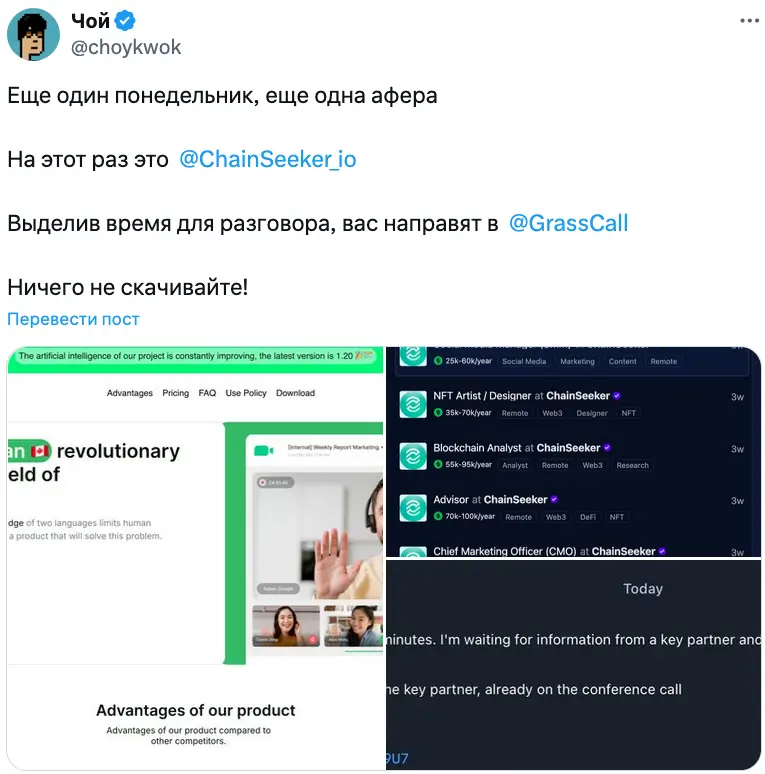

Источник: Choy.

Десятки соискателей рассказали на X и LinkedIn, что они подавали заявки на должность в Chain Seeker, а затем им отправляли вредоносную ссылку.

«Эта афера была чрезвычайно хорошо организована — у них был веб-сайт, профили LinkedIn и X, а также список сотрудников», — написал на платформе пользователь LinkedIn Кристиан Гита 26 февраля после подачи заявки на должность в фирме.

«Это выглядело законно почти со всех сторон. Даже инструмент для видеоконференций имел почти правдоподобное присутствие в сети», — добавил Гита.

Объявления о работе, размещенные Chain Seeker, в основном были удалены различными сайтами по трудоустройству, за исключением одного, который все еще был активен на LinkedIn на момент написания статьи.


Предложение о работе от Chain Seeker обещает зарплату до 150 000 долларов в год на должность менеджера по развитию бизнеса. Источник: LinkedIn

На веб-сайте Chain Seeker указаны финансовый директор по имени Изабель Олмедо и менеджер по персоналу по имени Адриано Каттанео, страницы обоих которых в LinkedIn были удалены. Учетная запись под именем Артемса Дзалбса все еще была активна и указывала себя как генерального директора фирмы.
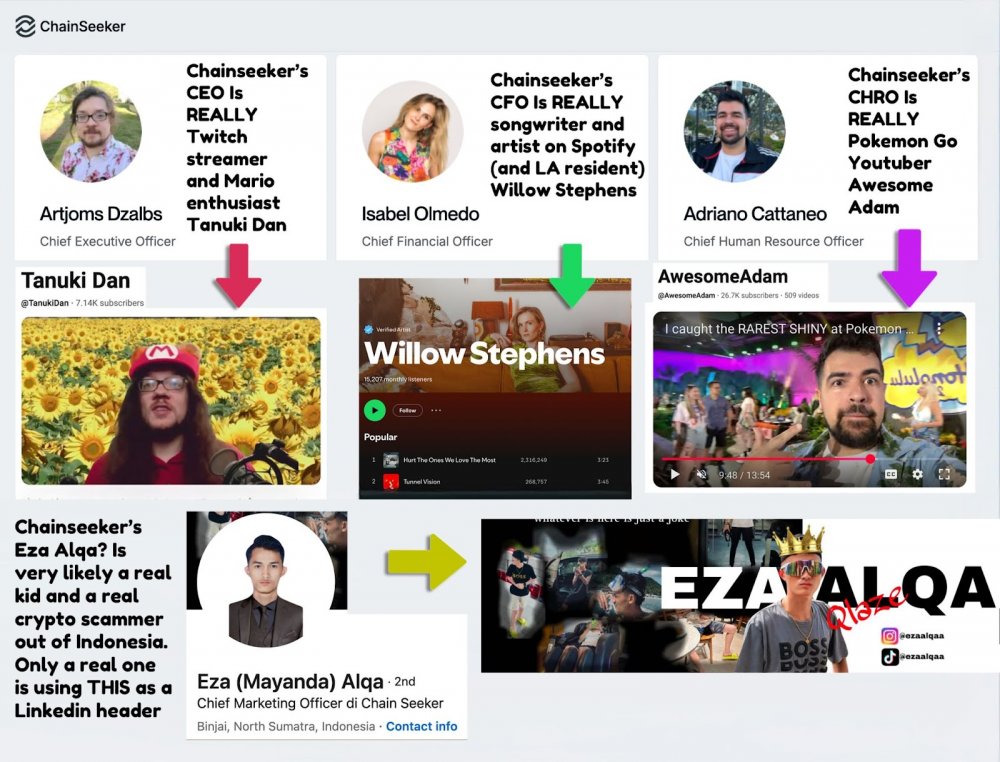

Пользователь LinkedIn Райли Роббинс обнаружил, что предполагаемая команда руководителей Chain Seeker использовала образы различных онлайн-персон. Источник: Райли Роббинс/Linkedin.

В своем отчете за прошлый месяц Recorded Future предупредила, что трейдеры криптовалют и невзаимозаменяемых токенов (NFT), а также игровые профессионалы «являются главными целями».

Многие пользователи X и LinkedIn посоветовали тем, кто считает, что они пострадали от вредоносного ПО GrassCall, использовать незараженное устройство для смены паролей и перевода криптовалюты на новые кошельки в качестве меры предосторожности.


İlgili Okumalar

BIS Report Compliance Observations: The True Risks of Stablecoins Go Beyond 'De-pegging'

The BIS report, "Anchoring trust in money: innovation beyond stablecoins," highlights that the primary risks of stablecoins extend beyond potential de-pegging. It argues that the core challenge is whether stablecoins can be integrated into a financial system that is identifiable, monitorable, accountable, and regulatable. While acknowledging efficiency gains like faster payments and programmability, BIS emphasizes that money requires an institutional framework—including legal certainty, liquidity support, and financial integrity controls—which many stablecoins currently lack. The report details compliance risks, noting that while blockchain transactions are transparent, address visibility does not equate to identity or purpose clarity. This creates a systemic risk as pseudonymity, non-custodial wallets, and cross-chain bridges can undermine AML/CFT controls. Furthermore, these risks can spill over into the traditional financial system through on- and off-ramps. The future direction, per BIS, is not to prohibit innovation but to embed regulatory rules—such as identity verification and transaction screening—directly into the technological infrastructure of tokenized finance. The key takeaway for compliance is that any new financial instrument must clearly address questions of customer identification, transaction monitoring, accountability, and cross-border rule consistency to be viable as a mainstream payment tool.

marsbit53 dk önce

BIS Report Compliance Observations: The True Risks of Stablecoins Go Beyond 'De-pegging'

marsbit53 dk önce

When US Giants Collectively "Defect" to Chinese AI Models

When Silicon Valley Giants Turn to Chinese AI Models to Cut Costs A surprising trend is emerging: major U.S. tech companies are significantly reducing AI costs by switching to Chinese models. Coinbase, the largest U.S. cryptocurrency exchange, reportedly halved its AI spending after migrating to China's GLM-5.2 and Kimi 2.7 models, despite increasing usage. They achieved this through a sophisticated three-part strategy: implementing an automatic routing system to select the most cost-effective model per task, boosting cache hit rates from 5% to 60% to reuse computations, and employing "context engineering" to provide AI with more precise, less cluttered information. They are not alone. AI startup Lindy switched from Claude to DeepSeek, saving millions, while Snowflake's tests found GLM-5.2 solved 66% of coding tasks compared to Claude Opus's 67%—but at a fraction of the cost (output pricing is 5-7 times lower). While the top Western models may offer slightly better stability, the massive price differential is leading many businesses to reconsider their value proposition. This shift signals a deeper change in the AI industry, moving beyond pure performance benchmarks to a fierce cost competition. As pressure mounts, even OpenAI and Anthropic have begun slashing prices. For users, this means more choices, lower costs, and a crucial lesson: using multiple models based on task complexity, optimizing with caching, and keeping contexts lean are now key to leveraging AI efficiently and affordably.

marsbit59 dk önce

When US Giants Collectively "Defect" to Chinese AI Models

marsbit59 dk önce

BIS Report Compliance Watch: The Real Risks of Stablecoins Are Not Just 'De-pegging'

BIS Report Compliance Observations: The real risks of stablecoins go beyond "depegging" The BIS report "Anchoring trust in money: innovation beyond stablecoins" argues that while stablecoins and tokenization offer efficiency gains, their primary risk lies in fitting into an identifiable, monitorable, accountable, and regulatable financial system. Money's trust stems not just from technology but from institutional arrangements: a common unit of account, guaranteed redemption at par, liquidity support, regulatory frameworks, and financial integrity requirements. Stablecoins, operating on permissionless blockchains with pseudo-anonymity and non-custodial wallets, create systemic compliance gaps: unclear customer identity, incomplete fund origins, unexplained transaction purposes, fragmented cross-chain paths, and ambiguous liability. On-chain transparency does not equal compliance transparency. Public addresses don't reveal identity or intent. While blockchain analytics aid law enforcement, they cannot replace routine, large-scale AML/CFT controls. Effective compliance requires a closed-loop process encompassing customer onboarding, transaction monitoring, investigation, reporting, and audit. Stablecoin risks are not confined to the blockchain; they re-enter the traditional financial system via on/off-ramps, exchanges, and payment institutions. This forces banks to monitor client accounts for activity linked to virtual assets. The future direction is not to prohibit innovation but to embed rules into the technology. Tokenized finance should integrate with the existing two-tier monetary system, embedding compliance—like customer identification, pre-transaction screening, and auditable data trails—directly into the transaction flow. For compliance professionals, the key takeaway is that any new financial instrument must answer core questions: Who identifies the customer? Who monitors transactions? Who handles exceptions? Who is liable? Compliance is not the antithesis of innovation but the essential infrastructure for its sustainable growth.

链捕手1 saat önce

BIS Report Compliance Watch: The Real Risks of Stablecoins Are Not Just 'De-pegging'

链捕手1 saat önce

When American Giants 'Defect' to Chinese AI Models

Summary: The trend of major U.S. technology firms adopting more cost-effective Chinese AI models is gaining momentum. A prime example is Coinbase, the largest U.S. cryptocurrency exchange, which reportedly halved its AI expenditure by switching to Chinese models GLM-5.2 and Kimi 2.7, while its usage volume increased. This was achieved through a sophisticated cost-saving system featuring intelligent model routing (selecting the most suitable model per task), dramatically improving cache hit rates from 5% to 60%, and implementing "Context Engineering" to streamline prompts. This shift is not isolated. Other companies like the AI startup Lindy and data cloud firm Snowflake are making similar moves, drawn by the significant price disparity. For instance, GLM-5.2 costs $1.40/$4.40 per million tokens (input/output), compared to $5/$25 for Claude Opus 4.7. While top Western models may offer slightly higher stability or speed in complex tasks, the performance gap is narrowing, making the price difference harder to justify for many enterprise use cases. The implications are significant for both businesses and individual users. It highlights the importance of a multi-model strategy based on task requirements, the value of caching and reusing outputs, and the effectiveness of providing concise context. Ultimately, this migration signals a potential reshaping of the AI industry's pricing model, moving competition from pure performance benchmarks to practical cost-effectiveness, with increased choice and downward price pressure benefiting end-users.

链捕手1 saat önce

When American Giants 'Defect' to Chinese AI Models

链捕手1 saat önce

İşlemler

Spot
活动图片