Известный миллионер кинул своих подписчиков, чтобы заработать 68 тысяч долларов на бестолковых мем-токенах

cryptonews.ru2023-01-08 tarihinde yayınlandı2025-02-08 tarihinde güncellendi

Мем-токены — один из главных трендов на этом буллране. Они известны невероятной волатильностью, из-за чего стоимость такого актива может прыгнуть в разы буквально за несколько часов или даже минут, после чего так же быстро падает. Воспользоваться данной особенностью решил основатель Barstool Sports Дейв Портной. Несмотря на наличие у него миллионов долларов, он решил поставить на кон свою репутацию ради пары десятков тысяч.

Дейв Портной и монета MONTOYA

Вчера вечером Портной опубликовал скриншот собственного криптокошелька Phantom, на котором находилось 2.68 миллиона монет MONTOYA. Свой пост предприниматель сопроводил следующей подписью, которую приводит Decrypt.

Оу. Дейви научился торговать шиткоинами и уже получил миллиард процентов прибыли на первой сделке.
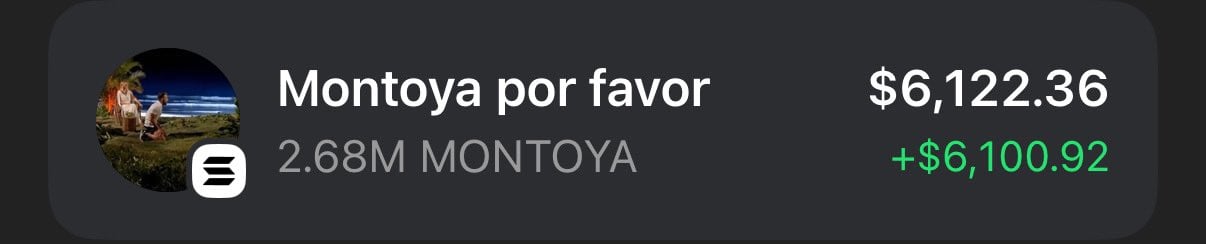

Скриншот мем-токена MONTOYA на кошельке Дейва Портного

Интерфейс кошелька дал понять, что этот мем-токен резко вырос за последний день. А это вполне предсказуемо привлекло трейдеров из числа подписчиков Портного, которые взялись покупать MONTOYA в попытке заработать.

Из-за таких операций рыночная капитализация мема довольно быстро прыгнула с 2.8 до 10 миллионов долларов.

Однако основатель Barstool Sports не учёл один важный момент: пользователи блокчейна довольно быстро определили кошелёк Дейва с помощью точного количества не самого популярного токена — речь идёт об адресе, который начинается с 5rkPD. Ну а это позволило им следить за операциями Портного с только что пропиаренным им криптоактивом.

Оказалось, что спустя пять минут Портной продал все 2.68 миллиона токенов за 118 SOL. Эквивалент операции составил приблизительно 24 тысячи долларов. Предприниматель прокомментировал ситуацию в следующей реплике.

Чёрт. У меня слишком много власти. Я заработал 25 тысяч долларов случайным образом. Это настоящая азартная игра, причём мой твит за секунды поднял капитализацию проекта с 2 до 10 миллионов долларов.


Продажа крупной суммы токенов в одной транзакции вполне предсказуемо сказалась на курсе токена. Он снизился в несколько раз, причём транзакция Портного действительно привела к обвалу графика.
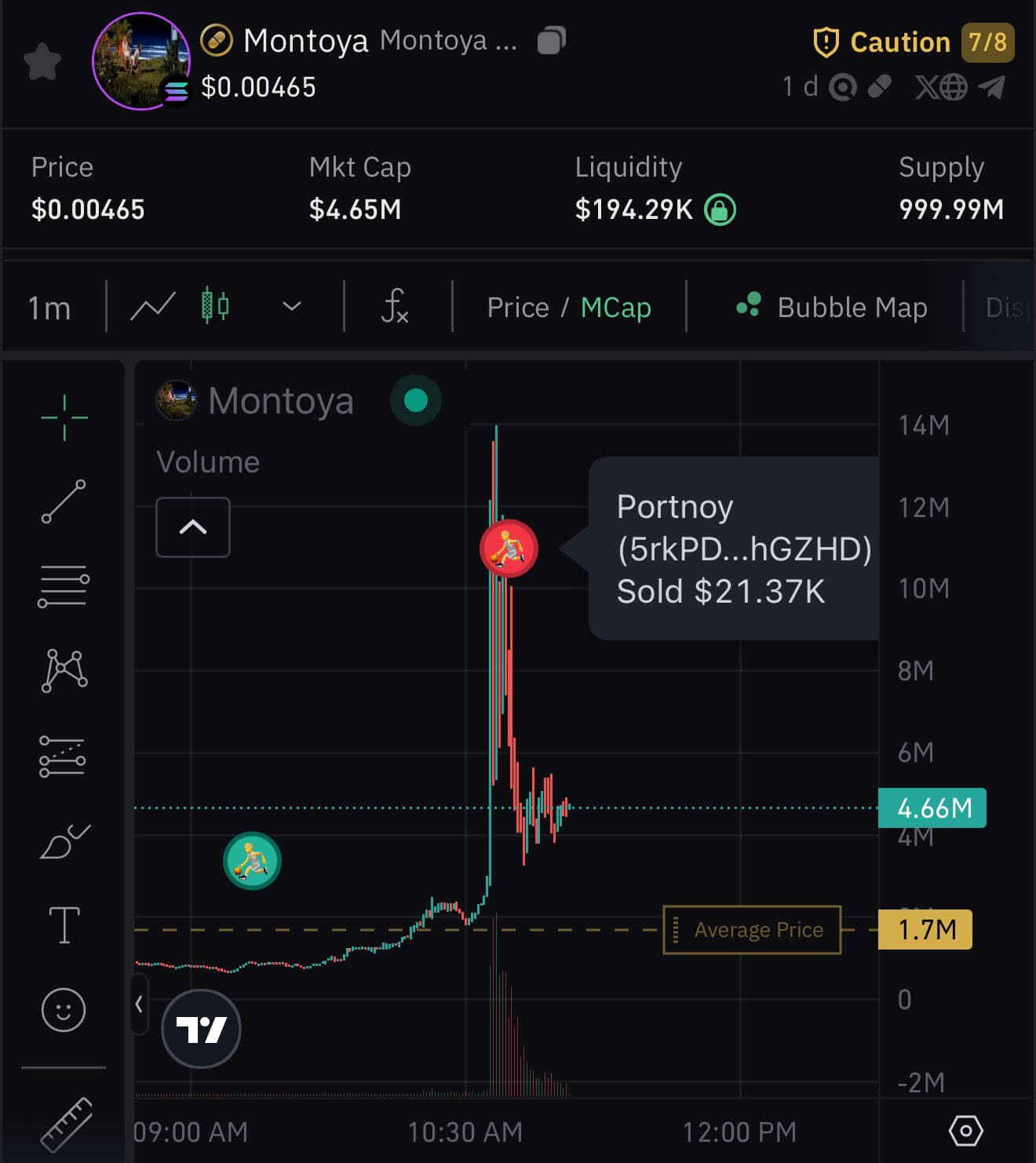
Операция по продаже MONTOYA Дейвом Портным на графике криптовалюты

Представитель Barstool отреагировал на публикацию и посоветовал Дейву быть осторожнее, поскольку он знает адрес кошелька предпринимателя. Впрочем, Портного это не смутило — в ответ он вспомнил о прозрачности блокчейна.

Я хочу, чтобы люди знали, чем я занимаюсь. Я не пытаюсь что-то скрывать. Вот почему мне это нравится — все могут видеть каждый мой шаг.


Как бы там ни было, с тех пор курс MONTOYA не восстановился. А значит покупатели мем-токена после твита Портного скорее всего находятся в минусе — и в первую очередь из-за соответствующей рекламы миллионера.
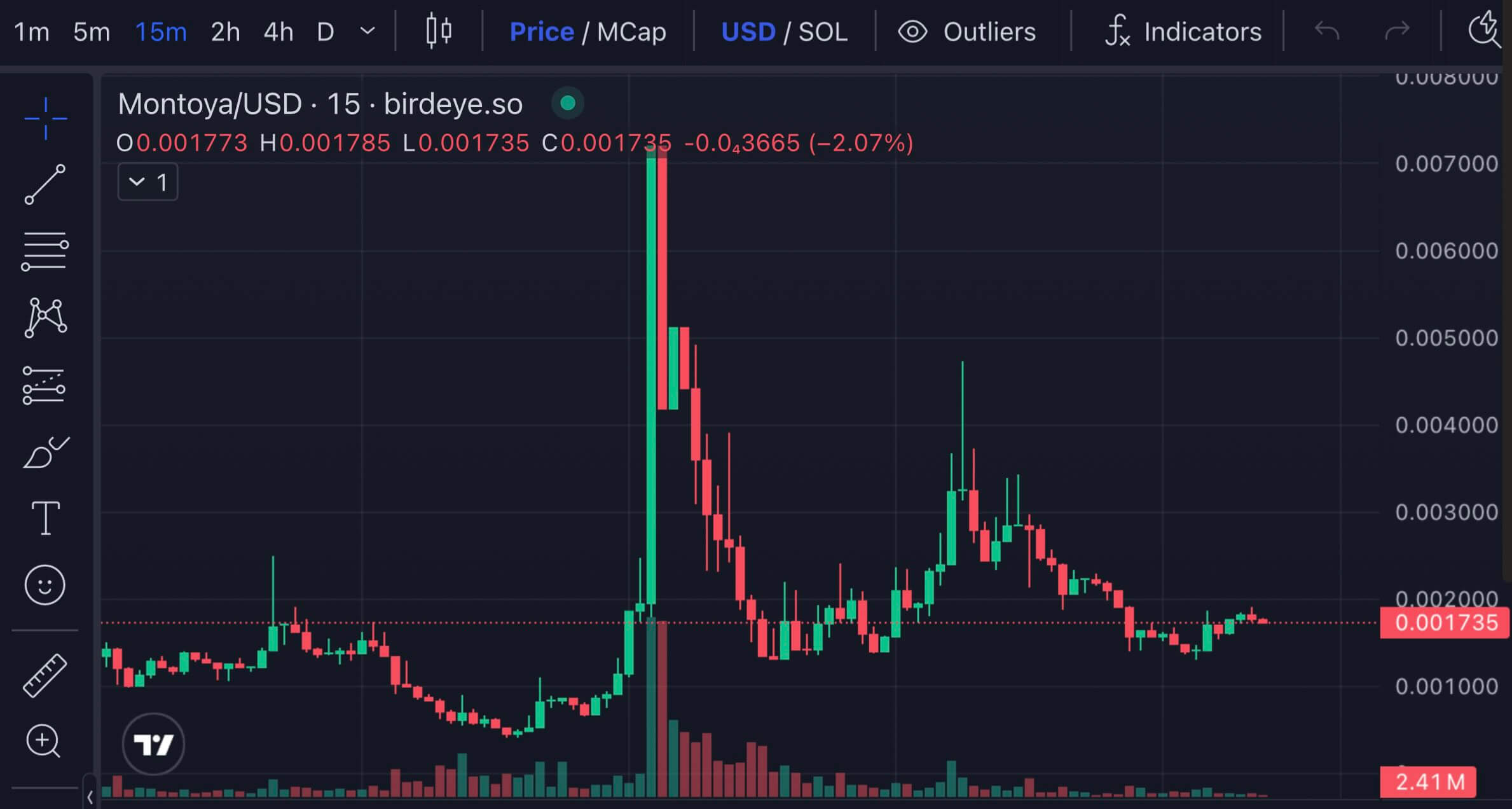
15-минутный график мем-токена MONTOYA

На этом приключения Дейва с мем-токенами не закончились. Спустя час он купил мем-токен MVP на 152 SOL, однако уже через десять минут избавился от накоплений. Прибыль по данной позиции составила 48 тысяч долларов. Реплика была следующей.

Я выхожу. Сегодня с помощью шиткоинов я превратил 10 тысяч долларов в 75 тысяч. Это всё равно что играть в ракеты на DraftKings. Я в восторге!


После раскрытия блокчейн-адреса Портного некоторые поклонники взялись отправлять монеты на его кошелёк. Вдобавок энтузиасты начали создавать мемы по мотивам собаки Дейва или компании Barstool Sports.

Стоит отметить, что дебютный опыт Портного с криптовалютами был неудачный. В начале августа 2020 года он потратил миллион долларов на покупку биткоинов. Однако спустя несколько недель Дейв слил монеты после обвала рынка, зафиксировав минус в 25 тысяч долларов.

По итогу дня Портной опубликовал новое видео и спросил, отправится ли он в тюрьму за это. По словам предпринимателя, подобное не должно нарушать законы.

Эксперты не смогли дать однозначный ответ по поводу произошедшего. И хотя многие инвесторы наверняка потеряли деньги на криптоактиве, прорекламированным Дейвом, его блокчейн-адрес был известен. Соответственно, Портной не скрывал своих действий и по сути действовал открыто. А значит привлечь его к ответственности за такое может не получиться.

Канье Уэст и мем-токен

Тему криптовалют ночью также затронула другая знаменитость — исполнитель Канье Уэст. На протяжении суток он публиковал неоднозначные твиты, которые вызвали непонимание подписчиков рэпера. В частности, он затрагивал темы антисемитизма, сексизма и даже Гитлера.

Публикации также затронули цифровые активы. Судя по одной из записей Уэста, он планирует связаться с руководителем криптовалютной биржи Coinbase Брайаном Армстронгом, сообщает The Block. Вот скриншот публикации, в которой ему обещают раздобыть контакты предпринимателя.
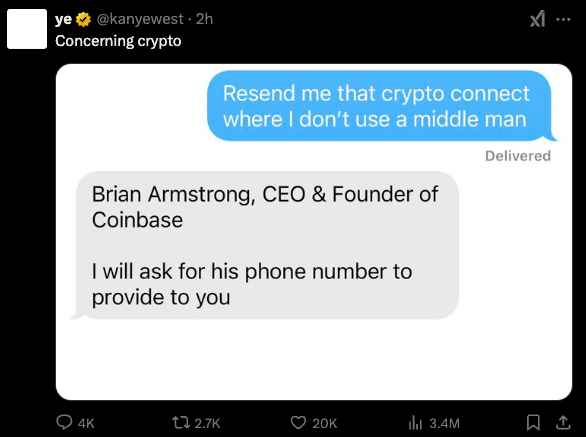
Твит Канье Уэста о криптовалютах

Уэст написал следующее.

Когда люди зарабатывают все эти деньги с помощью монет, это является наличными или концепцией?

Также исполнитель рассказал, что кто-то предложил ему 2 миллиона долларов за участие в рекламе фейкового токена. Судя по всему, схема предполагала публикацию адреса контракта криптоактива 32 миллионам его фолловеров, причём затем Уэст должен был заявить, что его учётная запись якобы была взломана.

Вот реплика.

Мне предложили 2 миллиона долларов за мошенничество с моим сообществом. Оставшимся его членов. Я сказал «нет» и прекратил работать с тем человеком, который это предложил.

Исполнитель Канье Уэст


Оба случая показывают, что мем-токены действительно являются одним из главных хитов этого буллрана. Впрочем, у них есть и обратная сторона. Всё же число таких монет исчисляется десятками миллионами, из-за чего капитал инвесторов размывается. А это не позволяет рынку выдать продолжительный рост и тем самым мешает продолжению нынешнего буллрана.


İlgili Okumalar

Glue Finance Founder: ETH Has Entered a Phase of Non-Consensus, an Inflection Point Is Approaching

Glue Finance founder argues that Ethereum's current price underperformance, despite high on-chain activity, stems from its incomplete state and lingering dependency on central stewards like the Ethereum Foundation. The core thesis is that the market is discounting ETH not for lack of use, but because the protocol remains a "machine under construction." Key unresolved issues include centralized L2 sequencers with limited escape hatches, state bloat, vulnerable public mempools, and the looming quantum computing threat. This perpetual "work-in-progress" status forces reliance on a small group of maintainers, undermining the network's promise of credible neutrality and immutability. The author, a self-described Ethereum maximalist, rejects two flawed paths: a "wartime mode" of centralizing for speed (surrendering Ethereum's unique value) or merely replacing the Foundation with another governing entity. The only solution is to complete and then "freeze" the protocol's neutral core through a focused "Manhattan Project" dubbed "Lean Ethereum." This project aims to bundle critical upgrades—consensus layer overhaul, massive scaling via ZK-proofs, quantum resistance, and statelessness—into a decisive push to finalize the base layer. Once the core rules are cryptographically solidified and beyond anyone's control (passing the "walk-away test"), Ethereum would shed its dependency discount and earn a "rigidity premium" for its credible neutrality and programmability, potentially surpassing Bitcoin's valuation. The race is between completing this hardening and the risks of protocol capture or stagnation.

链捕手1 dk önce

Glue Finance Founder: ETH Has Entered a Phase of Non-Consensus, an Inflection Point Is Approaching

链捕手1 dk önce

Hackers Steal Nearly $17 Million in 40 Days as 'Zombie Contracts' Become Their ATMs

According to an analysis published by ZeroDrift on June 22, 2026, attackers have stolen approximately $16.9 million over 40 days from five deprecated but still operational smart contracts across various blockchains. The primary issue is not a specific vulnerability but the incomplete decommissioning of legacy contracts. These "zombie contracts" often retain economic value, operational permissions, and callable functions, making them prime targets long after teams cease active development. The most significant loss occurred at DxSale, where an old locker contract lost about $7.3 million due to a forgotten control path becoming accessible again. Other affected projects include TrustedVolumes (~$5.87M), Raydium's legacy AMM pool (~$1.34M), Aztec Connect (~$2.28M), and Huma Finance V1 pool (~$101k). These incidents involved diverse systems—RFQ settlement, credit pools, liquidity lockers, AMMs—demonstrating the widespread nature of the risk. The analysis highlights that automated tools are lowering the cost for attackers to systematically scan for these long-tail targets, which have public code and weaker monitoring. In contrast, defensive practices for contract retirement remain underdeveloped. While the DeFi industry has mature audit processes for new deployments, it lacks strict protocols for securely sunsetting old contracts, which only become truly "retired" after all funds, permissions, authorizations, and trust assumptions are removed.

marsbit59 dk önce

Hackers Steal Nearly $17 Million in 40 Days as 'Zombie Contracts' Become Their ATMs

marsbit59 dk önce

Valuation Rout of Old Titans: The Demise of a Generation's Asset Valuation Framework

"The Old Titans' Valuation Collapse: The Death of an Era's Valuation Framework" Between Alibaba's 2014 NYSE debut at $93.89 and its 2026 price of ~$95, twelve years have passed with zero price appreciation. This stagnation symbolizes a wholesale valuation reset for an entire generation of Chinese internet assets. Companies like Tencent, Pinduoduo, Meituan, Bilibili, and Kuaishou have seen catastrophic declines of 80-98% from their peaks. The core question arises: what framework now prices these companies, or has the framework itself expired? The valuation logic for Chinese internet stocks followed a clear "anchor-setting and anchor-removing" process. From 2014-2017, the dominant narrative was "US comparable discounting" – applying a growth premium and governance discount to US peers' multiples. This anchor loosened with the 2018 US-China trade war and the VIE structure risk, then was violently uprooted by the 2020-2021 regulatory crackdowns (Ant Group, Didi, anti-monopoly fines). The 2022 delisting panic and subsequent 2025-2026 geopolitical shocks (US military lists, AI espionage accusations) completed the demolition. The old "US对标打折" model is dead. However, this is not solely a China story. A structural mirror exists in US "old titan" stocks ("老登股"). In 2026, even Microsoft – with robust fundamentals – saw its PE compress from a 34x median to 22x, its worst performer status among the "Magnificent Seven" driven by a $190 billion annual AI capex crushing free cash flow. The core dilemma is universal: legacy platform giants, whether Alibaba or Microsoft, are spending colossal sums to chase an AI paradigm that may颠覆 their own high-margin, user/subscription-based business models. They have shifted from "companies defining the future" to "companies needing to prove they won't be淘汰ed by the future." This phenomenon of a dying valuation坐标系 has a historical precedent: post-1989 Japan. After its bubble burst, the "Japan premium" narrative ("most efficient manufacturing + perpetual growth") collapsed. A 25-year valuation vacuum ensued until Warren Buffett provided a new language in the 2010s: "low valuation + high dividend + governance reform." China's internet sector is now in a similar vacuum six years into its reset. While different from Japan's deflationary context, the parallel is clear: the old macro assumption of "deep integration with global capital" is falsified, but a new pricing framework is absent. Potential "new languages" for Chinese internet valuations are contradictory. AI transformation requires gutting profitable core businesses (e.g., Alibaba's ad-driven e-commerce) for an unproven consumption-based model, risking a Microsoft-like cash flow crunch. Alternatively, shareholder returns (buybacks/dividends) could build a floor, following Buffett's Japanese playbook, but current scales are insufficient to form a standalone anchor. The current state mirrors mid-1990s Japan: the old framework is dead, the new one unborn. The market waits in a vacuum for a重新定义ing force – a person, event, or proven business model shift – to answer "why buy." This may only be the middle phase of a prolonged re-rating.

marsbit1 saat önce

Valuation Rout of Old Titans: The Demise of a Generation's Asset Valuation Framework

marsbit1 saat önce

STRC Trading at Significant Discount, mNAV Falls Below Break-Even, Strategy's Valuation Logic Has Been Rewritten

Title: STRC Deeply Discounted, mNAV Falls Below Break-even, Strategy's Valuation Logic Redefined The recent volatility in MSTR and STRC highlights the need to reassess the core business model of Bitcoin reserve companies. These entities function more like leveraged, single-asset banks rather than software/tech firms. Consequently, they should be valued using banking metrics, not based on their total Bitcoin holdings. The key valuation metric is mNAV (market net asset value), akin to a price-to-book ratio. It compares the company's market capitalization to the equity value of its Bitcoin holdings after deducting all senior debt and preferred equity (like STRC). As of June 24, Strategy's mNAV was 1.10x. The focus should be on "net Bitcoin per share" (the Bitcoin claim per share after senior claims) and its growth rate, equivalent to a bank's book value and return on assets. Given STRC's 19% discount to its $100 par value (yielding 14.2%), issuing new MSTR equity at the current price to buy more Bitcoin is inefficient. It slightly dilutes the widely watched "total Bitcoin per share" metric while providing minimal improvement to the more critical "net Bitcoin per share." The article analyzes four potential uses for $1 billion in new equity: 1. **Buy Bitcoin:** Least effective. Improves net Bitcoin per share only marginally while diluting total Bitcoin per share. 2. **Repurchase STRC:** Most effective for balance sheet repair. The discount creates immediate value, increasing net Bitcoin per share by 1.0%, reducing debt burden, and lowering future dividend obligations. 3. **Boost Cash Reserves:** Dramatically improves the "cash coverage ratio" for STRC dividends from 9.8 months to 16.8 months, a crucial liquidity metric in a tightening funding environment. 4. **50/50 Split (STRC buyback & cash):** A balanced approach improving all key metrics. Strategy's own Q1 report indicates its internal break-even mNAV for profitable equity issuance to buy Bitcoin is 1.22x. With the current mNAV at 1.10x, such a move would be value-destructive. The core assumptions of its previous expansion model—issuing STRC at par and maintaining ample dividend coverage—have broken down. The recommended path is to use new capital to optimize core financial health: repurchasing discounted STRC and/or bolstering cash reserves. This would repair the balance sheet, signal liquidity strength, support STRC's price, lower its yield, and potentially reopen the par-value issuance channel. The current STRC discount represents a low-cost capital opportunity to restart this positive cycle. Bitcoin reserve companies must be evaluated as banks, focusing on book value, leverage, and liquidity resilience.

Foresight News1 saat önce

STRC Trading at Significant Discount, mNAV Falls Below Break-Even, Strategy's Valuation Logic Has Been Rewritten

Foresight News1 saat önce

İşlemler

Spot
活动图片