Glue Finance Founder: ETH Has Entered a Phase of Non-Consensus, an Inflection Point Is Approaching

链捕手2026-06-26 tarihinde yayınlandı2026-06-26 tarihinde güncellendi

Özet

Glue Finance founder argues that Ethereum's current price underperformance, despite high on-chain activity, stems from its incomplete state and lingering dependency on central stewards like the Ethereum Foundation. The core thesis is that the market is discounting ETH not for lack of use, but because the protocol remains a "machine under construction." Key unresolved issues include centralized L2 sequencers with limited escape hatches, state bloat, vulnerable public mempools, and the looming quantum computing threat. This perpetual "work-in-progress" status forces reliance on a small group of maintainers, undermining the network's promise of credible neutrality and immutability. The author, a self-described Ethereum maximalist, rejects two flawed paths: a "wartime mode" of centralizing for speed (surrendering Ethereum's unique value) or merely replacing the Foundation with another governing entity. The only solution is to complete and then "freeze" the protocol's neutral core through a focused "Manhattan Project" dubbed "Lean Ethereum." This project aims to bundle critical upgrades—consensus layer overhaul, massive scaling via ZK-proofs, quantum resistance, and statelessness—into a decisive push to finalize the base layer. Once the core rules are cryptographically solidified and beyond anyone's control (passing the "walk-away test"), Ethereum would shed its dependency discount and earn a "rigidity premium" for its credible neutrality and programmability, potentially surpassi...

Author:@LaLiLuLeL0x

Compiled by: Jiahuan, ChainCatcher

The debate about stewards is just a distraction. Ethereum truly wins when it no longer needs any stewards, when its core is frozen, beyond the reach of the EF, Ethlabs, or any future successors. This is its "Manhattan Project," and it's proceeding quite well.

It's mid-2026, and the numbers don't add up. Ethereum's settled value is at an all-time high, hosting the vast majority of stablecoins, tokenized funds, and DeFi. Yet ETH is trading around $1,750, down about 57% from its 2025 high and still below the peak set in 2021.

Five years on, with the technical transition complete, the asset price lags behind the past. Something is wrong. The comforting explanations about macroeconomics, the Fed, or capital rotation into Bitcoin don't touch the core issue.

The real explanation is more brutal, and it's the whole reason I'm writing this. Ethereum is a machine that runs but is unfinished. It's operational, it's decentralized, it's never down. But it's full of half-finished features, works in progress, promises rather than deliveries.

Especially post-Merge and with the rollup-centric roadmap, it feels less like a finished network and more like a long-term promise—credibly neutral and decentralized on paper, but each upgrade quietly adds a new pile of problems that need solving before that promise can be fully realized. And each pile eventually lands on the same small group of people to clean up.

An unfinished machine needs mechanics. So, while Ethereum is formally sovereign, controlled by no single entity, in practice, it's still indirectly dependent on the Ethereum Foundation's goodwill to keep building and steering.

The market isn't mispricing Ethereum's usage. The market is pricing this dependency. And the project to ultimately fix this has a name: Lean Ethereum, also known as Ethereum's Manhattan Project.

Let me break this down step-by-step because I know this will upset many. But I believe it nails the reality and the true challenges Ethereum faces right now, both in leadership and at the protocol level. Remember, I'm an Ethereum maximalist. I'm not here to spread FUD; I'm here to keep the conversation pointed in the right direction. I have my viewpoint. Please give me a chance to lay it out.

1. The State of the Machine

Take an honest look at where Ethereum stands today.

The L2 bet is half-lost where it matters most. The rollup-centric roadmap was a bet on scaling without sacrificing decentralization. Years later, every major L2 still runs a centralized sequencer—a single operator ordering transactions that can censor, extract value, or just go down, as Linea paused in 2024 and Base went offline in 2025.

Of the dozens of rollups, almost none have passed L2Beat's own Stage 1 maturity criteria, let alone Stage 2's full trustlessness.

We asked for this.

The only defensible justification for centralized sequencers has always been the escape hatch. Even if the operator censors you or goes completely offline, the rollup should allow you to force-include your own transaction from L1 and withdraw assets back to Ethereum without anyone's permission.

That guarantee is why centralized sequencers were tolerated in the first place: The keys to the chain were never yours, but the exit always was.

Yet, the exit lanes turned out to be conditional. In April 2026, after Kelp DAO's cross-chain bridge was drained of about $292 million, Arbitrum's security council—twelve elected members—invoked emergency powers, forcibly stepping in and moving 30,766 ETH (worth about $71 million) from the attacker's address into a governance-controlled wallet.

Freezing a thief's loot sounds like the system working, and perhaps it was. But look at what it proves. A small council can proactively seize and freeze funds on Arbitrum, meaning your assets there are subject to their discretion. A power that can stop a hacker can stop anyone, including under subpoena or government pressure.

The escape hatch can only save you if the people holding no privileged keys decide otherwise. The irony wrote itself: The moment the on-chain freeze took effect, a U.S. court pierced right through Arbitrum's supposed "decentralized" governance, ordering the DAO not to move the funds at all. So much for unstoppable.

The base layer itself carries open wounds that may never heal. State bloat keeps increasing the data each node must store. The mempool is worse.

Because pending transactions sit publicly, using the public mempool has become a frontrunning death spiral: The moment you broadcast a transaction, it's seen, sandwiched and tailgated before it confirms—a permanent tax where bots extract value from ordinary users just by seeing order flow first.

The fix, encrypted mempools, has been discussed and drafted for years, still not live. These aren't rare edge cases. They're core properties of anything that wants to call itself a neutral settlement layer, and they're still stamped "under construction."

Quantum computing is no longer science fiction without a date. Vitalik's 2026 cryptography roadmap names four parts of Ethereum potentially breakable by quantum computers, with a threat model that includes "harvest now, decrypt later"—an adversary records encrypted data today, then cracks it the day the hardware arrives.

It's a countdown, and the clock is ticking.

Against this backdrop, one faction wants Ethereum to respond by going into wartime mode. Become aggressive, court institutions on their terms, relax the decentralization standards that hold everything back, get faster, more centralized, to compete on throughput with Solana and pump the price.

It sounds like ambition. It's actually surrender.

Because if Ethereum trades away the neutrality that makes it unique, it doesn't beat Solana; it just becomes a slower Solana.

The best-case outcome for the wartime path is Ethereum falling to Solana's market cap, because that's what the market pays for a fast chain that gave up credible neutrality. You don't win a monetary premium by turning into something that never had one.

2. Why ETH Isn't at $10,000

So, here lies the answer to the question every ETH holder has been puzzling over.

The reason ETH isn't at five figures, or even holding old highs while the underlying network keeps growing, isn't lack of usage. Its usage is overwhelming. The reason is the machine is unfinished, and an unfinished machine isn't reliable; it can't stand alone.

Think about what a global settlement layer truly needs to promise. Not speed. Not features. It must promise the ground beneath you won't move, that if you settle a billion dollars on it today, the rules are the same tomorrow and no one can change them on a whim.

Ethereum can't make that promise yet because Ethereum is still under construction, and the act of construction is the act of change. Scaling isn't finished. L2 decentralization isn't finished. The consensus layer is a five-year-old design waiting to be replaced.

Quantum resistance is a roadmap, not a delivered fact. Every unclosed gap is a place where the protocol still needs to change, and every change must be decided by someone.

That someone is the Ethereum Foundation. It's not a conspiracy; it's because they're the ones who can finish this unfinished machine.

The market sees all of this clearly. The market doesn't pay a forever premium to a chain that still clearly needs its founders to finish and steer it. A settlement layer that depends on mechanics isn't a settlement layer at all. It's just a fancy machine with a maintenance contract. That's what $1,750 is pricing. Dependency.

I argued the bullish side in "The Ossification Premium": The market pays for eternity, and the chain that becomes the most immutable wins the monetary prize. This is the other side of the same coin. Ethereum hasn't earned that premium yet because it hasn't become immutable. It's not set in stone; what's not set needs stewarding, and what needs stewarding gets discounted.

3. Everyone Is Exhausted

The unfinished machine has a cost, a cost never priced in, only felt by those actually building here. Everyone building on Ethereum is exhausted, each layer with the same fatigue: The ground beneath them keeps shifting, and nothing lasting can be built on it.

Start with L2s. They can't fully decentralize because they're stuck waiting for the next standard, the next blob upgrade, the next interoperability layer, the next account abstraction model, and the next thing the base will change. So they keep the keys.

As of 2026, no major rollup reaches Stage 2 on L2Beat's criteria; Arbitrum and Optimism are stuck at Stage 1, meaning security councils holding upgrade keys remain a core trust point, a multisig that can rewrite bridges or shut down proofs.

Everyone says it's the price of the early phase. The early phase never ends because the base is unpredictable, and the centralization never leaves.

One layer up, Dapps have the same fatigue. They're forced to deploy on every L2 simultaneously—Arbitrum, Optimism, Base, ZK chains, etc.—maintaining a dozen deployment instances, fragmenting liquidity, and trusting cross-chain bridges that are attack surfaces themselves.

Because the foundational uncertainty, they keep their contracts upgradeable, with admin keys, proxies, and pause switches—the very escape hatches that cost contracts credible neutrality.

The original dream was to write immutable code that no one, not even the author, could change. The reality is that uncertainty forces every serious team to set an upgrade key, because publishing something truly frozen on a foundation that isn't is a bet most developers can't afford.

Client teams aren't faring better.

Browser vendors compete on performance and features, yet they spend all their time rewriting the deepest internals of the protocol just to digest the next hard fork, now twice a year, with a full consensus rewrite queued ahead. They're maintaining not a finished standard but something stuck in migration mode, rewriting the base over and over instead of building on it.

The Foundation sees the symptoms and wants to cure them with a schedule: a predictable, biannual fork cadence, marketed like iOS or Android releases, explicitly to reduce uncertainty for developers. It helps you plan but doesn't cure the sickness. Predictable churn is still churn.

And here's what should worry most: Those who came for the promise should worry more.

This endless, "under construction" state is quietly killing decentralization from top to bottom. You cannot build a credibly neutral, immutable, walk-away application on a foundation that is itself neither immutable nor walk-awayable.

The mutability at the base forces mutability up the stack: upgrade keys on rollups, admin keys on Dapps, migration mode for clients. The unfinished machine forces everyone building on it to have a mechanic too. And a mechanic is a skeleton key, the absolute opposite of what we all came here to build.

4. Two Wrong Escape Routes

There are two tempting ways out here, and both are traps.

The first is the wartime mode mentioned above. Centralizing to compete is to erase the only trait worth paying for. Dead end.

The second route is subtler and more tempting for those who care: Deciding the problem is the Foundation, and replacing it with a better institution, or going to war with Vitalik.

This is also wrong, completely misreading the situation. The Ethereum Foundation and Vitalik today are a gift. For a decade, they've steered Ethereum, remaining neutral when they didn't have to. I'm not writing this against them. I'm grateful they exist.

But some things gratitude can't solve. Dependency on good stewards isn't the same as not needing stewards. Even a perfect foundation is a single point of trust; it won't last forever, it's made of people, and people change.

The EF of 2035 won't be the EF of 2025. A foundation that stays neutral today can be captured, pressured, bought, or simply replaced by worse people tomorrow.

No one should want the credible neutrality of a global settlement layer to depend on the continued goodwill of the EF, Ethlabs, or whoever holds the reins next.

The whole point of cryptocurrency is not having to trust the people in power.

Ethereum needs about $30 million a year to keep its client teams and researchers running. Those researchers are underpaid relative to their market value, acknowledged by the ecosystem itself, making their teams easier acquisition targets.

New money is crowding into this vacuum. Ethlabs launched in June 2026, founded by five former EF researchers, backed by BitMine, SharpLink, and Joe Lubin, with a public mission to make Ethereum the settlement layer for the global economy. They may be perfectly well-intentioned and deliberately route funds through an independent steward to protect neutrality. But that's not the point.

The point is structural: When neutral stewards step back and capital fills the void, neutrality stops being anchored in an institution with no skin in the game and starts relying on players who inherently have one.

Sharper conflicts are already visible, like a live proposal to let a 51% staked-weight vote redistribute validator rewards, which critics call out as a governance capture machine because the people who would receive the money are the ones designing the system.

Replacing one steward with another doesn't solve anything. It just changes the name of the single point of trust.

5. The Walk-Away Test

There's a clean way to see through the whole issue, and it's the core test of the entire argument.

Ask one question. If the Ethereum Foundation and Vitalik collectively walked away tomorrow, could Ethereum keep running, unchanged and credibly neutral, forever?
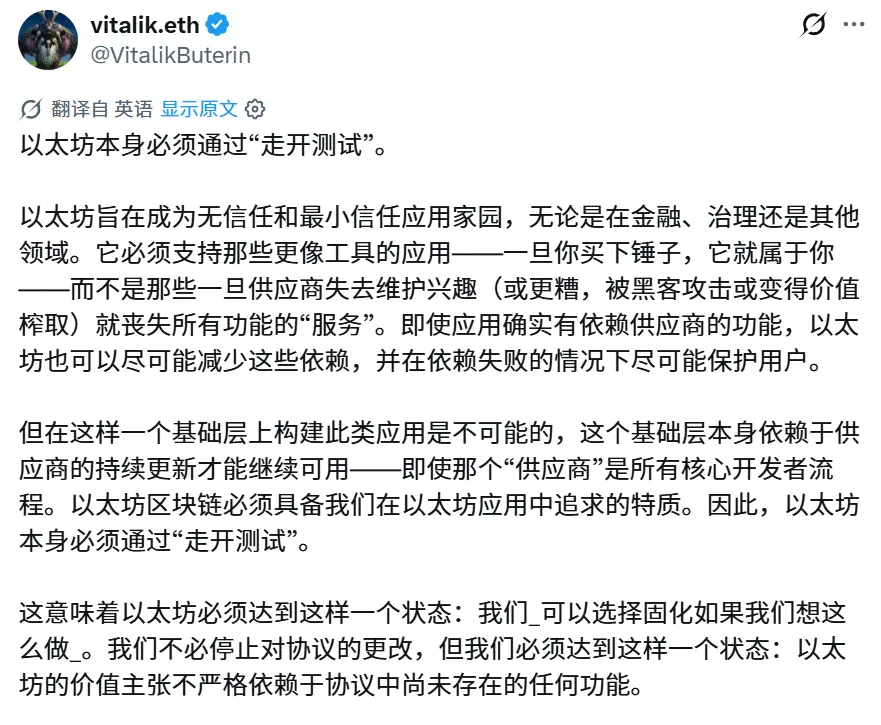
Be honest. The answer today is no. The machine is unfinished; it would stall if walked away from. And the neutrality it has is socially enforced, a promise kept by good people, not guaranteed by mechanics.

Vitalik himself defined credible neutrality as requiring transparent rules, equal application, open participation, and being hard to change. Ethereum achieves the first three but fails on the fourth.

Its rules are still easy to change, through a small off-chain process: an EIP proposal, a weekly All Core Devs call, rough consensus among ~150 core developers spread across ~11 organizations, and a few client teams. No enforced rules.

6. The Only Solution

The fix isn't a better foundation. It's finishing the machine, then freezing the parts that make it credibly neutral, putting the base layer into maintenance mode, so Ethereum finally passes the walk-away test on its own.

Once the neutral core is frozen, the dependency dissolves. Then, the Ethereum Foundation can do the healthiest thing a steward can do: become optional.

It can partner with a thousand new entities, shrink to a research lab, hand work off to a dozen competing teams, or even die off, and none of it threatens the blockchain because the part that defines Ethereum's neutrality can no longer be changed by anyone, whether captured or well-intentioned. You can't manipulate what can't be moved. You can't capture what's finished.

This is what makes the order non-negotiable, because the goal here isn't anti-capitalism; it's the opposite.

Private capital flooding into Ethereum research, entities like Ethlabs delivering tangible value instead of grant-chasing busywork, is one of the healthiest things that could happen to this ecosystem, and I hope for more of it.

But you can't put capitalism into an environment with no rule of law, where nothing stops you from hurting others, stealing, or tearing up contracts. A free market without an underlying rule of law doesn't create prosperity; it unleashes human nature's worst aspects, bound to money.

Capitalism on top of rule of law is a gift; apart from it, it's a predator.

Same for the protocol. First, freeze the parts that make Ethereum safe and credibly neutral, carve the fundamental rules into stone, then open the doors to private capital and let a hundred well-funded teams compete to build everything on top.

If you reverse the order, inviting capital in before the neutral core is frozen, you just get a Solana competitor with one-sixth of ETH's market cap today.

As an ETH maximalist, I don't enjoy writing what comes next, but it's the core truth of everything. Ethereum's endgame is its own Bitcoinization. Becoming as immutable as Bitcoin, earning the eternity premium the market actually pays for, and doing the one thing Bitcoin never could: cross the finish line with full programmability.

Bitcoin's freeze was accidental and neglectful, ending up as a rock that does nothing.

Ethereum has the chance to freeze (only certain parts) actively, intentionally, and end up the trusted neutral settlement layer for the entire tokenized economy. Same eternity. Much larger prize. That's the entire bullish case, and it demands ossification before wartime mode.

7. The Manhattan Project

Lean Ethereum is the path to finishing and freezing this machine, which is why I keep invoking the grandest historical metaphor. A Manhattan Project is when a field bundles its hardest problems into a single, concentrated, deadline-driven, existential push. That's the situation now.

It bundles the protocol's four hardest problems into one definitive plan, aiming for a single bundled hard fork rather than a decade of trickles.

Ossification. The consensus layer is being rebuilt from scratch as Lean Consensus, work formerly called Beam Chain, with 3-slot finality, ~12-second finality, and 4-second block times. Justin Drake calls the strategy ossification accelerationism: Pack every hard change into one jump to get the layer into maintenance mode as fast as possible. Build it once, then freeze it.

Scaling. The goal is L1-level trillion-gas-per-second, ~10,000 TPS at the base layer, millions at L2, through ZK verification and Blob- and PeerDAS-based data availability, not scaling blocks on centralized hardware. The pace is 3x, then 10x, then 100x.

Quantum Resistance. Validators' BLS signatures are replaced by leanXMSS, a hash-based, quantum-safe scheme, with a STARK aggregation engine compressing results ~250x. User accounts get signature agility via account abstraction, so wallets can opt into post-quantum protection without waiting for the whole chain. Target readiness ~2029.

ZK. Make the whole chain provable, letting anyone verify consensus with a succinct proof on cheap hardware, while the execution layer gets rebuilt around ZK-friendly VMs. Hash-based signatures also friendly to SNARKs are the key hinge merging quantum resistance and provability.

And, crucially, this plan closes the two specific wounds mentioned at the article's start.

Statelessness. State bloat is the first wound, where the full state copy each node must carry keeps growing, slowly pricing out home validators. Statelessness cuts it: Validators no longer store the whole state, instead verifying each block via compact proofs, turning the node-running burden back from a storage cost to cheap computation, keeping the validator set broad and decentralized.

Native Rollups. The L2 mess is the other wound, and the EXECUTE precompile in EIP-8079 is the fix. Native rollups no longer run their own proofs, governance, security councils; they hand their blocks back to Ethereum for direct validation, inheriting L1 security, upgrades, and quantum resistance for free.

No multisigs to hack, no upgrade keys to hold. The centralization trap rollups were forced into disappears: You're not reimplementing Ethereum; you're part of it, ossifying the day Ethereum ossifies.

Synchronous Compossability. Even better, it recovers what fragmentation stole. With shared execution and Ethereum-level ordering, rollups become atomically composable: A transaction can hit a few rollups and L1 in the same block, all succeed or all fail, like smart contracts on a single chain.

No cross-chain bridges, no routing, no doubt about what chain you're on. Liquidity pools into one whole, and Ethereum feels like the same computer no matter how many rollups run on top. It needs real-time proofs, still racing to production, but that's the finish line.

The work is already underway. The Fusaka upgrade is live, carrying PeerDAS and the first substantive steps of the scaling plan. Post-quantum efforts have a public home at pq.ethereum.org, with its alternative signature scheme designated. New client teams have formed around Lean Consensus.

The hard, definitive parts—the consensus rewrite, quantum migration, and final freeze—lie ahead, with the next forks, Glamsterdam and Hegotá, scheduled for 2026, targeting full readiness by the decade's end. That part is still on the clock.

The original Manhattan Project didn't just end the bloodiest war in history; it reshaped the global order around the nation that got there first.

Lean Ethereum aims for finality of the same magnitude. Not to win a blockchain race, but to end it. The day Ethereum freezes its neutral core, passes the walk-away test, and can no longer be steered by anyone, the race for the world's base layer is over.

Bitcoin has shown us what the market pays for an ossified rock that does nothing—over a trillion dollars for eternity alone.

The world has never priced an ossified rock that's also the global economy's settlement layer because it has never existed.

Lean Ethereum is the plan to build that thing. Finish it, and Ethereum doesn't just flip Bitcoin; it hits a number no model yet projects, and leaves Bitcoin behind for good because it finally has the one thing Bitcoin has—eternity—plus the one thing Bitcoin gave up—programmability.

That's why it can't be a decade of gentle incrementalism. It's a race between two clocks.

The first is the ossification clock: How fast Lean Ethereum finishes the machine and freezes the neutral core. The second is the capture clock: How fast the funding vacuum, the corporate stewards filling empty EF chairs, the wartime centralization push, and the quantum deadline harden into actual problems. Every year Ethereum stays unfinished is another year of window for capture, pressure, or just continued dependency on whoever happens to be holding the wheel.

8. Two Endings

So, past doomsaying and blind cheering, here's Ethereum's actual situation.

Finish the Manhattan Project, freeze the base, pass the walk-away test, and Ethereum becomes the world's first ossified, quantum-resistant, credibly neutral global economic settlement layer—a settlement layer that doesn't need a foundation, founders, or permission to stay neutral.

At that moment, the dependency discount crushing the price inverts into the eternity premium, a revaluation with no peer and no ceiling.

Stall, or let the wartime faction trade neutrality for speed, and Ethereum becomes, at best, a slower Solana; at worst, an untrustworthy, manipulated, forever-mutable chain, something captured and steered by its paymasters, with the premium it chased forever evaporated.

I'm long because I believe it can. But anyone telling you the outcome is guaranteed has skipped the hardest chapter. Finish the machine, freeze it, walk away from any need for stewards at all. That's the whole game now.


Trend Kriptolar

İlgili Sorular

QAccording to the article, why hasn't ETH's price reached or sustained higher levels despite high usage and settlement volume?

AThe article argues that the market is not mispricing Ethereum's usage. Instead, it is pricing in its 'dependency' on the Ethereum Foundation and its incomplete, evolving nature. ETH's price is discounted because Ethereum is an 'unfinished machine' that still requires stewards for development and guidance, preventing it from achieving the 'immutability premium' that comes with a truly reliable, neutral, and final settlement layer.

QWhat is the 'Manhattan Plan' (Lean Ethereum) as described in the article, and what are its four core objectives?

AThe 'Manhattan Plan,' or Lean Ethereum, is a decisive, bundled initiative to complete and 'freeze' Ethereum's neutral core. Its four core objectives are: 1. **Rigidification**: Rebuilding the consensus layer (Beam Chain) for speed and then entering maintenance mode. 2. **Scale**: Achieving massive throughput (e.g., 1 trillion gas per second) via ZK proofs and advanced data availability. 3. **Post-Quantum Security**: Replacing BLS signatures with quantum-safe alternatives like leanXMSS. 4. **ZK**: Making the entire chain provable with ZK-friendly VMs, which also enables key features like statelessness and native rollups.

QWhat is the 'handoff test' mentioned in the article, and what is the author's conclusion about Ethereum's current state regarding it?

AThe 'handoff test' asks: If the Ethereum Foundation and Vitalik Buterin collectively stepped away tomorrow, could Ethereum continue running, unchanged and reliably neutral, forever? The author concludes the honest answer today is 'no.' The machine is unfinished and would stall without its stewards. Its current neutrality is upheld by social consensus and the goodwill of its maintainers, not by mechanisms that are frozen and beyond anyone's reach.

QThe article discusses two 'wrong escape routes' for Ethereum. What are they, and why does the author consider them traps?

AThe two wrong escape routes are: 1. **War Mode**: Sacrificing decentralization and reliable neutrality for speed to compete with chains like Solana. The author argues this is surrender, turning Ethereum into a 'slower Solana' and forfeiting its unique monetary premium. 2. **Replacing the Stewards**: Focusing criticism on the EF or Vitalik and trying to replace them with another entity. The author believes this misreads the problem, as it merely changes the name of the single point of trust/dependency rather than eliminating the need for a steward altogether.

QWhat is the author's ultimate vision for Ethereum's endgame, and how does it relate to Bitcoin?

AThe author's vision is for Ethereum to 'Bitcoinize itself'—to become as immutable as Bitcoin, thereby winning the 'eternity premium' the market pays. However, Ethereum's opportunity is to achieve this 'rigidity' *actively and selectively* while retaining full programmability. The endgame is for Ethereum to become 'the world’s first rigid, post-quantum, credibly neutral settlement layer for the global economy'—possessing Bitcoin's key property (immutability) without abandoning its own (programmability), which would allow it to surpass Bitcoin in value and utility.

İlgili Okumalar

Airwallex's Pivot: From Dismissing Stablecoins a Year Ago to Making High-Profile Investments Today

Airwallex, a major cross-border payments fintech, has made a notable strategic shift by leading a seed round investment in Metal, a tokenized financial settlement network. This move is significant given that Airwallex founder Jack Zhang was a prominent critic of stablecoins just a year prior, arguing they failed to reduce costs for mainstream currency corridors and lacked clear utility. The investment targets Metal, a Layer-1 blockchain designed for the tokenization and settlement of assets like stocks, bonds, and stablecoins, aiming for the institutional market. Metal's team includes veterans from Ren Protocol and Meta's Diem project. For Airwallex, this partnership integrates tokenized finance into its global payments network, providing a new settlement layer. Despite his company's investment, Zhang maintains a distinction, stating his skepticism toward "cryptocurrencies" remains, while classifying regulated, asset-backed stablecoins as a separate category. This stance reflects a broader trend of traditional finance (TradFi) cautiously engaging with crypto infrastructure. Companies like Stripe, Mastercard, and major banks are similarly exploring stablecoin payments and tokenization networks, recognizing their potential in emerging markets and 24/7 settlement. The article concludes that Airwallex's investment is less a change of belief and more a strategic necessity to secure a position in the evolving landscape of digital asset settlement, where stablecoins are becoming a key interface for global finance.

marsbit5 dk önce

Airwallex's Pivot: From Dismissing Stablecoins a Year Ago to Making High-Profile Investments Today

marsbit5 dk önce

Spicy Review|Is the "Most Emotionally Valuable" Post Here? Could STRC Be the Next LUNA?

Here is an English summary of the article (under 1500 characters): This article from the spicy commentary series "LaPing" covers three key stories in the crypto world for the week. First, during a sharp market downturn in June where BTC fell over 20%, a Reddit post on r/Cryptocurrency rallying against "Fear, Uncertainty, and Doubt (FUD)" went viral. The comment section became a hub for retail traders to share memes and encouragement, with many advocating holding (HODLing) through the volatility, embodying the "be fearful when others are greedy" mantra. Second, it examines the situation with STRG (Strategy's perpetual preferred stock), which has "de-pegged," trading around $76 vs. its $100 face value, a ~25% discount. The concern is whether Michael Saylor's company, MicroStrategy, can sustain the $1.2 billion annual dividend payment, given its ~$1.4 billion cash reserve. While analysts note STRG is fundamentally different from the catastrophic LUNA collapse—as Saylor isn't obligated to pay the dividend—risks remain. If MicroStrategy's (MSTR) common stock investors feel their capital is being prioritized for STRG dividends, it could hurt MSTR demand. Third, the article analyzes the online persona of "Chuan Mu," a trader famous for turning $500 into $1 million during the 2023 ORDI inscription boom and again with short positions in 2025. An analysis of his 1,828 tweets reveals his success stems from a top-down analytical framework, asking systemic questions like "Where will the bottleneck be in the AI supply chain?" rather than chasing individual pumps. His investments migrated from crypto-linked stocks to AI infrastructure plays like SK Hynix and Samsung. However, the piece also notes criticism that he has occasionally "pumped" assets and sold positions without notifying followers, creating a contradictory public image. The weekly recap highlights themes of community sentiment during bear markets, financial instrument risks, and the complex realities of following influential online traders.

Foresight News39 dk önce

Spicy Review|Is the "Most Emotionally Valuable" Post Here? Could STRC Be the Next LUNA?

Foresight News39 dk önce

İşlemler

Spot

Popüler Makaleler

ETH 2.0 Nedir

ETH 2.0: Ethereum için Yeni Bir Dönem Giriş ETH 2.0, Ethereum 2.0 olarak da bilinir, Ethereum blok zincirinde önemli bir yükseltmeyi işaret eder. Bu geçiş yalnızca bir yüz değiştirme değil; ağın ölçeklenebilirliğini, güvenliğini ve sürdürülebilirliğini temelinden geliştirmeyi hedeflemektedir. Enerji yoğun Proof of Work (PoW) konsensüs mekanizmasından daha verimli olan Proof of Stake (PoS) mekanizmasına geçişle birlikte, ETH 2.0 blok zinciri ekosistemine dönüştürücü bir yaklaşım vaat etmektedir. ETH 2.0 Nedir? ETH 2.0, Ethereum'un yeteneklerini ve performansını optimize etmeye odaklanmış özel, birbirine bağlı güncellemelerin bir derlemesidir. Yenileme, mevcut Ethereum mekanizmasının karşılaştığı kritik zorlukları, özellikle işlem hızı ve ağ tıkanıklığı ile ilgili sorunları ele almak üzere tasarlanmıştır. ETH 2.0'ın Amaçları ETH 2.0'ın ana amaçları, üç temel unsuru geliştirmeye odaklanmaktadır: Ölçeklenebilirlik: Ağın saniye başına işleyebileceği işlem sayısını önemli ölçüde artırmayı hedefleyen ETH 2.0, mevcut yaklaşık 15 işlem/saniye sınırlamasını aşmayı ve potansiyel olarak binlerce işleme ulaşmayı planlamaktadır. Güvenlik: Geliştirilmiş güvenlik önlemleri, özellikle siber saldırılara karşı daha iyi direnç sağlama ve Ethereum'un merkeziyetsiz görünümünü koruma açısından ETH 2.0 için hayati öneme sahiptir. Sürdürülebilirlik: Yeni PoS mekanizması, sadece verimliliği artırmakla kalmayıp aynı zamanda enerji tüketimini de önemli ölçüde azaltma hedefiyle tasarlanmış olup, Ethereum'un operasyonel çerçevesini çevresel kaygılarla uyumlu hale getirmektedir. ETH 2.0'ın Yaratıcısı Kimdir? ETH 2.0'ın yaratılması Ethereum Vakfı'na atfedilebilir. Ethereum'un gelişimini destekleme konusunda kritik bir rol oynayan bu kar amacı gütmeyen kuruluş, dikkat çekici kurucu ortağı Vitalik Buterin tarafından yönetilmektedir. Daha ölçeklenebilir ve sürdürülebilir bir Ethereum vizyonu, bu yükseltmenin arkasındaki itici güç olmuştur ve protokolü geliştirmek için kendini adamış küresel bir geliştici ve meraklı topluluğunun katkılarını içermektedir. ETH 2.0'ın Yatırımcıları Kimlerdir? ETH 2.0 yatırımcıları ile ilgili detaylar kamuoyuna açıklanmamış olsa da, Ethereum Vakfı'nın blok zinciri ve teknoloji alanında çeşitli kuruluşlar ve bireyler tarafından desteklendiği bilinmektedir. Bu ortaklar arasında merkeziyetsiz teknolojilerin ve blok zinciri altyapısının geliştirilmesine karşılıklı ilgi duyan girişim sermayesi şirketleri, teknoloji firmaları ve hayır kurumları yer almaktadır. ETH 2.0 Nasıl Çalışır? ETH 2.0, onu öncüsünden ayıran bir dizi önemli özelliği tanıtmasıyla dikkat çekmektedir. Proof of Stake (PoS) PoS konsensüs mekanizmasına geçiş, ETH 2.0'ın en belirgin değişikliklerinden biridir. İşlem doğrulama için enerji yoğun madenciliğe dayanmak yerine, PoS kullanıcıların ağa yatırdıkları ETH miktarına göre işlemleri doğrulayıp yeni bloklar oluşturmalarına olanak tanır. Bu, enerji verimliliğinin artırılmasına yol açarak tüketimi yaklaşık %99,95 oranında azaltmakta ve Ethereum 2.0'ı önemli ölçüde daha çevre dostu bir alternatif haline getirmektedir. Shard Zincirleri Shard zincirleri, ETH 2.0'ın diğer bir kritik yeniliğidir. Bu daha küçük zincirler, ana Ethereum zinciri ile paralel olarak çalışarak birden fazla işlemin aynı anda işlenmesine olanak tanır. Bu yaklaşım, ağın genel kapasitesini artırarak Ethereum'u rahatsız eden ölçeklenebilirlik sorunlarını ele alır. Beacon Zinciri ETH 2.0'ın temelinde, ağı koordine eden ve PoS protokolünü yöneten Beacon Zinciri yer almaktadır. Bu, bir tür organizatör olarak işlev görür: doğrulayıcıları denetler, shard'ların ağa bağlı kalmasını sağlar ve blok zinciri ekosisteminin genel sağlığını izler. ETH 2.0 Zaman Çizelgesi ETH 2.0'ın yolculuğu, bu önemli yükseltmenin evrimini gösteren birkaç önemli dönüm noktası ile tanımlanmıştır: Aralık 2020: Beacon Zinciri'nin başlatılması, PoS'un tanıtımını işaret etmiş ve ETH 2.0’a geçiş için sahneyi hazırlamıştır. Eylül 2022: "The Merge" tamamlanması, Ethereum ağının başarılı bir şekilde PoW'den PoS çerçevesine geçiş yaptığı kritik bir anı temsil etmekte ve Ethereum için yeni bir dönemi müjdelemektedir. 2023: Shard zincirlerinin beklenen dağıtımı, Ethereum ağının ölçeklenebilirliğini daha da artırmayı hedeflemekte ve ETH 2.0'ı merkeziyetsiz uygulamalar ve hizmetler için sağlam bir platform haline getirmeyi pekiştirmektedir. Ana Özellikler ve Faydalar Geliştirilmiş Ölçeklenebilirlik ETH 2.0'ın en önemli avantajlarından biri, geliştirilmiş ölçeklenebilirliğidir. PoS ve shard zincirlerinin kombinasyonu, ağın kapasitesini artırarak, eski sistemle kıyaslandığında çok daha fazla işlem hacmi karşılayabilmesini sağlamaktadır. Enerji Verimliliği PoS'un uygulanması, blok zinciri teknolojisinde enerji verimliliği yönünde büyük bir adım teşkil etmektedir. Enerji tüketimini ciddi şekilde azaltarak, ETH 2.0 yalnızca işletme maliyetlerini düşürmekle kalmaz, aynı zamanda küresel sürdürülebilirlik hedefleriyle daha yakın bir uyum sağlar. Geliştirilmiş Güvenlik ETH 2.0'ın güncellenmiş mekanizmaları, ağ genelinde güvenliğin artırılmasına katkıda bulunmaktadır. PoS'un uygulanması ve shard zincirleri ile Beacon Zinciri aracılığıyla geliştirilen yenilikçi kontrol önlemleri, potansiyel tehditlere karşı daha yüksek bir koruma sağlar. Kullanıcılar için Düşük Maliyetler Ölçeklenebilirlik geliştikçe, işlem maliyetleri üzerindeki etkiler de belirgin hale gelecektir. Artan kapasite ve azalan tıkanıklığın, kullanıcılar için düşük ücretler anlamına gelmesi beklenmekte ve Ethereum'u günlük işlemler için daha erişilebilir hale getirmektedir. Sonuç ETH 2.0, Ethereum blok zinciri ekosisteminde önemli bir evrimi işaret etmektedir. Ölçeklenebilirlik, enerji tüketimi, işlem verimliliği ve genel güvenlik gibi temel sorunları ele alırken, bu güncellemenin önemi abartılamaz. Proof of Stake'e geçiş, shard zincirlerinin tanıtımı ve Beacon Zinciri'nin altyapı çalışmaları, Ethereum'un merkeziyetsiz piyasalarının artan taleplerini karşılayabileceği bir geleceği göstermektedir. Yenilik ve ilerleme ile şekillenen bir sektörde, ETH 2.0, blok zinciri teknolojisinin daha sürdürülebilir ve verimli bir dijital ekonomi için yol açmadaki yeteneklerinin bir kanıtıdır.

189 Toplam GörüntülenmeYayınlanma 2024.04.04Güncellenme 2024.12.03

ETH 2.0 Nedir

ETH 3.0 Nedir

ETH3.0 ve $eth 3.0: Ethereum'un Geleceği Üzerine Derinlemesine Bir İnceleme Giriş Hızla evrilen kripto para ve blok zinciri teknolojisi ortamında, ETH3.0, sıklıkla $eth 3.0 olarak adlandırılmakta, önemli bir ilgi ve spekülasyon konusu haline gelmiştir. Bu terim, netleştirilmesi gereken iki temel kavramı kapsamaktadır: Ethereum 3.0: Bu, mevcut Ethereum blok zincirinin yeteneklerini artırmayı hedefleyen olası bir gelecekteki güncellemeyi temsil eder, özellikle ölçeklenebilirlik ve performansı iyileştirmeye odaklanmaktadır. ETH3.0 Meme Token: Bu ayrı kripto para projesi, Ethereum blok zincirini kullanarak meme merkezli bir ekosistem oluşturmayı amaçlamakta ve kripto para topluluğu içinde etkileşimi artırmaktadır. ETH3.0'ün bu yönlerini anlamak, yalnızca kripto meraklıları için değil, aynı zamanda dijital alandaki daha geniş teknolojik trendleri gözlemleyenler için de hayati öneme sahiptir. ETH3.0 Nedir? Ethereum 3.0 Ethereum 3.0, zaten kurulmuş olan Ethereum ağına önerilen bir güncelleme olarak duyurulmaktadır; bu ağ, kuruluşundan bu yana birçok merkeziyetsiz uygulamanın (dApp'ler) ve akıllı sözleşmelerin belkemiği olmuştur. Tasarlanan iyileştirmeler, esasen ölçeklenebilirlik üzerine yoğunlaşmakta – shardlama ve sıfır bilgi kanıtları (zk-proofs) gibi ileri teknolojileri entegre etmektedir. Bu teknolojik yenilikler, saniyede eşi benzeri görülmemiş sayıda işlem (TPS) gerçekleştirmeyi kolaylaştırmayı amaçlamakta olup, muhtemelen milyonlara ulaşarak mevcut blok zinciri teknolojisinin karşılaştığı en büyük sınırlamalardan birine çözüm getirmektedir. İyileştirme yalnızca teknik değil, aynı zamanda stratejiktir; Ethereum ağını, merkeziyetsiz çözümlere olan artan talep ile belirginleşen bir geleceğe hazırlamak için tasarlanmıştır. ETH3.0 Meme Token Ethereum 3.0'ın aksine, ETH3.0 Meme Token, internet meme kültürünü kripto para dinamikleriyle birleştirerek daha hafif ve eğlenceli bir alanda hareket etmektedir. Bu proje, kullanıcıların Ethereum blok zincirinde meme alım, satım ve ticaret yapmalarına izin vererek, yaratıcılık ve ortak ilgi alanları aracılığıyla topluluk etkileşimini teşvik eden bir platform sunmaktadır. ETH3.0 Meme Token, blok zinciri teknolojisinin dijital kültürle nasıl kesişebileceğini göstererek, hem eğlenceli hem de finansal olarak sürdürülebilir kullanım senaryoları oluşturmayı hedeflemektedir. ETH3.0'un Yaratıcısı Kimdir? Ethereum 3.0 Ethereum 3.0'a yönelik girişim, esas olarak Ethereum topluluğundaki bir geliştirici ve araştırmacı konsorsiyumu tarafından yönlendirilmektedir ve bunlar arasında Justin Drake de bulunmaktadır. Ethereum'un evrimine yönelik içgörüleri ve katkılarıyla tanınan Drake, Ethereum'u “Beam Chain” olarak adlandırılan yeni bir konsensüs katmanına geçirme konusundaki tartışmalarda öne çıkan bir figür olmuştur. Geliştirmeye yönelik bu iş birliği yaklaşımı, Ethereum 3.0'ın tek bir yaratıcının ürünü olmadığını, aksine blok zinciri teknolojisini ilerletmeye odaklanmış kolektif bir dehanın tezahürü olduğunu göstermektedir. ETH3.0 Meme Token ETH3.0 Meme Token'ın yaratıcısına dair detaylar şu anda izlenemez durumdadır. Meme tokenların doğası, genellikle daha merkeziyetsiz ve topluluk odaklı bir yapıya yol açmakta olup, bu da spesifik bir atıf eksikliğini açıklayabilir. Bu durum, yeniliğin genellikle iş birliği yerine bireysel çabalardan ortaya çıktığı kripto topluluğunun genel felsefesiyle uyumludur. ETH3.0 Yatırımcıları Kimlerdir? Ethereum 3.0 Ethereum 3.0'a olan destek, esasen Ethereum Vakfı ve hevesli bir geliştirici ve yatırımcı topluluğu tarafından sağlanmaktadır. Bu temel birliktelik, yıllar süren ağ operasyonlarıyla inşa edilen güven ve itibarından yararlanarak önemli bir meşruiyet sağlamaktadır. Kripto para dünyasının hızla değişen ikliminde, topluluk desteği, gelişim ve benimsemeyi yönlendirmede kritik bir rol oynamakta ve Ethereum 3.0'ı gelecekteki blok zinciri ilerlemeleri için ciddi bir rakip haline getirmektedir. ETH3.0 Meme Token Mevcut kaynaklar, ETH3.0 Meme Token'ı destekleyen yatırım temelleri veya kuruluşları hakkında net bilgiler sağlamasa da, bu durum meme tokenlar için tipik olan finansman modelini göstermektedir; bu model genellikle tabandan destek ve topluluk katılımına dayanır. Bu tür projelerdeki yatırımcılar genellikle toplum odaklı yenilik potansiyeli ve kripto topluluğunda bulunan iş birliği ruhuyla motive olmuş bireylerden oluşmaktadır. ETH3.0 Nasıl Çalışır? Ethereum 3.0 Ethereum 3.0'ın ayırt edici özellikleri, önerilen shardlama ve zk-proof teknolojisinin uygulanmasında yatmaktadır. Shardlama, blok zincirini daha küçük, yönetilebilir parçalara veya “parçalara” ayırma yöntemidir; bu parçalar işlemleri ardışık değil, eşzamanlı olarak işleyebilir. Bu işlem yükünün merkeziyetsizliği, tıkanıklığı önlemeye yardımcı olur ve ağın yoğun yük altında bile yanıt verebilir olmasını sağlar. Sıfır bilgi kanıtı (zk-proof) teknolojisi, işleme katılan temel verileri ifşa etmeden işlem doğrulaması sağlamasıyla başka bir sofistike katman ekler. Bu yön, sadece gizliliği artırmakla kalmaz, aynı zamanda ağın genel verimliliğini de artırır. Bu güncellemeye, ağın yeteneklerini ve faydasını daha da artırarak sıfır bilgi Ethereum Sanal Makinesi (zkEVM) entegrasyonunun da eklenmesi gündeme gelmektedir. ETH3.0 Meme Token ETH3.0 Meme Token, meme kültürünün popülaritesinden yararlanarak kendini farklılaştırmaktadır. Kullanıcıların sadece eğlence için değil, aynı zamanda potansiyel ekonomik kazançlar için meme ticareti yapmalarına olanak tanıyacak bir pazar yeri oluşturur. Stake etme, likidite sağlama ve yönetim mekanizmaları gibi özelliklerin entegrasyonu sayesinde, proje topluluk etkileşimini ve katılımını teşvik eden bir ortam oluşturur. Eğlence ve ekonomik fırsatların eşsiz bir karışımını sunarak, ETH3.0 Meme Token, kripto tutkunlarından gündelik meme meraklılarına kadar çeşitli bir kitleyi çekmeyi hedeflemektedir. ETH3.0 Zaman Çizelgesi Ethereum 3.0 11 Kasım 2024: Justin Drake, ölçeklenebilirlik iyileştirmeleri etrafında şekillenen yaklaşan ETH 3.0 güncellemesine işaret ediyor. Bu duyuru, Ethereum'un gelecekteki mimarisi hakkında resmi tartışmaların başlangıcını simgeliyor. 12 Kasım 2024: Ethereum 3.0'a yönelik beklenen önerinin, Bangkok'taki Devcon'da açıklanması planlanıyor ve bu, daha geniş topluluk geri bildirimi ve gelişim için olası sonraki adımların zeminini hazırlıyor. ETH3.0 Meme Token 21 Mart 2024: ETH3.0 Meme Token, CoinMarketCap'ta resmi olarak listeleniyor, bu da kamusal kripto alanına adım atarak meme merkezli ekosisteminin görünürlüğünü artırıyor. Ana Noktalar Sonuç olarak, Ethereum 3.0, gelişmiş teknolojiler aracılığıyla ölçeklenebilirlik ve performansla ilgili sınırlamaların üstesinden gelmeye odaklanan Ethereum ağındaki önemli bir evrimi temsil etmektedir. Önerilen güncellemeleri, gelecekteki talepler ve kullanılabilirlik için proaktif bir yaklaşımı yansıtmaktadır. Öte yandan, ETH3.0 Meme Token, kripto para alanındaki topluluk odaklı kültürün özünü kapsamakta, meme kültürünü kullanarak kullanıcı yaratıcılığını ve katılımını teşvik eden etkileşimli platformlar oluşturmayı hedeflemektedir. ETH3.0 ve $eth 3.0'un farklı amaçlarının ve işlevlerinin anlaşılması, kripto alanındaki gelişmeleri takip eden herkes için hayati öneme sahiptir. Her iki girişim de benzersiz yollar çizerek, blok zinciri yeniliğinin dinamik ve çok yönlü doğasını birlikte vurgulamaktadır.

183 Toplam GörüntülenmeYayınlanma 2024.04.04Güncellenme 2024.12.03

ETH 3.0 Nedir

ETH Nasıl Satın Alınır

HTX.com’a hoş geldiniz! Ethereum (ETH) satın alma işlemlerini basit ve kullanışlı bir hâle getirdik. Adım adım açıkladığımız rehberimizi takip ederek kripto yolculuğunuza başlayın. 1. Adım: HTX Hesabınızı OluşturunHTX'te ücretsiz bir hesap açmak için e-posta adresinizi veya telefon numaranızı kullanın. Sorunsuzca kaydolun ve tüm özelliklerin kilidini açın. Hesabımı Aç2. Adım: Kripto Satın Al Bölümüne Gidin ve Ödeme Yönteminizi SeçinKredi/Banka Kartı: Visa veya Mastercard'ınızı kullanarak anında Ethereum (ETH) satın alın.Bakiye: Sorunsuz bir şekilde işlem yapmak için HTX hesap bakiyenizdeki fonları kullanın.Üçüncü Taraflar: Kullanımı kolaylaştırmak için Google Pay ve Apple Pay gibi popüler ödeme yöntemlerini ekledik.P2P: HTX'teki diğer kullanıcılarla doğrudan işlem yapın.Borsa Dışı (OTC): Yatırımcılar için kişiye özel hizmetler ve rekabetçi döviz kurları sunuyoruz.3. Adım: Ethereum (ETH) Varlıklarınızı SaklayınEthereum (ETH) satın aldıktan sonra HTX hesabınızda saklayın. Alternatif olarak, blok zinciri transferi yoluyla başka bir yere gönderebilir veya diğer kripto para birimlerini takas etmek için kullanabilirsiniz.4. Adım: Ethereum (ETH) Varlıklarınızla İşlem YapınHTX'in spot piyasasında Ethereum (ETH) ile kolayca işlemler yapın.Hesabınıza erişin, işlem çiftinizi seçin, işlemlerinizi gerçekleştirin ve gerçek zamanlı olarak izleyin. Hem yeni başlayanlar hem de deneyimli yatırımcılar için kullanıcı dostu bir deneyim sunuyoruz.

3.6k Toplam GörüntülenmeYayınlanma 2024.12.10Güncellenme 2026.06.02

ETH Nasıl Satın Alınır

Tartışmalar

HTX Topluluğuna hoş geldiniz. Burada, en son platform gelişmeleri hakkında bilgi sahibi olabilir ve profesyonel piyasa görüşlerine erişebilirsiniz. Kullanıcıların ETH (ETH) fiyatı hakkındaki görüşleri aşağıda sunulmaktadır.

活动图片