Ripple CTO Reveals Why The Payment Business Hasn’t Caught On In A ‘Big Way’

bitcoinist2024-11-14 tarihinde yayınlandı2024-11-14 tarihinde güncellendi

Özet

In an exchange on X (formerly Twitter), Ripple's Chief Technology Officer David Schwartz, also known as “JoelKatz”, addressed criticisms about...

In an exchange on X (formerly Twitter), Ripple’s Chief Technology Officer David Schwartz, also known as “JoelKatz”, addressed criticisms about his company and the XRP Ledger.

Has Ripple Failed With Its Payments Business?

User @188ape challenged Schwartz by questioning the uniqueness of the XRPL in today’s market, stating that it seems like “most new layer 1s can do what the XRPL can do, plus more.” In response, Schwartz emphasized the XRPL’s distinctive features, highlighting that it offers functionalities like stablecoins, non-fungible tokens (NFTs), and a decentralized exchange (DEX) without exposing users to the risks associated with smart contracts.

He stated: “I don’t think there’s any other blockchain that has features like stablecoins, NFTs, a DEX, and so on that doesn’t expose you to the risks of smart contracts where your wallet has no way to know what the things you agree to are actually doing.”

The conversation intensified when another user, @dr_wonder589 (Dr. Wonder Bread), remarked that despite these features, they don’t seem to translate into market value. “Over-engineering something doesn’t mean it’s valuable to the market,” he noted.

Addressing this skepticism, Schwartz expressed surprise at the slow adoption of the payments business by Ripple. We focused very heavily on payments in the early design stages. Using cryptocurrencies or blockchains for payments hasn’t really caught on in a big way anywhere yet. I find that quite surprising,” he admitted.

When pressed further about the reasons behind this lack of widespread adoption, Schwartz cited several factors. He mentioned regulatory uncertainty and the difficulty of providing a good user experience as significant hurdles. According to him, users with access to traditional financial services prefer to use their banks, while those without such access lack the discretionary funds to experiment with new technologies.

“Users with good access to financial services would rather just use their banks. Users without good access to financial services don’t have a bunch of ‘fooling around’ money they can tolerate not having good access to and need to be able to easily pay bills with their money. Two-sided market problems and difficulty forming closed loops. One-sided flows that are inefficient because you can’t net out external flows. And so on,” Schwartz elaborated.

The dialogue took a critical turn when Dr. Wonder Bread suggested that Ripple’s challenges serve as a convenient excuse for its stagnation while it continues to fund itself through XRP sales. He insinuated that this might be a tactic to indirectly influence the price of XRP and maintain its stability.

In defense, Schwartz reiterated Ripple’s transparent strategy since 2014. “Ripple very publicly chose to focus on payments in 2014 and was completely open about our strategy and why we chose it. I don’t think anyone in the space was more successful at it than we were,” he stated.

Unsatisfied, @188ape pressed Schwartz for concrete examples of a XRP success. “Where is the success, David? Give us an example of XRP being a success story… I’ll wait,” he demanded. As of the time of writing, Schwartz has not publicly responded to this query.

Another user, @hesu_krypto, observed that Schwartz was referring to Ripple, not XRP specifically. However, @188ape countered by suggesting that the community was led to believe otherwise. Echoing this sentiment, Dr. Wonder Bread accused Ripple of manipulating the market through indirect means, implying that this could be considered securities fraud.

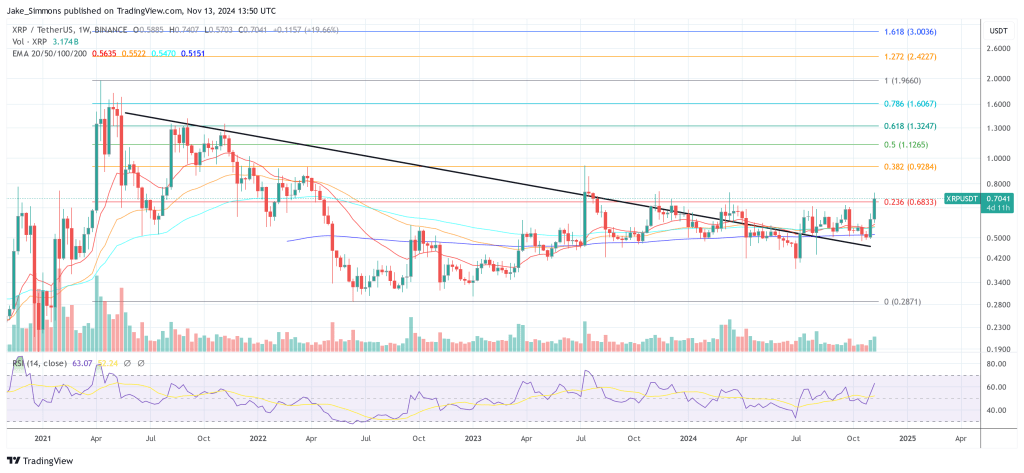
At press time, XRP traded at $0.70.
XRP price
XRP rises above the 0.236 Fib, 1-week chart | Source: XRPUSDT on TradingView.com
Featured image from YouTube, chart from TradingView.com
Jake Simmons

Jake Simmons

Jake Simmons has been a Bitcoin enthusiast since 2016. Ever since he heard about Bitcoin, he has been studying the topic every day and trying to share his knowledge with others. His goal is to contribute to Bitcoin's financial revolution, which will replace the fiat money system. Besides BTC and crypto, Jake studied Business Informatics at a university. After graduation in 2017, he has been working in the blockchain and crypto sector. You can follow Jake on Twitter at @realJakeSimmons.

İlgili Okumalar

The Warsh Storm Approaches

The article "The Warsh Storm Approaches" analyzes the potential market impact of Kevin Warsh becoming the new Federal Reserve Chairman, succeeding Jerome Powell. It argues that the current AI-driven stock market rally, concentrated in high-valuation tech giants, relies on a crucial premise: that long-term interest rates will eventually fall. This premise is now under threat as the 30-year Treasury yield remains persistently high, exceeding 5%, due to sticky inflation, worsening U.S. fiscal deficits, and deteriorating Treasury supply-demand dynamics. The core vulnerability is that high long-term rates pressure valuations by increasing the discount rate for future earnings. The article warns that Warsh's policy stance could intensify this pressure. Unlike Powell, Warsh is seen as more tolerant of market stress, more committed to quantitative tightening (QT/shrinking the Fed's balance sheet), and less inclined to provide implicit market support. His tenure at the Fed during the 2008 crisis shaped his skepticism about prolonged quantitative easing, believing it fuels asset bubbles without sufficiently boosting the real economy. While strong AI-driven earnings growth could theoretically offset higher rates, the narrative is currently concentrated in a few firms and hasn't yet translated into broad-based productivity gains for the wider economy. Therefore, the AI boom may not be enough to counter the valuation pressures from sustained high yields. Warsh's leadership could force the market to confront a new reality where the old supports—low long-term rates and a reliably supportive Fed—are no longer guaranteed, potentially triggering a reassessment of sky-high stock valuations.

marsbit11 dk önce

The Warsh Storm Approaches

marsbit11 dk önce

Anthropic Founder's Handbook: How to Build an AI-Native Company!

Anthropic has released "The Founder's Playbook: How to Build an AI Native Company," a guide that reimagines the startup lifecycle (Ideation, MVP, Launch, Scale) for 2026-era AI capabilities. The core thesis is that AI is fundamentally changing how ideas become reality, shifting the founder's role from an individual contributor to an orchestrator of AI agents. This lowers execution barriers, allowing domain experts (e.g., in medicine, law, education) to build products without deep technical skills, as AI can handle prototyping, coding, research, and operations. However, the playbook warns that easier prototyping increases the risk of building products no one needs, emphasizing that validation, not just building, is critical. It highlights that AI enables small teams to possess capabilities once reserved for large organizations, compressing functions like development, marketing, and support. This challenges traditional competitive advantages based on organizational size. For AI-native companies, sustainable moats will not come from the AI model alone but from deep domain knowledge, user data flywheels (behavioral fingerprints from real usage), and workflow lock-in that makes switching costly. Ultimately, the guide signals a shift in focus from raw model capability to how AI fundamentally reshapes company structure, processes, and competitive strategy. An AI-native company is defined not by using AI tools but by embedding AI into its core operational DNA from inception.

marsbit1 saat önce

Anthropic Founder's Handbook: How to Build an AI-Native Company!

marsbit1 saat önce

İşlemler

Spot
Futures

Popüler Makaleler

T Nasıl Satın Alınır

HTX.com’a hoş geldiniz! Threshold Network Token (T) satın alma işlemlerini basit ve kullanışlı bir hâle getirdik. Adım adım açıkladığımız rehberimizi takip ederek kripto yolculuğunuza başlayın. 1. Adım: HTX Hesabınızı OluşturunHTX'te ücretsiz bir hesap açmak için e-posta adresinizi veya telefon numaranızı kullanın. Sorunsuzca kaydolun ve tüm özelliklerin kilidini açın. Hesabımı Aç2. Adım: Kripto Satın Al Bölümüne Gidin ve Ödeme Yönteminizi SeçinKredi/Banka Kartı: Visa veya Mastercard'ınızı kullanarak anında Threshold Network Token (T) satın alın.Bakiye: Sorunsuz bir şekilde işlem yapmak için HTX hesap bakiyenizdeki fonları kullanın.Üçüncü Taraflar: Kullanımı kolaylaştırmak için Google Pay ve Apple Pay gibi popüler ödeme yöntemlerini ekledik.P2P: HTX'teki diğer kullanıcılarla doğrudan işlem yapın.Borsa Dışı (OTC): Yatırımcılar için kişiye özel hizmetler ve rekabetçi döviz kurları sunuyoruz.3. Adım: Threshold Network Token (T) Varlıklarınızı SaklayınThreshold Network Token (T) satın aldıktan sonra HTX hesabınızda saklayın. Alternatif olarak, blok zinciri transferi yoluyla başka bir yere gönderebilir veya diğer kripto para birimlerini takas etmek için kullanabilirsiniz.4. Adım: Threshold Network Token (T) Varlıklarınızla İşlem YapınHTX'in spot piyasasında Threshold Network Token (T) ile kolayca işlemler yapın.Hesabınıza erişin, işlem çiftinizi seçin, işlemlerinizi gerçekleştirin ve gerçek zamanlı olarak izleyin. Hem yeni başlayanlar hem de deneyimli yatırımcılar için kullanıcı dostu bir deneyim sunuyoruz.

424 Toplam GörüntülenmeYayınlanma 2024.12.10Güncellenme 2025.03.21

T Nasıl Satın Alınır

Tartışmalar

HTX Topluluğuna hoş geldiniz. Burada, en son platform gelişmeleri hakkında bilgi sahibi olabilir ve profesyonel piyasa görüşlerine erişebilirsiniz. Kullanıcıların T (T) fiyatı hakkındaki görüşleri aşağıda sunulmaktadır.

活动图片