Ripple Rumored To Consider Dirham-Backed Stablecoin In UAE

bitcoinist2024-11-08 tarihinde yayınlandı2024-11-09 tarihinde güncellendi

Özet

Ripple Labs could be exploring the launch of a dirham-backed stablecoin in the United Arab Emirates (UAE), expanding beyond its...

Ripple Labs could be exploring the launch of a dirham-backed stablecoin in the United Arab Emirates (UAE), expanding beyond its existing US-dollar-backed stablecoin, RLUSD. This speculation arises following Ripple’s newest blog post dated November 7, 2024, titled “UAE Stablecoin Regulation: A Blueprint for Financial Innovation.” The post hints at significant interest by Ripple in a dirham-backed stablecoin.

Will Ripple Launch A Dirham-Stablecoin?

The blog post outlines the UAE Central Bank’s (CBUAE) newly introduced regulatory framework designed to integrate both dirham-backed and non-AED stablecoins into the nation’s financial systems. “New regulations from the Central Bank of the United Arab Emirates (CBUAE) designed to integrate dirham-backed stablecoins as well as non-AED backed stablecoins into its financial systems are emblematic of this shift,” the Ripple team states.

The CBUAE’s framework aims to bolster the UAE’s standing as a global leader in digital asset regulation by providing clear guidelines that facilitate the issuance and use of AED-backed stablecoins for payments, while allowing non-dirham stablecoins to be registered for virtual asset transactions. “By embracing stablecoins, the UAE is laying the groundwork for safer, more efficient financial systems,” the Ripple blog emphasizes.

Ripple’s involvement in the region is well-established. The National Bank of Abu Dhabi became the first Middle Eastern bank to utilize Ripple Payments for secure and cost-effective remittance solutions, handling nearly $80 million in outbound remittances in 2022. Furthermore, XRP received approval from the Dubai Financial Services Authority (DFSA) for use within the Dubai International Financial Centre (DIFC) late last year.

The potential introduction of a dirham-backed stablecoin by Ripple aligns with the CBUAE’s objectives to promote a regulated stablecoin environment that mitigates the volatility inherent in cryptocurrencies and enhances investor protection. “The CBUAE’s aim is to proactively promote a well-regulated stablecoin ecosystem, specifically dirham-backed stablecoins, to offset more volatile cryptocurrencies and better protect investors,” the blog elaborates.

Notably, Tether has also signaled interest in the UAE stablecoin market, announcing plans to launch a UAE stablecoin pegged to the dirham as an alternative to the US dollar. The region has rapidly become the sixth largest crypto economy globally, processing nearly $400 billion in on-chain value between July 2022 and June 2023, according to Ripple.

The UAE’s comprehensive regulatory approach contrasts with other global frameworks, such as the United States’ proposed Clarity of Payment Stablecoins Act and the European Union’s MiCA regulations. Unlike these, the UAE’s framework permits unlimited use of dirham-backed stablecoins for payments while restricting non-dirham stablecoins to virtual asset transactions without imposing transaction caps. “This measured approach would also manage risks around liquidity, market volatility, compliance and operational challenges,” the blog notes.

“With a tech-forward citizenry and a government eager to foster innovation, the UAE is fertile ground for the integration of digital banking and blockchain into its financial sector,” the Ripple team concludes, adding that “stablecoins are now set to play a crucial role in the country’s economic diversification alongside its broader plans to launch a Central Bank Digital Currency (CBDC).

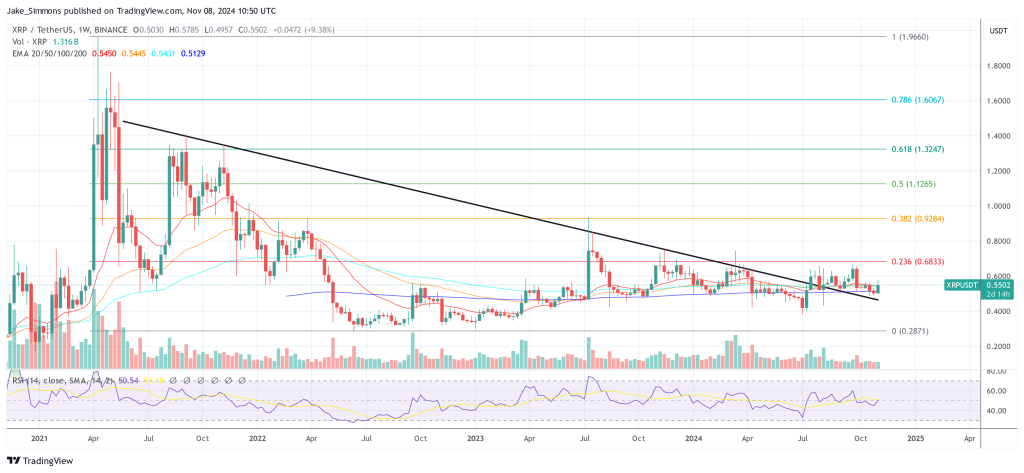
At press time, XRP traded at $0.55.
XRP price
XRP price, 1-week chart | Source: XRPUSDT on TradingView.com
Featured image created with DALL.E, chart from TradingView.com
Jake Simmons

Jake Simmons

Jake Simmons has been a Bitcoin enthusiast since 2016. Ever since he heard about Bitcoin, he has been studying the topic every day and trying to share his knowledge with others. His goal is to contribute to Bitcoin's financial revolution, which will replace the fiat money system. Besides BTC and crypto, Jake studied Business Informatics at a university. After graduation in 2017, he has been working in the blockchain and crypto sector. You can follow Jake on Twitter at @realJakeSimmons.

İlgili Okumalar

South Korea’s KB Financial Completes Stablecoin Pilot As Lawmakers Press For Regulatory Framework

South Korea's KB Financial Group has completed a Proof-of-Concept (PoC) for a won-denominated stablecoin in partnership with several companies. The pilot integrated the entire financial process—from stablecoin issuance to offline payments, merchant settlements, and international remittances—into a single blockchain-based workflow. A key test involved offline payments at a coffee shop via QR code without requiring a digital wallet. For international transfers, the model converted the won stablecoin to a dollar stablecoin, completing the process within three minutes and reducing fees by approximately 87% compared to traditional methods. KB aims to launch services once digital asset regulations are established. However, South Korea's Digital Asset Act, which would establish rules for such stablecoins, faces significant delays due to a disagreement between the Financial Services Commission (FSC) and the Bank of Korea (BOK). The central bank advocates for a consortium of banks to hold a majority stake in any issuer, while the FSC worries this could stifle innovation and tech firm participation. Lawmakers and experts have urged the National Assembly to prioritize the legislation, warning that South Korea is falling behind in the global digital asset market despite accounting for 10% of global transactions. Bank of Korea Deputy Governor Chang Cheong-soo acknowledged the potential of won-pegged stablecoins as a competitive future payment method.

bitcoinist36 dk önce

South Korea’s KB Financial Completes Stablecoin Pilot As Lawmakers Press For Regulatory Framework

bitcoinist36 dk önce

The Bond Market Deals a Blow to the AI Bull Market

The article "Bond Market Deals a Blow to the AI Bull Market" discusses how a recent global bond sell-off is threatening to end the AI-driven stock market rally that had been ongoing for about a month and a half. A sharp sell-off in global equity markets began last Friday, with significant declines in indices like South Korea's KOSPI and Japan's Nikkei 225. The primary suspect, according to Morgan Stanley, is the bond market. Key long-term bond yields, such as the U.S. 30-year Treasury and Japan's 10-year government bond, have surged to multi-decade highs. This breach of critical yield levels (like 5% for the 30-year U.S. Treasury) is seen as a dangerous signal that historically precedes risk asset corrections. The root cause is identified as resurgent inflation, fueled by rising oil prices due to renewed Middle East geopolitical tensions, specifically the breakdown of U.S.-Iran talks and the blockade of the Strait of Hormuz. This has led markets to drastically revise expectations for U.S. Federal Reserve policy, now pricing in a significant chance of future rate hikes instead of cuts. Higher bond yields negatively impact stocks, especially high-growth tech/AI stocks, through two main channels: 1. **Valuation Pressure:** Higher yields increase the discount rate used to value future earnings, making the present value of distant AI-related cash flows less attractive. 2. **Relative Attraction:** Safer government bonds offering ~5% yields reduce the appeal of riskier equity investments in emerging markets and tech sectors. Despite the pressure from bonds, the AI bull market has fundamental support from strong sector earnings (e.g., semiconductor companies). The current situation is described as a "tug-of-war" between bond market turbulence and AI prosperity. However, warnings exist that AI stock valuations have become excessive. For investors, the advice is to increase portfolio flexibility. Suggestions include focusing on specific AI supply chain segments (domestic computing, semiconductors, equipment) and being prepared for continued volatility. The article concludes by noting the market is at a precarious point, caught between geopolitical uncertainty and the AI revolution, requiring careful navigation.

marsbit41 dk önce

The Bond Market Deals a Blow to the AI Bull Market

marsbit41 dk önce

İşlemler

Spot
Futures
活动图片